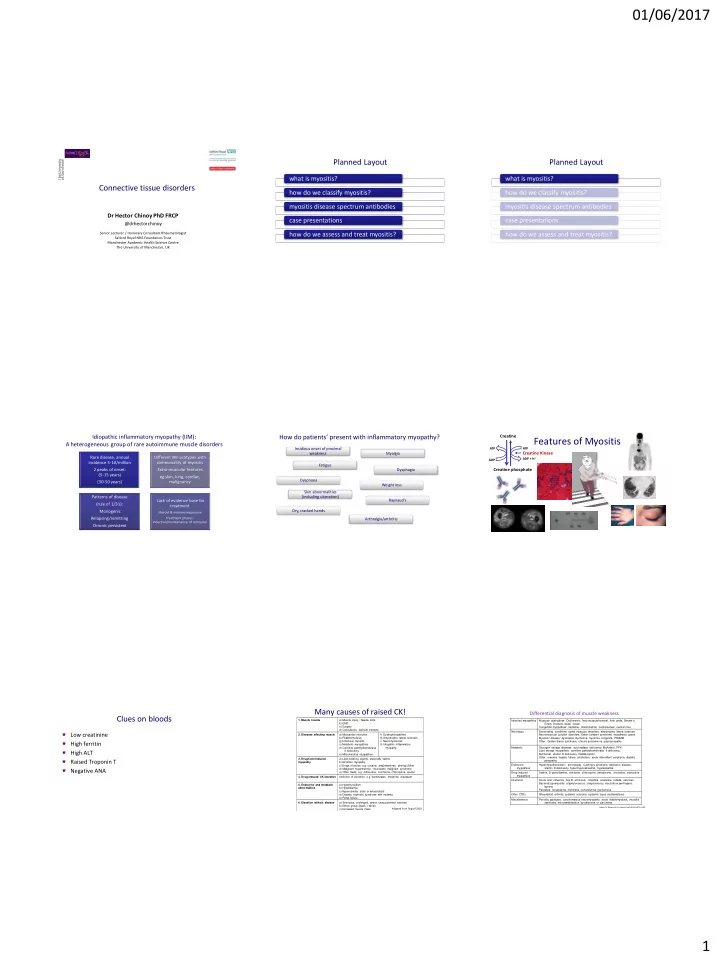
01/06/2017 Planned Layout Planned Layout what is myositis? what - - PDF document

01 06 2017
SMART_READER_LITE
LIVE PREVIEW

01/06/2017 Planned Layout Planned Layout what is myositis? what - - PDF document

01/06/2017 Planned Layout Planned Layout what is myositis? what is myositis? Connective tissue disorders how do we classify myositis? how do we classify myositis? myositis disease spectrum antibodies myositis disease spectrum antibodies Dr


slide-1
SLIDE 1

01/06/2017 1

Connective tissue disorders

Dr Hector Chinoy PhD FRCP

@drhectorchinoy

Senior Lecturer / Honorary Consultant Rheumatologist Salford Royal NHS Foundation Trust Manchester Academic Health Science Centre The University of Manchester, UK

what is myositis? how do we classify myositis? myositis disease spectrum antibodies case presentations how do we assess and treat myositis?

Planned Layout

what is myositis? how do we classify myositis? myositis disease spectrum antibodies case presentations how do we assess and treat myositis?

Planned Layout

Idiopathic inflammatory myopathy (IIM): A heterogeneous group of rare autoimmune muscle disorders

Rare disease, annual incidence 5-10/million 2 peaks of onset: (5-15 years) (30-50 years) Patterns of disease (rule of 1/3’s):

Monogenic

Relapsing/remitting Chronic persistent

Lack of evidence base for

treatment

Steroid & immunoresponsive Treatment phases: induction/maintenance of remission

Different IIM subtypes with commonality of myositis Extra-muscular features eg skin, lung, cardiac, malignancy

How do patients’ present with inflammatory myopathy?

Insidious onset of proximal weakness Myalgia Fatigue Dysphagia Dyspnoea Weight loss Skin abnormalities (including ulceration) Raynaud’s Dry, cracked hands Arthralgia/arthritis

Features of Myositis

Creatine Creatine phosphate

ATP ADP + H+ ATP ADP

Creatine Kinase

Clues on bloods

 Low creatinine  High ferritin  High ALT  Raised Troponin T  Negative ANA

Many causes of raised CK!

  • 1. Muscle trauma

a) Muscle injury / Needle stick b) EMG c) Surgery d) Convulsions, delirium tremens

  • 2. Diseases affecting muscle

a) Myocardial infarction b) Rhabdomyolysis g) Infectious myositis c) Metabolic myopathies d) Carnitine palmityltransferase II deficiency e) Mitochondrial myopathies f) Dystrophinopathies h) Amyotrophic lateral sclerosis i) Neuromyotonias h) Idiopathic inflammatory myopathy

  • 3. Drug/toxin-induced

myopathy a) Lipid-lowering agents, especially statins b) Alcoholic myopathy c) Drugs of abuse: e.g. cocaine, amphetamines, phencyclidine d) Malignant hyperthermia / neuroleptic malignant syndrome e) Other meds: e.g. zidovudine, colchicine, chloroquine, ipecac

  • 4. Drug-induced CK elevation

Inhibition of excretion: e.g. barbiturates, morphine, diazepam

  • 5. Endocrine and metabolic

abnormalities a) Hypothyroidism b) Hypokalemia c) Hyperosmolar state or ketoacidosis d) Diabetic nephrotic syndrome with oedema e) Renal failure

  • 6. Elevation without disease

a) Strenuous, prolonged, and/or unaccustomed exercise b) Ethnic group (black > white) c) Increased muscle mass Adapted from Targoff 2002

Differential diagnosis of muscle weakness

Inherited myopathies Muscular dystrophies: Duchenne’s, fascioscapulohumeral, limb girdle, Becker’s, Emery Dreifuss, distal, ocular Congenital myopathies: nemaline, mitochondrial, centronuclear, central core Neurologic Denervating conditions: spinal muscular atrophies, amyotrophic lateral sclerosis Neuromuscular junction disorders: Eaton-Lambert syndrome, myasthenia gravis Myotonic disease: dystrophia myotonica, myotonia congenita, PROMM Other: Guillain-Barre syndrome, chronic autoimmune polyneuropathy Metabolic Glycogen storage diseases: acid maltase deficiency, McArdle’s, PFK Lipid storage myopathies: carnitine palmityltransferase II deficiency Nutritional: vitamin E deficiency, malabsorption Other: uraemia, hepatic failure, alcoholism, acute intermittent porphyria, diabetic plexopathy Endocrine myopathies Hyper/hypothyroidism, acromegaly, Cushing’s syndrome, Addison’s disease, vitamin D deficiency, hyper/hypocalcaemia, hypokalaemia Drug-induced myopathies Statins, D-penicillamine, clofibrate, chloroquine, amiodarone, vincristine, zidovudine Infections Acute viral: influenza, hep B, echovirus, rickettsia, coxsackie, rubella, vaccines Bacterial pyomyositis: staphylococcus, streptococcus, clostridium perfringens, leprosy Parasites: toxoplasma, trichinella, schistosoma, cysticercus Other CTDs Rheumatoid arthritis, systemic sclerosis, systemic lupus erythematosus Miscellaneous Periodic paralyses, carcinomatous neuromyopathy, acute rhabdomyolysis, myositis

  • ssificans, microembolisation by atheroma or carcinoma

Oddis CV, Rheum Dis Clin North Am 2002;28:979-1001

slide-2
SLIDE 2

01/06/2017 2

what is myositis? how do we classify myositis? myositis disease spectrum antibodies case presentations how do we assess and treat myositis?

Idiopathic Inflammatory Myopathy Polymyositis Inclusion Body Myositis Dermatomyositis Juvenile dermatomyositis Myositis-CTD overlap

Malignancy

Necrotizing Myopathy

Bohan and Peter diagnostic criteria for polymyositis / dermatomyositis

1 Symmetrical weakness of limb-girdle muscles and anterior neck flexors 2 Muscle biopsy evidence typical of myositis 3 Elevation of serum skeletal muscle enzymes, particularly CK 4 Typical EMG features of myositis 5 Typical DM rash, including heliotrope and Gottron’s papules For the diagnosis of PM: For the diagnosis of DM:

Definite: Probable: Possible: All of items 1-4 3 of items 1-4 2 of items 1-4 Definite: Probable: Possible: Item 5 plus 3 of items 1-4 Item 5 plus 2 of items 1-4 Item 5 plus 1 of items 1-4

.

Exclusion criteria: congenital muscular dystrophies, central or peripheral neurological disease, infectious myositis, metabolic/endocrine myopathies and myasthenia gravis. Bohan A, Peter JB, N Eng J Med 1975

Extra-muscular features of Inflammatory Myopathy

Slides courtesy of IMACS, Prof Oddis & McHugh http://www.cytoskeleton.com/tropomyosin-troponin-complex-cs-tt05

Hughes M, Lilleker JB, Herrick AL, Chinoy H. Cardiac troponin testing in idiopathic inflammatory myopathies and systemic sclerosis-spectrum disorders: biomarkers to distinguish between primary cardiac involvement and low-grade skeletal muscle disease activity. Ann Rheum Dis. 2015 May;74(5):795-8

Gottron’s papules

Erythematous to violaceous papules and plaques over the extensor surfaces

  • f MCP and IP joints & other large joints in a symmetric distribution

Source: IMACS

Nail changes

what is myositis? how do we classify myositis? myositis disease spectrum antibodies case presentations how do we assess and treat myositis?

Myositis-Spectrum Disease Autoantibodies

Autoantibody formation Specific signs & symptoms HLA UV Infections Other genes Environmental risk factors Hood E: Environ Health Perspect 2003, 111:A274–A276. Slide adapted from Dr Gunawardena

Always worth Checking ANA pattern for clues

Gunawardena H. The Clinical Features of Myositis-Associated Autoantibodies: a Review. Clin Rev Allergy Immunol. 2017 Feb;52(1):45-57.

slide-3
SLIDE 3

01/06/2017 3

Myositis Spectrum Disease Antibodies & Clinical Associations in Adult Myositis

Betteridge Z, McHugh N. Myositis-specific autoantibodies: an important tool to support diagnosis of myositis. J Intern Med. 2016 Jul;280(1):8-23

Anti-TIF1g: diagnostic utility in cancer associated myositis

Trallero-Araguás et al, Arthritis Rheum 2012;64:523–532 Pooled sensitivity for cancer-associated myositis

SENSITIVITY SPECIFICITY

0.78 0.89

what is myositis? how do we classify myositis? myositis disease spectrum antibodies case presentations how do we assess and treat myositis?

Case 1: Mrs SH

  • 57 year old female, type II DM
  • 1 year post-simvastatin
  • 3 month history of marked proximal weakness
  • CK 11,384
  • EMG: fibrillations & brief duration simple and

complex motor unit potentials

MR images

T1 STIR

Muscle biopsy

H&E stained section showing necrotic fibres with macrophage infiltrates

Clinical features of anti-HMG CoA reductase (HMGCR) positive patients (45/750, 6%)

Features Age 52 ± 16 years Female 58% Statin exposure 30/45 (67%) (24/26, 92% >50 years) CPK 9,718 ± 7,383 iu/l Proximal weakness 96% Necrosis on biopsy 100% Inflammation on biopsy 20%

Mammen A et al. Arthritis Rheum 2011;63:713-721 Mammen A et al. Arthritis Care Res (Hoboken). 2012;64:269-72

Anti-HMGCR Ab not found in majority of statin-treated subjects, including those with self- limited statin- associated myopathy

Statin-related myotoxicity phenotype classification

Alfirevic A, Neely D, Armitage J, Chinoy H, Cooper RG, Laaksonen R, et al. Clin Pharmacol Ther. 2014 Oct;96(4):470-6. doi: 10.1038/clpt.2014.121.

Statin-related myotoxicity phenotype classification

Alfirevic A, Neely D, Armitage J, Chinoy H, Cooper RG, Laaksonen R, et al. Clin Pharmacol Ther. 2014 Oct;96(4):470-6. doi: 10.1038/clpt.2014.121.

slide-4
SLIDE 4

01/06/2017 4

what is myositis? how do we classify myositis? myositis disease spectrum antibodies case presentations how do we assess and treat myositis?

Study ID: _______ Study Visit Date: _ _ / _ _ / _ _ _ _ Study visit number (Circle): 1, 2, 3, 4, 5, 6, 7 MANUAL MUSCLE TESTING Muscle groups Left (0-10) Right (0-10) Axial (0-10) Axial (0-20) Neck Flexors

  • MMT8**
Neck Extensors
  • Proximal (0-160)
Shoulder elevators (Trapezius)
  • Shoulder abductors
(Deltoid Middle) MMT8**
  • Elbow flexors
(Bicepts Brachii) MMT8**
  • Hip extensors
(Gluteus Maximus) MMT8**
  • Hip abductors
(Gluteus Medius) MMT8**
  • Hip flexors
(Iliopsoas)
  • Knee flexors
(Hamstrings)
  • Knee extensors
(Quadriceps) MMT8**
  • Distal (0-80)
Wrist Extensors MMT8**
  • Wrist Flexors
  • Ankle Dorsiflexors
MMT8**
  • Ankle Plantar Flexors
  • MMT SCORING:
MMT8 0 - 80 MMT8 highlighted in boxes (MMT8**) MMT24 0 - 260 Axial + Proximal + Distal (all 26) MMT GRADING: FUNCTION OF THE MUSCLE GRADE No No contraction felt in muscle 0 / 0 Movement Feeble contraction felt in muscle, but no movement of part T / 1 MOVEMENT IN HORIZONTAL PLANE Test Moves through partial range of motion 1 / 2- Movement Moves through complete range of motion 2 / 2 ANTIGRAVITY POSITION Moves through partial range of motion 3 / 2+ Test Gradual release from test position 4 / 3- Position Holds test position (no added pressure) 5 / 3 Holds test position against slight pressure 6 / 3+ Holds test position against slight to moderate pressure 7 / 4- Holds test position against moderate pressure 8 / 4 Holds test position against moderate to strong pressure 9 / 4+ Holds test position against strong pressure 10 / 5

Version 1.0 SEPT 2009 Completed by: Consultant Completed for: All patients Completed at: All study visits

Aids to the examination

  • f the peripheral

nervous system http://bit.ly/2qcjnIf

Induction of remission (1)

 40-60mg prednisolone / day (~0.75mg/kg) or if severe disease, initial methylprednisolone 250-500mg 2-3 doses alternate days  Continue dose until CK <2x ULN  Then reduce by 10mg/wk to 40mg, then 5mg/wk to 15mg, then 2.5mg/wk to 7.5-10mg daily, then further gradual reductions once established on a 2nd line agent

Carstens PO, Schmidt J. Diagnosis, pathogenesis and treatment of myositis: recent advances. Clin Exp Immunol. 2014 Mar;175(3):349-58. doi: 10.1111/cei.12194.

 If CK not improving after 4-5 weeks

– Check diagnosis (?+antibody, biopsy, EMG, 2nd opinion) – Add in methylprednisolone if not done so already – IV cyclophosphamide – EUROLUPUS or CYCLOPS (gauge severity) – IVIG 2g/kg over 5 days – IV Rituximab

Induction of remission (2)

Maintanance of remission: Early introduction of disease modifying treatment

Early introduction of DMARDs

(may overlap with induction of remission)  Methotrexate 10-25mg/wk  Azathioprine 2.5-3mg/kg (check TPMT levels)  Mycophenolate mofetil 2-3g/day

Disease resistance

 Consider adding ciclosporin 3mg/kg to MTX  Consider adding MTX/AZA to MMF  Tacrolimus 2-5mg bd  Cyclophosphamide  Rituximab  Tocilizumab

Useful sites

MYONET www.myonet.eu www.euromyositis.eu Manchester myositis research http://research.bmh.manchester.ac.uk/epidemiology/CIGMR/research/autoimmune/Autoimmunity/My

  • sitis

IMACS resources including muscle biopsy video http://www.niehs.nih.gov/research/resources/imacs/diseaseactivity/index.cfm http://www.niehs.nih.gov/research/resources/imacs/othertools/index.cfm Freely accessible reviews on myositis and Abs Antibodies http://www.ncbi.nlm.nih.gov/pmc/articles/PMC3874450/ http://www.ncbi.nlm.nih.gov/pmc/articles/PMC3132021/ http://www.ncbi.nlm.nih.gov/pmc/articles/PMC4386580/ Myositis review http://www.ncbi.nlm.nih.gov/pmc/articles/PMC4104537/ Statin myotoxicitiy and classification http://www.ncbi.nlm.nih.gov/pmc/articles/PMC4172546/ Treatment reviews http://www.ncbi.nlm.nih.gov/pmc/articles/PMC4581266/ http://www.ncbi.nlm.nih.gov/pmc/articles/PMC3927896/ Free resources 1st myositis international conference http://onlinelibrary.wiley.com/doi/10.1111/joim.12525/full