SLIDE 1
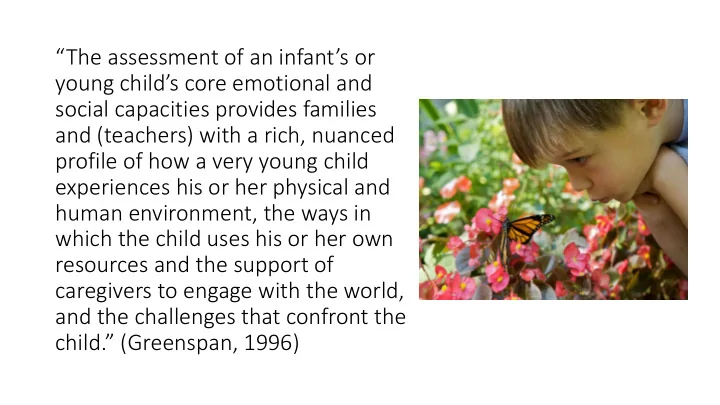
“The assessment of an infant’s or young child’s core emotional and social capacities provides families and (teachers) with a rich, nuanced profile of how a very young child experiences his or her physical and human environment, the ways in which the child uses his or her own resources and the support of caregivers to engage with the world, and the challenges that confront the child.” (Greenspan, 1996)
SLIDE 2 >
Tom Wolf, Governor Pedro A. Rivera, Secretary of Education | Teresa D. Miller, Secretary of Human Services
Leadership In Institute on Supporting Social/Emotional Development
Social Emotional Development in Early Childhood Programs: Identification of children with social-emotional needs
November 2018
SLIDE 3
Overall Goal
Children who are experiencing challenges in their social and emotional development across settings are accurately identified through the Early Intervention evaluation process.
SLIDE 4 Objectives:
- Understand background for greater attention on evaluation of the
social-emotional development of children
- Define social-emotional competencies and constructs
- Reflect on current practices related to identification of children
with social-emotional delays
- Review and consider tools to support evaluation of social-
emotional domain
- Prepare for and contribute to future plans to address
programmatic needs
SLIDE 5 Feedback: Evaluation of Social-Emotional Development
Social- Emotional Development
Governance
Leadership /Program Management Professional Development
SLIDE 6 Background: Evaluation of f social-emotional development
- 34 CFR § 300.304 Evaluation procedures
- 34 CFR § 300.305 Additional requirements
- PA Code §4226.22
- ANNOUNCEMENT: EI 13-#08
- Guidance on Eligibility Practices
- ANNOUNCEMENT: EI-12 #01
- ANNOUNCEMENT: EI-10 # 08
SLIDE 7 § 300.3 .304b Evaluation procedures
(1) Use a variety of assessment tools and strategies to gather relevant functional, developmental, and academic information about the child, including information provided by the parent…. (2) Not use any single measure or assessment as the sole criterion for determining whether a child is a child with a disability and for determining an appropriate educational program for the child; and (3) Use technically sound instruments that may assess the relative contribution of cognitive and behavioral factors, in addition to physical
SLIDE 8
§ 300.3 .304c
(1) Assessments and other evaluation materials used to assess a child under this part –
(i) Are selected and administered so as not to be discriminatory… (ii) Are provided and administered in the child's native language or other mode of communication and in the form most likely to yield accurate information… (iii) Are used for the purposes for which the assessments or measures are valid and reliable; (iv) Are administered by trained and knowledgeable personnel; and (v) … in accordance with any instructions provided by the producer of the assessments.
SLIDE 9
§ 300.3 .304c
(2) Assessments and other evaluation materials include those tailored to assess specific areas of educational need … (4) The child is assessed in all areas related to the suspected disability, including, if appropriate, health, vision, hearing, social and emotional status… (6) In evaluating each child with a disability … the evaluation is sufficiently comprehensive to identify all of the child's special education and related service needs whether or not commonly linked to the disability category in which the child has been classified. (7) Assessment tools and strategies that provide relevant information that directly assists persons in determining the educational needs of the child are provided.
SLIDE 10 § 300.3 .305a Additional requirements for evaluations and reevaluations
…. As part of an initial evaluation (if appropriate) and as part of any reevaluation under this part, the IEP Team and other qualified professionals, as appropriate, must – (1) Review existing evaluation data on the child, including - (i) Evaluations and information provided by the parents of the child; (ii) Current classroom-based …. assessments, and classroom-based
(iii) Observations by teachers and related services providers
SLIDE 11
§ 14.153 Evaluation
(2) Evaluations shall be sufficient in scope and depth to investigate information relevant to the young child’s suspected disability, including physical development, cognitive and sensory development, learning problems, learning strengths and educational need, communication development, social and emotional development, self-help skills and health considerations, as well as an assessment of the family’s perceived strengths and needs which will enhance the child’s development.
SLIDE 12 PA Code §4226.22
Eligibility for Early Intervention services. (a) The county MH/MR program shall ensure that early intervention services are provided to
all children who meet one or more of the following eligibility criteria: (1) A developmental delay, as measured by appropriate diagnostic instruments and procedures, of 25% of the child’s chronological age in one or more of the developmental areas of cognitive development; physical development, including vision and hearing; communication development; social or emotional development; and adaptive development. (2) A developmental delay in one or more of …. social or emotional development; … as documented by test performance of 1.5 standard deviations below the mean on accepted or recognized standard tests for infants and toddlers…….
SLIDE 13
ANNOUNCEMENT: EI 13-#08
SLIDE 14
ANNOUNCEMENT: EI-12 #01
ANNOUNCEMENT: EI-10 # 08
SLIDE 15
Social-emotional competencies and constructs
SLIDE 16 Collaborative for Academic and Social Emotional Le Learning (C (CASEL)- Socia
cial-Emotional Learnin ing (S (SEL) competenci cies in inclu clude:
ELS 16.1
SELF-AWARENESS & SELF-MANAGEMENT
ELS 16.2
ESTABL BLISHING & MAI MAINTAINING REL ELATIONSHIPS
ELS 16.3 ELS 16.2 ELS 16.3
DECISION MAKING & RESPONSIBLE BEHAVIOR
SLIDE 17 Self-Awareness
The ability to identify one’s own emotions, thoughts, interests and values and how they influence behavior. The ability to assess strengths and limitations, with a well-grounded sense of confidence, optimism, and a “growth mindset.”
- Identifying and labeling emotions
- Accurate self-perception
- Recognizing strengths
- Self-confidence
- Self-efficacy
Collaborative for Academic and Social Emotional Learning (CASEL)
SLIDE 18 Self-Management
The ability to successfully regulate
- ne’s emotions, thoughts, and
behaviors in different situations — effectively managing stress, controlling impulses, and motivating oneself. The ability to set and work toward personal and academic goals.
- Impulse control/Self-regulate
- Stress management
- Self-discipline
- Self-motivation
- Goal-setting
- Organizational skills
Collaborative for Academic and Social Emotional Learning (CASEL)
SLIDE 19 Social Awareness
The ability to take the perspective
- f and empathize with others,
including those from diverse backgrounds and cultures. The ability to understand social and ethical norms for behavior and to recognize family, school, and community resources and supports.
- Perspective-taking
- Empathy
- Appreciating similarities and
differences
- Understanding own and others’
behavior and emotions
Collaborative for Academic and Social Emotional Learning (CASEL)
SLIDE 20 Relationship Skills
The ability to establish and maintain healthy and rewarding relationships with diverse individuals and groups. The ability to communicate clearly, listen well, cooperate with others, take turns, develop friendships, negotiate conflict constructively, and seek and offer help when needed.
- Communication and listening skills
- Social engagement and
Relationship-building
- Teamwork, work well with others
- Resolve conflict with others
Collaborative for Academic and Social Emotional Learning (CASEL)
SLIDE 21 Responsible Decision-Making
The ability to make constructive choices about personal behavior and social interactions based on ethical standards, safety concerns, and social norms. The realistic evaluation of consequences of various actions, and a consideration of the well- being of oneself and others.
- Identifying problems
- Analyzing situations
- Solving problems
- Evaluating
- Reflecting
- Ethical responsibility
Collaborative for Academic and Social Emotional Learning (CASEL)
SLIDE 22
Current practices: Identification of children with social-emotional delays
SLIDE 23
Practices around the Evaluation of Social Emotional Development
Referral/ Intake Screening Evaluation
SLIDE 24 Referral/Intake
- Collaborate
- Program process and practices around referral?
- Administrator support the referral process for their
staff.
- Gather information from multiple respondents
- Ask probing questions/conversation starters
SLIDE 25
Meet Ben!
Why was he referred? Who made the referral? What is his Background History and Family Information? What would you do? Would you screen Ben or go straight to evaluation? Why? What other information might you consider?
SLIDE 26
Screening
Screen or Evaluate? Universal Screen Child Find Monitoring Evaluate
SLIDE 27
Factors to consider
Setting/Time Overall Development Health Family/ Cultural Factors Parental Concerns
SLIDE 28 Let’s take a closer look at Ben…
- Communication- Pass
- Gross motor- Pass
- Fine motor- Pass
- Problem solving- Pass
- Personal social- Pass
Total score was 145 cut score was 95 Recommended to refer for evaluation
SLIDE 29
Consider..
Tools
Age Range
Constructs Users
Evaluation- Tools
SLIDE 30
- Norm Referenced vs. Criterion-Referenced Instruments
- Scores provided
- Psychometric Properties- The reliability and validity of the
instrument as a form of measurement.
- Norming size
- Languages offered
- Users
- Parent and teacher forms
- Constructs
- Length of time to administer
- Age range
Evalu luatio ion In Instruments: What was consid idered?
SLIDE 31
Consider..
Users
Announcement: EI 13- #08
Evaluation- Tools
SLIDE 32
Consider..
Age Range
Evaluation- Tools
SLIDE 33
Evaluation- Tools
Consider.. Constructs
SLIDE 34
Total Protective Factors Scale Total Behavioral Concern Scale
Devereux Early ly Chil ildhood Assessment- Cli linic ical (D (DECA-C) C)
Initiative Self-Control Attachment Attention Problems Aggression Emotional Control Problems Withdrawal/Depression
SLIDE 35
All ll Users (E (EI Teachers and Therapists)
DECA-IT ITSEA
Achenbach (CBCL and C-TRF) DECA-C
DECA-P2 SSIS PKBS-2
SLIDE 36 How administrators can support access to social - emotional evaluation tools:
- Who needs access to these tools?
- Professional Development?
- Process/written procedures when to use it.
- Resources (Guidance on Eligibility Evaluation
Practices)
Evaluation
SLIDE 37 Ben’s BDI-2 Standard Scores:
- Cognitive development: 82 (SD -1.2)
- Communication Development: 90 (SD -0.67 )
- Social and Emotional Development: 87 (SD -0.87)
- Physical Development: 98 (SD -0.13)
- Adaptive Development: 83 (SD -1.13)
SLIDE 38 Ben’s Scores: Preschool and Kin indergarten Behavior Scales- 2 2 (PKBS-2)
Ben's preschool teacher
Standard Score = 62
- Problem Behaviors Composite
Standard Score= 125
Ben’s father
Standard Score = 78
- Problem Behaviors Composite
Standard Score= 127
SLIDE 39 A comprehensive evaluation includes:
- parent and caregiver information
- a review of the child’s medical and other records
- administration of a norm-referenced assessment tool or
test to assist in identifying the child’s level of developmental functioning
- observation of the child in typical routines and activities.
EITA Portal: Guidance on Eligibility Evaluation Practices
Determination of Eli ligibility
SLIDE 40
Prepare for and contribute to fu future plans
SLIDE 41 Timeline of activities
www.free-powerpoint-templates-design.com
2016 Sept 2018 Nov 2018
Jan-Feb 2019
Spring 2019
Tools and training to evaluate SE concerns of very young children Information from all environments Local coordination across systems Explore resources on social emotional Match learning needs with specific resources Access and utilize three
work Evaluation and Intervention- SE development Comprehensive and collaborative Tool suggestions Training and TA needs Complete full and comprehensive SE evaluation Gather/use intake information to determine appropriate tool and next steps Match child’s SE needs to constructs & tools Leadership informs tool training and TA Evaluation Forum Feedback Feedback Face-to-face training SE On-line Resources SE Development and Supporting Interventions Leadership Institute Face-to-face and
evaluators SE Evaluation Training on specific tools SE Tools
Supporting Social-Emotional Development in Early Intervention
SLIDE 42
Share your interests and programmatic needs
Leadership Institute 2018 – Needs assessment https://tinyurl.com/y85sake6
SLIDE 43