SLIDE 1
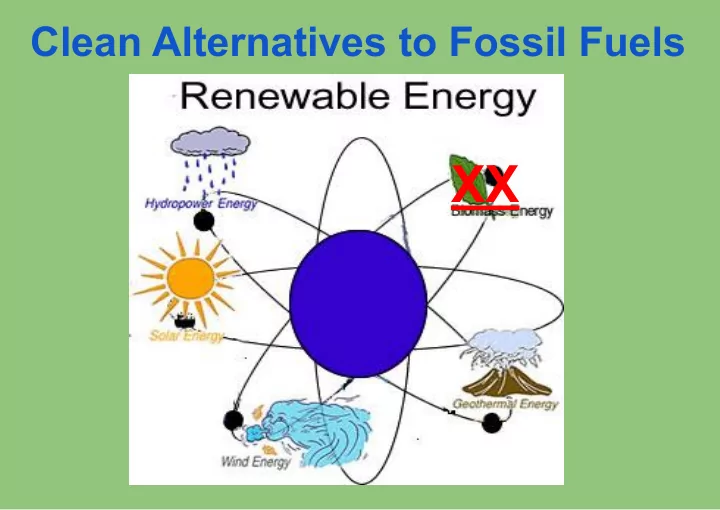
Clean Alternatives to Fossil Fuels
XX
SLIDE 2 Contents:
- Alternatives to using Coal, Natural Gas & Petroleum
* Wind * Geothermal * Hydroelectric * Solar
- Solar panels, roadways, devices & ovens
- Reducing Consumption of Fossil Fuels
- Striving for Energy Efficiency
- What’s Happening in Other Countries and Cities
- Directions for Making a Solar Panel & Oven
- Why Biomass is Not a Viable Source of Energy
SLIDE 3
Wind -- On Land and Offshore
An excellent source of energy for mountainous and coastal areas where wind velocity is high.
SLIDE 4 Hydroelectric
An excellent source of energy for communities close to large dams, waterfalls & large bodies of water.
· Geothermal · · · · · A good source of energy in
isolated, shady and low-wind areas
.
SLIDE 5
The Piedmont's Most Viable Alternative Source of Energy:
SLIDE 6 Solar Photovoltaic Farms
Guilford County, NC
Guilford County
These solar power stations
- perate much like other power
plants that generate electricity and transfer it over a electric grid to consumers as part of the utility’s energy mix.
SLIDE 7
Solar Panels on Homes
Rooftop panels are more attractive than solar farms & reduce the need for electrical grids.
SLIDE 8 ROOFTOP PANELS COST: $15,000 to $20,000
YIKES!! HOW DO YOU PAY FOR THEM?
- Net Metering: NCUC Incentive for Alternative Energy
requires utilities to pay customers for power they supply to grid.
- Leasing and Purchase Power Agreements:
The solar company pays the upfront cost and gets the incentives to install solar panels on your roof. You buy the power generated or sell it to the grid by net metering.
- Third Party Sales: a privately negotiated contract with solar
companies that would reduce a customer’s load and eliminate Duke Power's monopoly over sales and distribution of electricity.
SLIDE 9 Solar Photovoltaic Electricity on Buildings
is a practical solution for unused space.
SLIDE 10
Solar Collectors and Modules
These devices convert the energy in sunlight, or solar radiation, into a more usable and storable form of energy than solar panels. Watch these for future developments.
SLIDE 11
Solar Panels on Carports put space to good use,
providing shelter and solar stations for plug-in cars.
SLIDE 12
Solar Stations for Plug-in Vehicles
When prices come down and solar stations become a convenience, these vehicles will be vital to our sustainable future.
SLIDE 13
Solar Devices
SLIDE 14
Solar Driveways, Parking Lots and Highways???
SLIDE 15
Homemade solar ovens are a great, sustainable & healthy solution for reducing usage of natural gas and electricity.
Solar Ovens
SLIDE 16
Developed by Jon Bohmer, a Kenyan entrepreneur, this Kyoto Box oven just took $5 to make. It is made from two boxes of cardboard, one inside the other with an acrylic cover, which lets the sun rays prepare the food for you. It won the $75,000 prize money of FT Climate Change Challenge.
Solar Oven
SLIDE 17
Air-dry Laundry Clothes lines save money and also
decrease your carbon-dioxide emissions. Run washers on cold and use only when full.
Reduce Consumption of Electricity:
Wash dishes by hand or in energy-efficient
dishwashers, only when full, and let them air-dry. Save energy by drying dishes.
Turn off appliances, TV systems and e-gadgets They use electricity even when turned off.
Flicking off power strip switches when not in use effectively unplugs them.
SLIDE 18 Replace old A/C with a heat pump having a SEER
rating of 13 and add a programmable thermostat.
Adjust Thermostats Lower in winter, higher in
- summer. Use a programmable thermostat.
Insulate Home Seal & caulk doors and windows. Replace old lighting fixtures with
LED lighting.
Replace regular & CF bulbs with LED light bulbs,
which use about 70 percent less energy than regular bulbs and last 10 to 12 times longer.
Reduce Consumption of Electricity:
SLIDE 19
Reduce Consumption of Natural Gas...
Lower the thermostat on your hot water heater
to 120°F. Take short showers instead of baths.
Install a solar hot-water heater that harnesses the
sun’s unlimited, free energy to heat water.
SLIDE 20
Replace Natural Gas Furnaces
with Electric Heat Pumps or Quartz Infrared Heaters
(when renewable energy is available) QI heaters heat up to 1000 square feet and are efficient enough to run off of solar panels.
SLIDE 21
Reduce usage of Oil and Gasoline:
Reduce drive time and carpool in order to save gas and reduce carbon emissions.
SLIDE 22
Reduce usage of Oil and Gasoline:
Walk It's good for your health and good for our planet. Ride bicycles locally to school, meetings and work.
SLIDE 23
Reduce usage of Oil and Gasoline:
Bike share programs are an efficient, healthy, and clean form of mass transportation
SLIDE 24
Reduce usage of Oil and Gasoline:
Ride mass transit for longer distances.
SLIDE 25 Reduce usage of Oil and Gasoline:
Reduce fly-time until energy efficient and solar airplanes are fully developed
A new NASA project, N+2, seeks to cut fuel consumption of airplanes by as much as 50%, which would reduce nitrous oxide emissions by as much as 75%. The Solar Impulse 2, has a wingspan close to that of a huge 747 airplane yet, it weighs just about as much as a car (5,000 lbs).
SLIDE 26 Countries using the most Renewable Energy:
*Iceland: obtains 100% of its energy from renewable sources
(87% from hydropower and 13% from geothermal.
*Norway: 99% of all power production comes
from Hydropower
*Costa Rica: obtains 99% of its energy needs from hydroelectric,
geothermal and wind.
*Germany, China, Japan, Italy & US: produce the most solar
energy.
*China, US, Germany, India & Spain: are the top countries that
utilize the most wind energy.
United States gets most of it’s electrical energy from:
- Fossil Fuels-63% (Natural gas-38%, Coal-25%)
- Nuclear-20%
- Renewable Sources-18%
SLIDE 27
US City using the most Renewable Energy:
Oberlin, Ohio, a city of 8,000 residents and 3,000 college
students, reduced its carbon footprint to Zero or often a negative range by riding bicycles, crafting, planting trees, orchards and gardens, developing living machines, constructing buildings from reused and sustainably grown materials that utilize photovoltaic panels and geothermal systems.
SLIDE 28 WHAT ELSE CAN WE DO?
Write to your local utility company to tell them that you want solar energy for you home and check to see if it
- ffers a "green power" option for its customers, which is
- ne way of supporting renewable energy sources.
Write or call our City Council Representatives Urge them to give service/public agencies and business establishments incentives for placing solar panels on their buildings and in their parking lots. Write or call our Congressional Reps and Senators Urge them to develop local clean energy sources, move NC towards energy independence and support Third Party Sales in NC, so residents and businesses can lease solar panels. WE CAN TELL DECISION MAKERS WE CARE!!
SLIDE 29
Build a Frame Buy Solar Cells Solder Wires to the Cells Attach the Cells Together
Make your own Solar Panel
SLIDE 30
The solar panel guides from greenDIYenergy.com are great! Attach Strips of Cells Together Place them in the Frame
SLIDE 31
Biomass -- No longer considered a viable source of
energy due to massive efforts to clear-cut forests and speed production of vegetation with chemicals. Biomass is biological materials, such as plants, grass, wood, dead trees, branches, tree stumps, wood chips, and vegetable oils, that can be used as biofuel to generate electricity or produce heat. Tapping methane gas from large landfills and using it as an alternative fuel was also once a viable source of energy, but methane is not a clean energy.
SLIDE 32 Biomass Wood or Corn Home Heaters are used
to replace natural gas furnaces in rural areas. These heaters are claimed to be 100% natural and healthier for the environment, since biomass comes from the earth's natural resources (as long as, no chemicals are sprayed on the trees and crops for mass producing them).
Please note: Biomass heaters are not recommended for urban areas.
SLIDE 33
Biodiesel reduces usage of oil and gasoline,
but it is not a clean fuel. Biodiesel and ethanol are made from ground corn and vegetable oils.
SLIDE 34 References:
*All Topics: Sierra Club Magazine and Website
(http://sierraclub.typepad.com/greenlife or /compass)
*Solar Energy: The Ecologist, (http://www.theecologist.org) *What we can do: NC Conservation Network (http://ncconservation-
network.org)
SLIDE 35
Suggested Readings: Universe Story by Thomas Berry and Brian Swimme The Great Turning by David C. Korten The Great Unraveling: Losing Our Way in the New Century by Paul Krugman Active Hope by Joanna Macy and Chris Johnstone
SLIDE 36 Let's Explore, Enjoy and Protect Our Planet!!!
“If it can’t be reduced, reused, repaired, rebuilt, refurbished, refinished, resold, recycled or composted, then it should be restricted, redesigned or removed from production.”