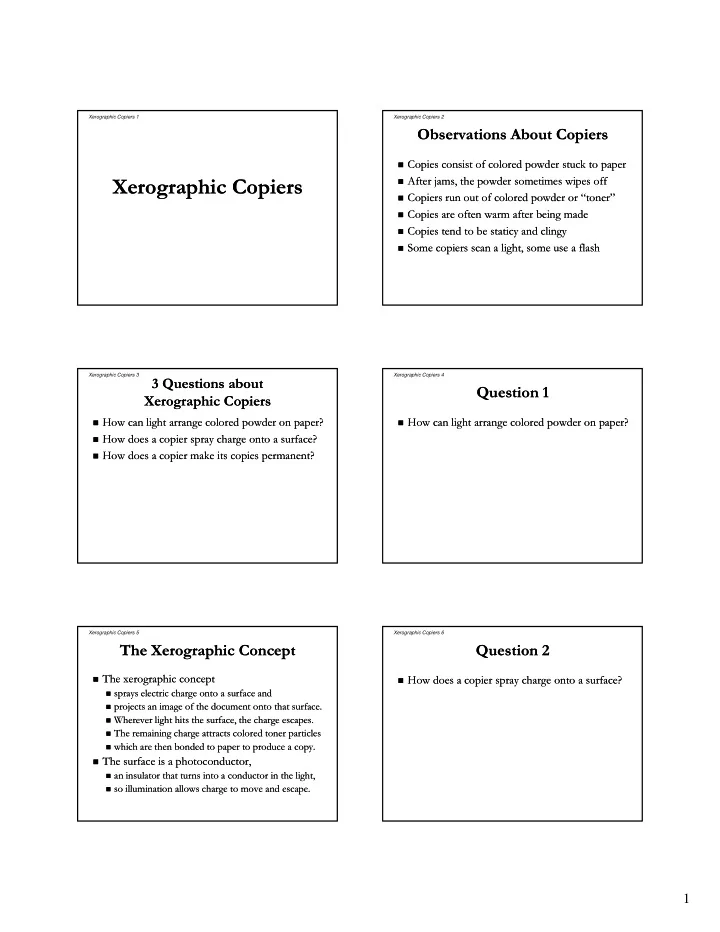
SLIDE 2 2
Xerographic Copiers 7
Electric Fields Electric Fields (Part 1)
(Part 1)
- Consider these two views of electric forces:
Consider these two views of electric forces:
The first view is charge charge-
charge
Charge
Charge1 pushes directly on Charge pushes directly on Charge2. .
The second view is
The second view is charge charge-
electric field-
charge
Charge
Charge1 creates an electric field creates an electric field
That electric field pushes on Charge
That electric field pushes on Charge2. .
This electric field isn’t a fiction; it actually exists!
This electric field isn’t a fiction; it actually exists!
Xerographic Copiers 8
Electric Fields Electric Fields (Part 2)
(Part 2)
An electric field
An electric field
is a structure in space that pushes on electric charge
is a structure in space that pushes on electric charge
is vector in character: it has magnitude and direction
is vector in character: it has magnitude and direction
m
d p nd n p iti n nd tim m d p nd n p iti n nd tim
may depend on position and time
may depend on position and time
The electric field at a given position and time
The electric field at a given position and time
is proportional to the force on a + test charge
is proportional to the force on a + test charge
is often represented graphically by an arrow
is often represented graphically by an arrow
but is actually located at just one point on that arrow
but is actually located at just one point on that arrow
Xerographic Copiers 9
Electric Fields and… Electric Fields and…
Consider these two views of electric forces:
Consider these two views of electric forces:
The first view is
The first view is electric field electric field-
charge
An electric field exerts a force on a + test charge
An electric field exerts a force on a + test charge
Xerographic Copiers 10
…Voltage Gradients …Voltage Gradients
The second view is
The second view is voltage gradient voltage gradient-
charge
An object accelerates to reduce potential energy (PE)
An object accelerates to reduce potential energy (PE)
so it experiences a force down the “gradient” of PE
so it experiences a force down the “gradient” of PE
+ t t h r
h l tr t ti p t nti l n r (EPE) + t t h r h l tr t ti p t nti l n r (EPE)
+ test charge has electrostatic potential energy (EPE)
+ test charge has electrostatic potential energy (EPE)
+ test charge’s EPE is proportional to its voltage
+ test charge’s EPE is proportional to its voltage
+ test charge experiences force down voltage gradient
+ test charge experiences force down voltage gradient
A voltage gradient exerts a force on a + test charge
A voltage gradient exerts a force on a + test charge
A voltage gradient
A voltage gradient is is an electric field! an electric field!
Xerographic Copiers 11
Electric Fields Electric Fields In and Around Metals In and Around Metals
Inside a metal, charges can move freely
Inside a metal, charges can move freely
and can rearrange to minimize their EPE.
and can rearrange to minimize their EPE.
At equilibrium, the metal has a uniform voltage,
At equilibrium, the metal has a uniform voltage,
nd th r i n
l tri fi ld in id th m t l nd th r i n l tri fi ld in id th m t l
and there is no electric field inside the metal.
and there is no electric field inside the metal.
Outside a metal, charges can’t move freely,
Outside a metal, charges can’t move freely,
so they cannot rearrange to minimize their EPE.
so they cannot rearrange to minimize their EPE.
At equilibrium, voltages can vary with location,
At equilibrium, voltages can vary with location,
and there can be an electric field outside the metal.
and there can be an electric field outside the metal.
Xerographic Copiers 12
Corona Discharges Corona Discharges
Outside a sharp or narrow metal at high voltage,
Outside a sharp or narrow metal at high voltage,
the voltage varies rapidly with position,
the voltage varies rapidly with position,
so that the electric field is very strong
so that the electric field is very strong
nd it
n p h h r nt p in ir p rti l nd it n p h h r nt p in ir p rti l
and it can push charges onto passing air particles.
and it can push charges onto passing air particles.
This phenomenon is a corona discharge
This phenomenon is a corona discharge
in which the narrow metal sprays charges
in which the narrow metal sprays charges
and can easily deposit or dissipate static electricity.
and can easily deposit or dissipate static electricity.