Sustainability and the Health 325 bed Tertiary Medical Center 3 - - PDF document

sustainability and the health
SMART_READER_LITE
LIVE PREVIEW

Sustainability and the Health 325 bed Tertiary Medical Center 3 - - PDF document

About us Integrated Delivery System Approximately 6,500 Total Employees 795 providers employed / 505 medical staff 59 clinic locations Sustainability and the Health 325 bed Tertiary Medical Center 3 Regional Hospitals of


slide-1
SLIDE 1

1

Sustainability and the Health

  • f Your Communities

Jeff Thompson, MD

Chief Executive Officer Estes Park Institute

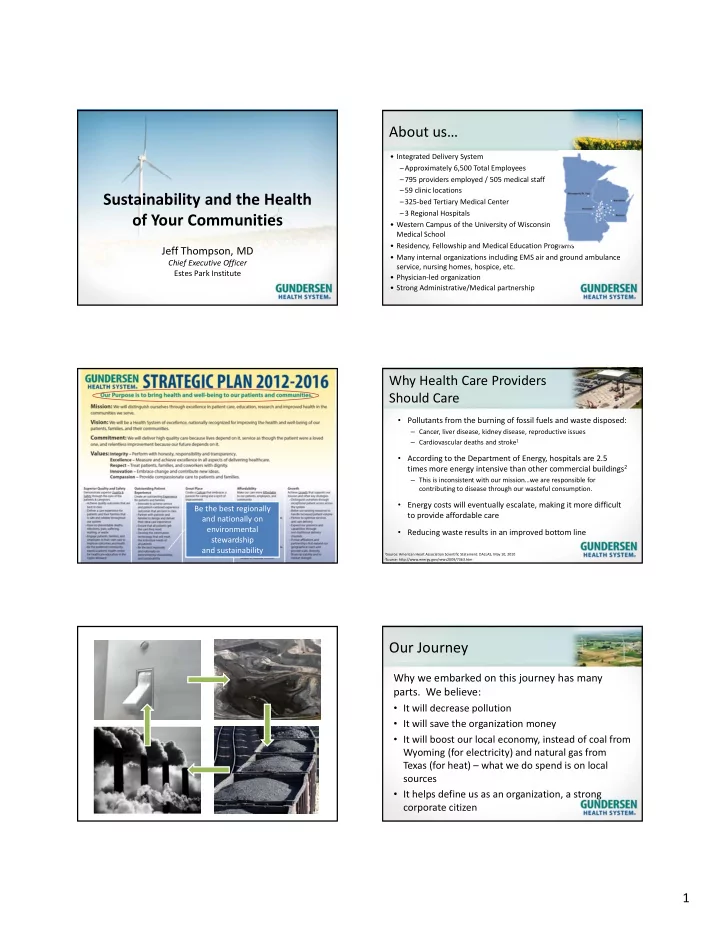
  • Integrated Delivery System

–Approximately 6,500 Total Employees –795 providers employed / 505 medical staff –59 clinic locations –325‐bed Tertiary Medical Center –3 Regional Hospitals

  • Western Campus of the University of Wisconsin

Medical School

  • Residency, Fellowship and Medical Education Programs
  • Many internal organizations including EMS air and ground ambulance

service, nursing homes, hospice, etc.

  • Physician‐led organization
  • Strong Administrative/Medical partnership

About us…

Be the best regionally and nationally on environmental stewardship and sustainability

Why Health Care Providers Should Care

  • Pollutants from the burning of fossil fuels and waste disposed:

– Cancer, liver disease, kidney disease, reproductive issues – Cardiovascular deaths and stroke1

  • According to the Department of Energy, hospitals are 2.5

times more energy intensive than other commercial buildings2

– This is inconsistent with our mission…we are responsible for contributing to disease through our wasteful consumption.

  • Energy costs will eventually escalate, making it more difficult

to provide affordable care

  • Reducing waste results in an improved bottom line

2Source: http://www.energy.gov/news2009/7363.htm 1Source: American Heart Association Scientific Statement: DALLAS, May 10, 2010

Our Journey

Why we embarked on this journey has many

  • parts. We believe:
  • It will decrease pollution
  • It will save the organization money
  • It will boost our local economy, instead of coal from

Wyoming (for electricity) and natural gas from Texas (for heat) – what we do spend is on local sources

  • It helps define us as an organization, a strong

corporate citizen

slide-2
SLIDE 2

2

Inspiration

  • No “cost” for

depleting natural resources

  • There is no “away”
  • People make money

being environmentally sound

“Face the Brutal Facts”

2008: GHS

  • 105 million pounds CO2
  • 476,000 pounds particulate matter
  • 2 pounds mercury
  • 100’s of thousands spent on waste disposal

Notable Sustainability Accomplishments

  • Elimination of food service Styrofoam in health system
  • Implemented Comprehensive Waste Management Program
  • Solid waste stream recycling rate above 43% for last 5 years
  • Reduced cafeteria pre‐consumer food waste by more than 75%

– Keeps approximately 17 tons of food from going to landfill each year – Implemented donation program with Salvation Army for leftover food totaling more than 9,000 meals in 2013

  • Founding Member of Fifth Season Cooperative, which coordinates the distribution of

local foods to institutional markets

Sustainability (non‐energy)

Accomplishments 2013

  • Recycle/Reuse Savings

$95,000

  • Remanufactured Device Savings

$415,000

– Surgical SUDs, O2 sensors, Toner Cartridges

*Total $510,000 Recycle/Reuse Rate 737 tons = 43%

– Construction Recycling/Reuse Rate 17,000 tons = 91%

*only monetary value measurement...does not measure overall benefit to the health of our community

Comprehensive Waste

“Small Waste Generator”

  • Since 2010 we have 20% less Biohazardous waste per patient

visit (5.9% of total waste stream).

  • Since 2010 there has been a reduction of over 13,000 lbs. of

pharmaceutical waste generated per year (59% decrease). A savings of $100,000 a year in disposal costs.

$0.00 $50,000.00 $100,000.00 $150,000.00 $200,000.00 2010 2011 2012 2013 Cost

Pharmaceutical Waste Disposal Costs

2 2.2 2.4 2.6 2.8 3 2010 2011 2012 2013 Lbs./patient

Biohazardous waste generated per Patient Visit

HHI Target

Hazardous Pharmaceutical Waste Reduction

slide-3
SLIDE 3

3

1st U.S. Health System with all of our 5 Hospitals Heat, Power & Cooling offset by our

  • wn Local Renewable Energy

We will improve health & lower cost

Why would a strong board allow this plan?

  • Best use of portion of savings
  • Good ROI (7.7 years)
  • Safer than stock or bond market (remember

2008?)

  • Local investment (great PR)
  • Timing (grants, partners)
  • Early successes (conservation projects)

Where is the Payoff

Education / Opportunity

  • Solar Hot Water Project

(Daycare)

  • Brewery Biogas
  • Solar PV Panels

Financial Successes

  • Conservation
  • +/‐ Wind Farms
  • Landfill Biogas
  • Biomass Boiler
  • Geothermal Field
  • Dairy Biogas
  • Energy Conservation should be our first

fuel

  • $2M Investment, $1.3M Savings/Year
  • Lowering our Fixed Operating Cost is

ESSENTIAL to our long term financial health

  • Improve health, lower costs

Energy Conservation

Onalaska Campus Landfill Gas Project

  • Partnered with La Crosse County Solid Waste Department
  • Project offsets 100% of Onalaska campus energy needs ~11% of

total goal

  • Started production in March 2012
  • The first known, Energy Independent Healthcare Campus in the

U.S.

Previous Behavioral Health Building 200 kBtu/sqft/yr New Behavioral Health Building 65 kBtu/sqft/yr

Facilities Replacement

slide-4
SLIDE 4

4 New Hospital Sustainable Design

433,000 Square Feet

Grumman Butkus Associates Hospital Survey

Annual Energy Usage:

115 kbtu/sqft

Estimated Annual Savings:

$660K at current energy rates

Biomass Boiler Project

Renewable, Locally Sourced, Wood Chip Fuel

  • 38% of energy independence goal (~150,000 MMBtu and 2,500,000 kWh)
  • Will produce the majority of heat / steam used by the health system
  • On‐site electricity production with back pressure steam turbines
  • Started production February 2013

We are the problem…but we can change

2008…

  • Electrical power from coal from Wyoming
  • Heat from natural gas from Texas

2014…

  • Locally sourced renewables

1Particulate conversion rate calculated from US EPA AP-42. 2 *Air pollution from electricity-generating large combustion plants (pdf), Copenhagen: European Environment Agency (EEA), 2008, ISBN 978-92-9167-355-1

2008 CO2 (pounds) 106,480,000 Mercury (pounds) 2.12 Particulate Matter* (pounds) 1 435,270 2014 35,858,000 1.08 191,878

Beyond the Health & Money

  • Staff Pride

– For being environmentally sound – For innovating ahead of the norm – For not settling for mediocrity Mild Excitement Huge Excitement

Sustainability Program Impact

  • Local Energy Purchase: Wind, Wood, Geothermal,

Dairy Biogas and Landfill Gas

  • Food: 70% Waste Reduction, Help start 5th Season

Food Co‐op (local bulk buying)

  • Education: Grade Schools, University, Technical

Schools, World Wide Visitors

  • Cost Savings: Total will be $3‐4M/year
  • Inspiration To: Community Partners, Families,

Employees, Applicants, Competitors

slide-5
SLIDE 5

5

We did not set out to be the greenest health system. We set out to make the air better for our patients to breathe, control our rising energy costs and help our local economy. We believe we have made substantial progress on all three.

The Choice…

  • To Lead
  • To Instigate
  • To Participate
  • To Vegetate

What will you say to the next generation?

Eloise Delaney Thompson

Jeff Thompson, MD

Chief Executive Officer Gundersen Health System

www.gundersenhealth.org