
SLIDE 1
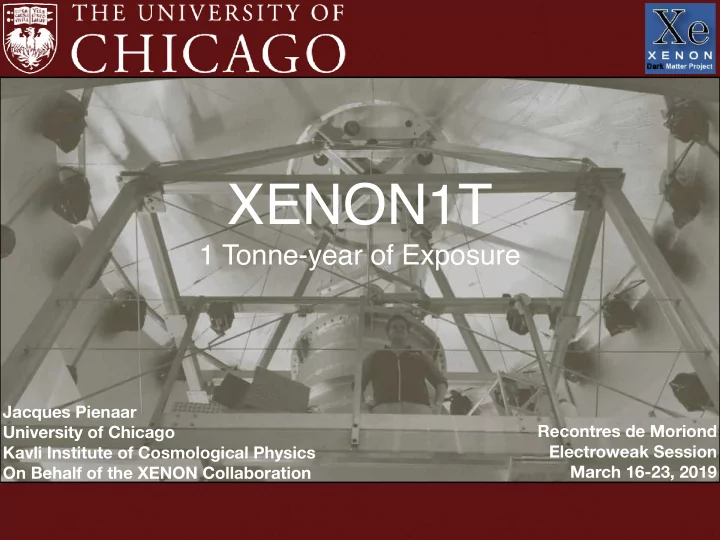
XENON1T
1 Tonne-year of Exposure
Jacques Pienaar University of Chicago Kavli Institute of Cosmological Physics On Behalf of the XENON Collaboration Recontres de Moriond Electroweak Session March 16-23, 2019
XENON1T 1 Tonne-year of Exposure Jacques Pienaar Recontres de - - PowerPoint PPT Presentation
XENON1T 1 Tonne-year of Exposure Jacques Pienaar Recontres de Moriond University of Chicago Electroweak Session Kavli Institute of Cosmological Physics March 16-23, 2019 On Behalf of the XENON Collaboration XENON Collaboration ~160
XENON1T
1 Tonne-year of Exposure
Jacques Pienaar University of Chicago Kavli Institute of Cosmological Physics On Behalf of the XENON Collaboration Recontres de Moriond Electroweak Session March 16-23, 2019
XENON Collaboration
~160 Scientists @ 27 Institutions
2 Jacques Pienaar, jpienaar@uchicago.edu Dual Phase Time Projection Chambers
Full 3D reconstruction of interaction Discrimination between ER/NR events Sub-keV energy threshold Scalable to multi-tonne low background detectors
Dual Phase Time Projection Chambers
Full 3D reconstruction of interaction Discrimination between ER/NR events Sub-keV energy threshold Scalable to multi-tonne low background detectors
Ideal for WIMP (and rare process) Searches
Fiducialization and Surface Bkg Suppression Suppression of 𝛿/β backgrounds Low energy threshold Sensitivity Larger Exposures Sensitivity
XENON1T Instrument Paper
Surface Homogeneous NR Neutrons CEνNS Other Surface (210Pb) Accidental Coincidence ER Materials (𝛿, β)
85Kr, 222RnReduce by fiducializition Reduce through S2/S1 discrimination
5!! WIMP-Like Background !!
Backgrounds
Jacques Pienaar, jpienaar@uchicago.eduarXiv:1604.03858
8B Solar neutrino signal looks like a 6 GeV WIMPElectronic Recoil (ER)
𝛿,β Backgrounds
Nuclear Recoil (NR)
WIMP signal, neutrons, CEνNS
Surface Homogeneous NR Neutrons CEνNS Other Surface (210Pb) Accidental Coincidence ER Materials (𝛿, β)
85Kr, 222RnBackgrounds
6Origin
Mitigation
veto
events and MC to constrain bkg.
JCAP04 (2016) 027
Induce NR
Jacques Pienaar, jpienaar@uchicago.edu Surface Homogeneous NR Neutrons CEνNS Other Surface (210Pb) Accidental Coincidence ER Materials (𝛿, β)
85Kr, 222RnBackgrounds
Degraded Reconstruction
Origin
reducing S2 size
band. Mitigation
develop PDF for likelihood
Jacques Pienaar, jpienaar@uchicago.edu 7 Surface Homogeneous NR Neutrons CEνNS Other Surface (210Pb) Accidental Coincidence ER Materials (𝛿, β)
85Kr, 222Rn 8Backgrounds
https://github.com/XENON1T/paxDegraded Reconstruction
Origin
signals
signals produce events reconstructed within the search region Mitigation
likelihood estimation
Jacques Pienaar, jpienaar@uchicago.edu Backgrounds
Origin
Mitigation
passive water shielding
acceptance for >99.75% ER rejection) Surface Homogeneous NR Neutrons CEνNS Other Surface (210Pb) Accidental Coincidence ER Materials (𝛿, β)
85Kr, 222RnInduce ER
Nuclear Recoils Electronic Recoils
Induced ERs, [1.4-15keVee], with diffused Rn220 calibration Induced NRs,[5-50keVR],with neutron source/generators
Jacques Pienaar, jpienaar@uchicago.edu Backgrounds
Origin
target Mitigation
down to sub-ppt concentrations of
natKr/Xewith as low Rn emanation as possible
Induce ER
Surface Homogeneous NR Neutrons CEνNS Other Surface (210Pb) Accidental Coincidence ER Materials (𝛿, β)
85Kr, 222Rn(0.17 ± 0.01) events / (tonne·day·keVee) in 1300 kg FV WIMP search region: (82-6+8) events / (tonne·yr·keVee) Of which: ~8 events / (tonne·yr·keVee) from 85Kr ~56 events / (tonne·yr·keVee) from 214Pb (inferred from Bi-Po time coincidences)
Jacques Pienaar, jpienaar@uchicago.edu Mass 1.3t 1.3t 0.9t (S2, S1) Full Reference Reference ER 627 ± 18 1.62 ± 0.3 1.12 ± 0.21 Neutron 1.43 ± 0.66 0.77 ± 0.35 0.41 ± 0.19 CEνNS 0.05 ± 0.01 0.03 ± 0.01 0.02 AC 0.47 +0.27 0.10 +0.06 0.06 +0.03 Surface 106 ± 8 4.84 ± 0.4 0.02 BG TOTAL 735 ± 20 7.36 ± 0.61 1.62 ± 0.28 WIMPs best-fit (200GeV) 3.56 1.70 1.16 Data 739 14 2
Background Prediction
Background models in 4 dimensions: S1, S2, r, z Numbers in table for illustration Statistical inference done with PLR analysis in 1.3t fiducial volume and full (S1,S2) space
Jacques Pienaar, jpienaar@uchicago.edu SR0+SR1 Combined Results
Energy Space
12charts correspond to unambiguously bkg events. Larger Pie Charts represent larger WIMP probability
each component for the best fit model of a 200 GeV WIMP (σ=4.4⋅10-47 cm2)
Surface Background NR Referecence Region 200 GeV WIMP Signal ER Background
Jacques Pienaar, jpienaar@uchicago.edu SR0+SR1 Combined Results
Spatial Distribution
13included as nuisance parameters.
to be sub-dominant to uniform 222Rn bkg
Jacques Pienaar, jpienaar@uchicago.edu SR0+SR1 Combined Results
Spin Independent Limits
14backgrounds
signal hypothesis either
Jacques Pienaar, jpienaar@uchicago.edu SR0+SR1 Combined Results
15 Jacques Pienaar, jpienaar@uchicago.eduSpin Dependent Limits
101 102 103WIMP mass [GeV/c2]
10−42 10−41 10−40 10−39 10−38 10−37 10−36WIMP-neutron σSD
χn [cm2] LUX (2017) P a n d a XWIMP mass [GeV/c2]
10−42 10−41 10−40 10−39 10−38 10−37 10−36WIMP-proton σSD
χ p [cm2] LUX (2017) P a n d a Xapplied to SI search
section
vector mediator
101 102 103 104 WIMP mass [GeV/c2] 102 103 Mediator mass [GeV/c2] CMS (2018) ATLAS (2018) PICO-60 (2017) X E N O N 1 T Axial-vector mediator Dirac WIMP gq=0.25, gχ=1.0 arXiv:1902.03234 SR0+SR1 Combined Results
16two nucleons
recoil spectrum as WIMP-nucleon interaction
results on 1 tonne-year exposure
Jacques Pienaar, jpienaar@uchicago.eduPion Coupling
XENONnT
Minimal Upgrade
The XENON1T infrastructure and sub- systems were designed to accommodate a larger TPC.
Fiducial Xe Target
XENONnT TPC features: total Xe mass = 8 t target mass = 5.9 t fiducial mass = ~4 t
Background
Identified strategies to effectively reduce 222Rn by ~ a factor 10. Decrease neutron background thanks to new active neutron veto.
Fast Turnaround
Use XENON1T sub- systems, already tested Fast pace: Installation summer 2019, commissioning by end 2019
x
Backup Slides
Combined Data Set
Energy Resolution
Calibration Fits
Rn220 AmBe NG
Model/Data Comparison
Lone S1/S2 Rate
Electron Lifetime
Light/Charge Yield Stability
Future Sensitivities of LXe Detectors
XENON Infrastructure
www.xenon1t.org
Cryogenics & Purification DAQ & SC Xe Storage & Recovery Kr distillation column & Xe Analytics Cryostat & LXeTPC Muon Veto