For the LBECA Collaboration: Rafael F. Lang, Purdue University, - - PowerPoint PPT Presentation

for the lbeca collaboration rafael f lang
SMART_READER_LITE
LIVE PREVIEW

For the LBECA Collaboration: Rafael F. Lang, Purdue University, - - PowerPoint PPT Presentation

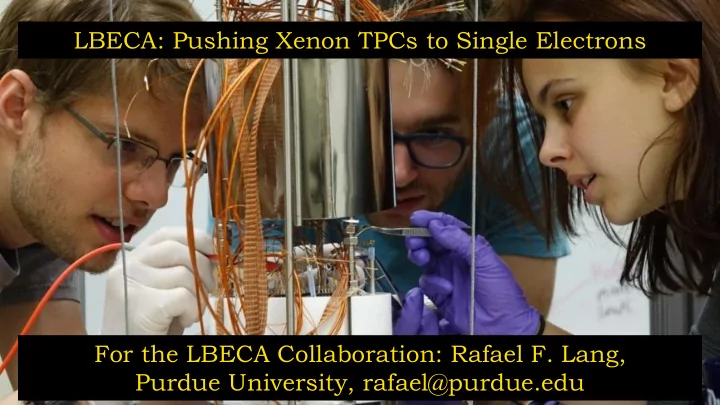
LBECA: Pushing Xenon TPCs to Single Electrons For the LBECA Collaboration: Rafael F. Lang, Purdue University, rafael@purdue.edu S2 Only Channel XENON1T Exploit built-in amplification (proportional scintillation) Rafael Lang: LBECA, Your


slide-1
SLIDE 1

LBECA: Pushing Xenon TPCs to Single Electrons For the LBECA Collaboration: Rafael F. Lang, Purdue University, rafael@purdue.edu

slide-2
SLIDE 2

Rafael Lang: LBECA, Your Way to Single Electrons™ 2

“S2 Only” Channel

XENON1T

Exploit built-in amplification (proportional scintillation)

slide-3
SLIDE 3

Rafael Lang: LBECA, Your Way to Single Electrons™ 3

Limited by Instrumental Background

J.Xu

radioactive background instrumental background

XENON100 1605.0626

slide-4
SLIDE 4

Rafael Lang: LBECA, Your Way to Single Electrons™ 4

  • Scalable to tons
  • Whopping signal:

Why Push LXe to Single e-

Xu+ 1904.02885

  • Xenon is radio-clean
  • Excellent self-shielding
  • Ionization energy
  • nly ∼9 eV → Large c-e-

scattering rate

  • Easily ionize additional

atoms (only ∼14 eVee) → produce multiple e- → less background

slide-5
SLIDE 5

Rafael Lang: LBECA, Your Way to Single Electrons™ 5

Background: Photoionization

XENON100 1311.1088

Xenon light 175nm=7eV photoionizes metals & impurities Not a huge worry: simply veto away

slide-6
SLIDE 6

Rafael Lang: LBECA, Your Way to Single Electrons™ 6

  • Long-lived impurity states?
  • Delayed extraction?
  • Self-Organized Criticality?

Background: Long Timescales

J.Xu/LUX, APS Meeting 2016 max drift 0.3ms Pereverzev in prep. max drift 1ms

XENON preliminary

Sorensen&Kamdin 1711.07025 Sorensen 1702.04805 XENON1T

slide-7
SLIDE 7

Rafael Lang: LBECA, Your Way to Single Electrons™ 7

…in three easy steps: 1) Characterize backgrounds

  • ngoing using R&D setups

and XENON1T&LUX data 2) Mitigate backgrounds

  • ngoing at Purdue, UCSD & LLNL (2019/2020)

3) Build a dedicated LXe TPC detector 2021/2022, design proposal submitted

The LBECA Project

LLNL: J.Xu, A.Bernstein, S.Pereverzev; LBNL: P.Sorensen; UCSD: K.Ni; Stony Brook: R.Essig, M.Fernandez-Serra; Purdue: Rafael

slide-8
SLIDE 8

Rafael Lang: LBECA, Your Way to Single Electrons™ 8

Sealed acrylic TPC realized at UCSD

Improved Purity

K.Ni graphene-coated fused silica electrode

slide-9
SLIDE 9

Rafael Lang: LBECA, Your Way to Single Electrons™ 9

Saturated extraction realized at LLNL

Improved Extraction

Xu+ 1904.02885

slide-10
SLIDE 10

Rafael Lang: LBECA, Your Way to Single Electrons™ 10

LXe IR setup at Purdue This just in: IR light really helps

Stimulated Emission/Quenching

IR LED Off IR LED On less single e- larger primary S2 Po210 peak

slide-11
SLIDE 11

Rafael Lang: LBECA, Your Way to Single Electrons™ 11

CEnNS in liquid xenon

Essig, Sholapurkar, Yu 1801.10159 LUX: 6e- @700eVnr

Expected rate uncertain: need dedicated calibration (already in progress)

high/fid/low

slide-12
SLIDE 12

Rafael Lang: LBECA, Your Way to Single Electrons™ 12

14 – 6 events/kg/year with 2e- threshold

CEnNS in liquid xenon

number of electrons Essig, Sholapurkar, Yu 1801.10159

slide-13
SLIDE 13

Rafael Lang: LBECA, Your Way to Single Electrons™ 13

LBECA Draft Design & Reach

Essig, Sholapurkar, Yu 1801.10159

slide-14
SLIDE 14

Rafael Lang: LBECA, Your Way to Single Electrons™ 14