x86 Memory Protection User System Calls Kernel and Translation - - PDF document

x86 memory protection
SMART_READER_LITE
LIVE PREVIEW

x86 Memory Protection User System Calls Kernel and Translation - - PDF document

8/31/12 Logical Diagram Binary Memory Threads Formats Allocators x86 Memory Protection User System Calls Kernel and Translation RCU File System Networking Sync Todays Lecture Don Porter (focus on CSE 506 Memory Device


slide-1
SLIDE 1

8/31/12 ¡ 1 ¡

x86 Memory Protection and Translation

Don Porter CSE 506

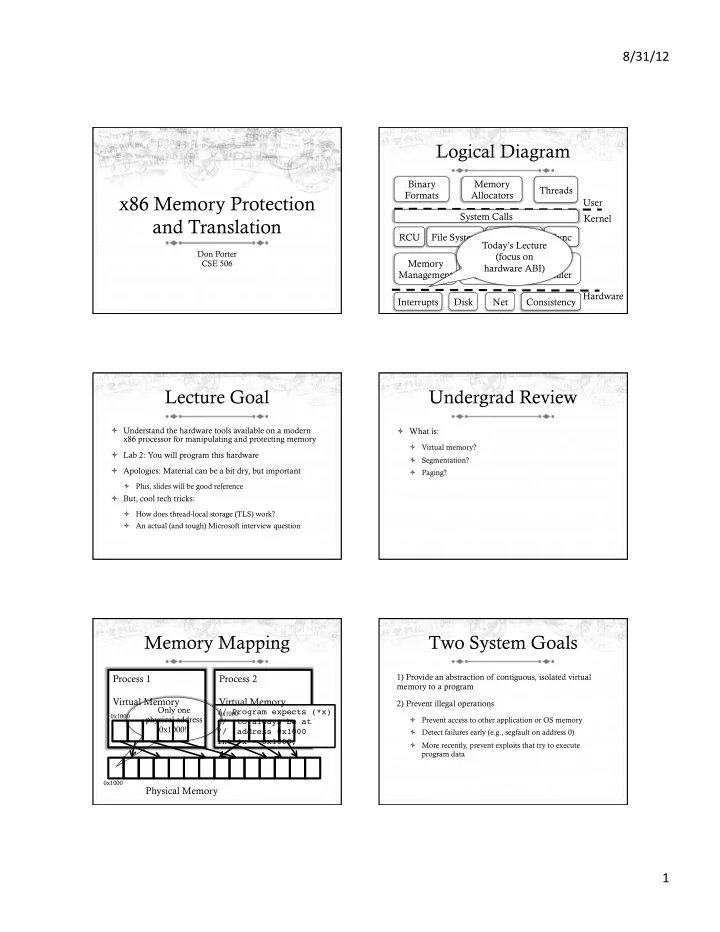
Logical Diagram

Memory Management CPU Scheduler User Kernel Hardware Binary Formats Consistency System Calls Interrupts Disk Net RCU File System Device Drivers Networking Sync Memory Allocators Threads Today’s Lecture (focus on hardware ABI)

Lecture Goal

ò Understand the hardware tools available on a modern x86 processor for manipulating and protecting memory ò Lab 2: You will program this hardware ò Apologies: Material can be a bit dry, but important

ò Plus, slides will be good reference

ò But, cool tech tricks:

ò How does thread-local storage (TLS) work? ò An actual (and tough) Microsoft interview question

Undergrad Review

ò What is:

ò Virtual memory? ò Segmentation? ò Paging?

Memory Mapping

Physical Memory Process 1 Virtual Memory

// Program expects (*x) // to always be at // address 0x1000 int *x = 0x1000;

0x1000

Only one physical address 0x1000!!

Process 2 Virtual Memory

0x1000 0x1000

Two System Goals

1) Provide an abstraction of contiguous, isolated virtual memory to a program 2) Prevent illegal operations

ò Prevent access to other application or OS memory ò Detect failures early (e.g., segfault on address 0) ò More recently, prevent exploits that try to execute program data

slide-2
SLIDE 2

8/31/12 ¡ 2 ¡

Outline

ò x86 processor modes ò x86 segmentation ò x86 page tables ò Software vs. Hardware mechanisms ò Advanced Features ò Interesting applications/problems

x86 Processor Modes

ò Real mode – walks and talks like a really old x86 chip

ò State at boot ò 20-bit address space, direct physical memory access

ò 1 MB of usable memory

ò Segmentation available (no paging)

ò Protected mode – Standard 32-bit x86 mode

ò Segmentation and paging ò Privilege levels (separate user and kernel)

x86 Processor Modes

ò Long mode – 64-bit mode (aka amd64, x86_64, etc.)

ò Very similar to 32-bit mode (protected mode), but bigger ò Restrict segmentation use ò Garbage collect deprecated instructions

ò Chips can still run in protected mode with old instructions

Translation Overview

ò Segmentation cannot be disabled!

ò But can be a no-op (aka flat mode)

0xdeadbeef Virtual Address Linear Address Physical Address 0x0eadbeef 0x6eadbeef Segmentation Paging

Protected/Long mode only

x86 Segmentation

ò A segment has:

ò Base address (linear address) ò Length ò Type (code, data, etc).

Programming model

ò Segments for: code, data, stack, “extra”

ò A program can have up to 6 total segments ò Segments identified by registers: cs, ds, ss, es, fs, gs

ò Prefix all memory accesses with desired segment:

ò mov eax, ds:0x80 (load offset 0x80 from data into eax) ò jmp cs:0xab8 (jump execution to code offset 0xab8) ò mov ss:0x40, ecx (move ecx to stack offset 0x40)

slide-3
SLIDE 3

8/31/12 ¡ 3 ¡

Segmented Programming Pseudo-example

// global int x = 1 int y; // stack if (x) { y = 1; printf (“Boo”); } else y = 0;

ds:x = 1; // data ss:y; // stack if (ds:x) { ss:y = 1; cs:printf

  • (ds:“Boo”);

} else ss:y = 0;

Segments would be used in assembly, not C

Programming, cont.

ò This is cumbersome, so infer code, data and stack segments by instruction type:

ò Control-flow instructions use code segment (jump, call) ò Stack management (push/pop) uses stack ò Most loads/stores use data segment

ò Extra segments (es, fs, gs) must be used explicitly

Segment management

ò For safety (without paging), only the OS should define

  • segments. Why?

ò Two segment tables the OS creates in memory:

ò Global – any process can use these segments ò Local – segment definitions for a specific process

ò How does the hardware know where they are?

ò Dedicated registers: gdtr and ldtr ò Privileged instructions: lgdt, lldt

Segment registers

ò Set by the OS on fork, context switch, etc.

Table Index (13 bits) Global or Local Table? (1 bit) Ring (2 bits)

Sample Problem: (Old) JOS Bootloader

ò Suppose my kernel is compiled to be in upper 256 MB of a 32-bit address space (i.e., 0xf0100000)

ò Common to put OS kernel at top of address space

ò Bootloader starts in real mode (only 1MB of addressable physical memory) ò Bootloader loads kernel at 0x0010000

ò Can’t address 0xf0100000

Booting problem

ò Kernel needs to set up and manage its own page tables

ò Paging can translate 0xf0100000 to 0x00100000

ò But what to do between the bootloader and kernel code that sets up paging?

slide-4
SLIDE 4

8/31/12 ¡ 4 ¡

Segmentation to the Rescue!

ò kern/entry.S:

ò What is this code doing?

mygdt: SEG_NULL # null seg SEG(STA_X|STA_R, -KERNBASE, 0xffffffff) # code seg SEG(STA_W, -KERNBASE, 0xffffffff) # data seg

JOS ex 1, cont.

SEG(STA_X|STA_R, -KERNBASE, 0xffffffff) # code seg

  • jmp 0xf01000db8 # virtual addr. (implicit cs seg)


 jmp (0xf01000db8 + -0xf0000000)


  • jmp 0x001000db8 # linear addr.

Execute and Read permission Offset

  • 0xf0000000

Segment Length (4 GB)

Flat segmentation

ò The above trick is used for booting. We eventually want to use paging. ò How can we make segmentation a no-op? ò From kern/pmap.c:

// 0x8 - kernel code segment [GD_KT >> 3] = SEG(STA_X | STA_R, 0x0, 0xffffffff, 0), Execute and Read permission Offset 0x00000000 Segment Length (4 GB) Ring 0

Outline

ò x86 processor modes ò x86 segmentation ò x86 page tables ò Software vs. Hardware mechanisms ò Advanced Features ò Interesting applications/problems

Paging Model

ò 32 (or 64) bit address space. ò Arbitrary mapping of linear to physical pages ò Pages are most commonly 4 KB

ò Newer processors also support page sizes of 2 and 4 MB and 1 GB

How it works

ò OS creates a page table

ò Any old page with entries formatted properly ò Hardware interprets entries

ò cr3 register points to the current page table

ò Only ring0 can change cr3

slide-5
SLIDE 5

8/31/12 ¡ 5 ¡

Translation Overview

From Intel 80386 Reference Programmer’s Manual

Example

0xf1084150 0x3b4 0x84 0x150 Page Dir Offset (Top 10 addr bits: 0xf10 >> 2) Page Table Offset (Next 10 addr bits) Physical Page Offset (Low 12 addr bits) cr3 Entry at cr3+0x3b4 * sizeof(PTE) Entry at 0x84 * sizeof(PTE) Data we want at

  • ffset 0x150

Page Table Entries

cr3 0x00384 PTE_W|PTE_P|PTE_U 0x28370 PTE_W|PTE_P Physical Address Upper (20 bits) Flags (12 bits)

Page Table Entries

ò Top 20 bits are the physical address of the mapped page

ò Why 20 bits? ò 4k page size == 12 bits of offset

ò Lower 12 bits for flags

Page flags

ò 3 for OS to use however it likes ò 4 reserved by Intel, just in case ò 3 for OS to CPU metadata

ò User/vs kernel page, ò Write permission, ò Present bit (so we can swap out pages)

ò 2 for CPU to OS metadata

ò Dirty (page was written), Accessed (page was read)

Page Table Entries

cr3 0x00384 PTE_W|PTE_P|PTE_U 0x28370 PTE_W|PTE_P| PTE_DIRTY … … Physical Address Upper (20 bits) Flags (12 bits) User, writable, present No mapping Writeable, kernel-only, present, and dirty (Dirty set by CPU on write)

slide-6
SLIDE 6

8/31/12 ¡ 6 ¡

Back of the envelope

ò If a page is 4K and an entry is 4 bytes, how many entries per page?

ò 1k

ò How large of an address space can 1 page represent?

ò 1k entries * 1page/entry * 4K/page = 4MB

ò How large can we get with a second level of translation?

ò 1k tables/dir * 1k entries/table * 4k/page = 4 GB ò Nice that it works out that way!

Challenge questions

ò What is the space overhead of paging?

ò I.e., how much memory goes to page tables for a 4 GB address space?

ò What is the optimal number of levels for a 64 bit page table? ò When would you use a 2 MB or 1 GB page size?

TLB Entries

ò The CPU caches address translations in the TLB

ò Translation Lookaside Buffer

cr3

Page Traversal is Slow

Virt Phys 0xf0231000 0x1000 0x00b31000 0x1f000 0xb0002000 0xc1000

  • Table Lookup is Fast

TLB Entries

ò The CPU caches address translations in the TLB ò Translation Lookaside BufferThe TLB is not coherent with memory, meaning:

ò If you change a PTE, you need to manually invalidate cached values ò See the tlb_invalidate() function in JOS

TLB Entries

ò The TLB is not coherent with memory, meaning:

ò If you change a PTE, you need to manually invalidate cached values ò See the tlb_invalidate() function in JOS

cr3 Virt Phys 0xf0231000 0x1000 0x00b31000 0x1f000 0xb0002000 0xc1000

  • Same

Virt Addr. No Change!!!

Outline

ò x86 processor modes ò x86 segmentation ò x86 page tables ò Software vs. Hardware mechanisms ò Advanced Features ò Interesting applications/problems

slide-7
SLIDE 7

8/31/12 ¡ 7 ¡

SW vs. HW

ò We already saw that TLB shootdown is done by software ò Let’s think about other paging features…

Copy-on-write paging

ò HW: Traps to the OS on a write to read-only page ò OS: Allocates a new copy of the page, updates page tables ò Note: can use one of the OS-managed flags for COW status

  • Async. mmap writeback

ò Suppose the OS maps a writeable file into a process’s address space. ò When the process exits, which pages to write back to the file?

ò Could write them all, but that is wasteful ò Check the dirty bit in the PTE!

Swapping

ò OS clears the present bit for an entry that is swapped out

ò What happens if you access a stale mapping?

ò OS gets a page fault the next time it is accessed ò OS can replace the page, suspend process until reloaded

Outline

ò x86 processor modes ò x86 segmentation ò x86 page tables ò Software vs. Hardware mechanisms ò Advanced Features ò Interesting applications/problems

Physical Address Extension (PAE)

ò Period with 32-bit machines + >4GB RAM (2000’s) ò Essentially, an early deployment of a 64-bit page table format ò Any given process can only address 4GB

ò Including OS!

ò Page tables themselves can address >4GB of physical pages

slide-8
SLIDE 8

8/31/12 ¡ 8 ¡

No execute (NX) bit

ò Many security holes arise from bad input

ò Tricks program to jump to unintended address ò That happens to be on heap or stack ò And contains bits that form malware

ò Idea: execute protection can catch these

ò Feels a bit like code segment, no?

ò Bit 63 in 64-bit page tables (or 32 bit + PAE)

Nested page tables

ò Paging tough for early Virtual Machine implementations

ò Can’t trust a guest OS to correctly modify pages

ò So, add another layer of paging between host-physical and guest-physical

And now the fun stuff… Thread-Local Storage (TLS)

// Global __thread int tid; … printf (“my thread id is %d\n”, tid);

Identical code gets different value in each thread

Thread-local storage (TLS)

ò Convenient abstraction for per-thread variables ò Code just refers to a variable name, accesses private instance ò Example: Windows stores the thread ID (and other info) in a thread environment block (TEB)

ò Same code in any thread to access ò No notion of a thread offset or id

ò How to do this?

TLS implementation

ò Map a few pages per thread into a segment ò Use an “extra” segmentation register

ò Usually gs ò Windows TEB in fs

ò Any thread accesses first byte of TLS like this:

mov eax, gs:(0x0)

slide-9
SLIDE 9

8/31/12 ¡ 9 ¡

TLS Illustration

Tid = 0

0xb0001000 Tid = 1 Tid = 2 0xb0002000 0xb0003000

printf (“My thread id is %d\n”, gs:tid);

Thread 0 Registers gs: = 0xb0001000 Thread 1 Registers gs: = 0xb0002000 Thread 2 Registers gs: = 0xb0003000

Set by the OS kernel during context switch

Viva segmentation!

ò My undergrad OS course treated segmentation as a historical artifact

ò Yet still widely (ab)used ò Also used for sandboxing in vx32, Native Client

ò Counterpoint: TLS hack is just compensating for lack of general-purpose registers ò Either way, all but fs and gs are deprecated in x64

Microsoft interview question

ò Suppose I am on a low-memory x86 system (<4MB). I don’t care about swapping or addressing more than 4MB. ò How can I keep paging space overhead at one page?

ò Recall that the CPU requires 2 levels of addr. translation

Solution sketch

ò A 4MB address space will only use the low 22 bits of the address space.

ò So the first level translation will always hit entry 0

ò Map the page table’s physical address at entry 0

ò First translation will “loop” back to the page table ò Then use page table normally for 4MB space

ò Assumes correct programs will not read address 0

ò Getting null pointers early is nice ò Challenge: Refine the solution to still get null pointer exceptions

Conclusion

ò Lab 2 will be fun

Housekeeping

ò Reminder: sign up for course mailing list

ò Read the whole thing before posting ò If you have an issue, please post if resolved (and how!)

ò Checkpoint your VM before changing things

ò Instructions to follow soon ò You break it, you buy it

ò I’ll update enrollment tomorrow