CS 105 x86-64 Linux Memory Layout x86-64 Linux Memory Layout Tour - - PowerPoint PPT Presentation

cs 105 x86 64 linux memory layout x86 64 linux memory
SMART_READER_LITE
LIVE PREVIEW

CS 105 x86-64 Linux Memory Layout x86-64 Linux Memory Layout Tour - - PowerPoint PPT Presentation

CS 105 x86-64 Linux Memory Layout x86-64 Linux Memory Layout Tour of Black Holes of Computing 00007FFFFFFFFFFF Stack


slide-1
SLIDE 1

Machine-Level Programming V: Miscellaneous Topics Machine-Level Programming V: Miscellaneous Topics

Topics

Linux Memory Layout

Buffer Overflow

C operators and declarations

CS 105 Tour of Black Holes of Computing

– 2 – 105

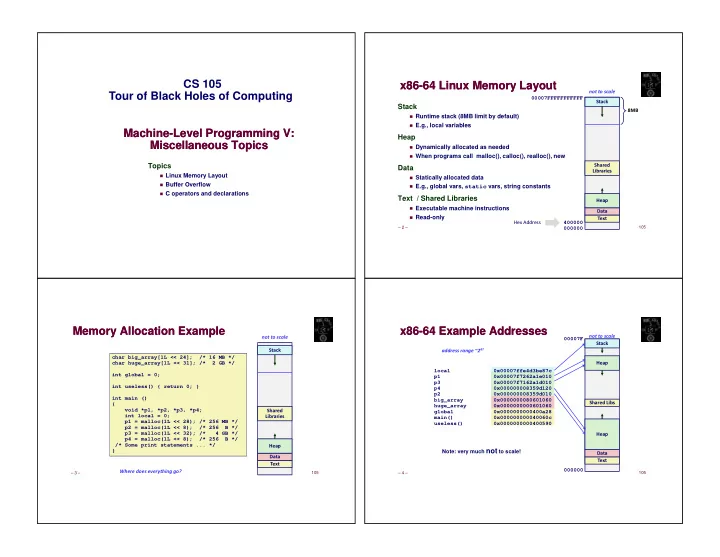
x86-64 Linux Memory Layout x86-64 Linux Memory Layout

Stack

Runtime stack (8MB limit by default)

E.g., local variables

Heap

Dynamically allocated as needed

When programs call malloc(), calloc(), realloc(), new

Data

Statically allocated data

E.g., global vars, static vars, string constants

Text / Shared Libraries

Executable machine instructions

Read-only

  • 00007FFFFFFFFFFF

000000

  • 400000
  • – 3 –

105

Memory Allocation Example Memory Allocation Example

char big_array[1L << 24]; /* 16 MB */ char huge_array[1L << 31]; /* 2 GB */ int global = 0; int useless() { return 0; } int main () { void *p1, *p2, *p3, *p4; int local = 0; p1 = malloc(1L << 28); /* 256 MB */ p2 = malloc(1L << 8); /* 256 B */ p3 = malloc(1L << 32); /* 4 GB */ p4 = malloc(1L << 8); /* 256 B */ /* Some print statements ... */ }

  • – 4 –

105

local 0x00007ffe4d3be87c p1 0x00007f7262a1e010 p3 0x00007f7162a1d010 p4 0x000000008359d120 p2 0x000000008359d010 big_array 0x0000000080601060 huge_array 0x0000000000601060 global 0x0000000000400a28 main() 0x000000000040060c useless() 0x0000000000400590

x86-64 Example Addresses x86-64 Example Addresses

00007F 000000

  • Note: very much not to scale!
slide-2
SLIDE 2

– 5 – 105

Carnegie Mellon

Memory-Referencing Bug Example Memory-Referencing Bug Example

Result is system-specific

fun(0) 3.14 fun(1) 3.14 fun(2) 3.1399998664856 fun(3) 2.00000061035156 fun(4) 3.14 fun(6)

  • typedef struct { /* An "anonymous" structure */

int a[2]; double d; } struct_t; /* "typedef" gives it a type name */ double fun(int i) { volatile struct_t s; s.d = 3.14; s.a[i] = 1073741824; /* 2**30, possibly out of bounds */ return s.d; }

– 6 – 105

Carnegie Mellon

Memory-Referencing Bug Example Memory-Referencing Bug Example

typedef struct { int a[2]; double d; } struct_t;

fun(0) 3.14 fun(1) 3.14 fun(2) 3.1399998664856 fun(3) 2.00000061035156 fun(4) 3.14 fun(6)

  • fun(i)
  • ?
  • ?
  • d7 ... d4
  • d3 ... d0
  • a[1]
  • a[0]
  • struct_t
  • – 7 –

105

Such problems are a BIG deal Such problems are a BIG deal

Generally called a “buffer overflow”

When exceeding the memory size allocated for an array

Why a big deal?

It’s the #1 technical cause of security vulnerabilities

#1 overall cause is social engineering / user ignorance

Most common form

Unchecked lengths on string inputs

Particularly for bounded character arrays on the stack

Sometimes referred to as “stack smashing”

– 8 – 105

String Library Code String Library Code

Implementation of Unix function gets()

No way to specify limit on number of characters to read

Similar problems with other library functions

strcpy, strcat: Copy strings of arbitrary length

scanf, fscanf, sscanf, when given %s conversion specification

/* Get string from stdin */ char *gets(char *dest) { int c = getchar(); char *p = dest; while (c != EOF && c != '\n') { *p++ = c; c = getchar(); } *p = '\0'; return dest; }

slide-3
SLIDE 3

– 9 – 105

Vulnerable Buffer Code Vulnerable Buffer Code

void call_echo() { echo(); } /* Echo Line */ void echo() { char buf[4]; /* Way too small! */ gets(buf); puts(buf); } unix>./bufdemo Type a string:012345678901234567890123 012345678901234567890123 unix>./bufdemo Type a string:0123456789012345678901234 Segmentation Fault

  • – 10 –

105

Buffer Overflow Disassembly Buffer Overflow Disassembly

00000000004006cf <echo>: 4006cf: 48 83 ec 18 sub $0x18,%rsp 4006d3: 48 89 e7 mov %rsp,%rdi 4006d6: e8 a5 ff ff ff callq 400680 <gets> 4006db: 48 89 e7 mov %rsp,%rdi 4006de: e8 3d fe ff ff callq 400520 <puts@plt> 4006e3: 48 83 c4 18 add $0x18,%rsp 4006e7: c3 retq 4006e8: 48 83 ec 08 sub $0x8,%rsp 4006ec: b8 00 00 00 00 mov $0x0,%eax 4006f1: e8 d9 ff ff ff callq 4006cf <echo> 4006f6: 48 83 c4 08 add $0x8,%rsp 4006fa: c3 retq

  • – 11 –

105

Buffer Overflow Stack Buffer Overflow Stack

echo: subq $24, %rsp movq %rsp, %rdi call gets . . . /* Echo Line */ void echo() { char buf[4]; /* Way too small! */ gets(buf); puts(buf); }

  • %rsp
  • call_echo

[3] [2] [1] [0] buf

  • – 12 –

105

Buffer Overflow Stack Example Buffer Overflow Stack Example

echo: subq $24, %rsp movq %rsp, %rdi call gets . . . void echo() { char buf[4]; gets(buf); . . . }

  • %rsp
  • call_echo

[3] [2] [1] [0] buf

  • . . .

4006f1: callq 4006cf <echo> 4006f6: add $0x8,%rsp . . .

  • 00 40 06 f6

00 00 00 00

slide-4
SLIDE 4

– 13 – 105

Buffer Overflow Example #1 Buffer Overflow Example #1

echo: subq $24, %rsp movq %rsp, %rdi call gets . . . void echo() { char buf[4]; gets(buf); . . . }

  • %rsp
  • call_echo

33 32 31 30 buf

  • . . .

4006f1: callq 4006cf <echo> 4006f6: add $0x8,%rsp . . .

  • 00 40 06 f6

00 00 00 00

unix>./bufdemo Type a string:01234567890123456789012 01234567890123456789012

37 36 35 34 31 30 39 38 35 34 33 32 39 38 37 36 00 32 31 30

  • – 14 –

105

Buffer Overflow Example #2 Buffer Overflow Example #2

echo: subq $24, %rsp movq %rsp, %rdi call gets . . . void echo() { char buf[4]; gets(buf); . . . }

  • %rsp
  • call_echo

33 32 31 30 buf

  • . . .

4006f1: callq 4006cf <echo> 4006f6: add $0x8,%rsp . . .

  • 00 00 00 00

unix>./bufdemo Type a string:0123456789012345678901234 Segmentation Fault

37 36 35 34 31 30 39 38 35 34 33 32 39 38 37 36 33 32 31 30

  • 00 40 00 34

– 15 – 105

Buffer Overflow Example #3 Buffer Overflow Example #3

echo: subq $24, %rsp movq %rsp, %rdi call gets . . . void echo() { char buf[4]; gets(buf); . . . }

  • %rsp
  • call_echo

33 32 31 30 buf

  • . . .

4006f1: callq 4006cf <echo> 4006f6: add $0x8,%rsp . . .

  • 00 00 00 00

unix>./bufdemo Type a string:012345678901234567890123 012345678901234567890123

37 36 35 34 31 30 39 38 35 34 33 32 39 38 37 36 33 32 31 30

  • 00 40 06 00

– 16 – 105

Buffer Overflow Example #3 Explained Buffer Overflow Example #3 Explained

  • %rsp
  • call_echo

33 32 31 30 buf

  • . . .

400600: mov %rsp,%rbp 400603: mov %rax,%rdx 400606: shr $0x3f,%rdx 40060a: add %rdx,%rax 40060d: sar %rax 400610: jne 400614 400612: pop %rbp 400613: retq

  • 00 00 00 00

37 36 35 34 31 30 39 38 35 34 33 32 39 38 37 36 33 32 31 30

  • retq main
  • 00 40 06 00
slide-5
SLIDE 5

– 17 – 105

Exploits Based on Overflows Exploits Based on Overflows

Buffer overflow bugs can allow remote machines to execute arbitrary code

  • n victim machines

Distressingly common in real progams

Programmers keep making the same mistakes

Recent measures make these attacks much more difficult

Examples across the decades

Original “Internet worm” (1988)

“IM wars” (1999)

Twilight hack on Wii (2000s)

… and many, many more

You will learn some of the tricks in lab 4

Hopefully to convince you to never leave such holes in your programs!!

– 18 – 105

Example: Original Internet Worm (1988) Example: Original Internet Worm (1988)

Exploited a few vulnerabilities to spread

Early versions of the finger server (fingerd) used gets() to read the argument sent by the client:

finger geoff@cs.hmc.edu

Worm attacked fingerd server by sending phony argument:

finger “exploit-code padding new-return-address” exploit code: executed a root shell on the victim machine with a direct TCP connection to

the attacker.

Once on a machine, scanned for other machines to attack

invaded ~6000 computers in hours (10% of the Internet )

see June 1989 article in Comm. of the ACM

the young author of the worm was prosecuted…

and CERT was formed… still homed at CMU

– 19 – 105

Example 2: IM War Example 2: IM War

July, 1999

Microsoft launches MSN Messenger (instant messaging system).

Messenger clients can access popular AOL Instant Messaging Service (AIM) servers

  • – 20 –

105

IM War (cont.) IM War (cont.)

August 1999

Mysteriously, Messenger clients can no longer access AIM servers

Microsoft and AOL begin the IM war:

AOL changes server to disallow Messenger clients Microsoft makes changes to clients to defeat AOL changes At least 13 such skirmishes

What was really happening?

AOL had discovered a buffer overflow bug in their own AIM clients They exploited it to detect and block Microsoft: the exploit code returned a 4-byte

signature (the bytes at some location in the AIM client) to server

When Microsoft changed code to match signature, AOL changed signature location

slide-6
SLIDE 6

– 21 – 105 Date: Wed, 11 Aug 1999 11:30:57 -0700 (PDT) From: Phil Bucking <philbucking@yahoo.com> Subject: AOL exploiting buffer overrun bug in their own software! To: rms@pharlap.com

  • Mr. Smith,

I am writing you because I have discovered something that I think you might find interesting because you are an Internet security expert with experience in this area. I have also tried to contact AOL but received no response. I am a developer who has been working on a revolutionary new instant messaging client that should be released later this year. ... It appears that the AIM client has a buffer overrun bug. By itself this might not be the end of the world, as MS surely has had its share. But AOL is now *exploiting their own buffer overrun bug* to help in its efforts to block MS Instant Messenger. .... Since you have significant credibility with the press I hope that you can use this information to help inform people that behind AOL's friendly exterior they are nefariously compromising peoples' security. Sincerely, Phil Bucking Founder, Bucking Consulting philbucking@yahoo.com

  • – 22 –

105

Aside: Worms and Viruses Aside: Worms and Viruses

Worm: A program that

Can run by itself

Can propagate a fully working version of itself to other computers

Virus: Code that

Adds itself to other programs

Does not run independently

Both are (usually) designed to spread among computers and to wreak havoc

– 23 – 105

OK, What to Do About Buffer Overflow Attacks? OK, What to Do About Buffer Overflow Attacks?

Avoid overflow vulnerabilities Employ system-level protections Have compiler use “stack canaries” Lets talk about each…

– 24 – 105

  • 1. Avoid Overflow Vulnerabilities in

Code (!)

  • 1. Avoid Overflow Vulnerabilities in

Code (!)

For example, use library routines that limit string lengths

fgets instead of gets

strncpy instead of strcpy

Don’t use scanf with %s conversion specification

Use fgets to read the string Or use %ns where n is a suitable integer

/* Echo Line */ void echo() { char buf[4]; /* Way too small! */ fgets(buf, 4, stdin); puts(buf); }

slide-7
SLIDE 7

– 25 – 105

  • 2. System-Level Protections Can Help
  • 2. System-Level Protections Can Help

Randomized stack offsets

At start of program, allocate random amount of space on stack

Makes it hard for hacker to predict beginning of inserted code

E.g.: 5 executions of memory allocation code

Stack repositioned each time program executes

Nonexecutable code segments

In traditional x86, can mark region of memory as either “read-only” or “writable”

Can execute anything readable

X86-64 added explicit “execute” permission

Stack marked as non-executable

– 26 – 105

  • 3. Stack Canaries can help
  • 3. Stack Canaries can help

Idea

Place special value (“canary”) on stack just beyond buffer

Check for corruption before exiting function

GCC Implementation

  • fstack-protector

Now the default (disabled earlier)

unix>./bufdemo-protected Type a string:0123456 0123456 unix>./bufdemo-protected Type a string:01234567 *** stack smashing detected ***

– 27 – 105

Protected Buffer Disassembly Protected Buffer Disassembly

40072f: sub $0x18,%rsp 400733: mov %fs:0x28,%rax 40073c: mov %rax,0x8(%rsp) 400741: xor %eax,%eax 400743: mov %rsp,%rdi 400746: callq 4006e0 <gets> 40074b: mov %rsp,%rdi 40074e: callq 400570 <puts@plt> 400753: mov 0x8(%rsp),%rax 400758: xor %fs:0x28,%rax 400761: je 400768 <echo+0x39> 400763: callq 400580 <__stack_chk_fail@plt> 400768: add $0x18,%rsp 40076c: retq

  • – 28 –

105

Setting Up Canary Setting Up Canary

echo: . . . movq %fs:40, %rax # Get canary movq %rax, 8(%rsp) # Place on stack xorl %eax, %eax # Erase canary . . . /* Echo Line */ void echo() { char buf[4]; /* Way too small! */ gets(buf); puts(buf); }

  • %rsp
  • call_echo

[3] [2] [1] [0] buf

slide-8
SLIDE 8

– 29 – 105

  • call_echo

Checking Canary Checking Canary

echo: . . . movq 8(%rsp), %rax # Retrieve from stack xorq %fs:40, %rax # Compare to canary je .L6 # If same, OK call __stack_chk_fail # FAIL .L6: . . . /* Echo Line */ void echo() { char buf[4]; /* Way too small! */ gets(buf); puts(buf); }

  • %ebp

[3] [2] [1] [0] %ebx

  • %rsp

33 32 31 30 buf

  • 00 36 35 34
  • – 30 –

105

C Operators C Operators

Operators Associativity

() [] -> . left to right ! ~ ++ -- + - * & (type) sizeof right to left * / % left to right + - left to right << >> left to right < <= > >= left to right == != left to right & left to right ^ left to right | left to right && left to right || left to right ?: right to left = += -= *= /= %= &= ^= != <<= >>= right to left , left to right

Note: Unary +, -, and * have higher precedence than binary forms See ~geoff/c_precedence on Wilkes and Knuth

– 31 – 105

C Pointer Declarations C Pointer Declarations

int *p p is a pointer to int int *p[13] p is an array[13] of pointer to int int *(p[13]) p is an array[13] of pointer to int int **p p is a pointer to a pointer to an int int (*p)[13] p is a pointer to an array[13] of int int *f() f is a function (unknown arguments) returning a pointer to int int (*f)() f is a pointer to a function returning int int (*(*f())[13])() f is a function returning ptr to an array[13]

  • f pointers to functions returning int

int (*(*x[3])())[5] x is an array[3] of pointers to functions returning pointers to array[5] of ints