CS 105 Intel x86 (IA32/64) Processors Intel x86 (IA32/64) - - PowerPoint PPT Presentation

cs 105 intel x86 ia32 64 processors intel x86 ia32 64
SMART_READER_LITE
LIVE PREVIEW

CS 105 Intel x86 (IA32/64) Processors Intel x86 (IA32/64) - - PowerPoint PPT Presentation

CS 105 Intel x86 (IA32/64) Processors Intel x86 (IA32/64) Processors Tour of the Black Holes of Computing Totally Dominate


slide-1
SLIDE 1

Machine-Level Programming I Machine-Level Programming I

Topics

Assembly Programmer’s Execution Model

Accessing Information

Registers Memory

Arithmetic operations

CS 105 “Tour of the Black Holes of Computing”

– 2 – CS 105

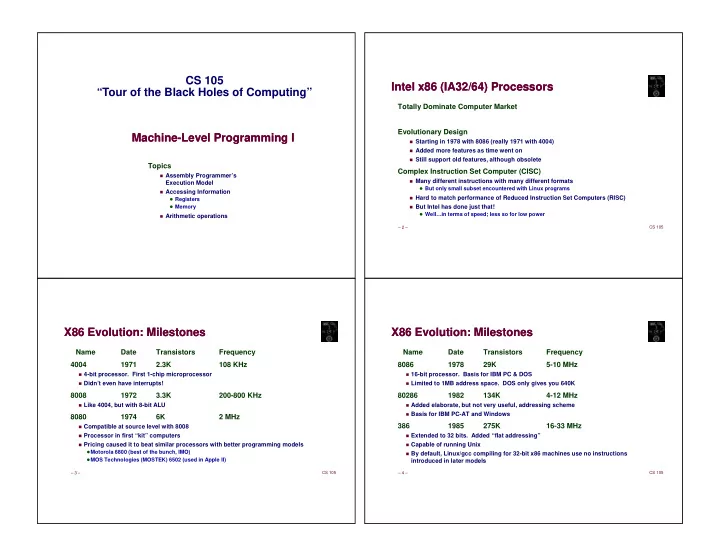
Intel x86 (IA32/64) Processors Intel x86 (IA32/64) Processors

Totally Dominate Computer Market Evolutionary Design

Starting in 1978 with 8086 (really 1971 with 4004)

Added more features as time went on

Still support old features, although obsolete

Complex Instruction Set Computer (CISC)

Many different instructions with many different formats

But only small subset encountered with Linux programs

Hard to match performance of Reduced Instruction Set Computers (RISC)

But Intel has done just that!

Well…in terms of speed; less so for low power

– 3 – CS 105

X86 Evolution: Milestones X86 Evolution: Milestones

Name Date Transistors Frequency 4004 1971 2.3K 108 KHz

4-bit processor. First 1-chip microprocessor

Didn’t even have interrupts!

8008 1972 3.3K 200-800 KHz

Like 4004, but with 8-bit ALU

8080 1974 6K 2 MHz

Compatible at source level with 8008

Processor in first “kit” computers

Pricing caused it to beat similar processors with better programming models

Motorola 6800 (best of the bunch, IMO) MOS Technologies (MOSTEK) 6502 (used in Apple II)

– 4 – CS 105

X86 Evolution: Milestones X86 Evolution: Milestones

Name Date Transistors Frequency 8086 1978 29K 5-10 MHz

16-bit processor. Basis for IBM PC & DOS

Limited to 1MB address space. DOS only gives you 640K

80286 1982 134K 4-12 MHz

Added elaborate, but not very useful, addressing scheme

Basis for IBM PC-AT and Windows

386 1985 275K 16-33 MHz

Extended to 32 bits. Added “flat addressing”

Capable of running Unix

By default, Linux/gcc compiling for 32-bit x86 machines use no instructions introduced in later models

slide-2
SLIDE 2

– 5 – CS 105

X86 Evolution: Milestones X86 Evolution: Milestones

Name Date Transistors Frequency 486 1989 1.9M 16-150 MHz Pentium P5 1993 3.1M 60-66 MHz Pentium 4E 2004 125M 2.8-3.8 GHz

First 64-bit Intel x86 processor

Core 2 2006 291M 1.0-3.5 GHz

First multi-core Intel processor

Core i7 2008 731M 1.7-3.9 GHz Ivy Bridge 2012 0.6-4.3B 3.2-4.0 GHz

Transistor counts are going crazy here…

…but max GHz has been stuck since 2004

– 6 – CS 105

X86 Evolution: Clones X86 Evolution: Clones

Advanced Micro Devices (AMD)

Historically

AMD has followed just behind Intel A little bit slower, a lot cheaper

Late 1990s

Recruited top circuit designers from Digital Equipment Corp. Exploited fact that Intel distracted by Itanium Became close competitors to Intel

Developed own extension to 64 bits (called x86_64)

Intel adopted in early 2000’s after Itanium bombed

Has recovered lead in semiconductor technology AMD has fallen behind again But in recent years ARM has been rising due to smartphones

– 7 – CS 105

Definitions Definitions

Architecture: (also ISA: instruction set architecture) The parts of a processor design that one needs to understand or write assembly/machine code.

Examples: instruction set specification, registers.

Microarchitecture: Implementation of the architecture.

Examples: cache sizes and core frequency.

Code Forms:

Machine Code: The byte-level programs that a processor executes

Assembly Code: A text representation of machine code

Example ISAs:

Intel: x86, IA32, Itanium, x86-64

ARM: Used in almost all smartphones

– 8 – CS 105

Assembly Programmer’s View Assembly Programmer’s View

Programmer-Visible State

RIP (Program Counter)

  • Address of next instruction

Register File

  • Heavily used program data

Condition Codes

  • Store status information about

most recent arithmetic operation

  • Used for conditional branching

R I P Registers CPU Memory Object Code Program Data OS Data Addresses Data Instructions Stack Condition Codes

Memory

  • Byte-addressable array
  • Code, user data, (most) OS data
  • Includes stack used to support

procedures

slide-3
SLIDE 3

– 9 – CS 105

text text binary binary Compiler (gcc –Wall -g -Og -S) Assembler (gcc or as) Linker (gcc or ld) C program (p1.c p2.c) Asm program (p1.s p2.s) Object program (p1.o p2.o) Executable program (p) Static libraries (.a)

Turning C into Object Code Turning C into Object Code

Code in files p1.c p2.c

Compile with command: gcc –Wall -g -Og p1.c p2.c -o p

Use basic, debugging-friendly optimizations (-Og) Put resulting binary in file p

– 10 – CS 105

Compiling Into Assembly

C Code (sum.c)

long plus(long x, long y); void sumstore(long x, long y, long *dest) { long t = plus(x, y); *dest = t; }

  • sumstore:

pushq %rbx movq %rdx, %rbx call plus movq %rax, (%rbx) popq %rbx ret

  • gcc –Og -g –S sum.c

sum.s

  • – 11 –

CS 105

Assembly Characteristics Assembly Characteristics

Minimal data types

Integer data of 1, 2, 4, or 8 bytes

Data values Addresses (untyped pointers)

Floating-point data of 4, 8, or 10 bytes

No aggregate types such as arrays or structures

Just contiguously allocated bytes in memory

Code is also just byte sequences encoding instructions

Primitive operations

Perform arithmetic function on register or memory data

Transfer data between memory and register

Load data from memory into register Store register data into memory

Transfer control

Unconditional jumps to/from procedures Conditional branches

– 12 – CS 105

sumstore

0x0400595: 0x53 0x48 0x89 0xd3 0xe8 0xf2 0xff 0xff 0xff 0x48 0x89 0x03 0x5b 0xc3

Object Code Object Code

Assembler

Translates .s into .o

Binary encoding of each instruction

Nearly-complete image of executable code

Missing linkages between code in different files

Linker

Resolves references between files

Combines with static run-time libraries

E.g., code for malloc, printf

Some libraries are dynamically linked

Linking occurs when program begins execution

  • 0x0400595
slide-4
SLIDE 4

– 13 – CS 105

Machine Instruction Example Machine Instruction Example

C Code

Store value t where designated by dest

Assembly

Move 8-byte value to memory

Quad words in x86-64 parlance

Operands:

t: Register %rax dest: Register %rbx *dest: MemoryM[%rbx]

Object Code

3-byte instruction

Stored at address 0x40059e

*dest = t; movq %rax, (%rbx) 0x40059e: 48 89 03

– 14 – CS 105

  • Disassembling Object Code

Disassembling Object Code

Disassembler

  • bjdump –d sum

Useful tool for examining object code

Analyzes bit patterns of series of instructions

Produces approximate rendition of assembly code

Can be run on either a.out (complete executable) or .o file

0000000000400595 <sumstore>: 400595: 53 push %rbx 400596: 48 89 d3 mov %rdx,%rbx 400599: e8 f2 ff ff ff callq 400590 <plus> 40059e: 48 89 03 mov %rax,(%rbx) 4005a1: 5b pop %rbx 4005a2: c3 retq

– 15 – CS 105

  • Dump of assembler code for function sumstore:

0x0000000000400595 <+0>: push %rbx 0x0000000000400596 <+1>: mov %rdx,%rbx 0x0000000000400599 <+4>: callq 0x400590 <plus> 0x000000000040059e <+9>: mov %rax,(%rbx) 0x00000000004005a1 <+12>:pop %rbx 0x00000000004005a2 <+13>:retq

Alternate Disassembly Alternate Disassembly

Within gdb Debugger

gdb sum disassemble sumstore

Disassembles procedure named sumstore x/14xb sumstore

Examines the 14 hex bytes starting at sumstore x/6i sumstore

Disassembles 6 insructions starting at sumstore

  • 0x0400595:

0x53 0x48 0x89 0xd3 0xe8 0xf2 0xff 0xff 0xff 0x48 0x89 0x03 0x5b 0xc3

– 16 – CS 105

What Can be Disassembled? What Can be Disassembled?

Anything that can be interpreted as executable code Disassembler examines bytes and reconstructs assembly source

% objdump -d WINWORD.EXE WINWORD.EXE: file format pei-i386 No symbols in "WINWORD.EXE". Disassembly of section .text: 30001000 <.text>: 30001000: 55 push %ebp 30001001: 8b ec mov %esp,%ebp 30001003: 6a ff push $0xffffffff 30001005: 68 90 10 00 30 push $0x30001090 3000100a: 68 91 dc 4c 30 push $0x304cdc91

slide-5
SLIDE 5

– 18 – CS 105

%rax %rbx %rcx %rdx %rsi %rdi %rsp %rbp

x86-64 Integer Registers x86-64 Integer Registers

%eax %ebx %ecx %edx %esi %edi %esp %ebp %r8 %r9 %r10 %r11 %r12 %r13 %r14 %r15 %r8d %r9d %r10d %r11d %r12d %r13d %r14d %r15d

– 19 – CS 105

Moving Data Moving Data

Moving Data

movq Source, Dest

Operand Types

Immediate: Constant integer data

Example: $0x400, $-533 Like C constant, but prefixed with ‘$’ Encoded with 1, 2, 4, or 8 bytes

Register: One of 16 integer registers

Example: %rax, %r13 But %rsp reserved for special use Others have special uses for particular instructions

Memory: 8 consecutive bytes of memory at address given by register

Simplest example: (%rax) Various other “address modes”

%rax %rcx %rdx %rbx %rsi %rdi %rsp %rbp %rN

– 20 – CS 105

movq Operand Combinations movq Operand Combinations

Cannot do memory-memory transfer with a single instruction movq

  • movq $0x4,%rax

temp = 0x4; movq $-147,(%rax) *p = -147; movq %rax,%rdx temp2 = temp1; movq %rax,(%rdx) *p = temp; movq (%rax),%rdx temp = *p;

  • – 21 –

CS 105

Simple Addressing Modes Simple Addressing Modes

Direct A Mem[A]

Memory address A is directly specified

Mostly used for static and global variables movl 0x804acb8,%eax

Normal (R) Mem[Reg[R]]

Register R specifies memory address

Aha! Pointer dereferencing in C movq (%rcx),%rax

Displacement D(R) Mem[Reg[R]+D]

Register R specifies start of memory region

Constant displacement D specifies offset movq 8(%rbp),%rdx

slide-6
SLIDE 6

– 22 – CS 105

Example of Simple Addressing Modes Example of Simple Addressing Modes

void swap(long *xp, long *yp) { long t0 = *xp; long t1 = *yp; *xp = t1; *yp = t0; } swap: movq (%rdi), %rax movq (%rsi), %rdx movq %rdx, (%rdi) movq %rax, (%rsi) ret

– 23 – CS 105

%rdi %rsi %rax %rdx

Understanding Swap() Understanding Swap()

void swap(long *xp, long *yp) { long t0 = *xp; long t1 = *yp; *xp = t1; *yp = t0; }

  • %rdi

xp %rsi yp %rax t0 %rdx t1 swap: movq (%rdi), %rax # t0 = *xp movq (%rsi), %rdx # t1 = *yp movq %rdx, (%rdi) # *xp = t1 movq %rax, (%rsi) # *yp = t0 ret

  • – 24 –

CS 105

123

Understanding Swap() Understanding Swap()

123 456 %rdi %rsi %rax %rdx 0x120 0x100

  • swap:

movq (%rdi), %rax # t0 = *xp movq (%rsi), %rdx # t1 = *yp movq %rdx, (%rdi) # *xp = t1 movq %rax, (%rsi) # *yp = t0 ret 0x120 0x118 0x110 0x108 0x100

  • – 25 –

CS 105

Understanding Swap() Understanding Swap()

123 456 %rdi %rsi %rax %rdx 0x120 0x100 123 456

  • swap:

movq (%rdi), %rax # t0 = *xp movq (%rsi), %rdx # t1 = *yp movq %rdx, (%rdi) # *xp = t1 movq %rax, (%rsi) # *yp = t0 ret 0x120 0x118 0x110 0x108 0x100

slide-7
SLIDE 7

– 26 – CS 105

Understanding Swap() Understanding Swap()

456 456 %rdi %rsi %rax %rdx 0x120 0x100 123 456

  • swap:

movq (%rdi), %rax # t0 = *xp movq (%rsi), %rdx # t1 = *yp movq %rdx, (%rdi) # *xp = t1 movq %rax, (%rsi) # *yp = t0 ret 0x120 0x118 0x110 0x108 0x100

  • – 27 –

CS 105

Understanding Swap() Understanding Swap()

456

  • %rdi

%rsi %rax %rdx 0x120 0x100 123 456

  • swap:

movq (%rdi), %rax # t0 = *xp movq (%rsi), %rdx # t1 = *yp movq %rdx, (%rdi) # *xp = t1 movq %rax, (%rsi) # *yp = t0 ret 0x120 0x118 0x110 0x108 0x100

  • – 28 –

CS 105

Simple Addressing Modes Simple Addressing Modes

Direct A Mem[A]

Memory address A is directly specified

Mostly used for static and global variables movl 0x804acb8,%eax

Normal (R) Mem[Reg[R]]

Register R specifies memory address

Aha! Pointer dereferencing in C movq (%rcx),%rax

Displacement D(R) Mem[Reg[R]+D]

Register R specifies start of memory region

Constant displacement D specifies offset movq 8(%rbp),%rdx

– 29 – CS 105

Complete Addressing Modes Complete Addressing Modes

Most General Form D(Rb,Ri,S) Mem[Reg[Rb]+S*Reg[Ri]+ D]

D: Constant “displacement” 1, 2, or 4 bytes (but not 8)

Can be small (offset) or large (address in first 4GB)

Rb: Base register: Any of 16 integer registers

Ri: Index register: Any, except for %rsp

S: Scale: 1, 2, 4, or 8

Special Cases (Rb,Ri) Mem[Reg[Rb]+Reg[Ri]] = 0(Rb,Ri,1) D(Rb,Ri) Mem[Reg[Rb]+Reg[Ri]+D] = D(Rb,Ri,1) (Rb,Ri,S) Mem[Reg[Rb]+S*Reg[Ri]] = 0(Rb,Ri,S) D Mem[D] = D(,,1) (,Ri,S) Mem[S*Reg[Ri]] = 0(,Ri,S)

slide-8
SLIDE 8

– 30 – CS 105

Address Computation Examples Address Computation Examples

%rdx %rcx 0xf000 0x100

Expression Computation Address 0x8(%rdx) 0xf000 + 0x8 0xf008 (%rdx,%rcx) 0xf000 + 0x100 0xf100 (%rdx,%rcx,4) 0xf000 + 4*0x100 0xf400 0x80(,%rdx,2) 2*0xf000 + 0x80 0x1e080

– 31 – CS 105

Address Computation Instruction Address Computation Instruction

leaq Src,Dest

Src is address mode expression

Set Dest to address denoted by expression

Uses

Computing address without doing memory reference

E.g., translation of p = &x[i];

Computing arithmetic expressions of the form x + k*y

k = 1, 2, 4, or 8.

LEARN THIS INSTRUCTION!!!

Used heavily by compiler

Appears regularly on labs, quizzes, & exams

– 32 – CS 105

leaq vs. movq leaq vs. movq

Assume dest is %rax: %rdi = 0xF000 %rsi = 0x8 Memory at 0xF000 = 0x12345 Memory at 0xF008 = 0x6789A Memory at 0xF010 = 0xBCDEF Src leaq movq (%rdi) 0xF000 0x12345 8(%rdi) 0xF008 0x6789A (%rdi,%rsi) 0xF008 0x6789A (%rdi,%rsi,2) 0xF010 0xBCDEF %rdi Illegal! 0xF000

– 33 – CS 105

Carnegie Mellon

Some Arithmetic Operations Some Arithmetic Operations

Two-Operand Instructions:

  • addq
  • Dest = Dest + Src

subq

  • Dest = Dest −

− − − Src imulq

  • Dest = Dest * Src

salq

  • Dest = Dest << Src
  • sarq
  • Dest = Dest >> Src
  • shrq
  • Dest = Dest >> Src
  • xorq
  • Dest = Dest ^ Src

andq

  • Dest = Dest & Src
  • rq
  • Dest = Dest | Src

Watch out for argument order! No distinction between signed and unsigned int (why?) Note: immediate source limited to 4 bytes (sigh)

slide-9
SLIDE 9

– 34 – CS 105

Carnegie Mellon

Some Arithmetic Operations Some Arithmetic Operations

One-Operand Instructions

incq decq − − − − negq − − − − notq

See textbook for more instructions

– 35 – CS 105

Carnegie Mellon

Arithmetic Expression Example Arithmetic Expression Example

Interesting Instructions

leaq: address computation

salq: shift

imulq: multiplication

  • But only used once!

long arith (long x, long y, long z) { long t1 = x+y; long t2 = z+t1; long t3 = x+4; long t4 = y * 48; long t5 = t3 + t4; long rval = t2 * t5; return rval; } arith: leaq (%rdi,%rsi), %rax addq %rdx, %rax leaq (%rsi,%rsi,2), %rdx salq $4, %rdx leaq 4(%rdi,%rdx), %rcx imulq %rcx, %rax ret

– 36 – CS 105

Carnegie Mellon

Understanding arith Understanding arith

long arith (long x, long y, long z) { long t1 = x+y; long t2 = z+t1; long t3 = x+4; long t4 = y * 48; long t5 = t3 + t4; long rval = t2 * t5; return rval; } arith: leaq (%rdi,%rsi), %rax # t1 addq %rdx, %rax # t2 leaq (%rsi,%rsi,2), %rdx salq $4, %rdx # t4 leaq 4(%rdi,%rdx), %rcx # t5 imulq %rcx, %rax # rval ret

  • %rdi

x %rsi y %rdx z %rax t1 t2rval %rdx t4 %rcx t5