X and increase their volume. Injuries: Bad posture causes stress - - PowerPoint PPT Presentation

x
SMART_READER_LITE
LIVE PREVIEW

X and increase their volume. Injuries: Bad posture causes stress - - PowerPoint PPT Presentation

The Voice as an Instrument Brooke Hain The Importance of Posture Luis Lopez Breathing: A singers posture is Hitting Notes: Improper posture Nicole Titus important because it affects breathing. impairs the ability to hit notes because A


slide-1
SLIDE 1

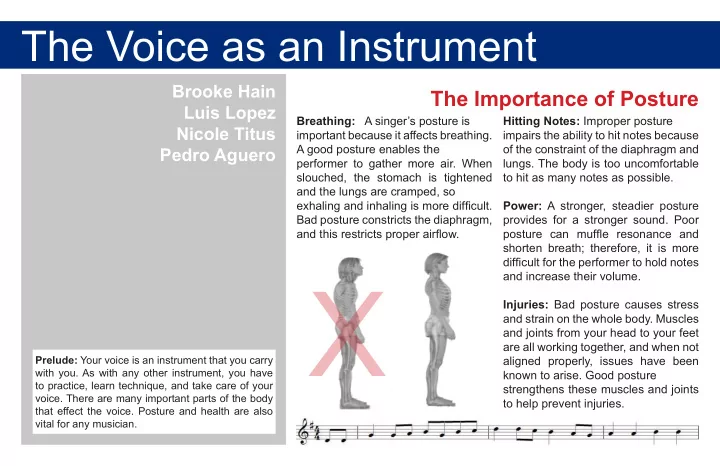
Breathing: A singer’s posture is important because it affects breathing. A good posture enables the performer to gather more air. When slouched, the stomach is tightened and the lungs are cramped, so exhaling and inhaling is more diffjcult. Bad posture constricts the diaphragm, and this restricts proper airfmow. Hitting Notes: Improper posture impairs the ability to hit notes because

  • f the constraint of the diaphragm and
  • lungs. The body is too uncomfortable

to hit as many notes as possible. Power: A stronger, steadier posture provides for a stronger sound. Poor posture can muffme resonance and shorten breath; therefore, it is more diffjcult for the performer to hold notes and increase their volume. Injuries: Bad posture causes stress and strain on the whole body. Muscles and joints from your head to your feet are all working together, and when not aligned properly, issues have been known to arise. Good posture strengthens these muscles and joints to help prevent injuries.

The Voice as an Instrument

The Importance of Posture

Brooke Hain Luis Lopez Nicole Titus Pedro Aguero

Prelude: Your voice is an instrument that you carry with you. As with any other instrument, you have to practice, learn technique, and take care of your

  • voice. There are many important parts of the body

that effect the voice. Posture and health are also vital for any musician.

X

slide-2
SLIDE 2

Hydration: Vocal cords vibrate fast so keeping them lubricated is very important. Vocal Naps: Rest your body and your vocal cords; they need it from working all day. Smoking: Not only does smoking irritate your vocal cords, but it also runs the risk of causing throat cancer. Abuse: Yelling, screaming, or loud talking can be very harmful for your

  • voice. When you notice your voice

getting hoarse it’s usually a sign that your cords are irritated, and it’s time to rest. Aging: As we age our vocal folds tend to thin, causing the folds to vibrate less, thus making speech sound shaky

  • r quiet.

Instrument Maintenance

Laryngitis: This disorder is characterized by a raspy

  • r hoarse voice due to infmammation of the vocal
  • cords. It is caused by excessive use of the voice.

Vocal Nodules: Nodules are benign growths on the vocal cords that are caused by abuse. Vocal Polyps: These are similar to blisters, and they cause a voice to be hoarse and low.

Maintaining A Healthy Voice

Vocal Cord Paralysis: This is when one or both vocal cords do not

  • pen or close as

they should. This can be life threatening as it makes swallowing very diffjcult.

Normal Vocal Cords Infmamed Vocal Cords

Vocal Cord Disorders

Relaxation: Keep your throat and neck relaxed when singing so as not to stress or strain yourself. Breath Flow: It is important to maintain a good breathing rhythm. Clearing your throat: Avoid clearing your throat too often; doing so can injure your vocal cords because it is like slamming them together. Instead, try swallowing or drinking some water when clearing your throat. Listen: Listen to how you are feeling; spare your voice when sick. Amplify: Amplifying your volume is important when directing large groups

  • f people or speaking in an open

space. Humidity: Humidify your home and singing environment because moisture is good for your voice.

slide-3
SLIDE 3

Vowel Shapes

Phonemes

Speech

Phonation: Vocal cords only produce sound; our mouths use the sound to create what we want to say or hear. Resonance is an important factor in voice production because it furnishes volume and quality; loudness is reliant on resonance rather than force.

Tongue Placements

O A E

slide-4
SLIDE 4

Music in America is inspired by a collection of sounds of the cultures that have immigrated to our country. The fjrst music in our country was the religious folk music of the Native

  • Americans. When English, French

and Spanish settlers immigrated, they brought with them choral singing and musical notation. African slaves inspired new styles of music, such as gospel and jazz. The most popular genres of American music are jazz, country, and rock and roll. ‘Simple Gifts’ was composed by Joseph Brackett in 1848. This Shaker song was written as a dance

  • song. It has been used in a wide

variety of ways throughout American

  • history. Various artists have shown

interest in the song, such as Aaron Copeland, Weezer, R.E.M, and Alison

  • Krauss. The melody can be heard in

popular culture ranging from ‘The Little House on the Prairie’ to ‘WWE Raw.’

References

Physics

Boyle’s Law: Pressure and volume are inversely related. Increasing volume causes a proportional decrease in pressure. This explains why our lung pressure decreases when we increase the volume of our lungs by expanding the rib cage and contracting the diaphragm to inhale. When we exhale, the rib cage contracts and the diaphragm relaxes, thus decreasing the lung volume and causing pressure to rise. This pressure then causes air to rush out of lungs. Bernoulli Effect: Vocal folds don’t vibrate through muscular contractions; they vibrate when pressure builds up in the lungs. When pressure is high enough, the soft tissues separate, and air stream fmows through the vocal folds. As air velocity increases, air pressure decreases. A drop in pressure sucks the vocal cords back together. Subglottic pressure continues the process; these motions are what create the air compressions and rarefactions that cause sound.

Background

A Brief History

http://www.slideserve.com/karl/anatomy-of-the-vocal- mechanism http://www.voicesource.co.uk/article/151 http://www.ncvs.org/ncvs/tutorials/voiceprod/tutorial/lung. html http://singingvoicetraining.com/science/ http://en.wikipedia.org/wiki/Simple_Gifus http://en.wikipedia.org/wiki/Music_history_of_the_ United_States http://www.drugs.com/health-guide/vocal-cord- disorders.html http://eliteathleticperformance.com/wp-content/ uploads/2013/02/bad-ideal-posture.jpg http://www.ehow.com/info_8262050_bad- efgectspoor-singing-posture.html http://www.livescience.com/4078-10-tips-healthy-voice. html http://www.hopkinsmedicine.org/healthlibrary/ conditions/otolaryngology/vocal_cord_ disorders_85,P00475/ http://img.webmd.com/dtmcms/live/webmd/ consumer_assets/site_images/media/medical/hw/ h9991587_001.jpg http://www.uofmhealth.org/sites/default/fjles/healthwise/ media/medical/hw/h9991587_002.jpg

slide-5
SLIDE 5

Anatomy

Larynx Lungs Trachea Diaphragm Nasal Concha

Inhale Exhale Exhale Inhale Exhale

Diaphragm Movement

slide-6
SLIDE 6

Physiology

Tongue Epiglottis Trachea Esophagus Larynx

(voice box)

Nasal Cavity Oral Cavity

High Range Mid Range Low Range Cartilage, Ligaments, and Muscle

Glottis Vocal Folds Vestible Fold Cartilage Epiglottis

Side Section of Larynx Top Section of Vocal Folds 3-D View of Larynx

Epiglottis Thyroid Cartilage Vestbular Ligament Vocal Ligament Thachea Cricoid Cartilage Arytenoid Cartilage Corniculated Cartilage