Worldwide The molecular mechanism underlying the development and - - PowerPoint PPT Presentation

worldwide
SMART_READER_LITE
LIVE PREVIEW

Worldwide The molecular mechanism underlying the development and - - PowerPoint PPT Presentation

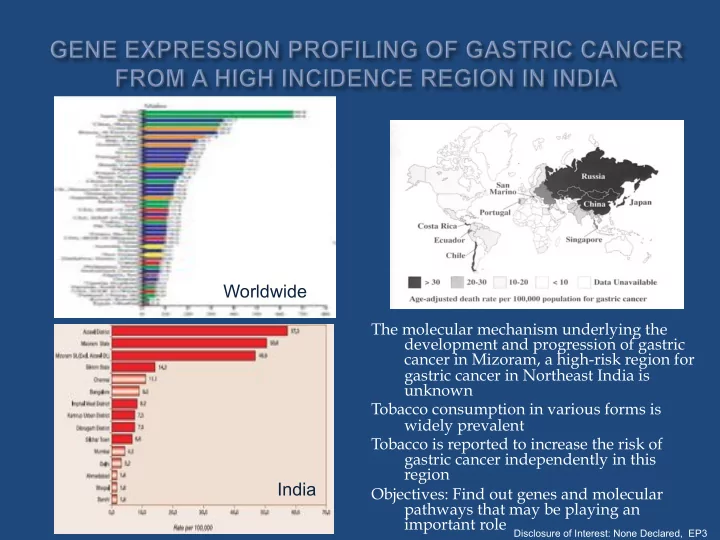
Worldwide The molecular mechanism underlying the development and progression of gastric cancer in Mizoram, a high-risk region for gastric cancer in Northeast India is unknown Tobacco consumption in various forms is widely prevalent Tobacco


slide-1
SLIDE 1

The molecular mechanism underlying the development and progression of gastric cancer in Mizoram, a high-risk region for gastric cancer in Northeast India is unknown Tobacco consumption in various forms is widely prevalent Tobacco is reported to increase the risk of gastric cancer independently in this region Objectives: Find out genes and molecular pathways that may be playing an important role Disclosure of Interest: None Declared, EP3

Worldwide India

slide-2
SLIDE 2

Pathogenesis of Gastric Ca Cornea pathway (Intestinal)

  • SNPs in PSCA gene has been

associated with diffuse gastric cancer

  • CDH1 mutation is seen in

70-90% sporadic and 10-30% familial cases

  • Targeted prevention is feasible

for high-risk subpopulation with inherited CDH1 mutation

Bacteria Bacteria Dietary Dietary

  • Tobacco

Trends in overall age standardized death rates - Europe

  • Incidence is declining
  • Early detection,

Better surgery

  • Decreased salt,

increased fruits, vegetables

  • Improved food

storage

  • Decreased smoking
  • Treatment of H.

pylori Genetic Predisposition In NE India

  • No reported decrease in incidence
  • CDH1 mutation was not found in our

earlier studies

  • Pathogenetic mechanism may be

different in NE India

EP3

slide-3
SLIDE 3

Risk factors! Cases (n=112)! Controls (n=66)! Multivariate! n (%)! n (%)! OR2 (95% CI)! P value! H.pylori Positivea! 75 (67)! 42 (64)! 1.19 (0.59-2.39)! 0.63! Tobacco Smokingb! 63 (56)! 32 (48)! 1.54 (0.79-3.02)! 0.21! Tobacco Chewingc! 77 (69)! 34 (52)! 2.11 (1.09-4.05)! 0.026! Betel-quid Chewingd! 60 (54)! 30 (45)! 1.27 (0.68-2.38)! 0.45! Alcohol Consumptione! 29 (26)! 18 (27)! 0.89 (0.42-1.81)! 0.72! ATP6V1G2, HBXIP, ACE2 CSNK1E, BMP7 JAG2, HES1 CDC2L1, JAG2, IL9

Cell proliferation Viral response

Hedgehog

signaling

RYK, SH2D2A, CSNK1E, LRP12, HSPE1,FGB, PXN, CHP RFX1,CXCL10, C3AR1, MALT1 CHP, CSNK1E, RYK CD151, PXN, WASF1 SH2D2A, ANG

Apoptosis Notch signaling Wnt signaling Immune response

Cell

adhesion Angiogenesis

Deregulated Pathways Microarray was done using

  • ligonucleotide based Cancer

OciChipsTM with tumor tissues and corresponding normals Tobacco chewers who were also

  • H. pylori positive conferred a seven fold risk

Tobacco conferred a significant increase risk

  • f upto two fold

Variables! Interaction! OR2(95% CI)! p-value! Tobacco chewingb!

  • H. pylori -ve X Non chewer!

1.0!

  • H. pylori -ve X Chewer!

3.7(1.52-9.03)! 0.004!

  • H. pylori +ve X Non chewer! 4.06(1.41-11.69)!

0.009!

  • H. pylori +ve X Chewer!

7.12(5.02-36.31)! ≤0.0001! Betel- quid chewingc!

  • H. pylori -ve X Non chewer!

1.0!

  • H. pylori -ve X Chewer!

2.01(0.76-5.31)! 0.16!

  • H. pylori +ve X Non chewer! 2.67(0.98-7.25)!

0.06!

  • H. pylori +ve X Chewer!

3.52(1.16-10.68)! 0.026!

EP3