Wong K. Snidvongs (3) Vorawit Meesuk (1) , Amnart Bali (2) & (1) - - PowerPoint PPT Presentation

wong k snidvongs 3
SMART_READER_LITE
LIVE PREVIEW

Wong K. Snidvongs (3) Vorawit Meesuk (1) , Amnart Bali (2) & (1) - - PowerPoint PPT Presentation

International Symposium on Grid Computing March 2010 Environmental Monitoring & Disaster Mitigation Lessons learned in Thailand from 2004 tsunami Wong K. Snidvongs (3) Vorawit Meesuk (1) , Amnart Bali (2) & (1) Vorawit Meesuk, Head of


slide-1
SLIDE 1

1

International Symposium on Grid Computing March 2010

Environmental Monitoring & Disaster Mitigation

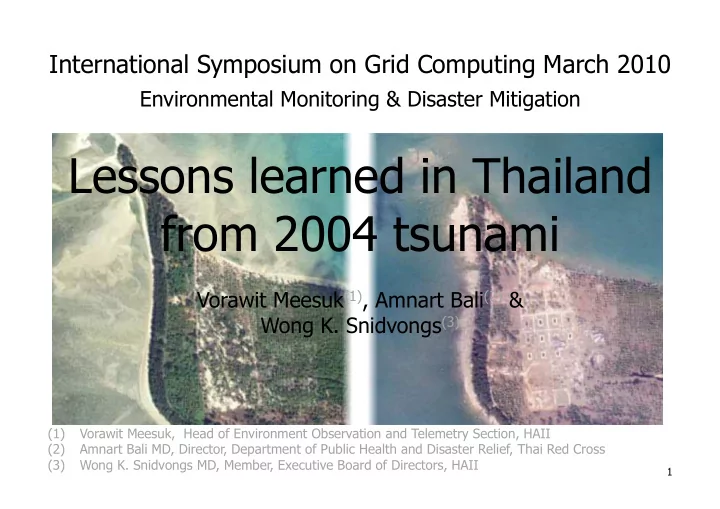
Lessons learned in Thailand from 2004 tsunami

Vorawit Meesuk(1), Amnart Bali(2) & Wong K. Snidvongs(3)

(1) Vorawit Meesuk, Head of Environment Observation and Telemetry Section, HAII (2) Amnart Bali MD, Director, Department of Public Health and Disaster Relief, Thai Red Cross (3) Wong K. Snidvongs MD, Member, Executive Board of Directors, HAII

slide-2
SLIDE 2

2

Contents

  • 1. Background information on quakes and

tsunamis.

  • 2. Tsunami’s strength and damages caused.
  • 3. Events during 26 December 2004

tsunami.

  • 4. Damages and losses.
  • 5. Monitoring systems, disaster

preparedness and mitigation at the time and at end of 2009.

slide-3
SLIDE 3

3

  • 1. Background information
  • n quakes and tsunamis

 Tsunami (harbor wave in Japanese) = seismic wave  Quakes > 7.1 from movements of continental and

  • ceanic plates, 77% in the ‘Ring of Fire’ area.

 Under ocean volcanic eruptions, subsidence of volcanic

craters, waves as high as 40 meters.

 Underwater or coastal land subsidences.  Nuclear tests, land subsides or dam bursts.  Meteorite hits in an ocean causing quakes.  Strong vertical separations of earth crusts force vast

amount of sea water to move up generating energy.

slide-4
SLIDE 4

4

Global Tsunami Distribution

NGDC/WDC Historical Tsunami Database contains:

  • 1700 Tsunami Source Events

– 77% Pacific Ocean, 7% Mediterranean Sea, 5% Indian Ocean (includes Malaysia and part of Indonesia), 5% Caribbean Sea, 3% Atlantic Ocean, 3% Red Sea and Black Sea

  • 9200 Tsunami Runup Locations

– 84% Pacific Ocean, 8% Indian Ocean (includes Malaysia and part of Indonesia), 2% Atlantic Ocean, 3% Caribbean Sea, 2% Mediterranean Sea, Red Sea and Black Sea <1%

  • Tsunami Source Distribution

– 81% Earthquakes (includes earthquake-generated landslides), 10% unknown, 5% Volcanoes, 3% Landslides, 1% combination

  • Percentages are a result of the hazard and intensive reconnaissance

studies

Events Generating Tsunami Tsunami Runup Locations

Courtesy of Paula Dunbar, 2007

Christa G. von Hillebrandt-Andrade Puerto Rico Seismic Network, UPRM with major contributions from Paula Dunbar National Oceanic and

tmospheric Administration (NOAA) National Geophysical Data Center (NGDC) World Data Center for Solid Earth Geophysics - Tsunamis Paula.Dunbar@noaa.gov
slide-5
SLIDE 5

5

  • 2. Tsunami’s strength and

damages caused

 Sea depths at source events, wave heights, coastal

profiles, ‘drag down effect’ sea receding up to 1 km.

 In deep sea, tsunami waves only 0.3-0.6 meters high,

with crests intervals of 10-120 minutes and >500 km. length of waves.

 Narrow coastal inlets mean taller waves &vice versa  Shallow coastal water reduces waves velocity.  Coral reefs, beach gradients, distance from quake  All contribute to speed and severity of devastation.

slide-6
SLIDE 6

6

Past tsunamis 1900- 2004 (before 26 December)

  • 1900 -1989, 946 occurred and 120 (14.5%) caused

widespread destruction and heavy loss of lives.

  • Approx. no.of deaths due to Asia Pacific tsunamis:

– 40,000 in South China Sea area in 1782 – 200,000 in Indian Bengal coast in 1876 – 36,500 from Krakatau eruption in 1883 – 26,400 on Japanese Honshu Island in 1933 – 1,997 in Nankaido, Japan in 1944 – 8,000 in Moro Bay, Philippines in 1974 – 2,182 in Papua New Guinea in 1994

slide-7
SLIDE 7

7

Location Date UTC Magnitude Coordinates

  • 1. Chile

1960 05 22 9.5 38.24 S 73.05 W

  • 2. Prince William Sound, Alaska

1964 03 28 9.2 61.02 N 147.65 W

  • 3. Andreanof Islands, Alaska

1957 03 09 9.1 51.56 N 175.39 W

  • 4. Kamchatka

1952 11 04 9.0 52.76 N 160.06 E

  • 5. Off the West Coast of

Northern Sumatra 2004 12 26 9.0 3.30 N 95.78 E

  • 6. Off the Coast of Ecuador

1906 01 31 8.8 1.0 N 81.5 W

  • 7. Rat Islands, Alaska

1965 02 04 8.7 51.21 N 178.50 E

  • 8. Assam - Tibet

1950 08 15 8.6 28.5 N 96.5 E

  • 9. Kamchatka

1923 02 03 8.5 54.0 N 161.0 E

  • 10. Banda Sea, Indonesia

1938 02 01 8.5 5.05 S 131.62 E

  • 11. Kuril Islands

1963 10 13 8.5 44.9 N 149.6 E

Largest earthquakes, 1900 - 2004

USGS

The M9.0 Andaman Islands-Sumatra Earthquake and Tsunami of 26 December 2004 L. Braile, Purdue University braile@purdue.edu, www.eas.purdue.edu/~braile

slide-8
SLIDE 8

8

  • 3. Events during

26 December 2004 tsunami

  • Quakes at 3.298 degree north and

95.778 degree east N/W of Sumatra Island, Indonesia at depth of 30 km.

  • Quakes’ centre 580 km. from Phuket on

Thai Andaman coast and 1,260 km. from Bangkok, severity of 9.3 occurring at 6.58 am. Local time.

  • Quakes caused by collision of Indian

and Myanmar plates over Sunda Trench near the Australian plate.

  • Vertical subsidence of ocean floor
  • ccurred causing a crack 1,200 km.

long parallel to the Sunda Trench from NW Sumatra Island reaching north to the Andaman group of Islands.

slide-9
SLIDE 9

9

2nd largest of the world tsunamigenic earthquakes record in historical time

ผลกระทบทางธรณีวิทยาและกายภาพจากสึนามิ เมื่อวันที่ 26 ธันวาคม 2547 Chulalongkorn Tsunami Research Team, Department of Geology, Faculty of Science, 28-29 July 2005

USGS

slide-10
SLIDE 10

10

Sequence of events in affected area of Thailand

Thailand’s time (GMT+7)

  • 7.58 am.- Quakes N/W of Sumatra Island
  • 9.35 am.- ‘drag down’ effect seen in Phuket and Pangnga
  • water receding for 100 meters from shoreline.
  • 9.40 am.- 2-3 meters high waves arrived
  • 9.45 am.- 6-7 meters high waves arrived
  • 10.05 am-.>10 meters high waves hit for 20 minutes
  • 10.25 am.-> 5 meters high waves caused 1 hour

flooding

  • 12 noon - sea level back to normal
slide-11
SLIDE 11

11

4 .Damages and losses

  • n Thailand’s Andaman coast

 Six provinces affected, damages in 407 villages,

12,000 families and 58,550 people suffered, died, or missing.

 No. of deaths 5,395, missing 2,817, injured

8,457

 Financial losses from business and earning

disruption approx. 15 billion baht (35 baht = 1 US dollar)

 Damages to public facilities = 1.058 billion baht

slide-12
SLIDE 12

12

Sunday 26 December 2004 (GMT) 00.57 - 9.0 magnitude earthquake occurs

  • n the seafloor near Ache in northern Sumatra

01.10 - Wave hit Sumatra coast (10-15 min.) Clock on Mosque, Banda Ache stops at 08.20 local time 02.30 - Sri lanka was hit by wave (report at 8.30 local time) 02.45 - Phuket, Coast of Thailand: The sea retracts before a big wave around 10.00 a.m. local time. Indian’s eastern Coastline: 04.00 - Male, Maldives: about 9.00 a.m. the capital of Male and other parts were flooded. 09.45 (12.45 local time) Tsunami hits Dar es Salam, Tanzania, East Africa.

Proposal for cooperation with countries surrounding the South China Sea in issues of earthquake monitoring and tsunami warning Bor-Shouh Huang, Chun-Chi Liu, Yue-Gau Chen, Wen-Tzong Liang and Wen-Gee Huang The 2004 Sumatra tsunami : Deaths and damages to buildings at the Kamala beach, Phuket, Thailand, Srivichai,S., Chidtong, Y., Supratid, S., and Shuto, N.

NOAA

http://ww

Runup Time

slide-13
SLIDE 13

13

Courtesy of NASA Sea Surface Height From Space 12/26/04 US/France Jason

Sea Surface Height

EARTHQUAKES & TSUNAMIS Frequently Asked Questions & 12/2004 Asian Event Ellen Prager, PhD StormCenter Communications, Inc.

slide-14
SLIDE 14

14

Tsunami heights measured @ Andaman Sea Coast, Thailand.

The 2004 Indian tsunami in Thailand: Surveyed runup heights and tide gauge Records Yoshinobu Tsuji1, Yuichi Namegaya1, Hiroyuki Matsumoto2, Sin-Iti Iwasaki3, Wattana Kanbua4, Mongkonkorn Sriwichai5, and Vorawit Meesuk6

slide-15
SLIDE 15

15

Date UTC Magnitude Max Ht Killed Location Comments 1992 09 02 7.2 10 m 170 Nicaragua Measured Pacific-wide 1992 12 12 7.5 26 m 1000 Flores Island 1993 07 12 7.6 30 m 200 Hokkaido 1994 06 02 7.2 14 m 220 Java 1994 10 04 8.1 11 m 11 Kuril Islands Measured Pacific-wide 1994 11 14 7.1 7 m 70 Mindoro 1996 02 21 7.5 5 m 12 Peru 1998 07 17 7.0 15 m 2000 New Guinea 2001 06 23 8.3 5 m 50 Peru Measured Pacific-wide

Some recent Tsunami 1992-2001

NOAA

The M9.0 Andaman Islands-Sumatra Earthquake and Tsunami of 26 December 2004 L. Braile, Purdue University braile@purdue.edu, www.eas.purdue.edu/~braile

slide-16
SLIDE 16

Conclusion: Earthquake magnitude does not determine tsunami impact.

Date Location Magnitude Early Warning? Fatalities 26 Dec 2004 Sumatra 9.2 No Tsunami death~230,000 28 Mar 2005 19 July 2005 Nias Island North California 8.7 7.7 Panic evacuation False alarm Evacuation killed ~100 No tsunami 27 Jan 2006 3 May 2006 19 July 2006 15 Nov 2006 Benda Sea Tonga South Java Kuril Islands 7.6 8.0 7.7 8.3 ? False Alarm No False alarm/alert No tsunami No tsunami Tsunami death~730 Small tsunami 13 Jan 2007 1 Apr 2007 15 Aug 2007 12 Sep 2007 Kuril Islands Solomon Island Central Peru South Sumatra 8.1 8.0 8.0 8.4 False alarm/alert No Alert Alert No tsunami Tsunami death~54 No tsunami No tsunami

Recent Tsunami Events 2004-2007

GPS Requirements for Tsunami Detection Y. Tony Song & Geoff Blewitt

slide-17
SLIDE 17

17

5 . Monitoring systems, disaster preparedness and mitigation

at the time and at end of 2009

Tools: Seismic Station

  • Broadband Seismic Stations, Taiwan
  • THAILAND Seismic Network
slide-18
SLIDE 18

18 18

Strong Motion Array TSMIP: Taiwan Strong-motion Instrumentation Program Free-field strong-motion station: 708

slide-19
SLIDE 19

19

THAILAND SEISMIC NETWORK, TMD

กรมอุตุนิยมวิทยา

slide-20
SLIDE 20

20

Lessons learned in Thailand

 Relay of data, formulated to information, timely warning, alert and

evacuation orders seemed possible especially for targets beyond Thailand.

 Evacuation routes, practices and depots of supplies for the first 24

hours are essential mitigation measures.

 Specially trained search and rescue teams at village  levels are vital. Back up medical teams at local hospitals.  Efficient logistics for relief supplies and personnel needed for large

scale disasters very important.

 Search and identification of victims must be systematic, professional

and of international standard.

 Communities’ participation in relief operations helped console

victims and relatives.

 Rehabilitation measures both physical and mental must be

sustained.

slide-21
SLIDE 21

21

Summary of assistance

 Immediate response by local authorities.  Disaster area in all six provinces declared.  Food, water, shelter, clothing distribution in place

and adequate within 12 hours.

 Field surgical teams from the Red Cross, medical

faculties in Bangkok deployed within 24 hours to help local hospitals.

 Search and identification of victims by forensic

teams were difficult because of delay in recovering bodies as well as lack or loss of personal records

slide-22
SLIDE 22

22

Discussion points

 When and where the next big quake will hit ?  Are the present monitoring and warning systems

adequate ?

 If not what are our improvement priorities ?  Do disaster preparedness and mitigation

measures have negative impacts on tourism industry and deter investments on major public utilities such as building hydroelectric dams ?