WLE: The Nile Basin and East Africa Focal Region Dr. Simon Langan - - PowerPoint PPT Presentation

wle the nile basin and east africa focal region
SMART_READER_LITE
LIVE PREVIEW

WLE: The Nile Basin and East Africa Focal Region Dr. Simon Langan - - PowerPoint PPT Presentation

WLE: The Nile Basin and East Africa Focal Region Dr. Simon Langan WLE Regional Program in the Ganges WLE Nile Focal Regional Co ordinator What is WLE? A global Research for Development programme 11 Partners, led by the International


slide-1
SLIDE 1

WLE Regional Program in the Ganges

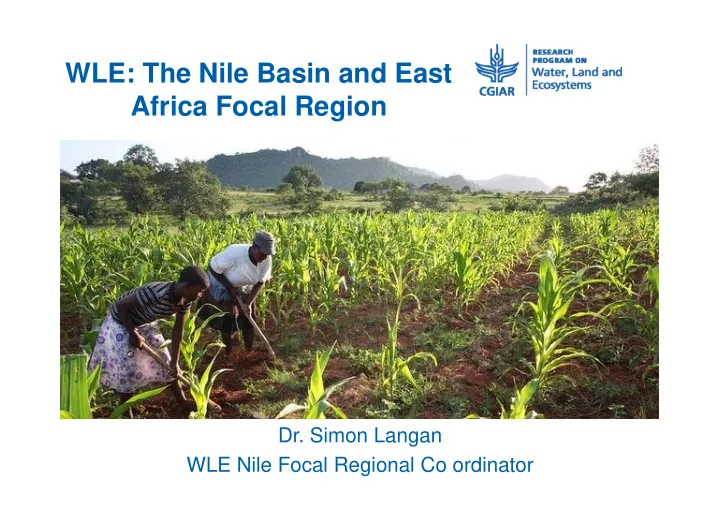
WLE: The Nile Basin and East Africa Focal Region

  • Dr. Simon Langan

WLE Nile Focal Regional Co ordinator

slide-2
SLIDE 2

Uniting agriculture and nature for poverty reduction

What is WLE?

  • A global Research for Development programme
  • 11 Partners, led by the International Water Management

Institute A healthy functioning ecosystem is seen as a prerequisite to sustainable agricultural development, resilience of food systems and human well-being.

  • Ecosystem Services lens: promoting new, integrated

approach to sustainable development

slide-3
SLIDE 3

Uniting agriculture and nature for poverty reduction

WLE: Conceptually

  • Ecosystem and services approach for sustainability:
  • Provisioning
  • Regulating
  • Cultural
  • Supporting
  • Providers and consumers differ in space and time
  • Not blue water but path of raindrop
  • Takes/Needs:
  • Demand driven
  • Integrated/ transdisciplinary approach
  • Capacity building
  • Primary data
  • Analysis
  • Communication and dissemination at scale
slide-4
SLIDE 4

Uniting agriculture and nature for poverty reduction

Unique Selling Points

  • Ecosystems as the foundation for agriculture productivity,

sustainable land &water management, equity, livelihoods & prosperity

  • Working across sectors to provide integrated solutions to

reverse land and water degradation

  • We combine an ecological & natural resource

management approach to build resilience = Integrated

  • Not protecting ecosystem for the sake of the ecosystem
  • Support human development by working with

ecosystems and people

slide-5
SLIDE 5

Uniting agriculture and nature for poverty reduction

WLE Program Structure

Figure 1: Program structure and theory of change

slide-6
SLIDE 6

Uniting agriculture and nature for poverty reduction

Integrating Ecosystem Solutions Into Policy & Investments

Critical Issues

  • National & regional issues

addressed in integrated manner

  • Supporting development through

sound economic investments. Key areas of work

  • The Nile and East Africa
  • The Volta/Niger
  • The Greater Mekong
  • The Ganges
  • The Innovation Fund

LEADER: Nathanial Matthews

slide-7
SLIDE 7

Uniting agriculture and nature for poverty reduction

Gendered Approach

Move away from:

  • Women produce < men

(23- 66%)

  • Cause unequal access to

inputs (fertilizer, information and labour, credit, education)

  • What of next generation

and youth?

slide-8
SLIDE 8

Uniting agriculture and nature for poverty reduction

Nile Basin and East Africa

  • Rapidly expanding economies reliant on

agriculture

  • Still persistent food insecurity
  • Different Farming systems
  • Pastoralists
  • Rainfed
  • Irrigation
  • FDI, energy……
slide-9
SLIDE 9

Uniting agriculture and nature for poverty reduction

Nile issues root causes

  • Poor land use planning
  • Poor water management
  • Poor land management
  • Limited access to resources
  • Low capacity human/knowledge
  • Equal access to all of society
  • Lack of policy development and implementation
  • Reduction in ecosystem function
  • Unsustainable natural resources use
slide-10
SLIDE 10

Uniting agriculture and nature for poverty reduction

Nile Basin and East Africa

Priority activities:

  • Understanding and minimizing the trade-offs in ecosystem

services from agricultural and infrastructure development

  • Achieving sustainable land management in degradation hot

spots

  • Strengthening equity and the role of women and youth in the

sustainable intensification of agriculture and ecosystem management

slide-11
SLIDE 11

Uniting agriculture and nature for poverty reduction

Towards Outcomes

  • Change in practice: At least one other CRP will have adopted a more

inclusive systematic approach to ecosystem services thinking greater than plant/field up to community, landscape and basin scales. This will happen within 2-5 years.

  • Policy development/amendment: The NBI is using WLE tools and

forums in their analysis planning and communication to affect policy change across the Nile Basin, specifically the consideration of selected ecosystem services and gender aspects of the policy will be

  • targeted. This will happen within 5 years.
  • Capacity building: More than 10 national universities/research
  • rganizations within the Nile will be using WLE generated knowledge,

tools and publications which highlight the role of women and youth in natural resource management. This will occur within 3-5 years.

slide-12
SLIDE 12

Uniting agriculture and nature for poverty reduction

WLE at Scale

slide-13
SLIDE 13

Uniting agriculture and nature for poverty reduction

Users

  • National Governments
  • Donors – USAID, World Bank, EU, BMGF, AU, FAO, IFAD
  • Investors – World Bank, Foundations, AU, Private

Companies, NGOs, GIZ

  • International Policy – UNEP, UNECA, UNDP, IUCN, EAC
  • Research – sub-national, national, international
  • Capacity – universities, ASARECA, Kilimo Trust,

UNESCO-IHE

  • Others – Agricultural advisory boards, EAC, SAGCOT,

General Public, Lake Victoria Commission, Nile Basin Initiative (ENTRO/RBAs), other CRPs (Humidtropics, CCAFS, Drylands) and regions of WLE

slide-14
SLIDE 14

Uniting agriculture and nature for poverty reduction

Nile Basin and East Africa Projects (1 of 2)

1. Agrobiodiversity for ecosystem service restoration in Ethiopia Led by Bioversity International 2. Using rangeland management to create resilient livelihoods in Ethiopia Led by Global Institute of Sustainability, Arizona State University 3. Sustaining Land Management Interventions through Integrating Income Generating Activities, Addressing Local Concerns and Increasing Women’s Participation Led by Amhara Regional Agricultural Research Institute 4. Nile Ecosystems Valuation for wise-Use Led by Makerere University, Uganda

slide-15
SLIDE 15

Uniting agriculture and nature for poverty reduction

Nile Basin and East Africa Projects (2)

5. Accounting for Nile waters: Connecting investments in large scale irrigation to gendered reallocations of water and labor in the Eastern Nile Basin Led by UNESCO-IHE 6. Water, Land and Ecosystems and Trade in Staples (WaLETS): using regional trade in staples for equitable food and nutrition security and ecosystems services in the EAC Led by Kilimo Trust 7. Laying the foundations for effective landscape-level planning for sustainable development in the SAGCOT corridor: Sumbawanga agricultural development cluster Led by The Nature Conservancy 8. Harnessing Floods to Enhance Livelihoods in Ecosystem Services Led by Spate Irrigation Network Foundation

slide-16
SLIDE 16

Uniting agriculture and nature for poverty reduction

Projects to Nile and Global programme

  • 8 Supplemented by CG research projects and Innovation Fund work
  • Influencing investments
  • Providing evidence
  • Consider/frame by Ecosystem Services
  • Role of women and youth

Expectations and support- promoting ES/gender/lessons learned

  • Reports on progress (issues, highlights)
  • Videos/photos/meetings
  • Wiki/web/blog/newsletter- internal/external
  • Publication / promotion material
  • Stakeholder engagement and awareness raising
  • Regional stakeholder workshop
slide-17
SLIDE 17

Uniting agriculture and nature for poverty reduction

WLE staff structure and support

Nile

  • Simon Langan co-ordinator
  • Zadoc Ogutu- manager
  • Abby Waldorf- comms
  • Desalegne Tadesse- uptake
  • Gender- tba
  • Fred Kizito-ESS
  • Yemisrach Regassa- support

Programmatic

  • Andrew Noble
  • Nate Matthews
  • Emma Greatrix
  • Nicoline de Haan
  • Michael Victor
  • David Rider-Smith
  • Mala Ranawake
  • (Fabrice de Clerk)
slide-18
SLIDE 18

WLE Regional Program in the Ganges

wle.cgiar.org/focal-regions/east-africa

slide-19
SLIDE 19

Uniting agriculture and nature for poverty reduction

Dinner after thoughts for discussion

  • Format/time/location of Ethiopia WLE stakeholder

information meeting

  • Gender tool
  • Utility of soil as an integrating ecosystem

component

  • Other support from WLE
  • Use of capacity building and start up project

money