With your IT Ops Mission Using Kanban Dominica DeGrandis - - PowerPoint PPT Presentation

with your it ops mission using kanban
SMART_READER_LITE
LIVE PREVIEW

With your IT Ops Mission Using Kanban Dominica DeGrandis - - PowerPoint PPT Presentation

Balancing Dev Agility With your IT Ops Mission Using Kanban Dominica DeGrandis @Dominicad Cycle of Frustration TOO MUCH WORK! THINGS TAKE TOO LONG! CONFLICTING THERES NO VISIBILITY PRIORITIES When everything is a priority 1


slide-1
SLIDE 1

¡

Dominica DeGrandis @Dominicad

¡

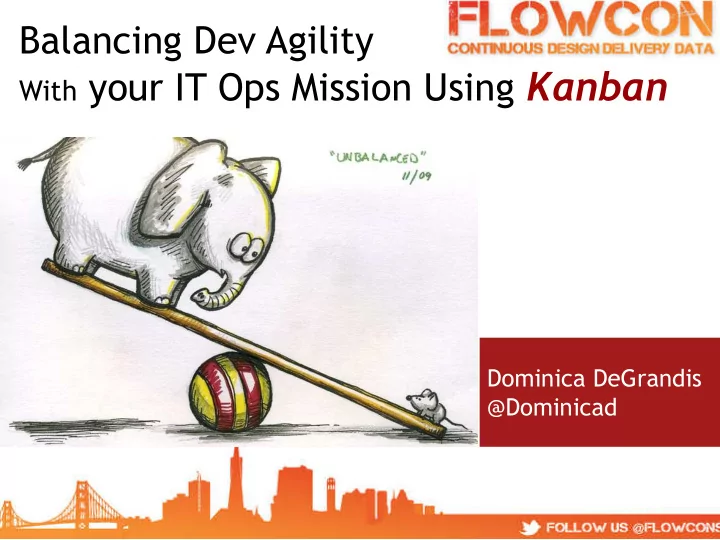
Balancing Dev Agility

With your IT Ops Mission Using Kanban
slide-2
SLIDE 2

Cycle of Frustration

THINGS TAKE TOO LONG! THERE’S NO VISIBILITY TOO MUCH WORK! CONFLICTING PRIORITIES

slide-3
SLIDE 3

When everything is a priority 1

slide-4
SLIDE 4

Context switching is expensive. And irritating!

because ...

  • Multitasking “stop & go” breaks the on-a-roll flow.
  • Churn and rework create waste.
slide-5
SLIDE 5

Kanban practices

  • 1. Make work visible
slide-6
SLIDE 6

Validate On Deck Implement Closed Prep doing

Xpedites

  • Misc. ¡

Project Project B Project A

Prep done ¡ ¡

Incident

(live issue, security breach)

Bringing visibility to Ops work

Project C CODB ¡

because ...

  • It’s hard to manage invisible work.
  • Humans absorb info faster visually than any other sense.
  • Visualization helps us see patterns ¡& ¡connections that matter.
slide-7
SLIDE 7

When the front end gets fixed without addressing the backend.

slide-8
SLIDE 8

Kanban practices

  • 1. Make work visible
  • 2. Limit work-in-progress
slide-9
SLIDE 9

Validate On Deck Implement Closed Prep doing

Xpedites

  • Misc. ¡

Project Project B Project A

Prep done ¡ ¡

Incident

(live issue, security breach)

Bringing limits to amount of work in play

Project C CODB ¡

96 3 10 3 8 6 4 5

because ...

  • Knowledge work is perishable.
  • Churn and rework create waste.
  • Increased cycle time increases cost.
slide-10
SLIDE 10

Time weighs heavily on heroes

I ¡CAN’T ¡HOLD ¡ ON ¡MUCH ¡ ¡ LONGER ¡

slide-11
SLIDE 11

Kanban practices

  • 1. Make work visible
  • 2. Limit work-in-progress
  • 3. Make process policies explicit
slide-12
SLIDE 12

Rules contribute to flow

slide-13
SLIDE 13

Infrastructure contributes to congestion

slide-14
SLIDE 14

Consider options that allow for improved flow

Roundabouts decrease “stop & go” increasing throughput by 20%. What rules would increase Ops throughput?

¡

slide-15
SLIDE 15

Ops workflow sample rules

Validate On Deck Implement Closed Prep doing

Xpedites

Misc ¡ Project

done

  • InfoSec
  • Arch
  • CAB

Items in backlog remain uncommitted and un- prioritized until there is capacity to absorb them.

¡

Prep done

Prioritized work limited to available capacity

¡ ¡

Auto closed > 5 days

Backlog

Address at Ops Review

slide-16
SLIDE 16
  • Quan&fy ¡cost ¡of ¡delay ¡–Calculate ¡missed ¡revenue ¡

(new ¡revenue ¡or ¡protecDng ¡exisDng ¡revenue) ¡

  • Incurred ¡costs ¡(staff, ¡data ¡centers, ¡vendors) ¡or ¡

fines/penalDes ¡(regularity, ¡contractual) ¡SOX ¡

  • compliance. ¡Sum ¡of ¡cost ¡of ¡delay ¡of ¡other ¡projects ¡

(oSen ¡missed) ¡ ¡ ¡ hTp://focusedobjecDve.com/cost-­‑of-­‑delay/ ¡

Calculating Cost of Delay

¡

Troy Magennis - http://focusedobjective.com/cost-of-delay/

slide-17
SLIDE 17

Kanban practices

  • 1. Make work visible
  • 2. Limit work-in-progress
  • 3. Make process policies explicit
  • 4. Measure flow
slide-18
SLIDE 18

Measure workflow

Validate On Deck Implement Closed Prep doing

Xpedites

Misc. ¡ Project

Prep done/ Approved

¡ ¡

because ...

  • Historical cycle time provides ability to set customer expectations.
  • Discovering where and why work gets bottlenecked is useful.
  • Looking at trends over time reveals improvement (or not).
slide-19
SLIDE 19

How long has work been idle?

0 ¡ 1 ¡ 2 ¡ 3 ¡ 4 ¡ 5 ¡ 6 ¡ 7 ¡ 8 ¡ 9 ¡ 10 ¡ 10 ¡ 20 ¡ 30 ¡ 40 ¡ 50 ¡ 60 ¡ 70 ¡ 80 ¡ 90 ¡ 120 ¡ 150 ¡ 180 ¡ 210 ¡ 240 ¡ 270 ¡ 300 ¡ More ¡ # ¡of ¡&ckets ¡ # ¡days ¡work ¡si5ng ¡in ¡Implementa&on ¡

slide-20
SLIDE 20

Rate of incoming vs. outgoing

slide-21
SLIDE 21

Measure for objectivity

slide-22
SLIDE 22

Kanban practices

  • 1. Make work visible
  • 2. Limit work-in-progress
  • 3. Measure flow
  • 4. Make process policies explicit
  • 5. Develop feedback loops
slide-23
SLIDE 23

OpportuniDes ¡to ¡hear ¡and ¡to ¡be ¡heard ¡

Lean Coffeehttp://leancoffee.org/

slide-24
SLIDE 24

Operations Review ¡

Reflect on quantitative performance measures

slide-25
SLIDE 25

Quantitative performance measures

  • WIP (work-in-progress)
  • Cycle time/Lead time
  • Throughput
  • Quality
  • Issues & blocked work

Trend & Variability

Across: ¡

slide-26
SLIDE 26

Kanban practices

  • 1. Make work visible
  • 2. Limit work-in-progress
  • 3. Measure flow
  • 4. Make process policies explicit
  • 5. Develop feedback loops
  • 6. Evolve Experimentally using models

& theory

slide-27
SLIDE 27

Experiment with applicable models & theory

slide-28
SLIDE 28
slide-29
SLIDE 29

www.ddegrandis.com Kanban for Devops & IT Ops dominica@ddegrandis.com

¡

Balance Dev Agility with your IT Ops Mission Using Kanban

¡

Dominica DeGrandis @Dominicad

¡