Why identity and relationships matter? Dr Jason Paul Mika | e: - - PowerPoint PPT Presentation

why identity and
SMART_READER_LITE
LIVE PREVIEW

Why identity and relationships matter? Dr Jason Paul Mika | e: - - PowerPoint PPT Presentation

Mori enterprises: Why identity and relationships matter? Dr Jason Paul Mika | e: j.p.mika@massey.ac.nz Guest lecture at Principles of Indigenous Economics AIS 426A/526A, American Indian Studies taught by Professor Ron Trosper, 3:00 pm


slide-1
SLIDE 1

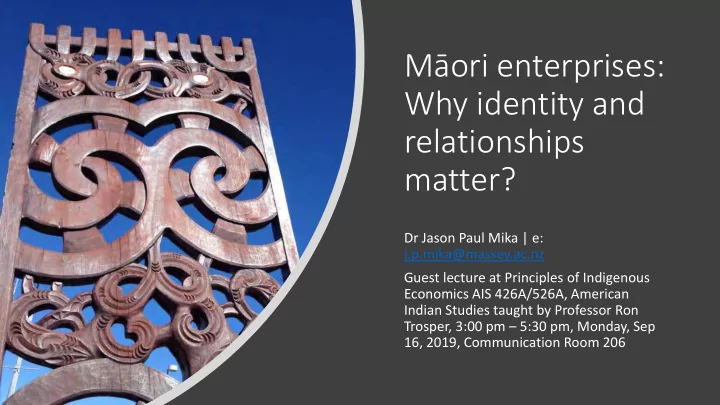
Māori enterprises: Why identity and relationships matter?

Dr Jason Paul Mika | e: j.p.mika@massey.ac.nz Guest lecture at Principles of Indigenous Economics AIS 426A/526A, American Indian Studies taught by Professor Ron Trosper, 3:00 pm – 5:30 pm, Monday, Sep 16, 2019, Communication Room 206

slide-2
SLIDE 2

Ōhinemataroa is my river Waikirkiri is my marae Maungapōhatu is my mountain Mika Te Tawhao is my ancestor

20-Aug-20 2

Tūhoe is my tribe

slide-3
SLIDE 3

Wisdom of my elders

20-Aug-20

3

slide-4
SLIDE 4

Overview

  • Māori identity and relationships
  • Māori social structure and organisation
  • Māori economic development
  • Māori identity and enterprise collaboration
  • Māori identity and entrepreneurship

20-Aug-20 4

slide-5
SLIDE 5

Māori world view

  • Key Māori concepts
  • Rangi and Papa and their
  • ffspring
  • Whakapapa (genealogy)

principle

  • Interconnectedness of all

things

  • Wairua (spirituality), tapū

(sacredness)

  • Mauri (life force)

20-Aug-20 5

slide-6
SLIDE 6

Māori social structure

Whānau generally means to “be born” (Mead, 2004, p. 212). Whānau “share common descent and kinship, as well as collective interests that generate reciprocal ties and aspirations” (Durie et al, 2010, p. 12). Hapū means “to be pregnant” (Williams, 2004, in Mead, 2004, p. 213), but “consists generally of more than one whānau…bound by strong kinship ties” (the whakapapa principle). Iwi means “bone” or “tribe (Mead, 2004, p. 219), a collection of subtribes who formed alliances for political, economic and defence purposes.

6

Whānau Hapū Iwi

slide-7
SLIDE 7

Māori economic development

Māori entrepreneur

Identity, indigenous entrepreneurial capabilities

Māori enterprise

Identity, definition and enterprise development

Māori economy

Identity, nature, measurement, development and growth

Māori development

Identity, self-determination, wellbeing, potential, freedom

20-Aug-20 7

Premises

  • 1. Entrepreneurs – Identify as Māori with cultural connections to past/present/future
  • 2. Enterprises – Diverse forms of enterprise and assets, developing as Māori enterprises
  • 3. Economy – Māori economy is integrated, growing, but fragmented, undercapitalised and stretched
  • 4. People – Collective identity, wellbeing, potential, freedom represent meaningful means and ends
  • 5. Support – Assistance not designed by/with and for Māori, uptake is low and not attunded to Māori
slide-8
SLIDE 8

Māori tribal organisation

A Māori organisation is

  • ne “where the identity,

values and ownership of an organisation are predominantly Māori, and whose activities produce benefits for the

  • rganisation’s members

and others”

(Mika & O’Sullivan, 2014, p. 655)

20-Aug-20 8

slide-9
SLIDE 9

What is the Māori economy?

“the assets owned and income earned by Māori – including collectively-owned trusts and incorporations, Māori-owned businesses (e.g., tourism, broadcasting, and the self-employed), service providers (especially in health and education), and the housing owned by Māori [and the] wages and salaries earned by Māori workers.” (NZIER, 2003, p. 7)

20-Aug-20 9

slide-10
SLIDE 10

Māori economy: Selected literature

20-Aug-20 10

slide-11
SLIDE 11

Is Māori economic growth sufficient?

20-Aug-20 11

slide-12
SLIDE 12

Māori enterprises

20-Aug-20 12

Source: BERL 2011 www.berl.co.nz

slide-13
SLIDE 13

Māori industries

20-Aug-20 13

slide-14
SLIDE 14

Why define Māori enterprise?

20-Aug-20 14

slide-15
SLIDE 15

What is a Māori enterprise?

20-Aug-20 15

slide-16
SLIDE 16

Māori enterprise

20-Aug-20 16

slide-17
SLIDE 17

Māori identity and enterprise collaboration

1 7

20-Aug-20

slide-18
SLIDE 18

Māori enterprise collaboration

Collaboration Active Management Good Governance Enterprise Performance

20-Aug-20 18

slide-19
SLIDE 19

Collaboration

  • Common agenda
  • Mutually reinforcing

activities

  • Continuous

communication

  • Backbone

infrastructure

  • Shared measures of

success

19 20-Aug-20

slide-20
SLIDE 20

Reasons to collaborate

20 20-Aug-20

slide-21
SLIDE 21

Collaboration: A Māori view

20-Aug-20 21

slide-22
SLIDE 22

22 20-Aug-20

slide-23
SLIDE 23

Māori entrepreneurship

  • A Māori entrepreneur is a

person who identifies as Māori and engages in entrepreneurial activity according to a Māori world view, but integrates within this, elements of a Western world view.

20-Aug-20 23

slide-24
SLIDE 24

A Māori way of doing business

  • Culture, identity and

socialisation as Māori

  • Self-determination,

potentiality and freedom

  • Māori enterprise ownership

and values

  • Duality, collectivism,

permanence and intergenerationality

  • Integrate Māori and Western

world views

20-Aug-20 24

slide-25
SLIDE 25

20-Aug-20 25