Why FP matters to Credit Suisse Hundreds of thousands of live - - PowerPoint PPT Presentation

why fp matters to credit suisse hundreds of thousands of
SMART_READER_LITE
LIVE PREVIEW

Why FP matters to Credit Suisse Hundreds of thousands of live - - PowerPoint PPT Presentation

Why FP matters to Credit Suisse Hundreds of thousands of live derivative trades Nightly risk run calculates value and sensitivity Computationally expensive numerical methods usually requires Our overnight run employs


slide-1
SLIDE 1

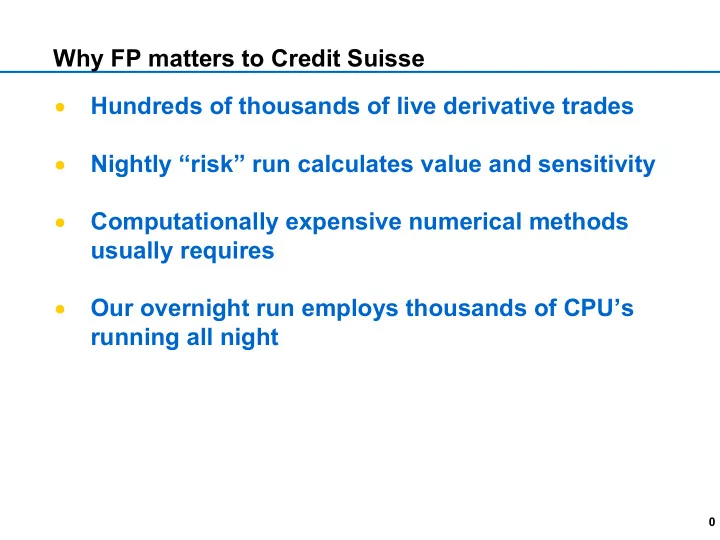
Why FP matters to Credit Suisse

  • Hundreds of thousands of live derivative trades
  • Nightly “risk” run calculates value and sensitivity
  • Computationally expensive numerical methods

usually requires

  • Our overnight run employs thousands of CPU’s

running all night

slide-2
SLIDE 2

1

Why FP matters to Credit Suisse

  • A decent proportion of our trades are non-vanilla
  • We build these “exotic” models by composing

reusable model components

  • Thousands of these components are glued

together to produce something large

  • System must be very robust and reliable
  • Non-obvious interaction of components can kill

us!

slide-3
SLIDE 3

2

The solution…

“The world’s most popular function programming language...*”

Microsoft Excel Microsoft Excel

* According to Simon Peyton Jones, et al * According to Simon Peyton Jones, et al

slide-4
SLIDE 4

3

The solution… Excel Excel C++ Analytics C++ Analytics

slide-5
SLIDE 5

4

Excel Pros:

  • A rapid development environment – instant results
  • I can call analytic functions that I have built elsewhere
  • Excel does incremental recalculation
  • Functions must be side-effect free so I can compose

disparate functionality and get something that works

  • The Excel grid provides a reasonable user interface (with a

little effort)

  • We can pass around non-native data types by passing

around a handle to the object

slide-6
SLIDE 6

5

Excel Cons:

  • A 0th order functional programming language
  • We have no…

!

abstraction

!

encapsulation

!

modularisation

  • Lots of duplication of logic
  • Very weak type system – number, string, boolean, error
  • UI is mixed with model internals – nothing is hidden
  • We have to run it inside Excel
slide-7
SLIDE 7

6

Solution #1:

  • Address Excel’s issues by introducing our own

functionality

!

Introduce abstraction/encapsulation

!

Layer our own type system on top

!

Encourage appropriate factorisation

!

Provide (limited) ability to run outside Excel

  • And then we discovered that we were trying to

build a functional programming language

slide-8
SLIDE 8

7

Solution #1 now:

  • We went looking for people with experience of

implementing functional programming languages

!

Hired Lennart Augustsson and Gabriele Keller

  • Our toolset has improved dramatically
  • Haskell has proved to be an excellent language for

implementing these kind of tools

!

Graph processing, type checking, code generation, etc.

!

Haskell only used by a handful of people

slide-9
SLIDE 9

8

Solution #2 Excel Excel Excel Excel FP FP C++ Analytics C++ Analytics

slide-10
SLIDE 10

9

Solution #2:

  • Use a real functional programming language
  • Haskell is a good fit, other FP’s are also promising

!

The C++ code exposed to Excel is side-effect free, functional in nature.

!

Maps into Haskell libraries extremely well.

!

We have already separated the core logic of our Excel addins from the Excel interfacing.

  • Haskell could replace a large proportion of what we do in

Excel

  • Replacing the C++ is a much harder sell
slide-11
SLIDE 11

10

Haskell Pros:

  • A natural progression from Excel, in some respects
  • Side-effect free functions integrate nicely into Haskell’s type system

!

And we can now handle our side-effecting I/O functions properly

  • Expressive type system

!

More errors caught at compile time

!

But people are used to the automatic coercions

  • Terse syntax
  • Higher-order functions etc. very powerful
  • Claimed to be natural for mathematicians but yet to be proven
  • Should be more suitable for writing multi-threaded code
slide-12
SLIDE 12

11

Haskell Cons:

  • Lots of new concepts to learn
  • Laziness makes space performance difficult to predict
  • Terse syntax
slide-13
SLIDE 13

12

Haskell Wish List:

  • Toolset appears “primitive”, not user-friendly

!

Most modellers are used to Visual Studio IDE

  • Unfamiliar/inadequate “debugging” environment

!

Modellers used to VS graphical debugger, or Excel’s immediate evaluation capabilities.

  • Performance for numerical code

!

Not heavily tested but ghc is not really tuned for this

  • Better XML processing tools

!

We have been using haxml

  • Microsoft interop

!

H/Direct needs a little work

!

.Net interop would be very useful

slide-14
SLIDE 14

13

Haskell Wish List: DLLs

  • Packaging into DLLs:

!

Runtime/libraries in DLLs

!

Memory mgmt

!

Versioning

!

Some runtime issues

slide-15
SLIDE 15

14

A shameless plug:

  • What can you the FP community do for us?

!

Come and work for us!

" Email howard.mansell@credit-suisse.com, or come and talk

to one of us today.

!

Address the Haskell wish list for us.

slide-16
SLIDE 16

15 CS does not provide any tax advice. Any tax statement herein regarding any US federal tax is not intended

  • r written to be used, and cannot be used, by any taxpayer for the purpose of avoiding any penalties. Any

such statement herein was written to support the marketing or promotion of the transaction(s) or matter(s) to which the statement relates. Each taxpayer should seek advice based on the taxpayer's particular circumstances from an independent tax advisor.

These materials have been provided to you by Credit Suisse ("CS") in connection with an actual or potential mandate or engagement and may not be used or relied upon for any purpose other than as specifically contemplated by a written agreement with CS. In addition, these materials may not be disclosed, in whole or in part, or summarized or otherwise referred to except as agreed in writing by CS. The information used in preparing these materials was obtained from or through you or your representatives or from public sources. CS assumes no responsibility for independent verification of such information and has relied on such information being complete and accurate in all material respects. To the extent such information includes estimates and forecasts of future financial performance (including estimates of potential cost savings and synergies) prepared by or reviewed or discussed with the managements of your company and/or

  • ther potential transaction participants or obtained from public sources, we have assumed that such estimates and forecasts have been

reasonably prepared on bases reflecting the best currently available estimates and judgments of such managements (or, with respect to estimates and forecasts obtained from public sources, represent reasonable estimates). These materials were designed for use by specific persons familiar with the business and the affairs of your company and CS assumes no obligation to update or otherwise revise these

  • materials. Nothing contained herein should be construed as tax, accounting or legal advice. You (and each of your employees,

representatives or other agents) may disclose to any and all persons, without limitation of any kind, the tax treatment and tax structure of the transactions contemplated by these materials and all materials of any kind (including opinions or other tax analyses) that are provided to you relating to such tax treatment and structure. For this purpose, the tax treatment of a transaction is the purported or claimed U.S. federal income tax treatment of the transaction and the tax structure of a transaction is any fact that may be relevant to understanding the purported or claimed U.S. federal income tax treatment of the transaction. CS has adopted policies and guidelines designed to preserve the independence of its research analysts. CS’s policies prohibit employees from directly or indirectly offering a favorable research rating or specific price target, or offering to change a research rating or price target, as consideration for or an inducement to obtain business or other compensation. CS’s policies prohibit research analysts from being compensated for their involvement in investment banking transactions except to the extent such participation is intended to benefit investor clients.