Why Employ DI Assistants? A partnership between the Increasing - - PDF document

why employ di assistants
SMART_READER_LITE
LIVE PREVIEW

Why Employ DI Assistants? A partnership between the Increasing - - PDF document

CO-TOP* EIS 8/24/10 Project CO-TOP*EIS State of the State Comprehensive Training Opportunities Colorado assures: for Paraprofessionals The State has a comprehensive system of in personnel development including the training of


slide-1
SLIDE 1

CO-TOP* EIS 8/24/10 1 Project CO-TOP*EIS

Comprehensive Training Opportunities for Paraprofessionals in Early Intervention Services

Ardith Ferguson

Early Intervention Colorado

Ritu Chopra & Geri DiPalma

The PAR2A Center, University of Colorado Denver

State of the State

 Colorado assures:

“The State has a comprehensive system of personnel development including the training of personnel development, including the training of paraprofessionals and the training of primary referral sources with respect to the basic components of early intervention services…” (20 U.S.C. 1435(a)(8)(A) and (B)

2

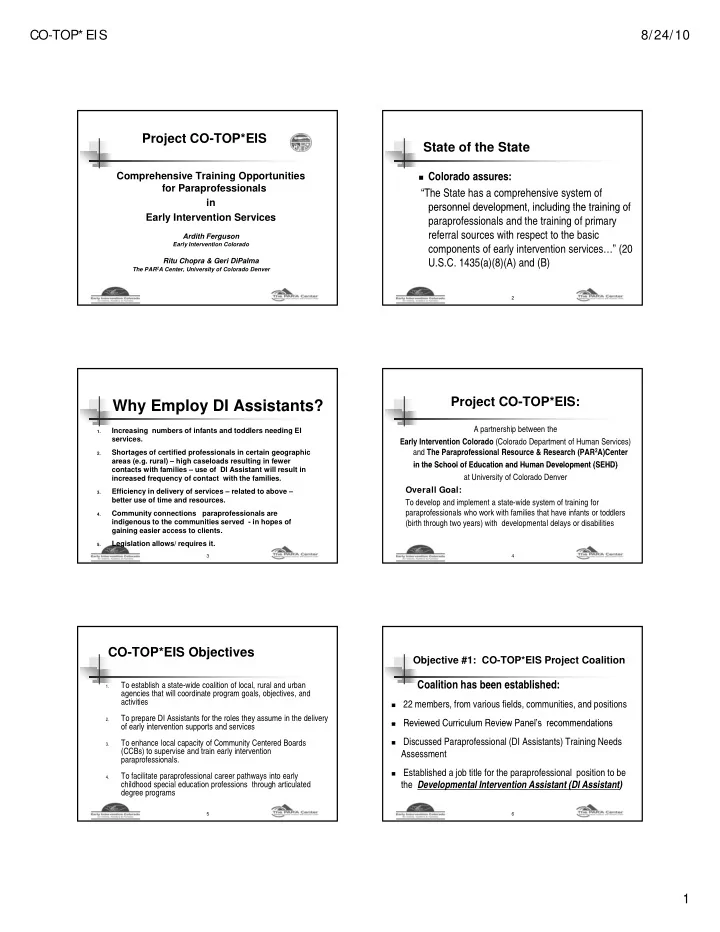
Why Employ DI Assistants?

1.

Increasing numbers of infants and toddlers needing EI services.

2.

Shortages of certified professionals in certain geographic areas (e.g. rural) – high caseloads resulting in fewer contacts with families – use of DI Assistant will result in increased frequency of contact with the families.

3.

Efficiency in delivery of services – related to above – better use of time and resources.

4.

Community connections paraprofessionals are indigenous to the communities served - in hopes of gaining easier access to clients.

5.

Legislation allows/ requires it.

3

Project CO-TOP*EIS:

A partnership between the Early Intervention Colorado (Colorado Department of Human Services) and The Paraprofessional Resource & Research (PAR2A)Center in the School of Education and Human Development (SEHD) in the School of Education and Human Development (SEHD) at University of Colorado Denver Overall Goal: To develop and implement a state-wide system of training for paraprofessionals who work with families that have infants or toddlers (birth through two years) with developmental delays or disabilities

4

CO-TOP*EIS Objectives

1.

To establish a state-wide coalition of local, rural and urban agencies that will coordinate program goals, objectives, and activities

2.

To prepare DI Assistants for the roles they assume in the delivery f l i t ti t d i

  • f early intervention supports and services

3.

To enhance local capacity of Community Centered Boards (CCBs) to supervise and train early intervention paraprofessionals.

4.

To facilitate paraprofessional career pathways into early childhood special education professions through articulated degree programs

5

Objective #1: CO-TOP*EIS Project Coalition

Coalition has been established:

 22 members, from various fields, communities, and positions  Reviewed Curriculum Review Panel’s recommendations  Reviewed Curriculum Review Panel s recommendations  Discussed Paraprofessional (DI Assistants) Training Needs

Assessment

 Established a job title for the paraprofessional position to be

the Developmental Intervention Assistant (DI Assistant)

6

slide-2
SLIDE 2

CO-TOP* EIS 8/24/10 2 Definition of DI Assistant

Established by the coalition

 Developmental Intervention Assistant

(DI Assistant) provides *Developmental Intervention services to families, infants

Objective #1: continued

Intervention services to families, infants and toddlers under the supervision of a qualified early intervention provider who holds a current license/certificate that meets the standards in the Early Intervention Colorado State Plan.

7

Objective #1: Project Coalition continues to..

 Discuss the role of the DI Assistant and Supervisor –to

develop standards for the state of Colorado

 Discuss the exception to the recommended practice regarding

ECSE as the supervisor of the DI Assistant

 Document the necessary qualifications a DI Assistant supervisor

(who is not an ECSE) must demonstrate.

 Review and revise the course/academy outlines for the DI Assistant

certificate

 Discuss the qualifications of the DI Assistant 8

Objective #2: To prepare paraprofessionals (DI Assistants)

Curriculum Review Panel (CRP) assembled with local & National experts:

Barbara Smith, Ph.D.UC Denver. Past President of Division For Early Childhood Education (DEC).

Expertise - Evidence Based Practices in Early Learning, L Center for Social Emotional Foundations for Early Learning

Susan Sandall, Ph.D. University of Washington. Lead author DEC Recommended Practices in

EI/ECSE

Peggy Hayden M A

Consultant to state and local education and human service agencies

Peggy Hayden, M.A. Consultant to state and local education and human service agencies –

extensive background in prek-12 paraprofessional training and supervision

Susan Moore, JD, MA-SLP, CCC, CU-Boulder. Expertise - Speech Language and Hearing,

culturally competent, family centered supports and services.

Donna Wittmer, Ph.D., retired Associate Professor , Early Childhood Education, UCD.

Expertise - Infant and Toddler Development and Responsive Program Planning, Relationship-Based Approach,

CRP’s Task was to establish the content for the DI Assistant Certificate of the CO-TOP *EIS

9

Objective# 2: DI Assistant Training

CRP recommendations – the curriculum must consider:

Clarification of paraprofessional roles vs. professional (supervisor) roles

Evidence based best practices and nationally recommended standards from NAEYC & DEC - (e.g. culturally appropriate, family centered trans disciplinary, routine based interventions, communication skills, self esteem, creativity, self reliance through play and other age – appropriate activities)

CRP established coursework for the DI Assistant

10

Coursework

I.

Orientation to Early Intervention

II.

Fundamentals of the IFSP Process

III.

Early Intervention Teamwork

IV.

Working With Families

V.

Promoting Social Emotional Development

VI

Instructional Strategies for Early Intervention

  • Each course carries one

undergraduate credits

  • Practicum carries two

undergraduate credits

Objective #2 continued…….

VI.

Instructional Strategies for Early Intervention

VII.

Health Support Needs in Early Intervention

VIII.

Language and Literacy for Early Intervention

IX.

Communication Support Needs in Early Intervention

X.

Individualized Intervention with Infants/Toddlers

XI.

Autism Spectrum Disorders in Early Intervention

XII.

Personal Growth and Development for DI Assistants

XIII.

Interpersonal Skills for DI Assistants

XIV.

Instructional and Assistive Technology in Early Intervention

XV.

Transition to Age 3

XVI.

Practicum

11

Objective # 3: To enhance local capacity of the CCBs to supervise and train DI Assistants

Provide training to CCB nominated “local” certified and licensed professionals to become more effective supervisors and or trainers of DI Assistants (Train the Trainers)

20 CCBs will be grouped under six training regions.

12

slide-3
SLIDE 3

CO-TOP* EIS 8/24/10 3

CO-TOP*EIS Training of Local Trainers

 Involves two trainings:

 Developmental Intervention Supervisor Academy

(DISA)

Objective # 3 continued…

( )

 Developmental Intervention Trainer Academy

(DITA) Each carries a graduate credit

13

DISA & DITA TRAININGS COMPLETED IN COLORADO

Developmental Intervention Supervisors & Trainers

33 Developmental Intervention Trainers 41 Developmental Intervention Supervisors Participating CCBs include: Arkansas Valley Colorado Bluesky Southern Colorado Developmental Disabilities Services The Resource Exchange Mesa Developmental Services Community Connections Community Options Foothills Gateway Envision Early Intervention Colorado (Statewide)

Questions:

For further information, contact :

 Ardith Ferguson - ardith.ferguson@state.co.us  Lenita Hartman - Lenita.Hartman@state.co.us @  Ritu Chopra – ritu.chopra@ucdenver.edu  Geri DiPalma – geraldine.dipalma@ucdenver.edu

17