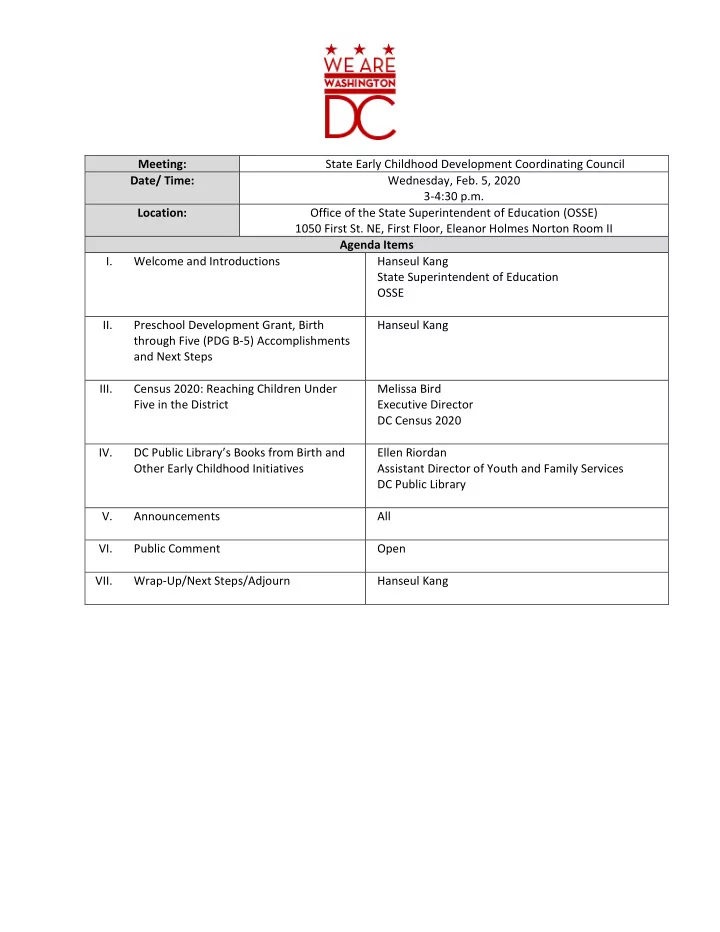
Meeting: State Early Childhood Development Coordinating Council - - PDF document

meeting state early childhood development coordinating
SMART_READER_LITE
LIVE PREVIEW

Meeting: State Early Childhood Development Coordinating Council - - PDF document

Meeting: State Early Childhood Development Coordinating Council Date/ Time: Wednesday, Feb. 5, 2020 3-4:30 p.m. Location: Office of the State Superintendent of Education (OSSE) 1050 First St. NE, First Floor, Eleanor Holmes Norton Room II


slide-1
SLIDE 1

Meeting: State Early Childhood Development Coordinating Council Date/ Time: Wednesday, Feb. 5, 2020 3-4:30 p.m. Location: Office of the State Superintendent of Education (OSSE) 1050 First St. NE, First Floor, Eleanor Holmes Norton Room II Agenda Items I. Welcome and Introductions Hanseul Kang State Superintendent of Education OSSE II. Preschool Development Grant, Birth through Five (PDG B-5) Accomplishments and Next Steps Hanseul Kang III. Census 2020: Reaching Children Under Five in the District Melissa Bird Executive Director DC Census 2020 IV. DC Public Library’s Books from Birth and Other Early Childhood Initiatives Ellen Riordan Assistant Director of Youth and Family Services DC Public Library V. Announcements All VI. Public Comment Open VII. Wrap-Up/Next Steps/Adjourn Hanseul Kang

slide-2
SLIDE 2

1

State Early Childhood Development Coordinating Council (SECDCC)

  • Feb. 5, 2020

Welcome and Introductions

slide-3
SLIDE 3

2

Preschool Development Grant, Birth through Five (PDG B‐5) Accomplishments and Next Steps

7

Updates:

  • Final version submitted to Administration for Children and

Families (ACF) on Dec. 31, 2019

  • Waiting on ACF feedback
  • Currently creating a truncated version for public release

The PDG B‐5 needs assessment included:

  • A review of 20 existing assessment reports;
  • Analysis of administrative and demographic data from national

and District databases;

  • Input from 32 family listening sessions;
  • Feedback from 23 focus groups;
  • Comments from 21 key informant interviews;
  • Responses from 2,099 family survey participants; and
  • A pilot demonstration project report.

Activity One: PDG B‐5 Needs Assessment

slide-4
SLIDE 4

3

8

Updates:

  • Final version submitted to ACF on Dec. 31, 2019
  • Waiting on ACF feedback

Strategic plan goals, objectives and actions were based on feedback and collaboration from:

  • District families
  • Health and education officials
  • Community‐based partners
  • Early care and education workforce
  • SECDCC and committees
  • PDG core team

Activity Two: PDG B‐5 Strategic Plan

9

Activity Three: Maximize Parent Choice

Activity Key Achievement My Child Care DC (Capital Quality profile and family profile) Completed 14 family focus groups with 130 families to develop the mockup of the new Capital Quality profile that will serve as blueprint for the new profile to be released in April 2020. Early Childhood Integrated Data System (ECIDS) Produced an unduplicated count report and visualizations of children B‐5 across the District within educational entities and one Head Start agency. Strong Start playgroups Playgroups have served 340 unique families with children with delays and disabilities since March 2019 (as of Jan. 8, 2020). Orchard Released enhancements to the Child and Adult Care Food Program (CACFP) application (i.e., at‐risk program elements and the capacity to complete amendments to applications).

slide-5
SLIDE 5

4

10

Activity Key Achievement Peer support networks Met with parent steering committee to discuss designing and developing the toolkit. My School DC Toolkit Developed and released the partner toolkit for the 2020‐21 school year lottery to support providers in their communications with families. Communications and Marketing Hired communications contractor to develop a communications strategy to support access and awareness for B‐5 families in the District. Thrive by Five DC OSSE and Thrive by Five signed a Memorandum of Understanding (MOU) amendment for fiscal year 2020 (FY20)

Activity Three: Maximize Parent Choice

11

Activity Key Achievement Early childhood summit (Dec. 6, 2019) Hosted the early childhood summit for more than 2,700 early childhood professionals. Quorum Provided more than 1,000 provider licenses to the Quorum online professional development platform for early childhood professionals. Healthy Futures Therapists attended trauma‐informed coaching for mental health professionals. Trauma‐informed, practice‐ based coaching/technical assistance (TA) Completed trainings on trauma‐informed practices for coaches (i.e., Quality Improvement Network (QIN), Head Start, Capital Quality) and consultants (i.e., Healthy Futures).

Activity Four: Sharing Best Practices

slide-6
SLIDE 6

5

9

Activity Key Achievement Access trauma informed care (Comprehensive Trauma‐ Informed Early Childhood Mental Health Consultants (ECMHC)) Therapists and psychiatrists in the Family Wellbeing Program began seeing clients in two sites for mindful parenting classes as a primary prevention strategy and hosted two Social Emotional and Academic Child and Parent Wellness Program (SEACAP) parent‐child therapy trainings with multiple and/or more intense therapeutic needs attended by seven centers. Enhancement to Quality in Early Childhood Programs (EQIP) Grants At least 36 eligible applications for $2,253,169 in requests were received to expand quality improvement for providers by providing supplementary funding for eligible early care and education center‐ and home‐based providers participating in Capital Quality.

Activity Five: Improving Overall Quality

12

Activity Key Achievement PDG baseline family survey Analyzing data from more than 2,099 participants

  • n the baseline family survey and discussing

different forms of reporting and dissemination with various stakeholders. Teacher/staff wellness survey Announced the teacher/staff wellness survey, an

  • nline survey for infant/toddler and preschool

teachers and classroom staff in order to better understand their health and wellness needs in multiple newsletters read by local education agencies and community‐based organizations.

Evaluation

slide-7
SLIDE 7

6

11

  • The District submitted its application for the PDG B‐5 Renewal

Funding Opportunity on Nov. 5, 2019.

  • Only 20 of the 46 states that applied for renewal funding received

awards.

  • The District was not among the recipients of the renewal grants.
  • Equipped with the PDG needs assessment and strategic plan, we

are well‐positioned to continue our progress going forward.

  • We can all be very proud of what has been accomplished and we

will continue to break down barriers and improve access to higher quality early childhood services in the District.

PDG Renewal Application

12

Census 2020: R eac hing Childr en Under F ive in the Distr ic t

@dc c e nsus # GetCo untedDC dc c e nsus2020.dc .gov

slide-8
SLIDE 8

7

The goal is to count every person living in the US,

  • nce, and only once and in the right place.

The US Constitution requires a census every 10

  • years. The first census was in 1790. The census

covers the entire country and every person living here. By law, the US Census Bureau must deliver a report

  • f population counts to the President of the United

States within nine months of “Census Day” (April 1, 2020), so that apportionment can be taken. The three main ways census data is used at the federal level: 1. To reapportion seats in the House of Representatives. 2. For state officials to redraw congressional and legislative districts based on population shifts. 3. To determine how to allocate more than $675 billion in federal dollars supporting state and local community programs across the country.

13

Facts Matter How to Respond to the 2020 Census

An invitation to respond to the US Census will be mailed to every household in

  • DC. This invitation will include a code unique to your address that will lead you to

the online survey. WHAT THE US CENSUS WILL SEND IN THE MAIL TO EACH HOUSEHOLD March 12-20 An invitation to respond online to the 2020 Census. March 16-24 A reminder letter. IF YOU HAVEN’T RESPONDED YET: March 26-April 3 A reminder postcard. April 8-16 A reminder letter and paper questionnaire. April 20-27 A final reminder postcard before the US Census follows-up in person at your residence. Once you have the invitation, you can either respond online, call the US Census to complete over the phone or call and request a hard copy be mailed to you.

14

slide-9
SLIDE 9

8

Children - All children who live in your household, including grandchildren, nieces and nephews, and the children of friends. Children who split their time between households, if they are living with you on April 1, 2020. Newborn babies, even those who are still in the hospital on April 1, 2020. College Students Off Campus - Students who live on campus will be included in the institutions of higher education’s “Group Quarters” count. Students in off campus housing will need to complete one census form for their household and include any roommates who also reside in the household. Roommates - One form per household. One person will complete the form and add all roommates onto the census form. Multiple generations - Only one person will need to complete the form but will need to include everyone in the household, such as grandparents, grandchildren and parents. More than one family in one household - Only one person will need to complete the form but will need to include every person (adult, children babies) from other families on the same form who reside in the household. Informal or complex arrangements - Only one person will need to complete the form but must include all additional persons in household even if they are unrelated or expected to not reside permanently in the household. Foster parents must include foster children on their census forms.

What about….?

15

Where are People Counted?

How many people are living at your home at the time of the census? Age, race, sex of each person in the household Whether the home is owned or rented Whether a person in the household is of Hispanic, Latino or Spanish origin The relationship of each person in the household to one central person (usually the person completing the form for the household).

The census will never ask you for:

  • Your Social Security

number.

  • Money or donations.
  • Anything on behalf of

a political party.

  • Your bank or credit

card account numbers.

16

2020 Questions

slide-10
SLIDE 10

9

Financial Resources-$6 billion annually to DC through federal assistance programs Planning and Policy Guidance- population data used by almost every District agency to set priorities Social and Racial Equity- the District must continue to ensure that the most vulnerable residents are counted and that District policies continue to support the diversity that makes DC great. Updating Ward Boundaries- Ensure fair and equal representation across eight Wards.

17

Why Does the Census Matter to DC?

18

“I’m using census data to figure out where we now have density to support new high‐frequency transit routes. This will help people spend less time in transit and more time doing what they love.” – Haley Peckett, District Department of Transportation (DDOT) Transportation Planner With anticipated growth of more than 100,000 residents over the next 10 years, we need accurate and complete 2020 census data to ensure our city and region continue to thrive:  Parks, schools, recreation centers, libraries  Dual language schools  Additional housing for all income levels  Expanding commercial centers  Fire and Emergency Medical Services Department (FEMS) and Metropolitan Police Department  Transit improvements  Utilities and infrastructure investments  Social services  Community-based healthcare, hospital beds  Medicaid, vouchers, Supplemental Nutrition Assistance Program (SNAP), Special Supplemental Nutrition Program for Women, Infants and Children (WIC) and child care subsidies

Planning for the Future

slide-11
SLIDE 11

10

19

One-third of DC Census tracts are at risk of being “Low Response Rate” (up to 40percent of residents are expected not to respond during self-response during the 2020 Census). The Low Response Score (LRS) is a metric developed by the US Census to identify areas according to their likelihood to self-respond. The higher the LRS value, the harder to count that area is.

DC Low Response Score (2016)

Young children most likely to be missed lived with:

  • Foster families
  • Unrelated people
  • Grandparents, single parents, young adults
  • Limited English household
  • Renters
  • Parents of caregivers with low incomes or insecure

housing Children under 5, across all demographics, are the most undercounted population in the country. In 2010, an estimated 1 million children under the age of 5 were not counted. Approximately 9,500 babies are born each year in DC!

20

Children Under Age 5

slide-12
SLIDE 12

11

Impacts to Children in DC

When young children are not counted, support for programs such as health insurance, hospitals, child care, food assistance and early childhood development is impacted.

Federal Entitlement Program FY 16 Funding Head Start $45 million WIC $15 million State Children Health Insurance Program $25 million SNAP $210 million Child Care Development Fund (CCDF) $11.8 million School Breakfast Programs $11 million National School Lunch Programs $28 million

21

In FY16, the federal government used census data to allocate more than $128 million in funding to DC schools. That’s just for ONE year. These funds are used to support critical needs and programming, such as:

  • Special education
  • Head Start
  • Classroom technology
  • Free and reduced-price meals
  • After-school programs

Every kid counts.

DC Public Schools (DCPS) relies on census data to set priorities for planning, population projections, programming and budgeting across the city.

22

Impacts to Education in DC

slide-13
SLIDE 13

12

Partnerships

Getting all kids counted, especially children under age 5, requires support, partnerships and engagement by “trusted messengers” who work with families.

  • Children’s National Health Network, birthing hospitals
  • Mary’s Center
  • Community-based clinics
  • Office of the State Superintendent of Education (OSSE)
  • DCPS
  • District of Columbia Public Charter School Board (PCSB)
  • Clinicians, pediatricians, early interventionists
  • Child development centers

What can you or your organization do to ensure young children are counted in 2020?

23

 Share printed materials in all locations where children or families gather.  Post census information in high-traffic areas.  Urge caregivers or service providers to talk about the census with families.  Educate yourself and others on the facts about the census.  Share census updates and reminders with families in print and

  • nline through newsletters, emails, text alerts, list serves and

social media.  Allow families access to computers to complete their census form online.  Wear census buttons or t-shirts.  Hold a census rally or special event with families or service providers to make sure they know how important the census is for young children.

24

How you can help

slide-14
SLIDE 14

13

Contact Information

Melissa Bird E xec utive Direc to r, Distr ic t Census 2020 Melissa.B ird@dc .gov (202) 478-1323 Rho nda Mendo nc a E xec utive Assistant, Distr ic t Census 2020 Rho nda.Mendo nc a1@dc .gov (202) 442-7621 dc c ensus2020@dc .go v

25

DC Public Library

Early Literacy Programs and Services

slide-15
SLIDE 15

14

Sing, Talk and Read (STAR)

  • Public awareness campaign

that is the umbrella for all birth to five programs and services.

  • STAR activities include all

programs that serve children age birth to five and their caregivers.

  • First step of the arc of

service that libraries provide for children birth to high school and their families.

  • Books From Birth
  • Ready Rosie
  • STAR Story times
  • Baby Lap Time
  • Toddler Explorations
  • Family story times
  • Early coding with BEE BOTS
  • Strong Start playgroups

27

STAR Programming Numbers

FY17 FY18 FY19 FY20 to date Number of Programs 5,021 4,872 6,025 1,566 Number of Participants 191,982 191,492 220,009 56,625

28

slide-16
SLIDE 16

15

Books from Birth Numbers

Metric FY17 FY18 FY19 FY20 (to date) Number of Active Children Enrolled 25,741 31,161 35,736 36,243 Total Number of Books Delivered 297,850 635,137 1,032,957 1,175,716 Enrollment Growth Rate* 9,618 5,420 4,575 2,828 Growth calculated based on FY20 Q1.

29

Find Out More

https://www.dclibrary.org/star https://www.dclibrary.org/ Ellen.Riordan@dc.gov

30

slide-17
SLIDE 17

16

Announcements Public Comment

slide-18
SLIDE 18

17

Wrap‐Up/Next Steps/Adjourn