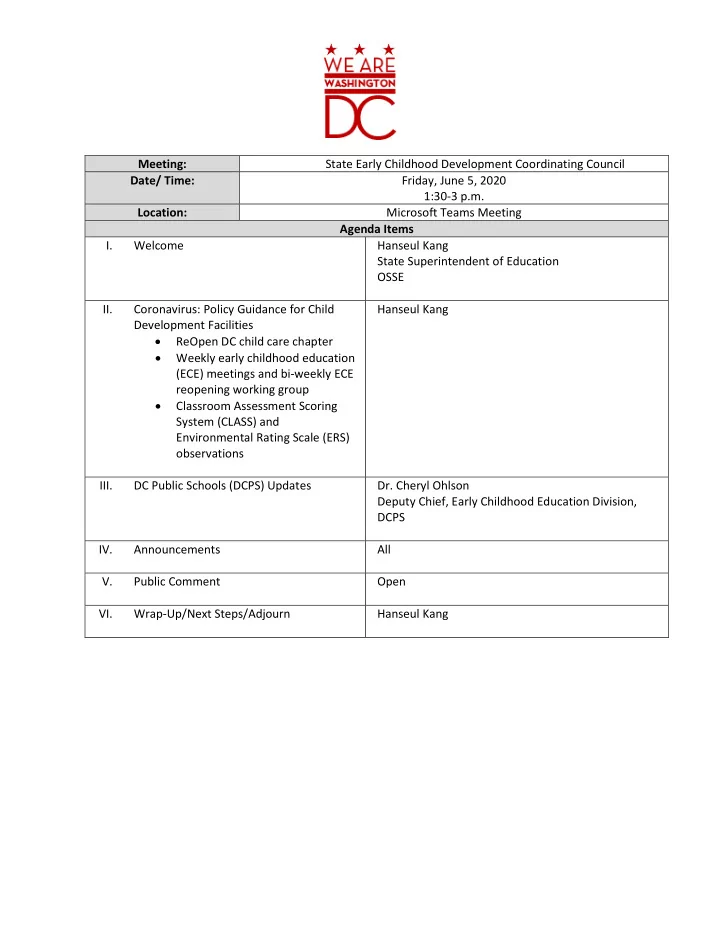
Meeting: State Early Childhood Development Coordinating Council - - PDF document

meeting state early childhood development coordinating
SMART_READER_LITE
LIVE PREVIEW

Meeting: State Early Childhood Development Coordinating Council - - PDF document

Meeting: State Early Childhood Development Coordinating Council Date/ Time: Friday, June 5, 2020 1:30-3 p.m. Location: Microsoft Teams Meeting Agenda Items I. Welcome Hanseul Kang State Superintendent of Education OSSE II. Coronavirus:


slide-1
SLIDE 1

Meeting: State Early Childhood Development Coordinating Council Date/ Time: Friday, June 5, 2020 1:30-3 p.m. Location: Microsoft Teams Meeting Agenda Items I. Welcome Hanseul Kang State Superintendent of Education OSSE II. Coronavirus: Policy Guidance for Child Development Facilities

  • ReOpen DC child care chapter
  • Weekly early childhood education

(ECE) meetings and bi-weekly ECE reopening working group

  • Classroom Assessment Scoring

System (CLASS) and Environmental Rating Scale (ERS)

  • bservations

Hanseul Kang III. DC Public Schools (DCPS) Updates

  • Dr. Cheryl Ohlson

Deputy Chief, Early Childhood Education Division, DCPS IV. Announcements All V. Public Comment Open VI. Wrap-Up/Next Steps/Adjourn Hanseul Kang

slide-2
SLIDE 2

State Early Childhood Development Coordinating Council (SECDCC)

June 5, 2020

slide-3
SLIDE 3

Welcome

slide-4
SLIDE 4

Coronavirus: Policy Guidance for Child Development Facilities

slide-5
SLIDE 5

ReOpen DC Child Care Chapter Committee Recommendations

slide-6
SLIDE 6

Phase One

5

  • Phase One began Friday, May 29.
  • The ReOpen DC Advisory Group recommendations will be

used to inform the Mayor’s decisions, along with the best available data and consultation with public health officials.

slide-7
SLIDE 7

Child care: The need

6

  • Many of the same challenges as schools: Need for public

health guidance; concerns on staff safety and availability; need for critical supplies; family concerns about safety of in- person settings.

  • Additional, unique challenges:

– Core in-person service and function; – Mix of public and private funding tied to in-person services; and – Public health guidance functionally limits enrollment capacity.

  • Uncertainty about continued financial viability, making

planning very challenging.

slide-8
SLIDE 8

Engagement with the early childhood education community

7

  • Quality Improvement Network (QIN) policy council
  • Weekly calls with the early childhood education community,

approximately 300 callers weekly

  • Early childhood education reopening working group
  • Survey results from Under 3 DC and DC Association for the

Education of Young Children (DCAEYC)

  • Individual conversations with providers and early childhood

education leaders

  • Results from the ReOpen DC survey
slide-9
SLIDE 9

Feedback from families

8

  • Many families are currently feeling unsure about returning to

in-person care.

  • Families are concerned about their ability to continue paying

for child care.

  • Find ways to help families understand the public health and

safety measures being taken in child development facilities and how they can play a part (e.g., checking temperature).

slide-10
SLIDE 10

Feedback from providers

9

  • Anxiety and uncertainty about financial support, both subsidy and

non-subsidy providers.

  • Questions about financial viability in the case of limited enrollment

possibilities during reopening.

  • Additional support with understanding and implementing health

and safety guidance and social distancing.

  • From some, desire for more specific guidance or requirements on
  • perating during the pandemic and on reopening.
  • Questions and concerns about liabilities after reopening.
  • Uncertainty about staff availability.
  • Requests for support accessing personal protective equipment

(PPE).

  • Wide range of needs in training and technical assistance shared.
  • Guidance on how to support ECE staff’s, families’ and children’s

increased mental health needs with trauma-informed practices.

slide-11
SLIDE 11

Opportunities: Enrollment guidance

10

  • Consider specific criteria or guidance, given limited enrollment

capacity. – Guidance on how to prioritize families for enrollment, such as the children of essential workers just returning to in- person workplaces. – Depending on decisions in the K-12 space, families may have additional or new needs for care of older children (beyond before and after care). – Support families with age-appropriate distance learning

  • pportunities for those who are not ready to return to in-

person child care.

slide-12
SLIDE 12

Opportunities: Health and safety supplies and training

11

  • Consider coordination of additional training and supplies to

support health and safety requirements. – Support providers in more deeply understanding new health and safety measures and social distancing with training and/or peer-to-peer learning opportunities. – Shared services or cooperative purchasing model for PPE and cleaning supplies.

slide-13
SLIDE 13

Opportunities: Subsidy policy and other sources of funding

12

  • Consider subsidy policy updates and support to access

additional sources of funding. – Formulate a long-term subsidy policy throughout the coronavirus pandemic that provides as much stability as possible. – Consider other sources of funding (e.g., private grants, small business grants and low-interest loans).

slide-14
SLIDE 14

Opportunities: Licensing flexibilities

13

  • Explore flexibility in licensing regulations to help providers
  • pen and expand capacity rapidly.
  • OSSE already exploring virtual inspection visits.
  • Flexibilities might be temporary, either for shorter reopening

period or for longer until the abatement of COVID-19 public health emergency.

slide-15
SLIDE 15

Opportunities: Communicate with families

14

  • Consider survey of early learning families to assess their needs

in order to return to child care.

  • Communications campaign that helps families understand

COVID-19 signs in children and importance of health and safety measures.

  • Explore appropriate distancing learning opportunities and

supports for families.

slide-16
SLIDE 16

ReOpen DC Recommendations

15

  • Full Recommendations: coronavirus.dc.gov/reopendc
  • Education and child care chapter:

coronavirus.dc.gov/sites/default/files/dc/sites/coronavirus/pa ge_content/attachments/01.%20Education%20and%20Childca re.pdf

  • Phase One: coronavirus.dc.gov/phaseone
slide-17
SLIDE 17

Early Childhood Education (ECE) Meetings and Reopening Working Group

slide-18
SLIDE 18

17

  • DC Early Childhood Stakeholder Calls

– Audience: About 300 providers, community partners and other early childhood stakeholders – Purpose: Provide updates, explain guidance and answer questions – When: Mondays at 10:10 a.m. – Email OSSE.DELCommunications@dc.gov if you would like to receive the invitation.

  • Child Care Recovery Working Group

– Audience: Smaller group (approximately 30) of child care facility leadership, early childhood education experts and staff from the Division of Early Learning and Thrive by Five – Purpose: To share recommendations and best practices for a safe and sustainable reopening – When: Every other week and as needed – Email Eva.Laguerre@dc.gov if you have any questions.

Engaging the Early Childhood Education Community

slide-19
SLIDE 19

Classroom Assessment Scoring System (CLASS) and Environmental Rating Scale (ERS) Observations

slide-20
SLIDE 20

19

  • OSSE is canceling the ERS and CLASS observations for all child

care providers for the remainder of the 2019-20 program year.

  • Capital Quality designations will not be calculated in fall 2020.

– Observations will resume in fall 2020 and the fall 2021 calculations will use the 2018-19 and 2020-21 school year

  • bservation data.

– Groups 4 and 5 will maintain their current designation at this time. – Additional designation updates are reflected in the next slide.

Important Capital Quality Updates and Designations

slide-21
SLIDE 21

20

Capital Quality Designation Changes for Groups 2 and 3

Group Original Timeline Update Pilot and Group 2 Tiered reimbursement aligns with the Capital Quality designation in fall 2020. Timeline remains the same; the designation reflected on My Child Care DC will be the designation at which you are reimbursed beginning

  • Oct. 1, 2020.

Group 3 Quality profile on My Child Care DC reflects the designation calculated in fall 2020 and tiered reimbursement rate reflects the calculated designation in fall 2021. The designation you are currently reimbursed at will continue for the next fiscal year beginning Oct. 1,

  • 2020. Your designation calculated in

fall 2021 will be reflected on My Child Care DC and will align with your reimbursement rate.

slide-22
SLIDE 22

District of Columbia Public Schools | 1200 First Street, NE | Washington, DC 20002 | T 202.442.5885 | F 202.442.5026 | dcps.dc.gov

DCPS Early Childhood Update

SECDCC June 5, 2020

slide-23
SLIDE 23

SY19-20 Head Start / Early Childhood Education (ECE) Programming

FY20 Budget Overview DCPS ECED

District of Columbia Public Schools |

Curren ent P Progr gram amming

  • DCPS serves over pre-K 6,900 students in 407

pre-K classrooms.

  • Currently, all pre-K classrooms in our 60 Title 1

schools are Head Start School-Wide Model classrooms, serving a socio-economically diverse population of students. We also have pre-K classrooms in our 18 non-Title 1 Schools. These are not Head Start classrooms.

  • Local funding is used to support teacher and

teacher aide salaries and facilities costs (as well as other costs).

slide-24
SLIDE 24

ECE Programmatic Shifts for SY20-21

FY20 Budget Overview DCPS ECED

District of Columbia Public Schools

Due to the shifting demographics of our schools — as well as the need to implement systemic changes to enhance student supervision and safety — DCPS anticipated a reduction in Head Start funding for Fiscal Year 2021 and has been planning as such. All of our schools will transition to non-Head Start pre-K programming for SY20-21.

No p pre re-K K classr srooms s will b be e closi sing, no p pre-K s sea eats s will be lost. t.

slide-25
SLIDE 25

ECE Programmatic Shifts for SY20-21 Key Points

FY20 Budget Overview DCPS ECED

District of Columbia Public Schools

DCPS remains committed to ensuring high-quality early learning programming across all of our pre-K classrooms. DCPS remains committed to supporting families furthest from opportunity with wraparound services in schools or through community partners. DCPS will make substantial new investments in ECE programming to ensure that we can continue to provide high-quality services to our youngest learners.

Robust instructional supports Family services Classroom resources

slide-26
SLIDE 26

ECE Programmatic Shifts for SY20-21 Key Points

FY20 Budget Overview DCPS ECED

District of Columbia Public Schools

Differentiated Supports through the DCPS Cluster Model

slide-27
SLIDE 27

ECE Programmatic Shifts for SY20-21 Additional Key Points

FY20 Budget Overview DCPS ECED

District of Columbia Public Schools

Pre-K program quality will continue to be assessed annually through the Classroom Assessment Scoring System (CLASS) assessment. Pre-K classroom curriculum and instructional coaching program will not change. CLASS will continue to be the driver for much of DCPS’ instructional coaching work. DCPS will continue to focus on the DC Early Learning Standards, and will continue to meet most Head Start program standards.

slide-28
SLIDE 28

Questions?

DCPS ECED

District of Columbia Public Schools |

slide-29
SLIDE 29

Announcements

slide-30
SLIDE 30

Needs Assessment

29

  • OSSE has strategically used the Preschool Development Grant,

Birth through Five (PDG B-5) funding to better understand parents’ awareness, access and utilization of early care and education benefits, programs and services throughout the mixed delivery system by conducting a comprehensive needs assessment.

  • The needs assessment report included qualitative and quantitative

data from 32 family listening sessions; 21 key informant interviews; 23 professional focus groups; analysis of administrative data; an online and print family survey with 2,099 respondents; and an inventory of existing pilot and demonstration projects in the District.

  • Please see link to the needs assessment report:

https://osse.dc.gov/page/preschool-development-grant-birth- through-five-pdg-b-5-grant-competition

slide-31
SLIDE 31

Public Comment

slide-32
SLIDE 32

Wrap-Up/Next Steps/Adjourn