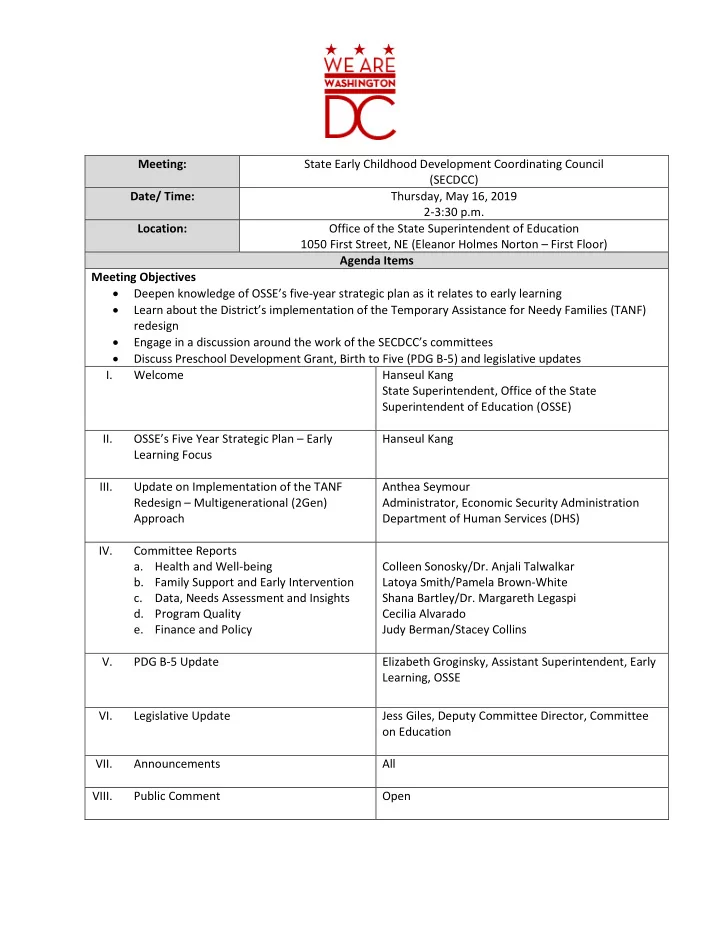
Meeting: State Early Childhood Development Coordinating Council - - PDF document

meeting state early childhood development coordinating
SMART_READER_LITE
LIVE PREVIEW

Meeting: State Early Childhood Development Coordinating Council - - PDF document

Meeting: State Early Childhood Development Coordinating Council (SECDCC) Date/ Time: Thursday, May 16, 2019 2-3:30 p.m. Location: Office of the State Superintendent of Education 1050 First Street, NE (Eleanor Holmes Norton First Floor)


slide-1
SLIDE 1

Meeting: State Early Childhood Development Coordinating Council (SECDCC) Date/ Time: Thursday, May 16, 2019 2-3:30 p.m. Location: Office of the State Superintendent of Education 1050 First Street, NE (Eleanor Holmes Norton – First Floor) Agenda Items Meeting Objectives

  • Deepen knowledge of OSSE’s five-year strategic plan as it relates to early learning
  • Learn about the District’s implementation of the Temporary Assistance for Needy Families (TANF)

redesign

  • Engage in a discussion around the work of the SECDCC’s committees
  • Discuss Preschool Development Grant, Birth to Five (PDG B-5) and legislative updates

I. Welcome Hanseul Kang State Superintendent, Office of the State Superintendent of Education (OSSE) II. OSSE’s Five Year Strategic Plan – Early Learning Focus Hanseul Kang III. Update on Implementation of the TANF Redesign – Multigenerational (2Gen) Approach Anthea Seymour Administrator, Economic Security Administration Department of Human Services (DHS) IV. Committee Reports

  • a. Health and Well-being
  • b. Family Support and Early Intervention
  • c. Data, Needs Assessment and Insights
  • d. Program Quality
  • e. Finance and Policy

Colleen Sonosky/Dr. Anjali Talwalkar Latoya Smith/Pamela Brown-White Shana Bartley/Dr. Margareth Legaspi Cecilia Alvarado Judy Berman/Stacey Collins V. PDG B-5 Update Elizabeth Groginsky, Assistant Superintendent, Early Learning, OSSE VI. Legislative Update Jess Giles, Deputy Committee Director, Committee

  • n Education

VII. Announcements All VIII. Public Comment Open

slide-2
SLIDE 2

State Early Childhood Development Coordinating Council (SECDCC)

May 16, 2019

slide-3
SLIDE 3

2

I. Welcome and Introductions II. OSSE’s Five Year Strategic Plan – Early Learning Focus III. Update on the Implementation of the TANF Redesign – Multigenerational (2Gen) Approach IV. Committee Reports V. Preschool Development Grant Birth to Five (PDG B-5) VI. Legislative Update

  • VII. Announcements
  • VIII. Public Comment

Agenda

slide-4
SLIDE 4

3

  • Deepen knowledge of OSSE’s five-year strategic plan as it

relates to early learning

  • Learn about the District’s implementation of the Temporary

Assistance for Needy Families (TANF) redesign

  • Engage in a discussion around the work of the SECDCC’s

committees

  • Discuss Preschool Development Grant, Birth to Five (PDG B-5)

Today’s Objectives

slide-5
SLIDE 5

OSSE’s Five Year Strategic Plan—Early Learning Focus

slide-6
SLIDE 6

2019-2023 Strategic Plan

District of Columbia Office of the State Superintendent of Education

slide-7
SLIDE 7

Our 2015-18 plan invested in improving foundational systems, operations, and partnerships and articulated OSSE’s key role in supporting student achievement

  • utcomes.

In 2015, OSSE created a four-year strategic plan

slide-8
SLIDE 8
  • Launched the DC School Report Card and STAR Framework to

provide clear, consistent information across all public schools in DC.

  • Released reports and analyses on student attendance, student

discipline, and student health and well-being.

  • Launched Capital Quality, a redesigned quality rating and

improvement system for child development centers and homes.

  • Designed innovative Adult and Family Education grants to better

support adult learners through integrated literacy and workforce training.

PROGRESS HIGHLIGHTS

OSSE has also made progress in the last four years

slide-9
SLIDE 9
  • Launched the Start of School campaign to transform how LEAs

and schools experience the beginning of the school year with OSSE and prepare them to better support all students.

  • Created on-site, individualized supports for early childhood

educators and child development facilities to support them in meeting new credential requirements.

  • Focused on recruitment and retention of Division of Student

Transportation bus drivers and attendants, resulting in a decrease in unfilled positions (15% to 3%) and a historic collective bargaining agreement that included substantial wage increases.

  • Improved our employee experience as evidenced by a 43 percent

increase in the number of staff who say: “I would recommend OSSE as a great place to work.”

OSSE has also made progress in the last four years (cont.)

PROGRESS HIGHLIGHTS

slide-10
SLIDE 10

DC Office of the State Superintendent of Education

9

VISION: DC will close the achievement gap and ensure people of all ages and backgrounds are prepared to succeed in school and in life. MISSION: As DC’s state education agency, OSSE works urgently and purposefully, in partnership with education and related systems, to sustain, accelerate, and deepen progress for DC students. In response to all that we have heard and learned, we are setting forth a bold new vision and clearly defining our mission:

slide-11
SLIDE 11

By 2023, we aim to reach the following ambitious goals to advance outcomes for DC students

10

6,700 more students

meet or exceed expectations on state assessments while

CLOSING ACHIEVEMENT GAPS

Elementary and Secondary Early Childhood

1,500 more

vulnerable infants and toddlers access quality care

4,100 more students

are in high-quality pre-K classrooms

1,100 more students

enroll in higher education, on a path to complete a two- or four-year degree

Postsecondary

slide-12
SLIDE 12

OSSE will provide quality seats to more infants and toddlers in need

Infant and toddler subsidy enrollment, 2012-2023

Note: Metric above is a near-term proxy to estimate enrollment of vulnerable infant and toddler population in quality and high-quality care; metric and target to be updated summer of 2019 to reflect quality considerations.

slide-13
SLIDE 13

OSSE will support more pre-kindergarten classrooms to meet or exceed quality targets

Note: The Classroom Assessment Scoring System (CLASS) is a research-based measure used to capture the quality of teacher-child interactions. The assessment includes three domains: Emotional Support, Classroom Organization, and Instructional Support. The District implements CLASS in LEA and CBO pre-K classrooms. These projections assume linear growth based on 23 and 70 classrooms meeting or exceeding CLASS targets in 2016-17 and 2017-18, respectively, and an average

  • f 13 students in these classrooms over time.

Pre-K quality as measured by % of classrooms that meet or exceed CLASS targets for all domains

slide-14
SLIDE 14

We set and maintain high standards for program quality and high expectations for learners to ensure our educational systems are driving toward excellence and equity.

Set high expectations

Over the next five years, the following pillars will form the foundation of our work as an agency

Above and beyond our focus

  • n all students, we bring

specific focus to two areas:

  • Early Childhood, to ensure

that DC’s significant investments are leveraged to maximize impact on long-term outcomes in school and in life, and

  • Special Education, to

catalyze progress and dramatically shift the trajectory of growth for students with disabilities.

Maximize OSSE’s impact Build ecosystem capacity

We convene partners, provide targeted support, and invest resources to improve quality, increase access, and advance equity in education.

Share and use actionable data

We collect and share reliable and actionable data to inform policy decisions, empower our partners to improve, and build community understanding.

Continue commitment to our talented team and culture of excellence

slide-15
SLIDE 15

Early childhood is an area OSSE is uniquely positioned to improve conditions citywide

  • National research reveals strong

reduction in achievement gaps after implementing high-quality universal pre-kindergarten programs. Growth in achievement is particularly strong for Black, Hispanic, and low-income students.

  • DC is #1 in the nation for preschool

access, with 69% of 3-year-olds and 89% of 4-year-olds enrolled in publicly funded pre-K programs, so our ability to influence positive change in early childhood is high.

  • “OSSE’s role is to support providers and

make sure quality care is nailed down.” – DC Education Stakeholder

  • There are 858 pre-K classrooms across

DCPS, charters, and community-based

  • rganizations.
  • OSSE licenses 476 child development

facilities, 247 of which accept child care subsidy vouchers to support low- income families.

  • There is need and an opportunity to

ensure families can access information about child care and pre-K options available in the District.

  • There is limited insight into

kindergarten to 2nd grade instruction and outcomes across the District. There is a gap in a statewide view of achievement between pre-K4 and 3rd grade.

  • DC has invested significantly in early

childhood education. OSSE oversees or administers much of this work through publicly funded pre-kindergarten, child care subsidy and tax credits for families, and quality improvement supports for child development facilities.

  • There is opportunity to further

leverage investments to maximize

  • utcomes for children through 3rd

grade by:

  • Improving the quality of care for

infants and toddlers,

  • Helping more vulnerable families

access quality care,

  • Improving the transitions between

early childhood settings and early grades, and

  • Improving the quality of

instruction in the early grades.

High-potential impact Complex, mixed-delivery system Opportunity to maximize investments

slide-16
SLIDE 16

By maximizing our impact in early childhood, we can improve citywide conditions

  • Capital Quality: Implement redesigned quality rating and

improvement system for child development facilities based

  • n research-based assessments and align subsidy rates to

the Capital Quality designation.

  • My Child Care DC: Provide families with a one-stop-shop to

access comprehensive information about all of the city’s licensed child development providers to help them make more informed decisions about care.

Highlights of our work to build from Select priorities to drive this pillar forward

  • Provide a robust set of quality supports to help providers

improve the quality of care and learning. Expand the impact

  • f the Quality Improvement Network, a comprehensive

system of supports for infant and toddler providers and families, and engage providers in the new Capital Quality continuous improvement process.

  • Strengthen communication and outreach with parents and
  • families. Promote the use of My Child Care DC and the

Capital Quality designations to help ensure families, especially those from low-income backgrounds, have more equitable access to high-quality care and learning.

slide-17
SLIDE 17

Update on the Implementation of the TANF Redesign – Multigenerational (2Gen) Approach

slide-18
SLIDE 18

TANF Implementation Update SECDDC

Anthea Seymour, Administrator DC Department of Human Services Economic Security Administration

May 16, 2019

slide-19
SLIDE 19

Department of Human Services

The mission of the District of Columbia Department of Human Services (DHS), in collaboration with the community, is to provide temporary support and assistance to low income families and individuals while helping them maximize their potential for economic security and self-sufficiency.

slide-20
SLIDE 20

RECAP: TANF POLICY IMPLEMENTATION

TANF Implementation

19

slide-21
SLIDE 21

TANF CASELOAD

Current Caseload

20

slide-22
SLIDE 22

DC’s TANF Program

  • The Temporary Assistance for Needy Families (TANF) program provides

cash assistance to families with dependent children when available resources do not fully address the family's needs and while preparing program participants for independence through work.

  • DC’s TANF program uses the federal block grant and local dollars to provide

individualized services to families.

Total Families and Children on TANF (April 2019)

21

Total Receiving TANF Cash Benefits Families 12,333 Children 21,900

slide-23
SLIDE 23

DC’s TANF Program

How w many ny famil milies ies receiv eive e TANF? NF?

  • Approximately 12,333 families (21,900 children) receive TANF in the

District.

  • Almost 63% of TANF participants live in Wards 7 and 8 compared with a

fraction of a % (0.2%) in Ward 3.

Im Impo port rtan ant t TANF NF Fac acts ts

  • In 2011, the Council passed legislation to impose a 60-month lifetime limit
  • n TANF benefits.
  • In 2017, the District decided to remove all time limits and reframed TANF

into a 2-Gen program.

slide-24
SLIDE 24

Ch Challenges allenges in n TA TANF NF

Today, the District still struggles with the best ways to get and keep customers engaged, especially when considering barriers to employment.

23

35% 31% 20% 18% 6%

Did not have enough work experience Did not have enough education/training Experienced housing instability/homeless Could not get child care for my children Abused by partner/spouse n=2,787

In the last year, have you ever had trouble working, looking for work, or attending a training program due to the following issue?

slide-25
SLIDE 25

Ch Challenges allenges in n TA TANF NF

Many customers do not get proper treatment for their physical and mental health problems.

24

41% 55% 63% 24% 15% 10% 25% 15% 4% 4% 10% 6% 6% 5% 18%

Had physical health issue (n=1078): visited doctor Had depression or anxiety (n=881): sought mental health treatment Had drug or alcohol abuse issue (n=84): sought drug/alcohol treatment Never Less than once a month 1-3 per month Once a week More than once a week

In the last year, how often have you gone to see a doctor or other healthcare professional to treat your health issues?

slide-26
SLIDE 26

Ch Challenges allenges in n TA TANF NF

Nearly half of families facing loss the of TANF benefits grappled with child care and child well-being.

25

45% 18% 14% 12% 11% 9% 9% 6% 3% 1%

Child Care / Child Well Being Mental Health Barriers Educational Barriers Legal Barriers Domestic Violence Health Barriers Housing Barriers Substance Abuse Learning Difficulties Adult Well Being

Unmet Needs of TANF Families Identified through TANF Comprehensive Case Review (TCCR)*

N=3,847

*

Between March 2015 and May 2016, DHS OWO conducted in-depth case review for a total of 3,847 TANF customers who had been on TANF for more than 60 months, and evaluated if their needs identified from the initial assessments had been met.

slide-27
SLIDE 27

Go Good

  • d Ne

News ws in n TA TANF NF

The District has made great progress in the following areas:

–Universal assessment (TCA); –Performance- based contracting; –Individualized service delivery model; and –Partnerships with sister agencies and CBOs.

26

slide-28
SLIDE 28

2G 2Gen en TA TANF NF P Pol

  • licy

cy

The Budget Support Act for FY18 allocated funding for the new 2Gen TANF

  • Policy. The new policy centers on two major program values:

1. That the enrichment, security and well-being of children is paramount and cash income to a household is a protective factor for children;

Since 21,900 children receiving TANF benefits. We do not want to eliminate the only source of income for many

  • f these families. Children who are 6 years old or younger composed about 46% of all children receiving TANF in

2007 and they now constitute 56% of all children

2. That supporting parents to replace income from TANF with income from work through meaningful engagement in education and employment activities that increase their economic security is a program requirement.

We are here to serve our customers. Our TANF families face many challenges, such as low to moderate education or work experience, behavioral health and or substance abuse issues, and a lack of family support systems/networks and more

27

slide-29
SLIDE 29

2G 2Gen en TA TANF NF P Pol

  • licy

cy

In FY18, the TANF program changed in three ways (effective April 1,2018): 1. No Time Limit: No time limit for families who receive TANF; 2. Increased Benefits: The benefit levels of families who received TANF for longer than 60 months increased; and 3. Reduced Sanction: The maximum sanction level for non-participation in work activities is 6% of the total TANF grant.

28

slide-30
SLIDE 30

2Gen TANF Policy

In FY18, the TANF program changed in three ways effective April 1, 2018: 1. No Time Limit: Time limit for families who receive TANF will be eliminated; 2. Increased Benefits: The benefit levels of families who have received TANF for longer than 60 months will increase; and 3. Reduced Sanction: The maximum sanction level for non-participation in work activities will be 6% of the total TANF grant.

29

slide-31
SLIDE 31

30

slide-32
SLIDE 32

RECAP OF 2 GEN APPROACH

2 Gen Policy

31

slide-33
SLIDE 33

Two - Generation (2 Gen) Approach

The 2 Gen approach addresses the needs of two or more generations at the same time. Addressing the needs of parents and children together harnesses the family’s full potential in creating meaningful opportunities for families to grow their economic security and thrive.

  • Supportive services focus on the whole family – recognizing the

interconnectedness of well-being and workforce outcomes

  • The 2 Gen approach can be applied to programs, policies, systems and research

32

Social Capital

Health and Well Being Families Programs Systems Policies Research & Evaluation

slide-34
SLIDE 34

33

Two - Generation (2 Gen) Approach

slide-35
SLIDE 35

CASE COACHING, EOT, & EMPLOYMENT SERVICES

New Approach

34

slide-36
SLIDE 36

35

Application & TANF Comprehensive Assessment

  • Orientation & Strengths Assessment
  • Barriers to Employment
  • Family & Child Well-Being
  • Health/Behavioral Health/DV/Housing

Detailed Individualized Responsibility Plan

  • Education & Occupational Training
  • Career Pathways
  • 2 Gen (Whole Family Approach)
  • Family Services Coordination
  • Bi weekly check-ins with customers

Support Services

  • Targeted Case Management and Coaching
  • Child Care
  • Transportation
  • POWER
  • TAPIT
  • Integrated TANF/Homeless Services
  • Family First Programs/Fatherhood/OCOF
  • Mayor’s Office on Returning Citizens Affairs

(MORCA)

Service Delivery

  • Performance-Based Contracts
  • Partnerships with Sister Agencies
  • Piloting National Best Practice Service

Delivery Models

Case Coaching Service Delivery

slide-37
SLIDE 37

36

Provider Teaming

When families are engaged with more than one service provider, TANF Primary and Secondary Service Providers work together to holistically support a families service delivery need by crafting a Detailed Individual Responsibility Plan (DIRP).

slide-38
SLIDE 38

Bridging 2 Gen Case Coaching & Career Pathways

DHS is bridging 2 Gen, case coaching, and career pathways, to ensure customers are ready to receive and/or be placed in job placement activities. The Provider employs motivational, career-coaching techniques that motivate the customer to complete education and occupational training program, such that they are ready to enter the workforce. Once the EOT Provider deems the customer ready to enter employment within a career pathway, the customer shall be deemed employable and ready to receive Job Placement Services. This will be different for each customer. Provider verifies the successful customer completion of the education and

  • ccupational training program and other job preparatory activities specified in the

Customer Detailed Individual Responsibility Plan (DIRP).

37

slide-39
SLIDE 39

Career Exploration

Labor Market Information (LMI):

Business Administration & IT Construction Infrastructure Healthcare Hospitality Security & Law

Career Pathway:

Career Ladder tools used to visualize the combination of education and experience needed to climb each rung

Education:

Increased focus & incentives for credentials and continued learning

Career Advancement:

Incentives and focus on stable, high-wage paying jobs that along with promotion potential, can lead to exit from TANF due to wages

38

slide-40
SLIDE 40

CUSTOMER INCENTIVES

New Incentives

39

slide-41
SLIDE 41

MOMS Program

slide-42
SLIDE 42

41

slide-43
SLIDE 43

MOMs Update

Program Status

  • 30 customers identified for April cohort (started

April 2019); total 180 moms

  • 20 customers identified for June cohort
  • Continued recruitment for subsequent cohorts (who

will function as the control group)

  • Refining recruiting strategy
  • Administrative data

– DHS is developing metrics with Yale

42

slide-44
SLIDE 44

Child Care Data

slide-45
SLIDE 45

44

  • Only one out of five TANF children under 5 years old participates in child subsidy

program.

  • A total of 2,200 TANF children are participating in child subsidy program in a given

month.

Child Care Subsidy Program - Key Findings

slide-46
SLIDE 46

POLICY EVALUATION

Partners and Evaluation

45

slide-47
SLIDE 47

TANF Policy Evaluation

  • DHS has established partnerships with research institutions to

complete an impact evaluation of the Two-Generation TANF Policy, which went into effect April 2018. These partnerships include:

– Yale University – The Urban Institute – The Lab @ DC – Ascend @ The Aspen Institute

  • Specifically, DHS will assess the impact of the two generation TANF

policy on child well-being and parent outcomes:

– Parent outcomes- participation in education/employment, changes in wage, mental health status, rates of meeting goals in Individual Responsibility Plan (IRP), housing stability, etc. – Child outcomes – school participation, child health, child welfare, etc.

46

slide-48
SLIDE 48
  • DHS partnered with the with the Center on Policy Innovation for Family Mental

Health at Yale University’s School of Medicine to conduct a survey among TANF families, to assess TANF customers’ needs and their expectation in the wake of the TANF policy change that became effective April 2018.

  • Key components of TANF policy changes
  • Elimination of 60-month time limits
  • Reinstatement of full benefits to families who received reduced TANF benefits

after 60 months – Increase of benefits for nearly 50% of TANF families

  • Cap of 6% of the TANF benefits as the maximum sanction level for adults’ non-

participation in work activities

  • Yale conducted survey results and published its official report in June 2018 but

limited the areas of analysis. ESA DARE conducted further analysis, including administrative data as well as survey results.

DHS Partnership with Yale

slide-49
SLIDE 49
  • Objectives

– Learn about challenges and barriers of TANF customers in a variety domains, including economy, child care, health care, etc., prior to the change of TANF policy. – Learn about patterns of TANF families’ resource utilization. – Build the framework to monitor the effectiveness of the new policy change ongoing.

  • Survey Target Population: 7646 adults (head of household >18 years old) receiving TANF

as of March 2018 and expected to receive benefits in April 2018 as well.

  • Survey Participants: 634 individuals completed survey.
  • Survey Method: Phone interview or face-to-face interview.
  • Survey Administration Time Period: March 6 – April 10, 2018.
  • Surveyors: DHS Office of Work Opportunity (OWO), Home Visitor Grantees, and TANF

Employment Program (TEP) providers, and CORE.

  • Source of Data

– Survey data for survey questions – Administrative data (DCAS/CATCH) whenever available

Overview of Survey

slide-50
SLIDE 50

49

Barriers to Employment

Child care, housing, and physical/emotional health were identified as Primary barriers to employment

1% 1% 8% 18% 19% 20% 39% Language Barrier Alcohol/drug use Have criminal record Emotional Health Problems Physical Health Problems Do not have stable housing Child Care

What are the barriers you face for not working?

* Respondents may have identified more than one barrier. n=463 (Respondents who are not working)

slide-51
SLIDE 51

50

Finance & Spending Management

slide-52
SLIDE 52

51

Financial Management

15% have saved money for emergencies; TANF long stayers are less likely to have checking or savings account.

48% 26% 40% 17% <=60 Months (n=251) >60 Months (n=283) Checking Savings

Have Checking/Savings Account

Yes 82 15% No 476 85%

Money Saved for Emergencies

n=558

slide-53
SLIDE 53

52

Financial Affordability

Many of TANF customers cannot afford to pay for utilities, transportation, education/training and child care; and TANF long stayers express more financial challenges.

53% 38% 49% 46% 58% 49% 61% 47% Utilities Transportation Education/Training Child Care <=60 Months >60 Months

I cannot afford to pay for: (Agree & Strongly Agree)

slide-54
SLIDE 54

53

Stress about Personal Finances

More than half of customers indicated that they consistently worry about their personal finances.

39% 44% 16% 17% 24% 16% 14% 15% 7% 8% <=60 Months (n=254) >60 Months (n=289) None Very Little Some A Fair Amount A Lot

How much stress or worry do you feel about your personal finances? 61% 55%

slide-55
SLIDE 55

54

Resources to Support families

1 of 3 customers indicated they received baby sitting, transportation or money from family and friends when they needed .

41% 29% 35% 34% 48% 51% 56% 53% 16% 18% 15% 13% Cope alone for stress (n=557) Someone to support when short of cash (n=567) Relative to transport children (n=567) Relative to watch children (n=531) True all of the time Occasionally true Never true

Support Services from customers' families and friends

slide-56
SLIDE 56

55

Health and Family Well-Being

slide-57
SLIDE 57

56

Health Insurance

Almost all of the customers (96%) who responded to the survey have health insurance coverage.

Medicaid 481 90% Private insurance 29 5% Not reported 24 5%

Type of Health Insurance

n=534

slide-58
SLIDE 58

57

Parents’ Health Care

2 out of 5 customers reported to visit ER for themselves in the past year, primarily for medical condition.

No 334 60% Yes 227 40%

Emergency Room Visit Last Year

n=561

3% 1% 8% 88% Other* Alcohol/Drug Emotional/Psychiatric Medical

Reasons for ER Visits

*Other is related to auto accident, work and personal issue

n=224

slide-59
SLIDE 59

58

Children’s Health Care

38% 89% 81% 92% Visited the ER in the past year (n=555) Saw a dentist in the past year (n=330) Saw a doctor in the past year (n=338) Received regular well-child visits (n=558)

Child Health Status

9 of 10 children received regular well-child visits while 2 of 5 visited ER in the past year.

slide-60
SLIDE 60

59

Child(ren) Education

3 of 4 children are attending schools, including day care & pre-school.

Not in School 128 23% Pre-school 163 29% Elementatry 176 32% Middle School 38 7% High School 49 9%

n=554

Grades Children are attending

slide-61
SLIDE 61

60

Child(ren) Education

1 of 10 children who are attending schools reported to be

  • suspended. Out of all suspended children, half of them had it at

least once

1 Suspension 13 52% 2~3 6 24% Over 3 3 12% No response 3 12%

Frequency of Suspensions in the last year

n=25 Note: 263 children reported to be in schools from elementary to high school.

Yes 25 10% No 238 90%

n=263

  • No. of Students Suspended
slide-62
SLIDE 62

DHS SERVICE CENTER NAVIGATOR PILOT PROJECT

DHS Initiatives: Improving the Customer Experience

61

slide-63
SLIDE 63

62

slide-64
SLIDE 64

Committee Reports

slide-65
SLIDE 65

64

Committee Reports

I. Health and Well-being – Colleen Sonosky and Dr. Anjali Talwalkar II. Family Support and Early Intervention – Latoya Smith and Pamela Brown-White

  • III. Data, Needs Assessment and Insights

– Shana Bartley and Dr. Margareth Legaspi

  • IV. Program Quality

– Cecilia Alvarado V. Finance and Policy – Judy Berman and Stacey Collins

slide-66
SLIDE 66

PDG B-5 Update

slide-67
SLIDE 67

66

Listening Sessions

  • 26 Listening sessions completed to

date, with 84 families.

  • Participants include:

– Large families – Non-English speakers – Teen parents – Dads – Grandparents – Single Moms – Working parents – Those who have been in shelters

  • Major topics covered

– Child care / education (selecting, hours, etc.) – Transportation – Healthcare – Housing – Jobs / Education – Finances and Financial Support

slide-68
SLIDE 68

67

Emerging Themes

1. Child care centers (and directors) are a key source of information and connections to programs for families. 2. There is a gap in support between emergency support, and support to allow parents to achieve financial independence. 3. Some bureaucracy limits families’ choices (jobs, training). 4. Child care hours can limit job opportunities. 5. Transportation is a major concern. 6. If I don’t hear about it from word-of-mouth, I Google it. 7. Non-English speakers can feel like they are offered fewer services. 8. Healthcare, high-quality child care facilities, developmental intervention programs, and rapid rehousing were all very highly praised.

slide-69
SLIDE 69

68

Quotes

“They wouldn’t hire me because I couldn’t get to my job before 7:30am because of child care drop-off.” “My Mom was letting my daughter and I stay with her, but I had to go to a shelter to qualify for support.” “To get recertified you have to wait hours to hand in one paper. Why can’t I do that online?” “Patty [Our Child Care Outreach Director] goes to OSSE meetings and then has parent meetings. She tells us everything we need to know.” “I pay 30 percent of market [rent] rate now. How am I going to learn how to get to 100 percent?”

slide-70
SLIDE 70

69

Emerging Themes - Details

  • Child care centers (and directors) are a real lifeline for families. Directors

connect families with vouchers, housing, screening, parenting programs, programs they are eligible for, learning about the DC school lottery, even diapers and food pantries.

  • There is a gap in support between emergency support, and allowing

parents to achieve financial independence. While families seek full time employment and training, they often find they can’t pay for child care, all their expenses, and market-rate rent. Similarly families with two working adults find they don’t qualify for programs and feel worse off.

  • Some bureaucracy limits parents choices. Getting child care vouchers and

TANF can take multiple days of hours-long visits to DHS. This can put their jobs/job hunt in jeopardy and is very difficult to coordinate with child care.

  • Child care hours can limit job opportunities. Many parents sought jobs in

fulfillment centers, hospitality, and driving, which required non-traditional

  • hours. Single parents had to restrict their choices, and also limit the child

care and school centers to those that fit their geographic constraints with travel.

slide-71
SLIDE 71

70

Emerging Themes - Details

  • If I don’t hear about it from word of mouth, I Google it. Nearly everyone

mentioned that if they don’t have a strong social network, they rely on Google to find what they need (e.g., “Free diapers in DC”).

  • Non-English speakers can feel like they are treated differently. While many

native-DC residents were presented with a variety of eligible programs (e.g., at DHS), some Spanish speakers felt they were only provided what they had specifically asked for, and not more.

  • Some programs were very highly praised. Generally the childcare voucher

program, high-quality child care, Medicaid, and Rapid Re-housing were considered excellent and very beneficial. Participants felt their children’s medical and social needs were well taken care of.

slide-72
SLIDE 72

Legislative Update

slide-73
SLIDE 73

72

Questions?

Jess Giles, Legislative Assistant At-Large Councilmember David Grosso Chairperson of the Education Committee Jgiles@dccouncil.us 202-724-7807

Legislative Update

slide-74
SLIDE 74

Announcements

slide-75
SLIDE 75

Public Comment

slide-76
SLIDE 76

Thank You!