WHY CM? Multiple people are working on changing software Jyrki - - PDF document

why cm
SMART_READER_LITE
LIVE PREVIEW

WHY CM? Multiple people are working on changing software Jyrki - - PDF document

WHY CM? Multiple people are working on changing software Jyrki Nummenmaa University of Tampere, CS Department Jyrki Nummenmaa University of Tampere, CS Department More than one version of the software needs to be supported:


slide-1
SLIDE 1

1

Software Engineering – http://www.cs.uta.fi/se University of Tampere, CS Department Jyrki Nummenmaa

Configuration management

Software Engineering – http://www.cs.uta.fi/se University of Tampere, CS Department Jyrki Nummenmaa

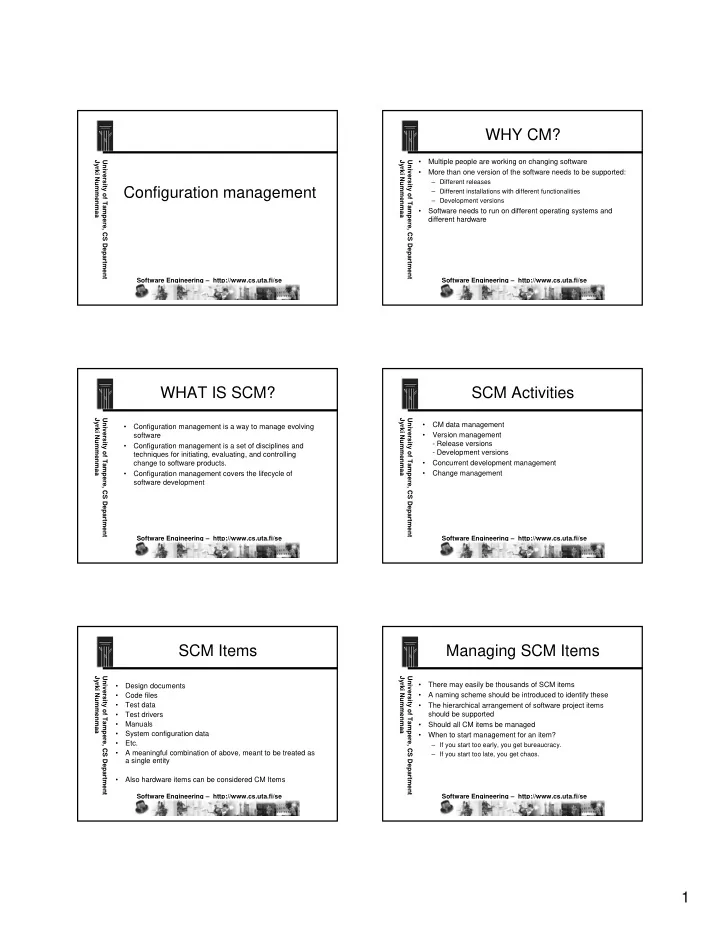
WHY CM?

  • Multiple people are working on changing software
  • More than one version of the software needs to be supported:

– Different releases – Different installations with different functionalities – Development versions

  • Software needs to run on different operating systems and

different hardware

Software Engineering – http://www.cs.uta.fi/se University of Tampere, CS Department Jyrki Nummenmaa

WHAT IS SCM?

  • Configuration management is a way to manage evolving

software

  • Configuration management is a set of disciplines and

techniques for initiating, evaluating, and controlling change to software products.

  • Configuration management covers the lifecycle of

software development

Software Engineering – http://www.cs.uta.fi/se University of Tampere, CS Department Jyrki Nummenmaa

SCM Activities

  • CM data management
  • Version management
  • Release versions
  • Development versions
  • Concurrent development management
  • Change management

Software Engineering – http://www.cs.uta.fi/se University of Tampere, CS Department Jyrki Nummenmaa

SCM Items

  • Design documents
  • Code files
  • Test data
  • Test drivers
  • Manuals
  • System configuration data
  • Etc.
  • A meaningful combination of above, meant to be treated as

a single entity

  • Also hardware items can be considered CM Items

Software Engineering – http://www.cs.uta.fi/se University of Tampere, CS Department Jyrki Nummenmaa

Managing SCM Items

  • There may easily be thousands of SCM items
  • A naming scheme should be introduced to identify these
  • The hierarchical arrangement of software project items

should be supported

  • Should all CM items be managed
  • When to start management for an item?

– If you start too early, you get bureaucracy. – If you start too late, you get chaos.

slide-2
SLIDE 2

2

Software Engineering – http://www.cs.uta.fi/se University of Tampere, CS Department Jyrki Nummenmaa

Baselines

  • Baseline: A specification or a product, which is formally

reviewed and agreed on, and which can only be changed through formal change procedures

  • Before an item becomes a baseline, changes can be made

quickly and informally.

  • Baseline is a kind of a milestone in software development
  • Baseline typically creates new versions in SCIs.

Software Engineering – http://www.cs.uta.fi/se University of Tampere, CS Department Jyrki Nummenmaa

Version control

  • Procedures and tools to manage different versions of

configuration objects

  • Versions may not always be created in sequential order,

e.g. you create 1.0 -> 1.1 -> 1.2 -> 2.0 and then you need to create 1.3 for some customers who can not run 2.0 but need some changes or improvements.

  • With big software, you may e.g have 4.0 as the official

current version. You work on 5.0 to release it as the next

  • fficial version, but you have already started to create 6.0,

as it takes so long to get it ready.

Software Engineering – http://www.cs.uta.fi/se University of Tampere, CS Department Jyrki Nummenmaa

CVS

  • Quite often versions are managed using a program / set of

utilities called CVS.

  • CVS manages versions using a space-effective way (does not

copy all things).

  • You can basically put any files into a CVS repository.
  • CVS has user and rights management.
  • CVS does not solve the problem of concurrent access to files

– It is just a version management system. – Different users can create different versions.

  • Usually CVS is accessed using a graphical user interface, like

Eclipse has one, and it allows you to e.g. synchronize your working version with the CVS repository.

Software Engineering – http://www.cs.uta.fi/se University of Tampere, CS Department Jyrki Nummenmaa

Change Control / 1

1. Need for change is recognised 2. Someone (like a user) makes a change request 3. Developer evaluates 4. Change report is generated 5. Change control authority decides

  • Change is denied -> User is informed
  • Change is accepted -> go to next slide :)

Software Engineering – http://www.cs.uta.fi/se University of Tampere, CS Department Jyrki Nummenmaa

Change Control / 2

  • 6. Change request is queued for action and and engineering

change order (technical descr) is made

  • 7. Assign individuals to make changes to configuration objects
  • 8. ”Check out” configuration items from project repository
  • > Need for controlled access to repository (e.g. CVS)!
  • 9. Make the change
  • 10. Review (audit) the change
  • 11. ”Check in” the changed configuration items
  • 12. Establish a baseline for testing the change

go to next slide :)

Software Engineering – http://www.cs.uta.fi/se University of Tampere, CS Department Jyrki Nummenmaa

Change Control / 3

  • 13. Perform quality assurance (QA) and testing activities
  • 14. ”Promote” changes for inclusionin next release
  • 15. Rebuild appropriate version of software
  • 16. Review (audit) the change to all configuration items
  • 17. Include changes in new version
  • 18. Distribute the new version
slide-3
SLIDE 3

3

Software Engineering – http://www.cs.uta.fi/se University of Tampere, CS Department Jyrki Nummenmaa

SCM Audit / 1

The following questions should be answered 1. Has the change specified in the ECO been made? Have any additional modifications been incorporated? 2. Has formal technical review been conducted to assess technical correctness? 3. Has the software process been followed and SE standards been applied? 4. Has the change been appropriately recorded in the SCIs?

Software Engineering – http://www.cs.uta.fi/se University of Tampere, CS Department Jyrki Nummenmaa

SCM Audit / 2

More questions to be answered:

  • 5. Have Software Configuration Management procedures for the

change been followed?

  • 6. Have all related SCIs been properly updated?