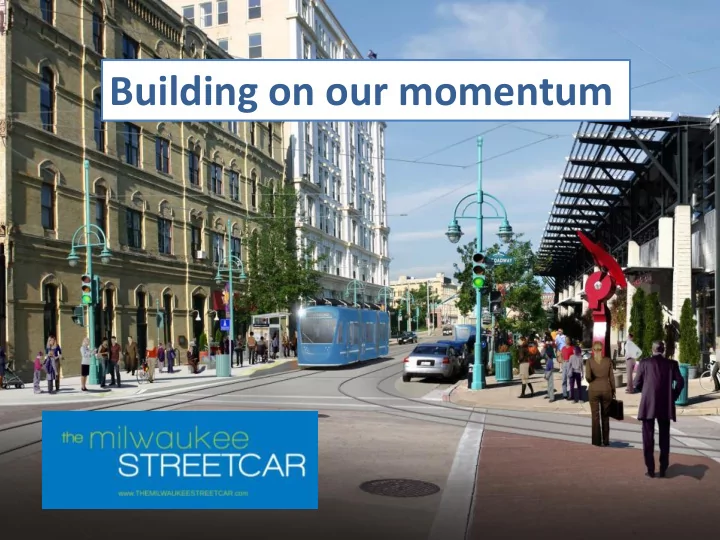
Building on our momentum Building on our momentum Three questions - - PowerPoint PPT Presentation
Building on our momentum Building on our momentum Three questions 1. Why this? 2. Why downtown? 3. Why now? Toronto Why a modern streetcar? Why? Investment and growth along and near the route. Why? Attract and retain business and
Building on our momentum
Three questions
Toronto
- 1. Why this?
- 2. Why downtown?
- 3. Why now?
Why a modern streetcar?
Why? Investment and growth along and near the route.
Why? Attract and retain business and talent.
Why? Millennials are less likely to own cars. They demand transit alternatives, prefer fixed transit.
The Young and Restless:
- 25 to 34 year olds with a
bachelor’s degree or higher level of education,
- Increasingly moving to the
close-in neighborhoods of the nation’s large metropolitan areas
- This migration is fueling
economic growth and urban revitalization.
Attitudes/location preferences of young adults
Attitudes and location preferences of young adults Change in Young and Restless in Close-in Neighborhoods, by Metro
Why? Further establish Milwaukee as a world- class city that competes globally.
Why? Improve transportation/access
Connect people to homes, jobs, attractions.
Why? Part of a comprehensive transportation strategy
Total Capital Budget for Core Infrastructure Programs 2004 - 2015
$0 $10 $20 $30 $40 $50 $60 $70 $80 $90 2004 2005 2006 2007 2008 2009 2010 2011 2012 2013 2014 2015 In Millions
Local Paving Replacement Cycle Selected Years: 2004-2014
20 40 60 80 100 120
2004 2008 2014 108 74 62
Examples of infrastructure investments that led to economic development
Commerce Street (Beerline) $1,800,568
Reflects just Commerce Street, not riverwalk or any other infrastructure.
Canal Street (Menomonee Valley) $52 million
Why? 720+ jobs from streetcar construction
Why? Workforce development and training opportunities
Commitment to Diversity
Why? Employment from ongoing investment along the route
Why downtown?
Why downtown? Simply put: “A healthy downtown with a healthy tax base helps the entire city.”
Milwaukee Journal Sentinel editorial
Why downtown? Expand throughout the community, but must start with the most successful route and highest possible ridership.
Why downtown? C.B.D. has: 80,000 workers 25,000 residents 5.5 million visitors annually = provides the strong start.
The starter route and initial extensions are within a 1/4-mile of:
- 100% hotels
- 90% occupied office
- 90% occupied retail
- 77% of parking
- 77% of housing
- 90% of major downtown attractions
- 100% of downtown’s 20 largest employers
Why downtown?
In Operation/Modern Portland: 2.4 miles/Phase I .6 miles/Riverplace Ext. .6 miles/Gibbs Ext. .4 miles/Lowell Ext. 4 miles/Eastside Loop Tacoma: 1.6 miles/Tacoma Link Seattle: 1.3 miles/Phase I 2 miles/Phase II
Examples of starter route lengths
In Operation/Modern (cont’) Tucson: 3.9 miles/Phase I In Operation/Vintage 2.4 miles/Tampa 1 mile/Kenosha 3.4 miles/Little Rock Under Construction 1.3 miles/Atlanta Phase I 2 miles/Wash., D.C. Phase I
We have the density to support fixed transit:
Fixed transit in the 40 most populated U.S. cities – 2013 Census
Density = Aver. population/square mile. Density Fixed transit
1 New York City 27,742 Yes 2 San Francisco 17,818 Yes 3 Boston 13,458 Yes 4 Chicago 11,924 Yes 5 Miami 11,601 Yes 6 Philadelphia 11,591 Yes 7 Washington 10,598 Yes 8 Long Beach 9,389 Yes 9 Los Angeles 8,282 Yes 10 Seattle 7,767 Yes 11 Baltimore 7,680 Yes 12 Minneapolis 7,409 Yes 13 Oakland 7,255 Yes 14 Milwaukee 6,241 In planning 15 San Jose 5,641 Yes 16 Cleveland 5,001 Yes 17 Detroit 4,955 Under Constr. 18 Sacramento 4,895 Yes 19 Portland 4,582 Yes 20 Fresno 4,553 No
Density Fixed transit
21 Las Vegas 4,437 Monorail 22 Denver 4,245 Yes 23 San Diego 4,172 Yes 24 Arlington, TX 3,954 Yes 25 Columbus 3,791 In planning 26 Dallas 3,688 Yes 27 Houston 3,660 Yes 28 Omaha 3,420 In planning 29 Atlanta 3,367 Yes 30 Mesa 3,365 In planning 31 San Antonio 3,056 No 32 Raleigh 3,019 No 33 Austin 2,971 Yes 34 Albuquerque 2,960 Yes 35 Phoenix 2,927 Yes 36 Charlotte 2,661 Yes 37 El Paso 2,645 No 38 Wichita 2,431 No 39 Indianapolis 2,336 Yes 40 Fort Worth 2,332 Yes
Why now?
We have the funding and, hopefully, civic and political will.
Costs Amount Maintenance Facility $7.5 m 4 Vehicles $17.6 m Phase 1: Blue Line Tracks/Stops/Systems $73.8 m Phase 2: Lakefront Tracks/Stops/Systems $25.0 m Total Costs $123.9 m Sources Amount Federal: ICE Funding (Existing) $54.9 m Federal: TIGER application (New) $10.0 m Local: Cathedral Square TID (Existing) $9.7 m Local: Amend Erie St. TID 56 to 19 years (New) $18.3 m Local: East Michigan TID @ 19 years (New) $31.0 m Total Source of Funds $123.9 m
Why now?
Why now? Project held up by utility issue. State law exists – although under appeal – we are moving ahead.
New lakefront line connects new developments in that area and across downtown.
Why now?
Milwaukee Journal Sentinel editorial: “Milwaukee has a choice to make, and it shouldn't be a hard one: Remain a transport backwater or get on board along with many other cities that understand the benefits of a modern system. We support a streetcar line for downtown.” Milwaukee Business Journal editorial: “But if Milwaukee finally wants to do something to improve its public transportation system, aldermen need to approve Barrett's request and finally get the project underway. The streetcar is not the only way to improve the region's transit system, but, as we have said before, it is a good first step and has been successful in other cities.” Milwaukee Magazine Kurt Chandler (about a downtown boom): “So here’s to bold ideas. We’re hoping the city leaders have learned from past mistakes and can overcome their long-held aversion to taking calculated risks.”
Why now?
Next Steps
- Ongoing Public Outreach
- Vehicle Selection - 2015
- Final Design - 2015
- Construction – 2015-2017
- Streetcar Operations –