Whole Numbers Jumping Jack Snap Game (numeral Cluedo Numerals! - - PDF document

whole numbers
SMART_READER_LITE
LIVE PREVIEW

Whole Numbers Jumping Jack Snap Game (numeral Cluedo Numerals! - - PDF document

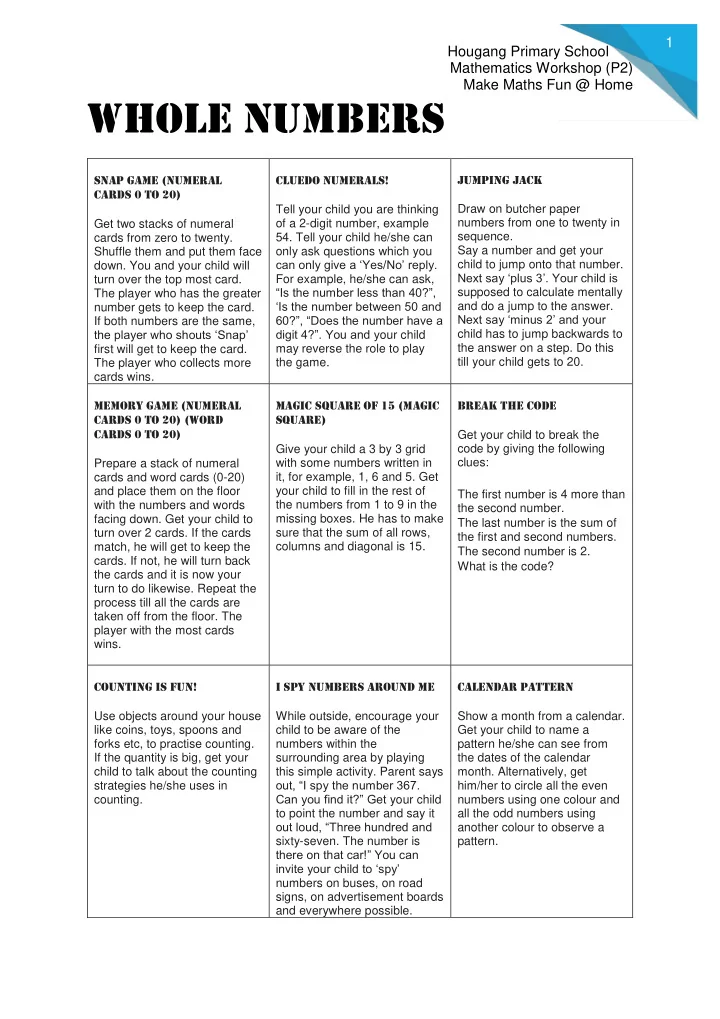
1 Hougang Primary School Mathematics Workshop (P2) Make Maths Fun @ Home Whole Numbers Jumping Jack Snap Game (numeral Cluedo Numerals! cards 0 to 20) Tell your child you are thinking Draw on butcher paper numbers from one to twenty in


slide-1
SLIDE 1

1 Hougang Primary School Mathematics Workshop (P2) Make Maths Fun @ Home

Whole Numbers

Snap Game (numeral cards 0 to 20) Get two stacks of numeral cards from zero to twenty. Shuffle them and put them face

  • down. You and your child will

turn over the top most card. The player who has the greater number gets to keep the card. If both numbers are the same, the player who shouts ‘Snap’ first will get to keep the card. The player who collects more cards wins. Cluedo Numerals! Tell your child you are thinking

  • f a 2-digit number, example
  • 54. Tell your child he/she can
  • nly ask questions which you

can only give a ‘Yes/No’ reply. For example, he/she can ask, “Is the number less than 40?”, ‘Is the number between 50 and 60?”, “Does the number have a digit 4?”. You and your child may reverse the role to play the game. Jumping Jack Draw on butcher paper numbers from one to twenty in sequence. Say a number and get your child to jump onto that number. Next say ‘plus 3’. Your child is supposed to calculate mentally and do a jump to the answer. Next say ‘minus 2’ and your child has to jump backwards to the answer on a step. Do this till your child gets to 20. Memory Game (numeral cards 0 to 20) (word cards 0 to 20) Prepare a stack of numeral cards and word cards (0-20) and place them on the floor with the numbers and words facing down. Get your child to turn over 2 cards. If the cards match, he will get to keep the

  • cards. If not, he will turn back

the cards and it is now your turn to do likewise. Repeat the process till all the cards are taken off from the floor. The player with the most cards wins. Magic Square of 15 (magic square) Give your child a 3 by 3 grid with some numbers written in it, for example, 1, 6 and 5. Get your child to fill in the rest of the numbers from 1 to 9 in the missing boxes. He has to make sure that the sum of all rows, columns and diagonal is 15. Break the Code Get your child to break the code by giving the following clues:  The first number is 4 more than the second number.  The last number is the sum of the first and second numbers.  The second number is 2.  What is the code? Counting is Fun! Use objects around your house like coins, toys, spoons and forks etc, to practise counting. If the quantity is big, get your child to talk about the counting strategies he/she uses in counting. I Spy Numbers Around Me While outside, encourage your child to be aware of the numbers within the surrounding area by playing this simple activity. Parent says

  • ut, “I spy the number 367.

Can you find it?” Get your child to point the number and say it

  • ut loud, “Three hundred and

sixty-seven. The number is there on that car!” You can invite your child to ‘spy’ numbers on buses, on road signs, on advertisement boards and everywhere possible. Calendar Pattern Show a month from a calendar. Get your child to name a pattern he/she can see from the dates of the calendar

  • month. Alternatively, get

him/her to circle all the even numbers using one colour and all the odd numbers using another colour to observe a pattern.

slide-2
SLIDE 2

2 Hougang Primary School Mathematics Workshop (P2) Make Maths Fun @ Home

Multiplication/ Division/Fraction

Beannie Shares! Pick a handful of beans and put them on a table. Then count the number of beans without moving them. Next, tell your child that the winner is the

  • ne who is able to put the

beans into equal groups in the fastest possible time. Try with different number of beans. In situations where they cannot be put into equal groups, get your child to explain. For example, 19 cannot be put into groups of 2, there will be one extra leftover. Skip Count We Go! Tell your child you are learning multiplication tables with him/her. Say you start with multiplication table of 3. So, you start with ‘1’, your child will say ‘2’. When it is your turn, you will say ‘skip’ instead of ‘3’. Then your child will continue with ‘4, you ‘5’ and then your child will say ‘skip’ instead of 6. Each time either one of you reaches multiples of 3, say ‘skip’ instead of the answer. Try it out with other multiplication tables. 7-UP You and your child will take turns to say a number, starting from 1. When it is a multiple of 7, either of you will say ‘7-UP’. You will start from 1 again if you forget to say that. Try to set a time limit for both

  • f you to complete the game

from number 1 to 84. Egg Carton Multiplication Give your child a simple problem like 3 x 4. Explain to them that this is asking for 3 groups of 4 items. Have your child put 4 Cheerios into 3 of the egg carton slots. Have them count the total number of Cheerios in all of the slots. Egg Carton Division Give your child a simple division problem like 8 ÷ 4. Give them 8 Cheerios and explain that they need to be put into four of the slots. They can do this easily by putting

  • ne Cheerio at a time into each

slot until they are used up. Now ask them how many Cheerios are in one of the

  • slots. Explain that this is the

answer to the problem. House of (3) Tables Draw a house on a sheet of construction paper. Include a door and 13 windows. Label each window 0 to 12. Write on the door the multiplication table eg, three. Cut each window along any three sides. Next paste the house onto another construction paper. Open each window and write the answer for each multiplication table of

  • 3. For eg, the Window 5 will

have the answer 15. Use it to test your child‘s multiplication facts. Fraction Fruit Salad Get your child to cut up different kinds of fruits into halves, quarters, eights etc. Get your child to say the fraction as he savours the different fractioned fruits. Fraction chocolate bar Get a bar of chocolate. Encourage your child to divide the chocolate into ½ , ¼ etc. Math Bingo Create a 5 by 5 grid of different multiplication or division equations such as 4x2, 3x5, 10x8 etc Say out different numbers (answers to the multiplication/division equations) to get your child to make a row and win the BINGO game. Fraction Food Use Fraction terms as you cut up food like pies, pizza, cake. Start with: This is a whole __. Let’s divide or share it into _ pieces the same size. Each piece is the same size and part of the whole ___. Use the terms, whole, part of a whole, part of a set, equal, not equal, the same as, not the same as, half, halves, third, thirds, fourth, fourths, a quarter as you play with the children.

slide-3
SLIDE 3

3 Hougang Primary School Mathematics Workshop (P2) Make Maths Fun @ Home

Money / Geometry

Shopping is Fun! Get your child to help you in grocery shopping the next time you visit a supermarket. Pass him/her your grocery list. Get him/her to estimate the bill before paying for the groceries. Get him/her every opportunity to sharpen his/her estimation skills! Money, Money, Money Take some coins from your coin box. Get your child to form the least/most amount he/she can make with 5 coins. Alternatively, get him/her to show the different ways to form $1 with the coins given. My Little Shop You can get your child to set up a toy shop to sell his toys to his family members/friends. You can help him to determine the cost of the items. Each friend or family member will be given $20 to spend. Cut Me Out! Demonstrate to your child how to do a symmetrical cut-out. An example is shown below. Get them to tell you where the lines

  • f symmetry are.

Shapes in Our House and Everywhere! To get your child to recognise shapes (e.g. rectangle, square, triangle and circle), invite your child to identify objects within the house that has the shape that he/she learns in school. Encourage your child to outline the shape with his/her finger and talk about the shape on the object. Possible questions that you may ask; “What shape is it? Are there other shapes that you can find from this

  • bject and can you show them

to me?” You can extend this activity by inviting your child to group the objects that have been identified according to the shapes. While outdoors, provide the

  • pportunity to get your child to

recognise the shapes within his/her surrounding. Blind But I See! Blindfold your child. Tell your child you have a picture in mind for him/her to draw. Describe the picture in details using words such as ‘There is a circle. Inside the circle, there are two triangles that look like

  • eyes. There is a square just

below the circle. It is joined to the circle. Inside the square, there is a small rectangle. On the left side of square there is a circle drawn next to it.” Once the drawing is done, remove your child’s blindfold, show him/her your actual drawing. You and your child may reverse the role to play this game and have a good laugh. Angles, Angles, Everywhere! Ask your child to point out

  • bjects in the house that have

angles greater than 90º, less than 90º or exactly 90º Tracing Fun Give your child 3-D objects such as chocolate boxes, tins, gift boxes and containers. Lay each object with the flat surface on paper. Trace out the shape and get him/her to name and describe the shape. I am a Great Saver! Show your child a newspaper article on different sale items. You can get them to calculate the original price of the items

  • r the amount saved.
slide-4
SLIDE 4

4 Hougang Primary School Mathematics Workshop (P2) Make Maths Fun @ Home

Measurement (Length, Mass, Volume, Time)

Cook it Right Parents can get children to help out in the kitchen when cooking a meal or baking some

  • cookies. Involve your child in

measuring the amount of ingredients needed by using measuring cups and weighing

  • scales. The actions of

measuring the ingredients required will help your child to strengthen his/her estimation skills in Mathematics. Talk to your child about the appropriate measures, the abbreviations (e.g. g, kg, l and ml) and the mass (e.g. in terms

  • f heavy, light, more and less

than). Flour Fun! Get your child to scoop a tablespoon filled with flour. Next, weigh the flour. It should weigh about 25 grams. Look at a baking recipe. The mass of flour required should be in multiplies of 25, i.e. 100g, 125g, 150g, etc. Ask your child to scoop the approximate mass

  • f flour required for a recipe. If

the recipe requires 150g of flour, your child should tell you that he/she should scoop 6 tablespoons of flour. Then, get your child to weigh the flour to

  • check. The mass should be

about 150g. Baking is Fun! Look at a baking recipe. Usually, the recipe may state the number of servings. Supposedly, the recipe states the amount of each ingredients required for 5 serves. Tell your child that he/she and you are baking cakes for 10 people, get him/her to work out the amount

  • f each ingredients in

preparation for baking. Tell Me the Time Build the positive habit of getting your child to tell you the time when doing the daily activities together. Possible scenario; “We are leaving at 1 p.m. for lunch and we need half an hour to get ready, how much time do we have now?” Parents can also take the

  • pportunity to talk about time in

terms of seconds, minutes and hours. This activity can also be applied when you get your child to talk about days, months and years. Possible scenarios; “It is 2 weeks before your birthday can you tell me how many days that would be?” As tall as me! Get your child to measure his

  • height. Encourage him to

compare heights of different

  • items. Get your child to use

terms like as tall as me, shorter than, taller than, double my height Units of Measurement Use different items around the home to measure out length or heights of objects. For example, find out how many spoons make up the length of the coffee table.