Who Are We? Naturopathic Doctors 4-year doctorate program - - PDF document

who are we
SMART_READER_LITE
LIVE PREVIEW

Who Are We? Naturopathic Doctors 4-year doctorate program - - PDF document

Who Are We? Naturopathic Doctors 4-year doctorate program Licensed in 16 states Correcting Insulin Resistance: Holistic Natural Health Care Preventing and Treating Chronic Stimulate and support the bodys own healing


slide-1
SLIDE 1

1

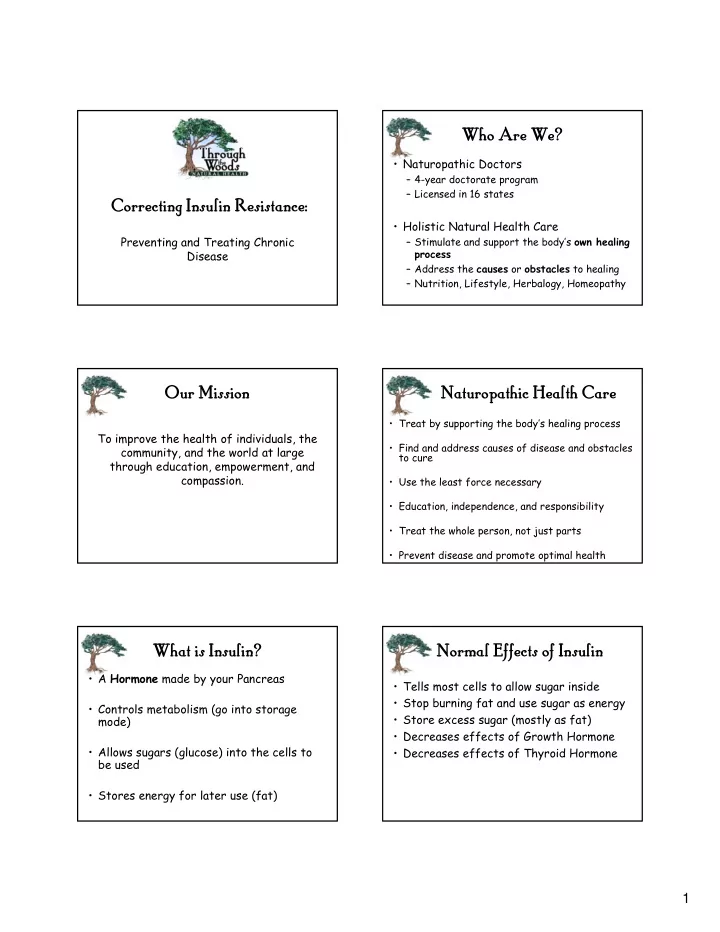
Correcting Insulin Resistance:

Preventing and Treating Chronic Disease

Who Are We?

  • Naturopathic Doctors

– 4-year doctorate program – Licensed in 16 states

  • Holistic Natural Health Care

– Stimulate and support the body’s own healing process – Address the causes or obstacles to healing – Nutrition, Lifestyle, Herbalogy, Homeopathy

Our Mission

To improve the health of individuals, the community, and the world at large through education, empowerment, and compassion.

Naturopathic Health Care

  • Treat by supporting the body’s healing process
  • Find and address causes of disease and obstacles

to cure

  • Use the least force necessary
  • Education, independence, and responsibility
  • Treat the whole person, not just parts
  • Prevent disease and promote optimal health

What is Insulin?

  • A Hormone made by your Pancreas
  • Controls metabolism (go into storage

mode)

  • Allows sugars (glucose) into the cells to

be used

  • Stores energy for later use (fat)

Normal Effects of Insulin

  • Tells most cells to allow sugar inside
  • Stop burning fat and use sugar as energy
  • Store excess sugar (mostly as fat)
  • Decreases effects of Growth Hormone
  • Decreases effects of Thyroid Hormone
slide-2
SLIDE 2

2

When is Insulin Released?

  • In response to sugar entering the blood.

– This occurs after eating carbohydrates – Any carbohydrates!! Complex carbohydrates increase insulin levels. – Complex carbohydrates mixed with fat and protein slows down absorption the most.

  • Slower absorption means less insulin at once.
  • Also occurs some in response to sweet

tastes.

Insulin Resistance

  • The cells that require insulin stop

listening.

  • Like my response to telemarketers
  • Eventually develop type 2 diabetes if not

checked.

Problems with High Insulin

  • Abdominal weight gain
  • Wasting of lean muscle mass (weakness)
  • Increased inflammation
  • Increased rates of heart disease
  • Increased tumor formation and growth
  • Oxidation of tissues not resistant to

insulin (kidney, eyes, nerves, blood vessels)

Problems with High Insulin (continued)

  • Inhibits thyroid hormone (fatigue, weight

gain, dry skin, etc)

  • Inhibits growth hormone (decreased

repair)

  • High uric acid levels (gout)
  • Vision changes (especially near-sighted)
  • Acne
  • Early menarche
  • Excessive bone growth (really tall people)

Heart Disease

  • Increased inflammation
  • Thickening of blood
  • Increased triglycerides and low HDL in

blood

  • Smaller LDL particle size
  • These lead to plaques and inflammation in

the arteries and eventually heart attack and/or strokes.

Cancer

  • High insulin leads to increased oxidation which

increases likelihood of a cancerous cell forming.

  • Insulin-like growth factor-1 (IGF-1) increases

growth of cancers

  • Increased insulin and IGF-1 associated with

cancers of breast, prostate, colon, endometrium (uterus)

  • Also associated with benign growth such as

uterine fibroids and enlarged prostate

slide-3
SLIDE 3

3

Causes of Insulin Resistance

  • Genetic predisposition

– 25% highly-prone, 40% moderately prone

  • Too much carbohydrate in the diet
  • Decreased binding on cell membranes:

– Deficiency of omega-3 fats in the diet – High omega-6:omega-3 ratio

  • Too many vegetable oils and processed food

– Trans-fatty acids

Causes of Insulin Resistance

  • Vitamin and mineral deficiencies

(especially chromium)

  • Lack of exercise
  • Stress
  • Lack of sleep
  • Nicotine

Causes of Insulin Resistance

Summary: Insulin resistance is the result of our sugar addicted, sedentary, stressful lifestyles while eating highly processed, nutrient depleted foods. “Earth should be renamed Sucrosia”

  • Paul Bergner

Correcting Insulin Resistance

  • Live more like our distant (or not so distant)

ancestors:

– Eat real foods – Exercise daily – especially burst exercise – Eat (or supplement) small amounts of omega-3 fatty acids – Eat plenty of saturated fats – Decrease stress levels – Get plenty of sleep – Eat or supplement chromium, magnesium, zinc, and B- vitamins – Stop smoking

Exercise

  • Get up and move!!

– Especially 1-2 hours after a meal. – Burst exercise almost instantly removes glucose and insulin from the blood

  • Fast walk up a hill
  • Sprinting
  • Intense calisthenics

– Muscles that get used become less insulin resistant.

Stress and Sleep

  • Take a walk, exercise, prayer, meditation,

quality leisure time, journaling.

– Stress increases cortisol levels which directly increases glucose and insulin levels

  • Sleep deprivation has a direct effect on

insulin resistance

– Some people need 9 hours.

slide-4
SLIDE 4

4

Vitamins and Minerals

  • Chromium is required for binding of

insulin to cells—it is the only known use of chromium

  • Zinc, magnesium, and B-vitamins are

directly or indirectly related to insulin’s proper function.

  • Get these in your food or supplement

Stop Smoking

  • Nicotine increases insulin resistance

– This is a major reason nicotine increases risk

  • f heart disease and cancer (among other

things)

Conclusion

Correcting insulin resistance is a journey requiring major changes in lifestyle, kicking bad habits and addiction, and getting off the couch to get some exercise. You will be living as people are supposed to live and eat as people are supposed to eat.

Resources

  • My Handout – overall summary of today’s

topics

  • The Schwarzbein Principle by Diana

Schwarzbein

– My recommended book on understanding insulin-resistance, its effects on your health, and correcting it using diet – I disagree with her regarding hormone- replacement therapy, soy, and a few other topics

Intermission Real Foods

  • Real foods as our ancestors ate:

– Truly organic and its equivalent – Animals that live like the animal should live

  • Grass-fed beef, free-roaming poultry (and their eggs), wild

fish, wild game, some dairy

– Lots of vegetables from nutrient-dense soils

  • Especially greens

– Whole fruits in season especially the berries – Beans and grains soaked and slow-cooked – Nuts and seeds – Nutritious broths – Undamaged natural fats and oils (olive, coconut, butter, animal fats)

slide-5
SLIDE 5

5

Balanced Diet

What would you eat if there were no grocery stores? Lots of greens, roots, meat, eggs, fish, some grains and beans, berries in season or dried in small amounts, seeds Bread is a luxury that requires lots of work. It would be a rare treat. I highly disagree with the food pyramid—eating their recommended carbohydrates leads to insulin resistance and diabetes.

Fats

  • Get omega-3 fats in your diet:

– Cod-liver oil (with vitamin D) – Fish oil – Flax seeds – Walnuts – Wild cold-water fish (salmon, halibut, tuna) – Free-roaming chicken eggs

  • Get plenty of traditional saturated fats

– Coconut, butter, animal fats

  • Builds strong cell membranes that allow binding
  • f insulin
  • Avoid refined vegetable oils (corn, soy,

cottonseed, canola, safflower)

Carbohydrates

  • Eat low-glycemic foods and only with

protein and fat

  • Carbohydrate functions mainly as fuel.
  • Carbohydrate intake should depend on

activity levels and conditioning.

0-15 0-15 7.5-15 7.5 Snack 30-40 15-30 15 15 Meal Overweight especially around midsection 0-7.5 0-15 0-15 7.5-15 Snack 45-60 30 15-30 15 Meal Slightly overweight

  • esp. around midsection

0-15 0-7.5 0-7.5 15 Snack 45-60 30-45 30 15-30 Meal Normal Body Composition with fat around midsection 0-30 0-30 0-7.5 0-7.5 Snack 45-75 30-60 30-45 30 Meal Normal Body Composition 0-30 0-30 0-15 0-15 Snack 45-80 30-60 30-45 30 Meal Underweight Extremely Active Active Somewhat Active Sedentary

Carbohydrate Table Sample Breakfast

  • ½ cup cooked corn grits
  • 2 pasture-raised eggs (cooked in organic

butter)

  • ½ cup sautéed collards (also cooked in

butter)

  • 15 grams of carbohydrate total

Sample Lunch

  • Stew with:

– 1/3 cup of soaked and cooked navy beans – 2-3 ounces grass-fed beef – Stewed onion, carrot, celery, and beet greens – Seasoned with plenty of herbs and spices

  • Salad of lettuce, grated beets, carrots, and

celery root

– Dressing of olive oil, balsamic vinegar, mustard, and herbs

  • 15 grams of carbohydrate
slide-6
SLIDE 6

6

Sample Dinner

  • 1/3 cup cooked brown rice
  • Lots of sautéed or steamed vegetables
  • Organic or pasture-raised chicken breast

sautéed or baked with the skin (we want that fat)

  • Add a handful of dried cranberries or raisins
  • 15 grams carbohydrate (a little more with the

cranberries)

Getting Started

  • Start with one meal (breakfast)

– Think about what you eat right now – Total the carbohydrates – Adjust the recipe/menu to keep the carbohydrates at an appropriate level

  • If that is not possible, abandon that menu

– Add in good fats and proteins to keep the calories high enough so you are satisfied

What about Dessert?

  • Get some sweet with your meals and you will

have less cravings for sugar.

  • Choose desserts that have plenty of good fats

to offset the sugar.

– Homemade cheese cake – Nuts with dried fruit – Homemade ice cream – Fresh fruit and yogurt sweetened with maple syrup

  • Eat dessert occasionally and enjoy the heck out
  • f it.

Any Questions? Resources

  • My Handouts – overall summary of today’s

topics along with carbohydrate tables

  • The Schwarzbein Principle by Diana

Schwarzbein

– My recommended book on understanding insulin-resistance, its effects on your health, and correcting it using diet – I disagree with her regarding hormone- replacement therapy, soy, and a few other topics

  • Nourishing Traditions by Sally Fallon

Glenn Ingram, ND Marty Ingram, ND

828-233-5576 naturedocs@throughwoods.com www.throughwoods.com