
SLIDE 1
Center for Direct Catalytic Conversion of Biomass to Biofuels - - PowerPoint PPT Presentation
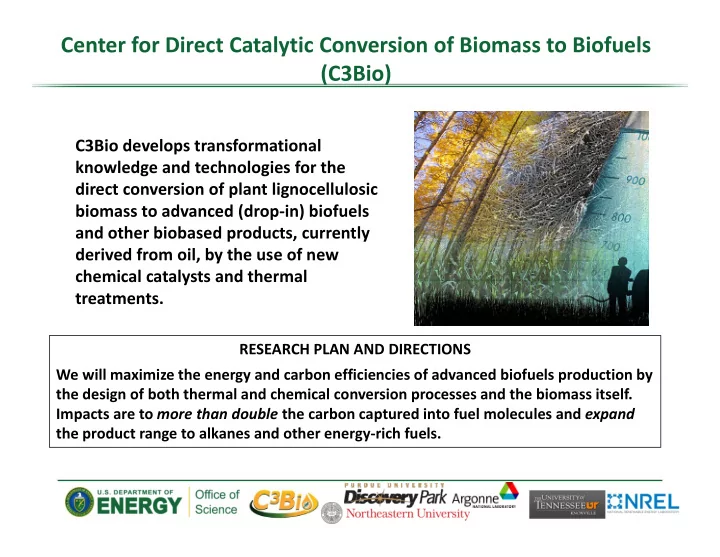
Center for Direct Catalytic Conversion of Biomass to Biofuels (C3Bio) C3Bio develops transformational knowledge and technologies for the direct conversion of plant lignocellulosic biomass to advanced (drop in) biofuels and other biobased
Donohoe, B. S.; Ciesielski, P. N.; and Vinzant, T. B. PRESERVATION AND PREPARATION OF LIGNOCELLULOSIC
BIOMASS SAMPLES FOR MULTI‐SCALE MICROSCOPY ANALYSIS, In: Michael E. Himmel (ed.), Biomass
Conversion: Methods and Protocols, Methods in Molecular Biology, 908, 31‐47 (2012). [10.1007/978‐1‐61779‐956‐3_4] Work was performed at NREL
‐ NREL’s Biomass Surface Characterization Laboratory (BSCL) is a leader in multi‐scale microscopic structural analysis of biomass conversion processes. ‐ C3Bio enabled a critical transition in the BSCL workflow to include quantitative image analysis as the final goal of all imaging efforts. ‐ The impact quantitative image analysis has had on informing sample prep and image acquisition is reflected in this chapter.
staining' solu+on' deionized' water' mul+2 grid' holder' staining' bath'''
a" b c b a
water(convec, on(pla/ orm( vacuum chamber thermocouple sample chambers drying chamber hot(and(cold(water( controllers CO2 cylinder water(chiller water(heater condenser( chamber
Vinueza, N.R., Gallardo, V.A., Klimek, J.F., Carpita, N., and Kenttämaa, H.I. ANALYSIS OF CARBOHYDRATES BY ATMOSPHERIC PRESSURE CHLORIDE ANION ATTACHMENT TANDEM MASS SPECTROMETRY, Fuel, 105, 235‐246 (2013). Work was performed at Purdue University
‐ Used linear quadrupole ion trap and a variety of ionization methods to ionize pure carbohydrates ‐ After identification of the best ionization method, examined known mixtures of carbohydrates ‐ Measured tandem mass spectra up to MS4 to gather useful structural information from the fragmentation patterns of the carbohydrates
140 160 180 200 220 240 260 280 300 320 340 360 380 400 m/z 10 20 30 40 50 60 70 80 90 100 377 215 185 379 217 187 161
[M+ 35Cl]¯ [M+ 35Cl]¯ [M+ 35Cl]¯ Fructose Cellobiose Xylose Relative Abundance [C6H9O5]¯
Isolation of ion of m/z 377 followed by fragmentation Chloride anion attachment mass spectrum for a mixture of three compounds (35Cl and 37Cl Isotopes facilitate Identification)
Fructose
A porphyrin‐based porous organic polymer (POP) loaded with Fe3+ catalyst is a thermally stable and recyclable catalyst for oxidation of hydroxymethylfurfural (HMF) to 2,5‐furandicarboxylic acid (FDCA) in water using molecular oxygen.
converts glucose in non‐crystalline polymers in biomass to HMF.
with >85% selectivity in water under mild reaction conditions.
catalysis and metal does not leach into solution.
derived terephthalic acid for polyester production.
Saha, B.; Gupta, D.; Abu‐Omar, M. M.; Modak, A.; and Bhaumik, A. PORPHYRIN
BASED POROUS ORGANIC POLYMER SUPPORTED IRON(III) CATALYST FOR EFFICIENT AEROBIC OXIDATION OF 5‐HYDROXYMETHYLFURFURAL INTO 2,5‐FURANDICARBOXYLIC ACID. Journal
[10.1016/j.jcat.2012.12.024] Work was performed at Purdue University and University of Delhi. Catalyst was prepared by collaborator at Indian Association for the Cultivation
Before catalysis After catalysis
20 40 60 80 100 120 2 4 6 8 10 12 HMF conversion and product distribution, % Time, h
O COOH HOOC O CHO HOOC O CHO HO O CHO CHO
which self‐assemble to larger sizes.
mechanism with the formation of peroxyl radical in the catalytic cycle.
Significance and Impact
Ciesielski, P. N.; Matthews, J. F.; Tucker, M. P.; Beckham, G. T.; Crowley, M. F.; Himmel, M. E.; Donohoe, B. S. 3D ELECTRON TOMOGRAPHY OF PRETREATED BIOMASS INFORMS ATOMIC MODELING OF CELLULOSE MICROFIBRILS. ACS Nano, 7, 8011‐8019. 2013. DOI: 10.1021/nn4031542. Work performed at the National Renewable Energy Laboratory The radius of curvature of the microfibrils was measured from the fitted curves. Atomistic models were constructed using the extracted geometric parameters. Kink defects were predicted in the atomic models when the fibril was bent about certain crystallographic directions. Tomographic subvolumes showing space curves fit to cellulose microfibrils (scale bars 10 nm)
Averagae radius of curvature (nm)
Original atomic coordinates Energy‐minimized atomic coordinates
A combined Zn/Pd/C catalyst effectively cleaved the lignin β‐O‐4 linkage and subsequently hydrodeoxygenated the aromatic fragments without loss of aromatic functional groups. The catalyst is robust and fully recyclable without the need for additional zinc.
The β‐O‐4 linkage is the most abundant repeating subunit of the lignin macromolecule. Devising a catalyst that can selectively cleave this type of ether linkage and undergo hydrodeoxygenation provides a means of unzipping the very complex polymeric structure into smaller, manageable molecules that have higher energy value.
Parsell TH, Owen BC, Klein I, Jarrell TM, Marcum CL, Haupert LJ, Amundson LM, Kenttämaa HI Ribeiro F, Miller JT, Abu‐ Omar MM. Cleavage and hydrodeoxygenation (HDO) of C–O bonds relevant to lignin conversion using Pd/Zn synergistic catalysis. Chem. Sci., 4, 806‐813 (2013). [10.1039/C2SC21657D] Work was performed at Purdue University and Argonne National Lab
− In a typical experiment: substrate, 5 wt% Zn/Pd/C, and methanol (15 mL) were added to a dry glass sleeve, placed into a stainless steel Parr reactor and sealed. While stirring, the mixture was purged with UHP grade H2 for ca. 1–2 min., pressurized with H2 (30–300 psi, 2–20.4 bar), and heated to 150⁰C. − The monomeric lignin surrogate substrates were 4‐(hydroxymethyl)‐2‐methoxyphenol, 4‐hydroxy‐3‐ methoxybenzaldehyde, and 4‐(methoxymethyl)‐2‐methoxyphenol. The dimeric lignin surrogate was guaiacylglycerol‐β‐guaiacyl. − Reaction products were characterized using HPLC coupled to an LQIT mass spectrometer equipped with an ESI source using negative ion mode.
‐ Cedeno, D.; Bozell, J. J.; Tetrahedron Lett. 2012, 53, 2380‐2383. ‐ Biannic, B.; Bozell, J. J. manuscript in preparation Work was performed at: University of Tennessee, Center for Renewable Carbon
‐ Previous studies from our laboratory showed that G lignin models undergo oxidation in presence
‐ This new unsymmetrical Co‐salen catalyst oxidizes each of the lignin primary units. ‐ The catalyst contains an internal nitrogen ligand (needed for S and G subunits) and an internal bulky base (needed for G subunit). ‐ An efficient protecting group‐free strategy for the synthesis of lignin models has also been developed.
L i g n i n M o d e l s L i g n i n M o d e l s H i g h V a l u e C h e m i c a l s H i g h V a l u e C h e m i c a l s
!"#$% & #' ( ) *+ ,& ‐ "% ,% *+ & . % /( "% & + 0% & "% #$1( *&
23&
45 ' % * 5 ( *& 6 ' 7 &
28
OH O O
Diana C, and Bozell JJ. Catalytic oxidation of para‐substituted phenols with cobalt‐ Schiff base complexes/O2 ‐ selective conversion of syringyl and guaiacyl lignin models to benzoquinones. Tetrahedron Letters 53, 2380‐2383 (2012). Work was performed at the University of Tennessee, Knoxville Center for Renewable Carbon
₋ In order to assess the involvement of the sterically hindered base, we studied the interaction between DIPEA and Co(salen) using NMR and UV–vis spectroscopy ₋ Although S subunit models from guaiacyl unit models were easily converted into their corresponding p‐quinones, the same approach with vanillyl alcohol, a model of the G subunit, gave the corresponding 2‐methoxybenzoquinone in only 21% yield. G models are more difficult to oxidize than S models because formation of the key phenoxy radical is slower. ₋ Molecular modeling studies (DFT) have provided new insight into the mechanism and its control ₋ Mass spectrometry development at Purdue has identified new products resulting from lignin oxidation
Wegenhart, Benjamin L.; Liu, Shuo; Thom, Melanie; Stanley, David; and Abu‐Omar, Mahdi M. SOLVENT‐FREE METHODS FOR MAKING ACETALS DERIVED
FROM GLYCEROL AND FURFURAL AND THEIR USE AS A
BIODIESEL FUEL COMPONENT, ACS Catalysis, 2, 2524‐ 2530 (2012). [10.1021/cs300562e] Work was performed at Purdue University
‐ Reactions between furfural and glycerol are performed at 100°C with a five‐ fold excess of furfural, allowing for yields up to 90% ‐ The addition of a dry stream of nitrogen purging the headspace improves yields and allows for a reduced excess of furfural ‐ The novel reaction methods are applicable to crude glycerol ‐ Acetal products were successfully hydrogenated and acetylated, and the resulting material tested as fuel additives in biodiesel