Where does the clot go? (products include the HeRO graft) Back - - PowerPoint PPT Presentation

where does the clot go
SMART_READER_LITE
LIVE PREVIEW

Where does the clot go? (products include the HeRO graft) Back - - PowerPoint PPT Presentation

4/17/2015 DISCLOSURES Speaker and consultant to Cryolife Where does the clot go? (products include the HeRO graft) Back table or the pulmonary Speaker for Gore (products included circulation - an argument for dialysis access grafts and


slide-1
SLIDE 1

4/17/2015 1

Where does the clot go?

Back table or the pulmonary circulation - an argument for commonsense

Stephen E. Hohmann, MD FACS Vascular Surgeon Baylor University Medical Center Dallas, Texas

DISCLOSURES

  • Speaker and consultant to Cryolife

(products include the HeRO graft)

  • Speaker for Gore (products included

dialysis access grafts and stents)

Neither of these will be discussed in this presentation

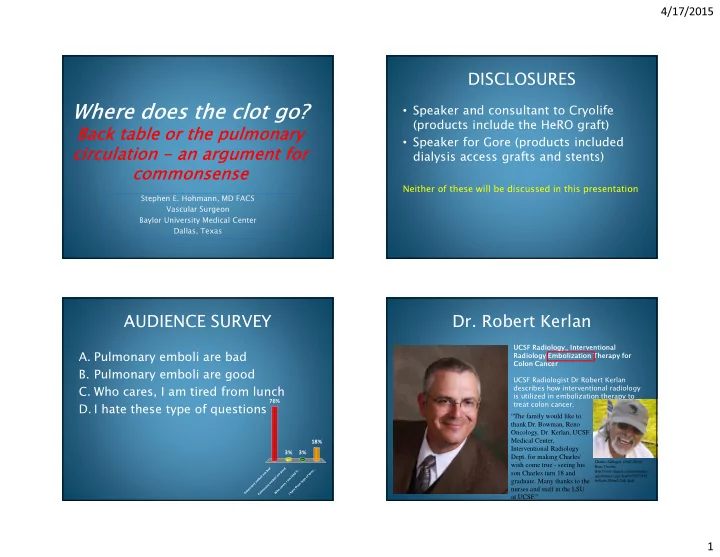
AUDIENCE SURVEY

  • A. Pulmonary emboli are bad
  • B. Pulmonary emboli are good
  • C. Who cares, I am tired from lunch
  • D. I hate these type of questions

P u l m

  • n

a r y e m b

  • l

i a r e b a d P u l m

  • n

a r y e m b

  • l

i a r e g

  • d

W h

  • c

a r e s , I a m t i r e d f r . . I h a t e t h e s e t y p e

  • f

q u e s . . .

76% 18% 3% 3%

  • Dr. Robert Kerlan

UCSF Radiology_ Interventional Radiology Embolization Therapy for Colon Cancer UCSF Radiologist Dr Robert Kerlan describes how interventional radiology is utilized in embolization therapy to treat colon cancer. “The family would like to thank Dr. Bowman, Reno Oncology, Dr. Kerlan, UCSF Medical Center, Interventional Radiology

  • Dept. for making Charles'

wish come true - seeing his son Charles turn 18 and

  • graduate. Many thanks to the

nurses and staff in the LSU at UCSF.”

Charles Gallegos (1947-2014) Reno Gazette http://www.legacy.com/obituaries/ rgj/obituary.aspx?pid=170573181 #sthash.Z8mxC2mk.dpuf

slide-2
SLIDE 2

4/17/2015 2

Clinical Professor Department of Radiology President-Elect, UCSF Medical Staff

  • Dr. Robert Kerlan is the Chief of Interventional Radiology. He is particularly

interested in the management of liver disease, including biliary disease, portal hypertension and hepatic malignancy. In his research, he is working to develop new procedures to diagnose and treat patients with problems related to living donor organ transplants. His UCSF campus-wide service memberships include the Surgical Case and Hospital Mortality Review Committee (SCHMRC), Allocation Committee, Patient Safety Committee, Clinical Vascular Access Committee and Executive Medical Board (EMB).

  • Dr. Kerlan joined the UCSF Medical Staff in 1993 from La Jolla Radiology

Medical Group, where he was a partner. Prior to that he was a staff radiologist at Scripps Memorial Hospital in Encinitas, CA, and Chief of Interventional Radiology at Scripps Memorial Hospital in La Jolla, CA. Education USC, School of Medicine, MD, 1977 UCLA, School of Medicine, Internship, Internal Medicine, 1978 UCSF, School of Medicine, Residency, Radiology, 1981

Can you really trust him?

www.bloguin.com

NY Post

Assumptions

  • Clotted accesses are full of thrombus

and an arterial plug made of platelet aggregate

  • Embolism to the lungs is bad, large or

small and chronic small embolism may lead to pulmonary hypertension

  • Declotting is often done

percutaneously for convenience

slide-3
SLIDE 3

4/17/2015 3

Clearly there can be a problem

  • K. Toosy, S. Saito, C. Patrascu, and R. Jean, “Cardiac arrest

following massive pulmonary embolism during mechanical declotting of thrombosed hemodialysis fistula: successful resuscitation with tPA,” Journal of Intensive CareMedicine, vol.23, no. 2, pp. 143–145, 2008.

  • L. A. Grebenyuk, R. J. Marcus, E. Nahum, J. A. Spero, N. S.

Srinivasa, and R. L. McGill, “Pulmonary embolism following successful thrombectomy of an arteriovenous dialysis fistula,”Journal of Vascular Access, vol. 10, no. 1, pp. 59–61, 2009. Avni Shah, Naheed Ansari, and Zaher Hamadeh, “Cardiac Arrest Secondary to Bilateral Pulmonary Emboli following Arteriovenous Fistula Thrombectomy: A Case Report with Review of the Literature,” Case Reports in Nephrology, vol. 2012, Article ID 831726, 6 pages, 2012. doi:10.1155/2012/831726

S/P Percutaneous Thrombectomy

Avni Shah, Naheed Ansari, and Zaher Hamadeh, “Cardiac Arrest Secondary to Bilateral Pulmonary Emboli following Arteriovenous Fistula Thrombectomy: A Case Report with Review of the Literature,” Case Reports in Nephrology, vol. 2012, Article ID 831726, 6 pages, 2012. doi:10.1155/2012/831726

Duck Some interesting numbers

  • Arterial emboli can occur in up to 6.3% of

cases during percutaneous thrombolysis, although symptomatic cases are rare [1]

  • “Clinically significant pulmonary

embolism during percutaneous thrombectomy procedures is an expected complication, yet it is rare, and the true incidence of PE is unknown” [2]

[1} F. L. Weng and J. S. Berns, “Complications of percutaneous treatment of thrombosed hemodialysis access grafts,” Seminars in Dialysis, vol. 16, no. 3, pp. 257–262, 2003. [2] F. L. Weng and J. S. Berns, “Complications of percutaneous treatment of thrombosed hemodialysis access grafts,” Seminars in Dialysis, vol. 16, no. 3, pp. 257–262, 2003.

slide-4
SLIDE 4

4/17/2015 4

Are there any studies examining pulmonary embolism after percutaneous thrombectomy?

Yes, Indeed

  • J. D. Petronis, F. Regan, G. Briefel, P. M. Simpson, J. M. Hess,

and C. S. Contoreggi, “Ventilation-perfusion scintigraphic evaluation of pulmonary clot burden after percutaneous thrombolysis of clotted hemodialysis access grafts,” American Journal of Kidney Diseases, vol. 34, no. 2, pp. 207–211, 1999.

  • T. L. Swan, S. H. Smyth, S. J. Ruffenach, S. S. Berman, and
  • G. D. Pond, “Pulmonary embolism following hemodialysis

access thrombolysis/thrombectomy,” Journal of Vascular and Interventional Radiology, vol. 6, no. 5, pp. 683–686, 1995.

  • T. B. Kinney, K. Valji, S. C. Rose et al., “Pulmonary embolism

from pulse-spray pharmacomechanical thrombolysis of clotted hemodialysis grafts: urokinase versus heparinized saline,” Journal of Vascular and Interventional Radiology, vol. 11, no. 9,

  • pp. 1143–1152, 2000.
  • H. F. M. Smits, P. P. Van Rijk, J. W. Van Isselt, W. P. T.
  • M. Mali, H. A. Koomans, and P. J. Blankestijn, “Pulmonary

embolism after thrombolysis of hemodialysis grafts,” Journal

  • f the American Society of Nephrology, vol. 8, no. 9, pp. 1458–

1461, 1997.

Interesting Conclusions

  • The radiographic incidence of

pulmonary embolism ranged from 0-59% of cases.

  • Most did not experience any

symptoms

  • Of the four studies, only a few

sympomatic PEs were identified but noted that “silent” pulmonary emboli

  • ccurred frequently

Silent pulmonary emboli?

Hsieh MY, Lai CL, Wu YW, Lin L, Ho MC, Wu CC. Impact

  • n pulmonary arterial pressures after repeated endovascular

thrombectomy of dialysis grafts: a prospective follow-up study. J Vasc Interv Radiol. 2014 Dec;25(12):1883-9. doi: 10.1016/j.jvir.2014.07.018. Epub 2014 Aug 23. Cardiovasc Intervent Radiol. 2005 Jan-Feb;28(1):17-22. Pulmonary hypertension among end-stage renal failure patients following hemodialysis access thrombectomy. Harp RJ1, Stavropoulos SW, Wasserstein AG, Clark TW. Cases (ie those with previous declot) were slightly more likely to have pulmonary hypertension than group 2 controls (OR = 1.5), although this failed to reach statistical significance (p = 0.14).

slide-5
SLIDE 5

4/17/2015 5

Journal of Vascular Surgery 2009:50, 953-6

CONCLUSION: Endovascular and surgical intervention for thrombosed dialysis prosthetic graft fistulae results in comparable early success and long-term primary and secondary patency rates. Surgery yields a better outcome for autogenous arteriovenous fistulae, in particular in the long-term.

slide-6
SLIDE 6

4/17/2015 6

Why to declot surgically?

  • At present, you can have the best of

both worlds

#1 Clot does not go to lungs or arterial bed #2 You can angioplasty or stent or surgically revise the inflow or outflow #3 If it is a fistula, you have better short and particularly long term outcomes, leading to less morbidity and $$$$$

The Choice is Clear

Surgery WINS!!