What we do The Behaviour Change Collaborative is a social - - PowerPoint PPT Presentation

what we do
SMART_READER_LITE
LIVE PREVIEW

What we do The Behaviour Change Collaborative is a social - - PowerPoint PPT Presentation

About us What we do The Behaviour Change Collaborative is a social enterprise that applies multidisciplinary approaches to affect positive change. Our reputation for excellence has allowed us to establish local, national and international


slide-1
SLIDE 1

About us

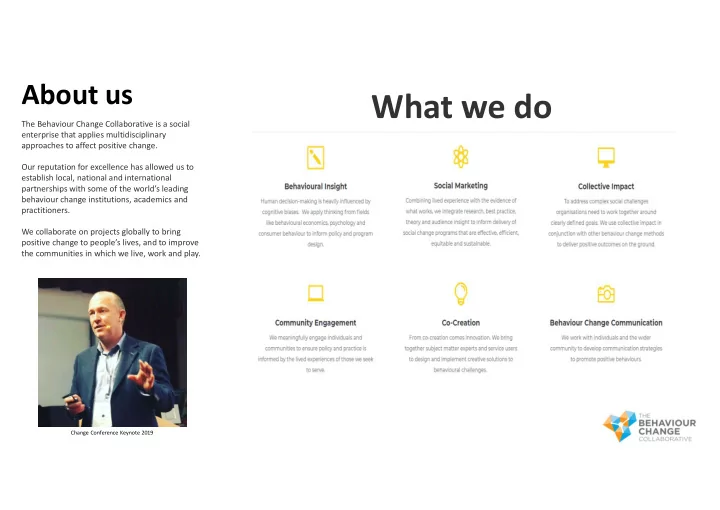
The Behaviour Change Collaborative is a social enterprise that applies multidisciplinary approaches to affect positive change. Our reputation for excellence has allowed us to establish local, national and international partnerships with some of the world’s leading behaviour change institutions, academics and practitioners. We collaborate on projects globally to bring positive change to people’s lives, and to improve the communities in which we live, work and play.

What we do

Change Conference Keynote 2019

slide-2
SLIDE 2

Activity Time Scene setting 5mins Consumer orientation, insight and behavioural goals 10mins Group activity 1 Choose a target segment & build a persona 20mins Feedback 5mins Group activity 2 Behavioural objectives 10mins Feedback 5mins Closing remarks & Questions 5 mins

Agenda.

Shift in mode of transportation to school between 1969 and 2009 for K-8 students . . .

My wow moment!

Source: Green Health: Urban Planning and the Development of Healthy and Sustainable Neighbourhood's and Schools

slide-3
SLIDE 3

What if catching the bus was cool?

slide-4
SLIDE 4
slide-5
SLIDE 5

People adopt behaviours that are FUN, EASY and POPULAR.

slide-6
SLIDE 6
slide-7
SLIDE 7

But behaviour change can be complex.

slide-8
SLIDE 8
slide-9
SLIDE 9

The Behaviour change wheel.

Susan Michie, University College London.

slide-10
SLIDE 10

Consider behavioural chains…

Source: Doug McKenzie Mohr.

slide-11
SLIDE 11

The average smartphone user [touches] their device a staggering 2,617 times each day. Among the heaviest users that figure more than doubles to 5,427.

People are too busy to listen, let alone act.

slide-12
SLIDE 12

So where do we start?

slide-13
SLIDE 13
slide-14
SLIDE 14

What moves and motivates people?

slide-15
SLIDE 15

Developing a robust understanding of the audience, based on good market and consumer research, combining data from different sources.

Customer orientation.

slide-16
SLIDE 16

Why would you do that then?

slide-17
SLIDE 17

99 miles Last mile To travel the “last mile.”

  • The term originated in telecommunications,

then adopted by logistics more generally.

  • Not to be confused with the first and last mile

problem in public transport…

  • Customer insight is the fuel that can help us

traverse the last mile.

Data. Understanding Customer insight.

slide-18
SLIDE 18

Data is too often mistaken for insight.

slide-19
SLIDE 19

What constitutes a “behaviour”?

Audience insight Intervention Intervention Behavioural insight Behavioural economics Social marketing

There are two types of insight.

slide-20
SLIDE 20

What constitutes a “behaviour”?

WHAT DATA

Facts & observations.

UNDERSTANDING WHY SO WHAT? INSIGHT

Explaining what’s going on. The deep truth that strikes a chord with people.

We also need to build actionable insight.

68% use cars

Proximity to public transport is a key factor

?

slide-21
SLIDE 21

Defining behaviour.

slide-22
SLIDE 22

Under specific conditions By a specific target audience An

  • bservable

action

A behaviour is...

Behavioural goals

  • Broad. Strategic.

Behavioural objectives Specific, concrete and measurable.

slide-23
SLIDE 23

Activity

slide-24
SLIDE 24

Activity overview.

PART A: Customer orientation (20 mins) Build a persona to represent a member of your target audience. PART B: Behavioural goal (10 minutes) Write a clear behavioural goal for your target persona (audience).

Demographics Habits Competition Barriers Information sources Key influencers Attitudes & aspirations Enablers

Under specific conditions By a specific target audience An

  • bservable

action

slide-25
SLIDE 25
  • A. Building a persona.

A practical way of applying a customer-centric approach, and allow the design of communications and interventions whilst keeping in mind the end user as a human rather than a set of data points.

Personas Aspiring Leader

Behavioural goal? Male, 18 – 25 Lives in the city, at home with parents. Usually drives to uni. P/T job to pay board and social expenses. Saving for home deposit. Info sources – Friends, family, Twitter. Influencers – peers, business thought leaders. Enabler - Owns a bike. Health is important. Competition – Car is easier. Time. Barriers – Inconvenient. No perceived reward. Habits – Gym 4 x per week. Friday night drinks.

Demographics Habits Competition Barriers Information sources Key influencers Attitudes & aspirations Enablers

slide-26
SLIDE 26
  • B. Behavioural goal.

Task Write a clear behavioural goal for your target persona (audience).

Under specific conditions By a specific target audience An

  • bservable

action

Example A 3% increase in the proportion of male students using a bike to get to and from campus at least 2 times per week by July 30, 2021.

slide-27
SLIDE 27 Demographics Habits Competition Barriers Information sources Key influencers Attitudes & aspirations Enablers

What next?

Audience profile Behavioural

  • bjective

Educate

Support Design Control

Methods mix

Post details to the Your Move website by Friday, 6th December.

slide-28
SLIDE 28

And if all else fails…

slide-29
SLIDE 29

Photos: Audrey Penven

slide-30
SLIDE 30

Additional tools

slide-31
SLIDE 31

4P’s in social marketing.

Product

  • What does the customer/consumer get?
  • What’s being offered to them?

Price

  • How much will it cost them?
  • (Not just money, but also time, effort, emotional costs, etc)

Place

  • Where does the relevant behaviour happen?
  • Where are there opportunities to reach the customer/consumer?

Promotion

  • What package of incentives can be put in place which will be

valued by the customer/consumer?

Source: The NSMC

slide-32
SLIDE 32

The Methods Mix

Educate Support Design Control

Consumer

  • Inform. Advise. Persuade. Inspire.

What do people need? What do they value? Environmental and physical. Regulation and policy.

slide-33
SLIDE 33

Incentive Disincentive Active Decision

Conscious / Considered Automatic / Unconscious

Passive Decision

Hug Smack Shove Nudge

Value/cost exchange

Source: Strategic Social Marketing.

e.g. A fine. A reward for doing something good. e.g. Default saving scheme. e.g. Carbon Tax

slide-34
SLIDE 34

Method, value, cost exchange

Hug Nudge Shove Smack Control Design Educate Support

slide-35
SLIDE 35

Luke van der Beeke, Founder.

  • m. 0401 325 153
  • e. luke@thebcc.org.au
  • w. www.thebcc.org.au

Find us on Twitter, Facebook, LinkedIn and Instagram.