Share of Countries over 1/3 Urbanized, by GDP per Capita (2012 $) - - PowerPoint PPT Presentation

share of countries over 1 3 urbanized by gdp per capita
SMART_READER_LITE
LIVE PREVIEW

Share of Countries over 1/3 Urbanized, by GDP per Capita (2012 $) - - PowerPoint PPT Presentation

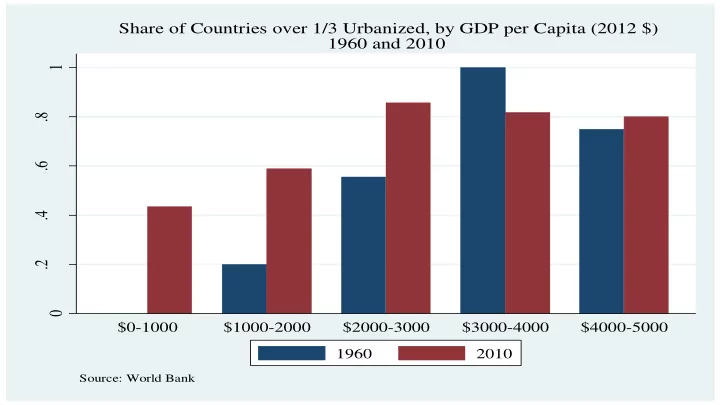
Share of Countries over 1/3 Urbanized, by GDP per Capita (2012 $) 1960 and 2010 1 .8 .6 .4 .2 0 $0-1000 $1000-2000 $2000-3000 $3000-4000 $4000-5000 1960 2010 Source: World Bank Per Capita GDP Growth 1960-2010 (Poor


slide-1
SLIDE 1

.2 .4 .6 .8 1 $0-1000 $1000-2000 $2000-3000 $3000-4000 $4000-5000

Source: World Bank

Share of Countries over 1/3 Urbanized, by GDP per Capita (2012 $) 1960 and 2010

1960 2010
slide-2
SLIDE 2

Per Capita GDP Growth 1960-2010 (Poor Countries<$5000 PC GDP)

Congo, Dem. Rep. Burundi Liberia Niger Malawi Sierra Leone Central African Republic Afghanistan Uganda Rwanda Togo Nepal Zimbabwe Bangladesh Benin Kenya Cambodia Pakistan Senegal Cameroon Cote d'Ivoire Zambia Ghana Papua New Guinea India Nicaragua Sudan Bolivia Honduras Philippines Sri Lanka Iraq Egypt, Arab Rep. Morocco Guatemala Syrian Arab Republic Congo, Rep. El Salvador Ecuador China Algeria Thailand Jamaica Dominican Republic Peru Colombia South Africa Panama Costa Rica Malaysia Mexico Turkey Brazil Uruguay Chile Korea, Rep. Portugal Greece Spain Hong Kong SAR, China Singapore Japan

  • 2
  • 1

1 2 3 .2 .4 .6 .8 1 Urbanization in 1960

slide-3
SLIDE 3

6 7 8 9 10 11 .2 .4 .6 .8 1 % Urbanization, 2010 Log of P.C. GDP 2010 PPP Fitted values

slide-4
SLIDE 4

Outline of Talk: Good and Bad of Cities

  • Do the same factors that predict success in the wealthy world also hold for three

large developing countries?

  • Computer vision techniques for measuring income, infrastructure and assessing

housing prices.

  • Dealing with the downsides of density.
  • A broad lesson: Cities are about interactions and hence institutions– like rule of

law– that govern interactions are particularly critical in cities.

  • CITIES AND RULE OF LAW ARE COMPLEMENTS.
slide-5
SLIDE 5
slide-6
SLIDE 6
slide-7
SLIDE 7

Share of Adults with B.A.s 2000 Per Capita GDP 2010 . .1 .2 .3 .4 .5 20000 40000 60000 80000 100000

  • Bakersfi
  • Las Vega
  • Detroit
  • New York
  • Atlanta
  • Boston
  • San Jose
  • San Fran
slide-8
SLIDE 8
slide-9
SLIDE 9
slide-10
SLIDE 10

.05 .1 .15 1 2 3 4 5

Average Population Growth by Share with BA in 2000 (Quintiles)

slide-11
SLIDE 11
slide-12
SLIDE 12
slide-13
SLIDE 13
slide-14
SLIDE 14

Measuring Streetscapes (with Nikhil Naik)

slide-15
SLIDE 15

Predicting Income from Imagery

Proof-of-concept experiment for the U.S.

Median Income of the Census Block group: $60,000

slide-16
SLIDE 16

Image Features Derived from Pixels

Training Examples Machine Learning

$74,000 $38,000 $18,000

Predicted Income

$54,000

slide-17
SLIDE 17

Training Sample – New York Income

R^2 = 0.85

slide-18
SLIDE 18

Testing Sample – New York Income

R^2 = 0.81

slide-19
SLIDE 19

Test: New York City Test: Boston

R^2 = 0.81 R^2 = 0.86

slide-20
SLIDE 20

Chinitz: Contrasts in Agglomeration: New York and Pittsburgh

slide-21
SLIDE 21

.5 1 1.5 2 1 2 3 4 5

Smallest firms are in Quintile 1

MSA Employment Growth (1977-2010) by Average Firm Size (1977) Quintiles

Economic Growth and Firm Size

slide-22
SLIDE 22
slide-23
SLIDE 23

A Trio of Failures: Politics, Public Management, Law

  • Public Management Failures means that the projects are poorly

performed and corruption and waste are rife.

  • Economics of Corruption, Public Private Partnerships
  • Legal failures mean that private property is unsafe and that it is

impossible to deal with the negative externalities with effective incentives.

  • Economics of Crime, Law and Economics
  • Political failures means the wrong projects (or no projects) get built –

the direction of policy is wrong.

  • Political Economy
slide-24
SLIDE 24

Public Management Failure: Tweed’s Infamous Courthouse

slide-25
SLIDE 25

Political Failures: Detroit’s Infamous People Mover

slide-26
SLIDE 26

A Tale of Two Technologies

  • Many urban services can be provided by a cheap individual

technology and a (socially if not privately) costly shared technology:

  • Sewage system vs. Pit Latrine
  • Shallow Well vs. Aqueducts and Piped Water
  • Jitneys vs. Public BRT/Rail System
  • Also cheap private schools, private secturity, etc.
  • We focus on cases where the individual option generates negative

externalities, which means that there is a case for inducing adoption

  • f the collective technology.
slide-27
SLIDE 27

A Tale of Two Technologies

Gautrain by Habib M’henni

slide-28
SLIDE 28
slide-29
SLIDE 29

The Last Mile Problem in Zambia

  • 1975-1983, the World Bank had provided Zambia with $20 million for Lusaka

Squatters

  • Plan for upgrading 26,000 households (with access to communal taps– like NYC

hydrants).

  • Households applied for water, but not sewers.
  • Externalities are a larger share of benefit for sewers
  • Cost of connection is about $960 – high relative to incomes.
  • Massive infrastructure program has had far too little impact because of non-

adoption.

  • Unclear ownership reduces incentive to invest.
  • Public sector has a strong anti-subsidy bent.
  • But they don’t really want to impose penalties either.
  • Current fees are typically not collected (10% in one study).
slide-30
SLIDE 30
slide-31
SLIDE 31

Executive vs. Judicial Incapacity

slide-32
SLIDE 32

Property Rights and Urban Governance

  • Ownership entails responsibilities. With ownership comes the ability

to fine for not taking actions that create social costs.

  • Ownership also creates the possibility for property taxes.
  • Use computer vision techniques for mass appraisal.
  • But demand for titling in a world where property rights remain

uncertain often seems week.

  • How to predict prices with computer vision techniques.
slide-33
SLIDE 33
slide-34
SLIDE 34

World Justice Project Survey Data

slide-35
SLIDE 35
slide-36
SLIDE 36

Rwanda Mali Ghana India Moldova Iraq Egypt, Arab Rep. Morocco Guatemala Indonesia Ukraine Thailand Bulgaria South Africa Romania Malaysia Argentina Mexico Russian Federation Brazil Uruguay Poland Slovenia Cyprus Spain New Zealand Italy United Kingdom France Germany Japan Finland Canada United States Netherlands Sweden Australia Norway

  • .1

.1 .2 4 6 8 10 12 Log of Per Capita GDP