SLIDE 1
Lingyun Meng, Ph.D., Associate Professor State Key Laboratory of Rail Traffic Control and Safety Beijing Jiaotong University, Beijing, China Email: lymeng@bjtu.edu.cn April, 2016
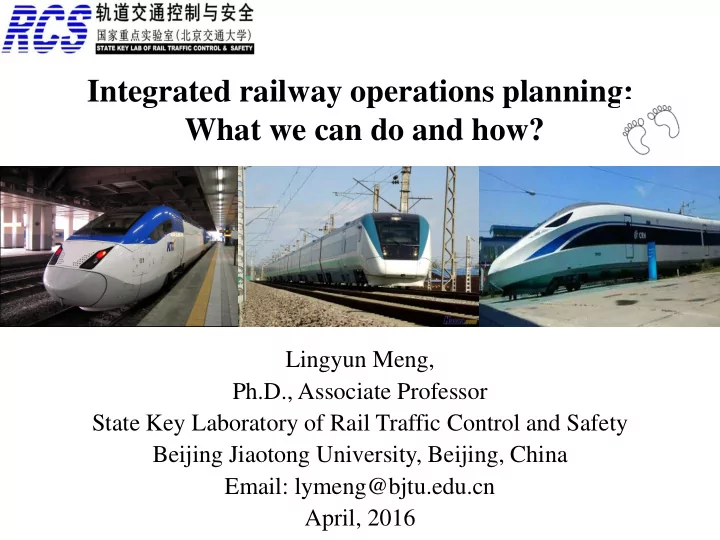
Integrated railway operations planning: What we can do and how?
SLIDE 2
SLIDE 3
April 2016, Dagstuhl Seminar, Germany Many kinds of plans- Line plan in the Netherlands
SLIDE 4 April 2016, Dagstuhl Seminar, Germany
- Many kinds of plans-Train timetable for Beijing-Shanghai HSR
SLIDE 5
April 2016, Dagstuhl Seminar, Germany Many kinds of plans-Rolling stock circulation plan in the Netherlands Source: Alfieri, A., Groot, R., Kroon, L., Schrijver, A., Efficient Circulation of Railway Rolling Stock, 2006.
SLIDE 6
April 2016, Dagstuhl Seminar, Germany Many kinds of plans-Crew schedule Source: http://www.aviationsystems.co.uk/wp-content/uploads/2014/03 /Roster-Graphics.jpg
SLIDE 7
Line planning Train routing and Scheduling Vehicle scheduling Crew scheduling Traditionally
April 2016, Dagstuhl Seminar, Germany
SLIDE 8
Question #1: Is it necessary to do integration?
April 2016, Dagstuhl Seminar, Germany
1.1 Does practical work need integration?
My own experience in a dispatching center of one Chinese railway bureau tells me YES! A train dispatcher needs to frequently communicate with rolling stock dispatcher to make sure his dispatch plan is FEASIBLE.
SLIDE 9
Question #1: Is it necessary to do integration?
April 2016, Dagstuhl Seminar, Germany Anita Schöbel: An integrated solution is always as least as good as optimizing stage by stage. (Oct, 2014) Existing studies in integrated line planning train timetabling : Such as: Schöbel and Schmidt (2014), Niu and Zhou (2015), Espinosa-Aranda et al. (2015)
Solution space Hierarchical Integrated
In theory: integration seems to be promising for better solutions
SLIDE 10
Question #2: What are possible topics for us?
April 2016, Dagstuhl Seminar, Germany
Line planning Train routing and Scheduling Vehicle scheduling Crew scheduling Possible integration?
SLIDE 11
Question #2: What are possible topics for us?
April 2016, Dagstuhl Seminar, Germany
Line planning Train routing and Scheduling Vehicle scheduling Crew scheduling Possible integration?
SLIDE 12
Question #2: What are possible topics for us?
April 2016, Dagstuhl Seminar, Germany
Line planning Train routing and Scheduling Vehicle scheduling Crew scheduling Possible integration?
SLIDE 13
Question #2: What are possible topics for us?
April 2016, Dagstuhl Seminar, Germany
Line planning Train routing and Scheduling Vehicle scheduling Crew scheduling Possible integration?
SLIDE 14
Question #2: What are possible topics for us?
April 2016, Dagstuhl Seminar, Germany
Line planning Train routing and Scheduling Vehicle scheduling Crew scheduling Possible integration?
SLIDE 15
Question #2: What are possible topics for us?
April 2016, Dagstuhl Seminar, Germany
Line planning Train routing and Scheduling Vehicle scheduling Crew scheduling
Possible integration?
SLIDE 16
Question #2: What are possible topics for us?
April 2016, Dagstuhl Seminar, Germany
2.1 Are there any interesting integration topics? 2.2 Are there any integration-related research topics? Someone doubted already about this and listed similar methods (for finding research topics) in job shop scheduling research area. Thus we need to find integration topics with real demand from practice and research point of view.
SLIDE 17
Question #3: Challenges if we do integration?
April 2016, Dagstuhl Seminar, Germany 3.1 How complex it will be if we optimize a joint problem?
NP1 NP2 +
Still NP? More complex? 3.2 How can we guarantee that we can find better solutions in a larger solution space efficiently?
Hierarchical Integrated
SLIDE 18
3.3 Does “integration” mean “a holistic framework with sub-models which are solved iteratively ”?
Question #3: Challenges if we do integration?
April 2016, Dagstuhl Seminar, Germany 3.4 Integrated models normally yield in decision variables with high dimensions, then how do we deal with curse of dimensionality? 3.5 If we build an integrated model and we want to do decomposition, how? In a different way from iterative approach.
SLIDE 19
Question #4: How do we meet the challenges?
April 2016, Dagstuhl Seminar, Germany 4.1 Can solution algorithms with parallel computing techniques can solve integrated problems to satisfactory solutions efficiently? 4.2 How much time do we need before we see some substantial processes? 2 years, 5 years, or longer? We need domestic and international collaboration to do integration.
SLIDE 20
SLIDE 21 Ongoing research topics
- 1. Demand-oriented vehicle routing scheduling for a
transport system Xuesong Zhou, Arizona State University
- 2. Integrated railway traffic control and train control
Francesco Corman, Xiaojie Luan, TUDelft Yihui Wang, Beijing Jiaotong University
April 2016, Dagstuhl Seminar, Germany
SLIDE 22 April 2016, Dagstuhl Seminar, Germany
Ongoing research topics
- 1. Demand-oriented vehicle routing scheduling for a
transport system
Based on a state-space-time network An integer programming model with vehicle and infrastructure capacity constraints Solved by Lagrangian relaxation and dynamic programming
SLIDE 23
A special issue on Part C journal about integrated approaches
SLIDE 24 Expected topics in the special issue
The topics of interest include, but are not limited to, the following:
- Demand-oriented line planning and train timetabling
- Integrated optimization of train timetabling, rolling stock and crew
scheduling
- Streamlined train operations planning, infrastructure and rolling stock
maintenance scheduling
- Traffic control and train control for demand-oriented urban transit
- Train, rolling stock and crew real-time rescheduling.
Welcome to submit a paper to the issue if you have one and no destination journal decided Deadline is May 1st
SLIDE 25 INFORMS RAS Problem Sovling competition
https://www.informs.org/Community/RAS/Problem-Solving- Competition Integrating train timetabling and maintenance task scheduling To be announced soon! Work together with Dr. Francesco Corman from TUDelft
Line_1 Line_2 Line_1
1 3 13 23 26 42 55 44 24 25 33 30 32 31 2 12 49 54 43 50 45 52 53 41 56 58 47 57 20 5 9 4 8 21 6 7 18 19 down up up down up down up down down up 10 11 14 15 17 16 37 39 40 48 46 51 22 27 28 29 34 35 38 36
Line_2
SLIDE 26
Lingyun Meng, Ph.D., Associate Professor State Key Laboratory of Rail Traffic Control and Safety Beijing Jiaotong University, Beijing, China Email: lymeng@bjtu.edu.cn April, 2016