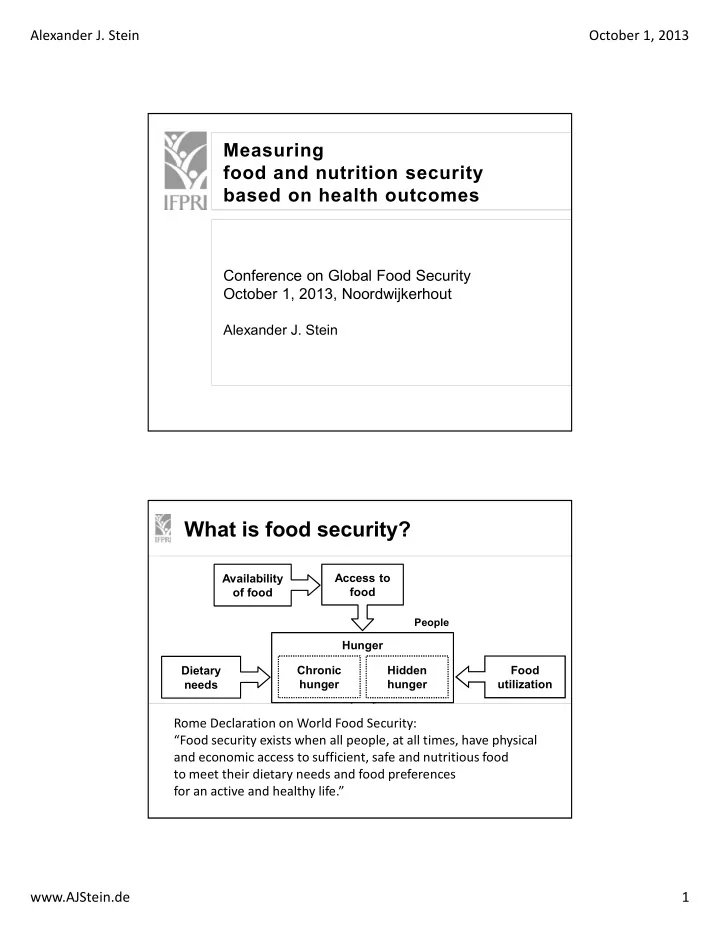
What is food security? Access to Availability food of food - - PDF document

what is food security
SMART_READER_LITE
LIVE PREVIEW

What is food security? Access to Availability food of food - - PDF document

Alexander J. Stein October 1, 2013 Measuring food and nutrition security based on health outcomes Conference on Global Food Security October 1, 2013, Noordwijkerhout Alexander J. Stein What is food security? Access to Availability food


slide-1
SLIDE 1

Alexander J. Stein October 1, 2013 www.AJStein.de 1

Measuring food and nutrition security based on health outcomes

Conference on Global Food Security October 1, 2013, Noordwijkerhout

Alexander J. Stein

What is food security?

Dietary needs Food utilization Hunger Chronic hunger Hidden hunger Access to food Availability

  • f food

People

Rome Declaration on World Food Security: “Food security exists when all people, at all times, have physical and economic access to sufficient, safe and nutritious food to meet their dietary needs and food preferences for an active and healthy life.”

slide-2
SLIDE 2

Alexander J. Stein October 1, 2013 www.AJStein.de 2

Why is food security important?

Dietary needs Food utilization Hunger Chronic hunger Hidden hunger Access to food Availability

  • f food

People

U5 mortality Underweight Stunting Anemia Etc., etc., etc.

How is food security measured?

Current measures:

  • Prevalence of undernourishment (FAO/MDG1)
  • Anthropometric indicators (stunting, etc.)
  • Global Hunger Index (IFPRI/DWHH/Concern)
  • Global Food Security Index (EIU/DuPont)
  • Many others for different dimensions & scopes

(“index inflation” through re-packaging of data)

slide-3
SLIDE 3

Alexander J. Stein October 1, 2013 www.AJStein.de 3

How is food security measured?

Current measures:

  • FAO’s indicator captures mainly changes in

food availability at the household level

  • Anthropometrics capture only single outcomes

(not comparable, ignore “depth” of problem)

  • GHI adds data on underweight and mortality

to FAO figures to create an abstract index score

  • GFSI covers various aspects of food affordability,

availability, quality and safety at national level

Many things are looked at…

Hunger Chronic hunger Hidden hunger

Determinants

  • r Inputs

Dietary needs Food utilization Access to food Availability

  • f food

People

U5 mortality Underweight Stunting Anemia Etc., etc., etc.

slide-4
SLIDE 4

Alexander J. Stein October 1, 2013 www.AJStein.de 4

Hunger Chronic hunger Hidden hunger Burden

  • f hunger

Adverse health consequences

  • f undernourishment

Adverse health consequences

  • f micronutrient deficiencies

Overall Result

  • r Outcome

People

… why not at the overall outcome? … why not at the overall outcome?

  • WHO data on health outcomes at country level:

“disability-adjusted life years” (DALYs) lost

  • DALYs are weighted person-years lost

due to shortened life and disability:

  • DALYs lost = YLL + YLD weighted
  • Attribution to undernutrition:
  • Data on protein-energy malnutrition, vitamin A, iron

& iodine deficiency, maternal conditions, measles, diarrhoeal diseases, and lower respiratory infections

  • 65 million DALYs lost due to undernutrition in 2011

(4% of the global burden of disease), of which

two thirds due to “hidden hunger”

slide-5
SLIDE 5

Alexander J. Stein October 1, 2013 www.AJStein.de 5

Rankings for selected countries

DALYs Stunting FAO GHI GFSI Angola 2 54 29 10 19 Niger 3 5 60 17 15 Malawi 11 10 37 32 8 Burkina Faso 12 35 31 32 18 Nigeria 17 24 76 37 26 Tanzania 23 21 9 25 7 Uganda 24 33 12 37 35 Benin 25 17 80 42 24 Sudan 45 35 7 17 10 Tajikistan 50 30 19 37 22 India 54 7 47 13 40 Guatemala 56 7 23 46 46 Botswana 63 48 27 43 59 Paraguay 64 83 32 73 57 Ecuador 98 n/a 44 62 48 Sri Lanka 108 86 36 43 44

Newer data & approach, new result

  • Same approach using more detailed health data

from Inst. for Health Metrics & Evaluation (IHME)

  • Disadvantage: only available as global aggregate
  • Different: no discounting, new set of weights
  • Advantage: available for 1990, 2005 and 2010
  • 160 million DALYs lost due to undernutrition in 2010

(6% of the global burden of disease), of which

more than half due to hidden hunger

  • 320 million DALYs lost due to undernutrition in 1990
  • Burden of hunger in 2010 half the burden of 1990!
  • Very different if compared to FAO/MDG1 measure
slide-6
SLIDE 6

Alexander J. Stein October 1, 2013 www.AJStein.de 6

Prevalence vs. burden of hunger Why this discrepancy?

Food availability but one factor for food security:

  • Dietary needs (mechanisation, motorisation, ICTs)
  • Food waste (storage, pest control, preservation, retail)
  • Food utilization (nutrition education, infant feeding,

water, parasites, health status, dietary change)

  • Depth of undernourishment below given threshold

DALYs measure outcome of all these factors:

  • More comprehensive, catch-all picture of “hunger”
  • Incl. impaired cognitive and physical development
  • Link to human capital development & econ. growth
slide-7
SLIDE 7

Alexander J. Stein October 1, 2013 www.AJStein.de 7

Implications for economic growth

  • WHO’s Commission on Macroeconomics & Health:

DALYs valued at three times per capita income as improved health spurs economic growth

  • Global cost of hunger amounts to Int$ 0.8 trillion

(1% of world income) if based on WHO’s DALYs

  • Global cost of hunger even Int$ 1.9 trillion

(2.4% of world income) if approximated using IHME

  • FAO’s State of Food and Agriculture 2013:

global cost of undernutrition is US$ 1.4-2.1 trillion

  • Based on World Bank country estimate for loss in

productivity due to undernutrition of 2-3% of GDP

Conclusions

  • Experts and stakeholders in the field of agriculture

and nutrition need to be aware of outcomes-based indicators, such as DALYs, which better capture the results of food insecurity

  • Data is available but needs to be updated more

frequently – and made accessible; more attention should be paid to nutrition details

  • Further discussion and agreement on details of

methodology needed, but it seems food security

(MDG1) improved more than commonly thought…

  • … although the remaining burden and cost of

hunger is still unacceptably high!

slide-8
SLIDE 8

Alexander J. Stein October 1, 2013 www.AJStein.de 8

Absolute and relative burden of undernutrition

DALYs Stunting FAO GHI GFSI Outcomes

  • f undernutrition

Several (expand- able) One (stunting) No Mortality, under- weight No Determinants of undernutrition No No One (food availability) One (food availability) Several Highest level

  • f measurement

Individual Individual Household Household Country Measures depth

  • f problem

DA-weight, diff.

  • utcomes

No (threshold) No (threshold) Partially (index) Partially (index) Tangible units

  • f measurement

Yes (years) Yes (capita) Yes (capita) No (index score) No (index score) Summable and comparable units Many uses

  • f DALYs

No No No No Data availability 192/187 countries 118 countries 185 countries 120 countries 105 countries Updating

  • f data

Planned annually Annually Annually Annually Annually Timeliness

  • f raw data

Last before 2004/10 2007-2011 2010-2012 2005-2010 2000-2012

slide-9
SLIDE 9

Alexander J. Stein October 1, 2013 www.AJStein.de 9

Thank you very much for your attention!

Forthcoming IFPRI Discussion Paper:

“Rethinking the Measurement of Undernutrition in a Broader Health Context”

 www.ifpri.org/publications Alexander J. Stein