Food Policy Challenges and Opportunities 2011 and Beyond Per - - PDF document

food policy challenges and opportunities 2011 and beyond
SMART_READER_LITE
LIVE PREVIEW

Food Policy Challenges and Opportunities 2011 and Beyond Per - - PDF document

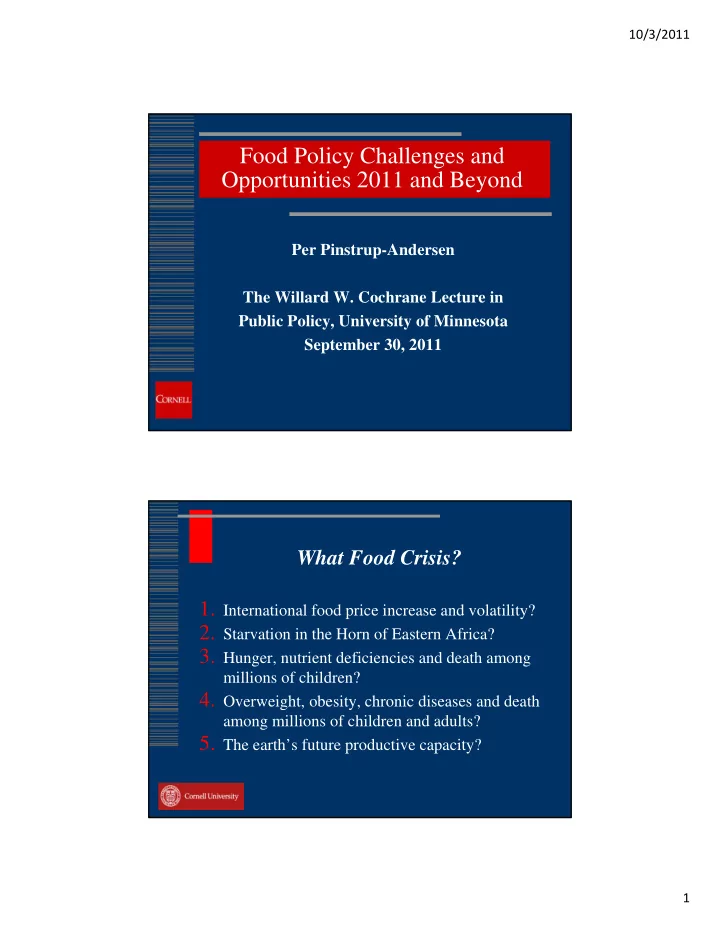
10/3/2011 Food Policy Challenges and Opportunities 2011 and Beyond Per Pinstrup-Andersen The Willard W. Cochrane Lecture in Public Policy, University of Minnesota September 30, 2011 What Food Crisis? 1. International food price increase and


slide-1
SLIDE 1

10/3/2011 1

Food Policy Challenges and Opportunities 2011 and Beyond

Per Pinstrup-Andersen The Willard W. Cochrane Lecture in Public Policy, University of Minnesota September 30, 2011

What Food Crisis?

  • 1. International food price increase and volatility?
  • 2. Starvation in the Horn of Eastern Africa?
  • 3. Hunger, nutrient deficiencies and death among

millions of children?

  • 4. Overweight, obesity, chronic diseases and death

among millions of children and adults?

  • 5. The earth’s future productive capacity?
slide-2
SLIDE 2

10/3/2011 2

Source: FAO, http://www.fao.org/worldfoodsituation/wfs-home/foodpricesindex/en/

slide-3
SLIDE 3

10/3/2011 3

International Maize Prices

Source: FAO, http://www.fao.org/giews/pricetool2/

International Rice Prices

Source: FAO, http://www.fao.org/giews/pricetool2/

slide-4
SLIDE 4

10/3/2011 4

International Rice Prices versus Rice Prices in Delhi, India

Source: FAO, http://www.fao.org/giews/pricetool2/

International Maize Prices versus Maize Prices in Niger

Source: FAO, http://www.fao.org/giews/pricetool2/

slide-5
SLIDE 5

10/3/2011 5

Maize Weekly Price Minus 12-Month Moving Average

  • 80
  • 60
  • 40
  • 20

20 40 60 80 100

Rice Weekly Price Minus 12-Month Moving Average

  • 150
  • 100
  • 50

50 100 150 200 250 300 350

slide-6
SLIDE 6

10/3/2011 6

Wheat Weekly Price Minus 12-Month Moving Average

  • 100
  • 50

50 100 150 1998 1999 1999 2000 2001 2002 2003 2004 2005 2006 2007 2008 2009 2010

Volatility in Weather Patterns

Drought Flooding Strong Winds Production Volatility Irregular Rainfall Patterns

slide-7
SLIDE 7

10/3/2011 7

Production Volatility

Supply Responses Government Policy Market Information Speculation Government Policies Energy Prices Demand Changes

Price Volatility

Policy Response to Food Price Increases

  • Maintaining government legitimacy
  • Emphasis on Short-term measures
  • Price controls, export bans, lifting import tariffs, rationing, food

distribution

  • Emphasis on short-term transfers to urban lower middle

class

  • Continued neglect of the rural poor
  • Expanding food production
  • Renewed interest in national self-sufficiency
  • Reserve stocks, acquisition or control of land across borders
slide-8
SLIDE 8

10/3/2011 8

The Effects of Export Restrictions

  • n Rice Prices

Source: Derek D. Headley, “Rethinking the Global Food Crisis: The Role of Trade Shocks,” International Food Policy Research Institute Discussion Paper 0958, March 2010.

Stock of Rice, Maize, and Wheat in Percent of Use in China, 2005-2011 (%)

Source: USDA, World Agricultural Supply and Demand Projections, Several Years. 28.9 29 30.2 37.4 41.1 37.2 43.7 5 10 15 20 25 30 35 40 45 50 2005-06 2006-07 2007-08 2008-09 2009-10 2010-11 2011-12

%

%

slide-9
SLIDE 9

10/3/2011 9

India – Grain Stock 2005/06 – 20011

15 25 54 10 20 30 40 50 60 70 2005/06 2007/08 2009/10 2011 Estimate Rice Wheat

Million Tons

65 Source: Timmer, P. 2011. Managing Price Volatility: Approaches at the Global, National, and Household Levels. Stanford Symposium Series on Global Food Policy and Food Security in the 21st Century, Center on Food Security and the Environment, Stanford University.

Approaches to Managing Food Price Volatility

Prevent Cope Private Storage Transportation Insurance Hedging & Futures Markets Public Buffer Stocks Import/Export Controls Financial Market Regulation Safety Nets Transfers

slide-10
SLIDE 10

10/3/2011 10

What do we want from the food system?

  • Food Security and good nutrition
  • Efficient and Sustainable Resource Use
  • Reasonable incomes for farmers
  • Reasonable prices for consumers
  • Meeting Non-food Demands
  • Support of general economic growth

Food Policy Challenges

  • Widespread and increasing hunger and malnutrition
slide-11
SLIDE 11

10/3/2011 11

The Triple Burden of Malnutrition

  • 1. Energy and protein deficiencies: Hunger
  • 2. Specific nutrient deficiencies: Hidden

Hunger

  • 3. Excessive net energy intake: Overweight

& Obesity

Progress Towards Meeting the WFS Goal Globally

848 923 1020 863 842 421 400 500 600 700 800 900 1000 1100 Millions

Data 91-04 WFS 925

Source: FAO 2006

slide-12
SLIDE 12

10/3/2011 12

Progress Towards Meeting the MDG Globally

20% 18% 16% 16% 17% 18% 17% 0% 5% 10% 15% 20% 25% 1990-92 1995-97 2000-02 2005-07 2008 2009 2010

Food Policy Challenges

  • Widespread and increasing hunger and malnutrition
  • Population growth, diet transition and biofuel
slide-13
SLIDE 13

10/3/2011 13

Population Growth Rate

0.5 1 1.5 2 2.5 3

CIS

  • E. Asia

LAC Dev'ing Avg

  • S. Asia

W/C Africa E/S Africa

Source: UNICEF 2006

Source: PRB, 2007

slide-14
SLIDE 14

10/3/2011 14

Annual Average Population Growth Rate, %

0.5 1 1.5 2 2.5 World More Developed Regions Less Developed Regions 1950-2000 2000-2050 2050-2100

Under-Five Mortality Rate (per thousand)

50 100 150 200 250 300 World More Developed Regions Less Developed Regions 1950 2000 2050 2100

slide-15
SLIDE 15

10/3/2011 15

Change in the Contribution of Each Food Group to Energy Intake 1980-2005

Food Policy Challenges

  • Widespread and increasing hunger and malnutrition
  • Population growth, diet transition and biofuel
  • Lack of government commitment, policy failure
slide-16
SLIDE 16

10/3/2011 16

Food Policy Challenges

  • Widespread and increasing hunger and malnutrition
  • Population growth, diet transition and biofuel
  • Lack of government commitment, policy failure
  • Increasing water scarcity and soil degradation

Liters of Water per Kilogram of Product

Source: Waterfootprint ( https://waterfootprint.org) accessed May 15, 2009; Gleick 2008

slide-17
SLIDE 17

10/3/2011 17

Food Policy Challenges

  • Widespread and increasing hunger and malnutrition
  • Population growth, diet transition and biofuel
  • Lack of government commitment, policy failure
  • Increasing water scarcity and soil degradation
  • Climate change

Greenhouse Gas Emissions per Kilogram of Food Item

Source: Williams, Audsley, and Sandars 2006.

slide-18
SLIDE 18

10/3/2011 18

Food Policy Challenges

  • Widespread and increasing hunger and malnutrition
  • Population growth, diet transition and biofuel
  • Lack of government commitment, policy failure
  • Increasing water scarcity and soil degradation
  • Climate change
  • Falling productivity growth rates, large losses

Food Policy Challenges

  • Widespread and increasing hunger and malnutrition
  • Population growth, diet transition and biofuel
  • Lack of government commitment, policy failure
  • Increasing water scarcity and soil degradation
  • Climate change
  • Falling productivity growth rates, large losses
  • Poor rural infrastructure
slide-19
SLIDE 19

10/3/2011 19

Food Policy Challenges

  • Widespread and increasing hunger and malnutrition
  • Population growth, diet transition and biofuel
  • Lack of government commitment, policy failure
  • Increasing water scarcity and soil degradation
  • Climate change
  • Falling productivity growth rates, large losses
  • Poor rural infrastructure
  • Poorly functioning markets

Projected Growth in African Food Systems, 2010-2050

Source: Haggblade, Steven. 2011. Modernizing African agribusiness: Reflections for the future. Journal of Agribusiness in Developing and Emerging Economies 1(1): 10-30.

Growth multiple: 2050 value/2010 value Consumption

Distribution Packaging Processing Marketing

Farming Inputs 6X 3X 9X

slide-20
SLIDE 20

10/3/2011 20

Food Policy Challenges

  • Widespread and increasing hunger and malnutrition
  • Population growth, diet transition and biofuel
  • Lack of government commitment, policy failure
  • Increasing water scarcity and soil degradation
  • Climate change
  • Falling productivity growth rates, large losses
  • Poor rural infrastructure
  • Poorly functioning markets
  • Food price volatility

Food Policy Opportunities

  • Attention of policy-makers to food crisis
  • Application of modern science
  • Expanding investment in public goods
  • Internalizing environmental costs into private

costs

  • Improving policies and institutions
slide-21
SLIDE 21

10/3/2011 21

Suggested Priority 1

  • Large-scale investments in rural infrastructure,

domestic markets and Human Resources

  • Feeder roads
  • Appropriate institutions
  • Farmer associations
  • Public sector institutions (contract enforcement, weights and

measures, etc.)

  • Market information
  • Water management infrastructure
  • Primary education, health care and improved sanitation

Suggested Priority 2

  • A doubling of public investment in agricultural

research and technology

  • Improved water management to enhance use efficiency
  • Increased sustainable land and labor productivity and

reduced production risks

  • Biotic and abiotic stresses: drought tolerance, resistance to

insects and diseases

  • Sustainable production methods, biodiversity protection
  • Mitigation of impact of climate change and adaptation to

changes that will occur

slide-22
SLIDE 22

10/3/2011 22

Suggested Priority 3

  • Enhanced policy incentives for the private sector to

invest in sustainable agriculture

  • Savings and credit institutions for farmers
  • Risk management tools for farmers and traders (for

market and production risks)

  • Public goods investments
  • Strengthen the purchasing power of small-holders
  • Establish competitive funds for technology development
  • Assure incentives for private sector innovation

Suggested Priority 4

  • Remove international trade distortions (both

import and export restrictions)

  • Regulation of Land Grabbing
  • Clarity on water and land tenure
  • Full Costing
  • Pursue multiple-win solutions
slide-23
SLIDE 23

10/3/2011 23

Environmental Kuznets Curve

Hypothetical Relationships Between Income and Deforestation/Soil Mining

slide-24
SLIDE 24

10/3/2011 24

Hypothetical Relationships Between Income and Deforestation/Soil Mining

Concluding Questions

  • Can future generations be well fed?
slide-25
SLIDE 25

10/3/2011 25

Concluding Questions

  • Can future generations be well fed?
  • Is environmental degradation necessary to meet

future food needs?

Concluding Questions

  • Can future generations be well fed?
  • Is environmental degradation necessary to meet

future food needs?

  • Is the food price increase since 2005 the beginning
  • f a long-term trend of increasing food prices?
slide-26
SLIDE 26

10/3/2011 26

Concluding Questions

  • Can future generations be well fed?
  • Is environmental degradation necessary to meet

future food needs?

  • Is the food price increase since 2005 the beginning
  • f a long-term trend of increasing food prices?
  • Will biomass be an important source of energy?

Concluding Questions

  • Can future generations be well fed?
  • Is environmental degradation necessary to meet

future food needs?

  • Is the food price increase since 2005 the beginning
  • f a long-term trend of increasing food prices?
  • Will biomass be an important source of energy?
  • Will everybody get access to the food they need?
slide-27
SLIDE 27

10/3/2011 27