What about Virtualization? Basic Goals Basic goals: Stephen Hand - - PDF document

what about virtualization basic goals basic goals stephen
SMART_READER_LITE
LIVE PREVIEW

What about Virtualization? Basic Goals Basic goals: Stephen Hand - - PDF document

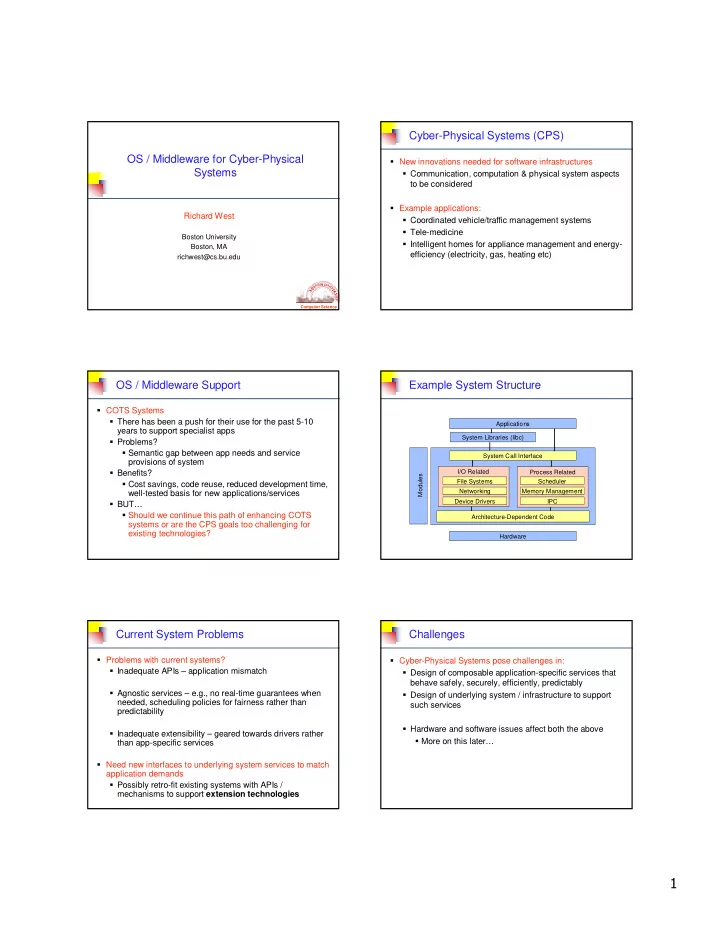
Cyber-Physical Systems (CPS) OS / Middleware for Cyber-Physical New innovations needed for software infrastructures Systems Communication, computation & physical system aspects to be considered Example applications: Richard West


slide-1
SLIDE 1
  • Computer Science

OS / Middleware for Cyber-Physical Systems

Richard West

Boston University Boston, MA richwest@cs.bu.edu

Cyber-Physical Systems (CPS)

New innovations needed for software infrastructures Communication, computation & physical system aspects to be considered Example applications: Coordinated vehicle/traffic management systems Tele-medicine Intelligent homes for appliance management and energy- efficiency (electricity, gas, heating etc)

OS / Middleware Support

COTS Systems There has been a push for their use for the past 5-10 years to support specialist apps Problems? Semantic gap between app needs and service provisions of system Benefits? Cost savings, code reuse, reduced development time, well-tested basis for new applications/services BUT… Should we continue this path of enhancing COTS systems or are the CPS goals too challenging for existing technologies?

Example System Structure

Applications System Libraries (libc) System Call Interface Hardware Architecture-Dependent Code I/O Related Process Related Scheduler Memory Management IPC File Systems Networking Device Drivers Modules

Current System Problems

Problems with current systems? Inadequate APIs – application mismatch Agnostic services – e.g., no real-time guarantees when needed, scheduling policies for fairness rather than predictability Inadequate extensibility – geared towards drivers rather than app-specific services Need new interfaces to underlying system services to match application demands Possibly retro-fit existing systems with APIs / mechanisms to support extension technologies

Challenges

Cyber-Physical Systems pose challenges in: Design of composable application-specific services that behave safely, securely, efficiently, predictably Design of underlying system / infrastructure to support such services Hardware and software issues affect both the above More on this later…

slide-2
SLIDE 2
  • What about Virtualization?

Stephen Hand et al (Xen, Cambridge U.) – HotOS paper: Are VMs micro-kernels done right? Right now, virtualization is a means to provide isolation amongst other VMs/apps Useful for legacy systems/apps to co-exist on same physical platform BUT… No significant communication between VMs unlike client/server communication in micro-kernels Coarse-grained solution to safety / security No resource / service guarantees

Basic Goals

Basic goals: Service composition / customization Safety / security Access rights, capabilities Who should be allowed to deploy services and where? Predictability / efficiency real-time, latency, throughput guarantees etc Resource monitoring, management, QoS Communication protocols System structure API between underlying system and application Interactions between hardware and software Hardware abstraction / heterogeneity

Interactions Between Hardware & Software

Leveraging architectural features in “best” way, e.g.: L2 shared caches Hyper-threading Multi-core architectures Tagged TLBs for protection Interrupt-vectoring to app-specific trusted services

Heterogeneity

Physical systems may have diverse computational and resource characteristics Different processor architectures, memory capacities, cache configurations, I/O devices, interconnects One vision: Build a base software system deployed across hardware platforms that offers resource multiplexing and communication between higher-level applications/services Have hardware or a software compiler take a common- language (or byte-code) base software and target it for given platform

A Common Platform Alliance

OS developers provide base code and services in a hardware-independent manner A target compiler for a given platform produces hardware- enhanced binary image of base OS (like a very small microkernel) Additional services are isolated and communicate using “best” approach according to compiler for target platform, the features of that platform and the requirements of services/applications e.g., services may be isolated using hardware segmentation/paging if available, or even compiler generated run-time software checks to enforce memory safety if hardware protection is unavailable

Example: Intelligent Home Network

www.epa.gov/ne/pr/2004/jan/040110.html Study suggested that by replacing 5 most used light- bulbs w/ energy efficient bulbs in every US household could reduce electricity usage by 800 billion KWh per year Equivalent to $60/yr per homeowner or output from 21 power plants per year Would reduce one trillion pounds of greenhouse gases that cause global warming

slide-3
SLIDE 3
  • Example (continued)

Intelligent home network could support services to monitor electricity (and other resources e.g., gas) throughout the day Services could suggest ways to more efficiently spread energy usage over 24 hours, rather than at set hours when demand is excessive Over-riding control of appliance usage Possibly enforce resource quota or re-channeling of resource (here, electricity) distribution amongst homes according to a shared service policy GOAL: lowering overall resource consumption while meeting individual objectives

Example (continued)

Who should be allowed to deploy specific services and where? Perhaps not homeowners except to configure basic parameters of existing services or to upgrade services Service providers could be 3rd parties relative to system developers To what extent can users control / influence service provisions to other customers? Perhaps they shouldn’t be allowed to do this at all Perhaps they should be allowed to do this to some degree if it is for the global good The socialist view – if I share my resources will you repay the favor when needed?

Vehicle Control / Traffic Management Example

Coordinated in-vehicle traffic management system Allow in-car services to communicate congestion hot- spots to other vehicles, or even to over-ride user- responsiveness when emergency braking is required etc…

Questions?

  • What limitations does the existing (architectural, intellectual etc)

separation between X and Y place on our ability to develop CPS? How could we redesign X and Y to remove those limitations…? Mismatch between app-needs and agnostic service provisions TCP, IP networks not real-time, have bandwidth/latency mismatches with certain apps OS services: scheduling, paging misaligned with demands of apps Again, need extensibility here…a breakdown of the barriers between coarse-grained services and components Possibly user-configurable and implementable protocols and services Methods to activate those services in keeping with QoS (real- time, latency etc) requirements Methods to safely and securely isolate X and Y Leverage of hardware features in meeting these goals

Questions? (continued)

Are there opportunities to co-design, hybridize, or otherwise combine parts of the current state of the art in ways that

  • vercome existing limitations, without requiring us to re-start

from too primitive a basis? Could build new base software architecture for safe, predictable and efficient resource multiplexing to higher- level services and VMs Could allow for existing software to run above this base layer Could retro-fit existing systems to support better extensibility for user-configurable services, isolation and invocation Provide improved APIs