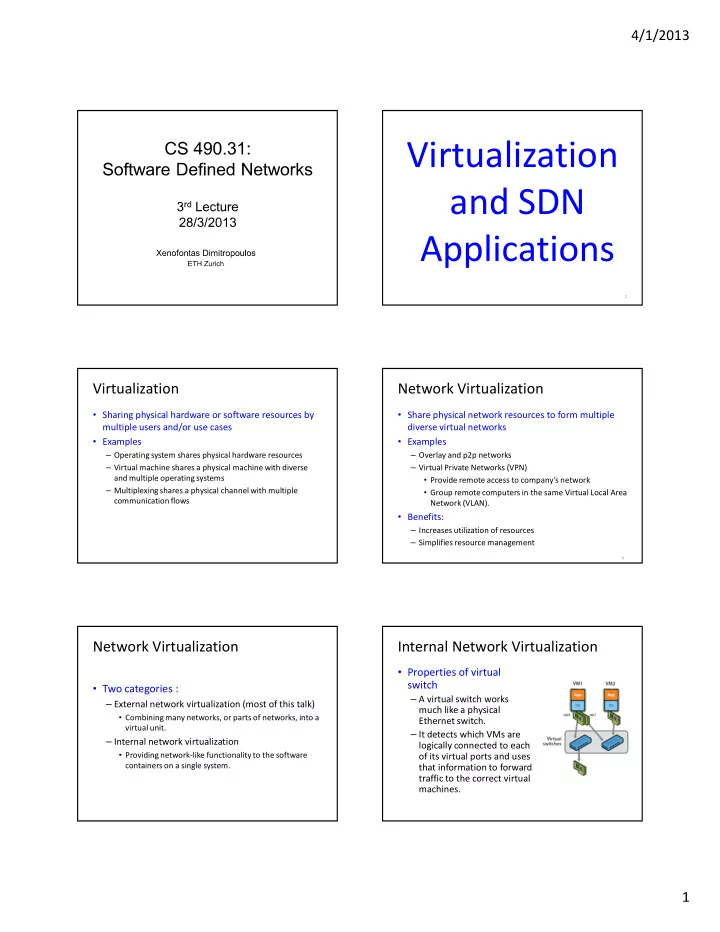
Virtualization and SDN Applications 2 Virtualization Network - - PDF document

virtualization and sdn applications
SMART_READER_LITE
LIVE PREVIEW

Virtualization and SDN Applications 2 Virtualization Network - - PDF document

4/1/2013 Virtualization and SDN Applications 2 Virtualization Network Virtualization Sharing physical hardware or software resources by Share physical network resources to form multiple multiple users and/or use cases diverse virtual


slide-1
SLIDE 1

4/1/2013 1

Virtualization and SDN Applications

2

Virtualization

  • Sharing physical hardware or software resources by

multiple users and/or use cases

  • Examples

– Operating system shares physical hardware resources – Virtual machine shares a physical machine with diverse and multiple operating systems – Multiplexing shares a physical channel with multiple communication flows

Network Virtualization

  • Share physical network resources to form multiple

diverse virtual networks

  • Examples

– Overlay and p2p networks – Virtual Private Networks (VPN)

  • Provide remote access to company’s network
  • Group remote computers in the same Virtual Local Area

Network (VLAN).

  • Benefits:

– Increases utilization of resources – Simplifies resource management

4

Network Virtualization

  • Two categories :

– External network virtualization (most of this talk)

  • Combining many networks, or parts of networks, into a

virtual unit.

– Internal network virtualization

  • Providing network-like functionality to the software

containers on a single system.

Internal Network Virtualization

  • Properties of virtual

switch

– A virtual switch works much like a physical Ethernet switch. – It detects which VMs are logically connected to each

  • f its virtual ports and uses

that information to forward traffic to the correct virtual machines.

slide-2
SLIDE 2

4/1/2013 2

Key properties of virtual network

  • Partitioning: each resource can be used

concurrently by multiple VN instances

  • Isolation: the clear isolation of any VN from all
  • thers
  • Abstraction: in which a given virtual resource need

not directly correspond to its component resources

  • Aggregation: aggregate multiple instances to
  • btain increased capabilities

7

What are virtual networks used for?

  • Same purposes as non-virtualized networks without

interfering the operation of other virtual networks while sharing the key components among virtual networks – Coexistence of multiple VNs

  • Different VNs may use different network

technologies without interference

  • Increase utilization

– Can support seamless migration/update of VNs – Can provide normalized set of interfaces and make it easier to provision VNs

8

App

Simple Packet Forwarding Hardware Simple Packet Forwarding Hardware Simple Packet Forwarding Hardware

App App

Simple Packet Forwarding Hardware Simple Packet Forwarding Hardware

Network Operating System

  • 1. Open interface to hardware
  • 3. Well-defined open API
  • 2. At least one good operating system

Extensible, possibly open-source

The “Software-defined Network”

9 Simple Packet Forwarding Hardware

Network Operating System 1

Open interface to hardware

Virtualization or “Slicing” Layer

Network Operating System 2 Network Operating System 3 Network Operating System 4

App App App App App App App App

Many operating systems, or Many versions Open interface to hardware Isolated “slices”

Simple Packet Forwarding Hardware Simple Packet Forwarding Hardware Simple Packet Forwarding Hardware Simple Packet Forwarding Hardware 10

11

Virtualized OpenFlow Substrate

  • OpenFlow

Protocol

Network Hypervisor & Policy Control Dave’s Controller

API Net Services

Larry’s Controller

OpenFlow Protocol

API Net Services

Steve’s Controller

API Net Services

FlowVisor Creates Virtual Networks

  • OpenFlow

Protocol

FlowVisor Dave’s Controller Larry’s Controller

OpenFlow Protocol

Steve’s Controller FlowVisor slices OpenFlow networks, creating multiple isolated and programmable logical networks on the same physical topology.

12

slide-3
SLIDE 3

4/1/2013 3

Slicing Policies

  • The policy specifies resource limits for each

slice:

– Link bandwidth – Maximum number of forwarding rules – Topology – Fraction of switch/router CPU – FlowSpace: which packets does the slice control?

Switch Based Virtualization

Normal L2/L3 Processing

Flow Table

Production VLANs Research VLAN 1

Controller

Research VLAN 2

Flow Table Controller

Use Case: VLAN Based Partitioning

  • Basic Idea: Partition Flows based on Ports and

VLAN Tags

– Traffic entering system (e.g. from end hosts) is tagged – VLAN tags consistent throughout substrate

Switch Port MAC src MAC dst Eth type VLAN ID IP Src IP Dst IP Prot TCP sport TCP dport * * * * 1,2,3 * * * * * * * * * 7,8,9 * * * * * * * * * 4,5,6 * * * * * Dave Larry Steve

Use Case: New CDN - Turbo Coral ++

  • Basic Idea: Build a CDN where you control the entire network

– All traffic to or from Coral IP space controlled by Experimenter – All other traffic controlled by default routing – Topology is the entire network – End hosts are automatically added (no opt-in) Switch Port MAC src MAC dst Eth type VLAN ID IP Src IP Dst IP Prot TCP sport TCP dport * * * * *

84.65.* *

* * * * * * * * *

84.65.* *

* * * * * * * * * * * * Turbo Coral Default

Use Case: Your Internet Protocol

– A new layer 3 protocol – Replaces IP – Defined by a new Ether Type Switch Port MAC src MAC dst Eth type VLAN ID IP Src IP Dst IP Prot TCP sport TCP dport * * * YourIP *

*

* * * * * * * !YourIP * * * * * * Your IP Rest

FlowSpace: Maps Packets to Slices

slide-4
SLIDE 4

4/1/2013 4

Applications of SDN

19

Dynamic Flow Aggregation on an OpenFlow Network

Scope

  • Different Networks want different flow granularity (ISP, Backbone,…)
  • Switch resources are limited (flow entries, memory)
  • Network management is hard
  • Current Solutions : MPLS, IP aggregation

How OpenFlow Helps?

  • Dynamically define flow granularity by wildcarding arbitrary header fields
  • Granularity is on the switch flow entries, no packet rewrite or encapsulation
  • Create meaningful bundles and manage them using your own software (reroute, monitor)

Higher Flexibility, Better Control, Easier Management, Experimentation

20

ElasticTree:

Reducing Energy in Data Center Networks

  • The demo:
  • Hardware-based 16-node

Fat Tree

  • Your choice of traffic

pattern, bandwidth,

  • ptimization strategy
  • Graph shows live power

and latency variation

  • Shuts off links and switches to reduce data center power
  • Choice of optimizers to balance power, fault tolerance, and BW
  • OpenFlow provides network routes and port statistics

demo credits: Brandon Heller, Srini Seetharaman, Yiannis Yiakoumis, David Underhill

21 22

  • penflow.org/videos

http://www.openflow.org/wk/index.php/OpenFlow_Tutorial

23

TutorialFlow

24 Today’s Hands-On Session Part 5 of OpenFlow Tutorial: http://www.openflow.org/wk/index.php/OpenFlow_Tutorial

slide-5
SLIDE 5

4/1/2013 5

Tutorial Setup

Controller port6633 c0 OpenFlow Switch s1

dpctl (user space process)

h3

10.0.0.4

h2

10.0.0.3

h1

10.0.0.2

virtual hosts OpenFlow Tutorial 3hosts-1switch topology

loopback (127.0.0.1:6633) loopback (127.0.0.1:6634) s1-eth0 s1-eth1 s1-eth2 h1-eth0 h3-eth0 h4-eth0

25

This talk wouldn’t be possible without:

Past slides from:

Brandon Heller Nick McKeown Rob Sherwood Nick McKeown Rob Sherwood Guru Parulkar Srini Seetharaman Yiannis Yiakoumis Guido Appenzeller Masa Kobayashi Scott Shenker Sangjin Jeong

  • thers