
SLIDE 1
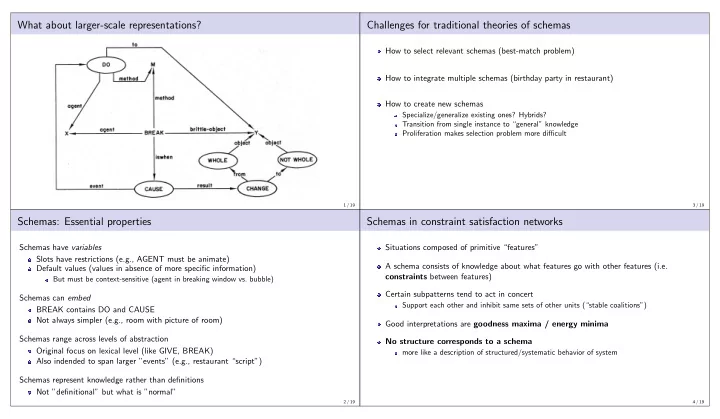
What about larger-scale representations?
1 / 19
Schemas: Essential properties
Schemas have variables Slots have restrictions (e.g., AGENT must be animate) Default values (values in absence of more specific information)
But must be context-sensitive (agent in breaking window vs. bubble)
Schemas can embed BREAK contains DO and CAUSE Not always simpler (e.g., room with picture of room) Schemas range across levels of abstraction Original focus on lexical level (like GIVE, BREAK) Also indended to span larger ”events” (e.g., restaurant “script”) Schemas represent knowledge rather than definitions Not ”definitional” but what is ”normal”
2 / 19
Challenges for traditional theories of schemas
How to select relevant schemas (best-match problem) How to integrate multiple schemas (birthday party in restaurant) How to create new schemas
Specialize/generalize existing ones? Hybrids? Transition from single instance to “general” knowledge Proliferation makes selection problem more difficult
3 / 19
Schemas in constraint satisfaction networks
Situations composed of primitive “features” A schema consists of knowledge about what features go with other features (i.e. constraints between features) Certain subpatterns tend to act in concert
Support each other and inhibit same sets of other units (“stable coalitions”)
Good interpretations are goodness maxima / energy minima No structure corresponds to a schema
more like a description of structured/systematic behavior of system
4 / 19