Negotiating Commercial Loan Covenants, Representations and - - PowerPoint PPT Presentation

negotiating commercial loan covenants representations and
SMART_READER_LITE
LIVE PREVIEW

Negotiating Commercial Loan Covenants, Representations and - - PowerPoint PPT Presentation

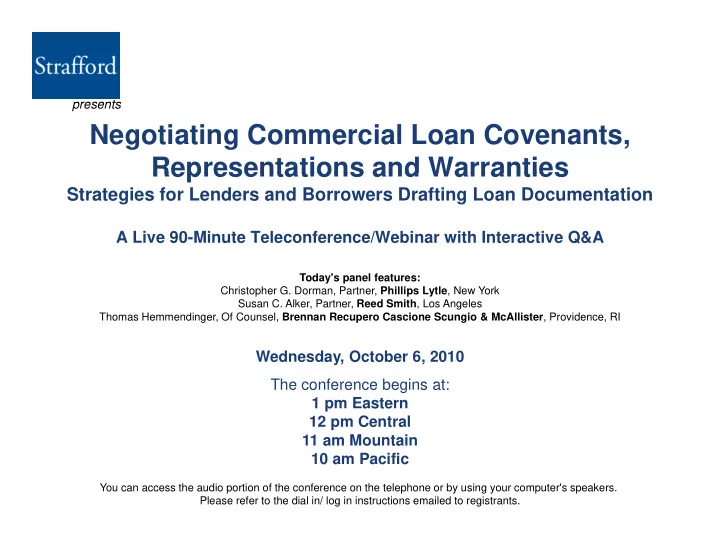
presents presents Negotiating Commercial Loan Covenants, Representations and Warranties Representations and Warranties Strategies for Lenders and Borrowers Drafting Loan Documentation A Live 90-Minute Teleconference/Webinar with Interactive


slide-1
SLIDE 1

presents

Negotiating Commercial Loan Covenants, Representations and Warranties

presents

Representations and Warranties

Strategies for Lenders and Borrowers Drafting Loan Documentation

A Live 90-Minute Teleconference/Webinar with Interactive Q&A

Today's panel features: Christopher G. Dorman, Partner, Phillips Lytle, New York Susan C. Alker, Partner, Reed Smith, Los Angeles Th H di Of C l B R C i S i & M Alli t P id RI

Q&

Thomas Hemmendinger, Of Counsel, Brennan Recupero Cascione Scungio & McAllister, Providence, RI

Wednesday, October 6, 2010 The conference begins at: The conference begins at: 1 pm Eastern 12 pm Central 11 am Mountain 10 P ifi 10 am Pacific

You can access the audio portion of the conference on the telephone or by using your computer's speakers. Please refer to the dial in/ log in instructions emailed to registrants.

slide-2
SLIDE 2

For CLE purposes, please let us know how many people are listening at your location by y

  • closing the notification box
  • and typing in the chat box your
  • and typing in the chat box your

company name and the number of attendees attendees.

  • Then click the blue icon beside the box

to send to send.

For live event only. y

slide-3
SLIDE 3
  • If you are listening via your computer

If you are listening via your computer speakers, please note that the quality of your sound will vary depending on the speed and lit f i t t ti quality of your internet connection.

  • If the sound quality is not satisfactory and you

li t i i t k are listening via your computer speakers, please dial 1-866-873-1442 and enter your PIN when prompted. Otherwise, please send e p o p ed O e se, p ease se d us a chat or e-mail sound@straffordpub.com immediately so we can address the problem.

  • If you dialed in and have any difficulties

during the call, press *0 for assistance.

slide-4
SLIDE 4

Negotiating Commercial Loan Covenants Negotiating Commercial Loan Covenants, Representations and Warranties

Susan C. Alker – Partner Reed Smith LLP – Los Angeles, CA Ch i h G Christopher G. Dorman – Partner Phillips Lytle LLP Thomas S. Hemmendinger – Of Counsel

  • as S.

e e d ge O Cou se Brennan, Recupero, Cascione, Scungio & McAllister LLP Presented via Webinar for Strafford Publications O t b 6 2010 October 6, 2010

October 6, 2010 4

slide-5
SLIDE 5

Introduction

  • Representations, Warranties, and Covenants

in Commercial Loan Agreements g

  • Why are they important?

Risk allocation tools – Risk allocation tools – Distant early warning

October 6, 2010 5

slide-6
SLIDE 6

Introduction

  • Representation – A statement of fact as of

a point in time . . .

  • Warranty – A promise that a stated fact is

true . . .

  • Covenant – A promise to do or not do

something . . .

. . . made to induce the lender to make the loan.

October 6, 2010 6

slide-7
SLIDE 7

Introduction

  • Impact of the credit crisis on loan

documentation:

– Fewer deals – Tighter covenants v. looser covenants Tighter covenants v. looser covenants – Small business and community lending – Mid-market Mid-market – Larger (often syndicated) deals

October 6, 2010 7

slide-8
SLIDE 8

Introduction

  • DDJ Management, LLC v. Rhone Group

L.L.C., 15 N.Y.3d 147, 931 N.E.2d 87 (June , , ( 24, 2010)

– Express reps and warranties mean something Express reps and warranties mean something – Fraud claim against insiders – Guidance on what makes for “justifiable” Guidance on what makes for justifiable reliance

October 6, 2010 8

slide-9
SLIDE 9

Representations and Warranties

  • Representations are statements of fact made

to induce the lender to lend.

  • Warranties are guaranties that the

statements made are true and correct statements made are true and correct.

  • The two are put together in loan

agreements agreements.

October 6, 2010 9

slide-10
SLIDE 10

Representations and Warranties

  • Help Lender to elicit information
  • Effect Pricing

Effect Pricing

  • Effect Structure

B k di l i

  • Back up credit analysis
  • Encourage Self Audit
  • Allocate Risk

October 6, 2010 10

slide-11
SLIDE 11

Representations and Warranties

  • Misrepresentation or Breach constitutes

default

  • Lender may need to show

materiality – materiality – reliance

October 6, 2010 11

slide-12
SLIDE 12

Representations and Warranties

  • Borrower Concerns

– amount of information – scope of representation – survival/continuing rep g p – materiality – knowledge – fact versus Law – the risk shift

October 6, 2010 12

slide-13
SLIDE 13

Representations and Warranties

  • Corporate Existence, Power and

Authority

B i i d l i d Borrower is a corporation duly incorporated, validly existing, and in good standing. Borrower has corporate power to make this Agreement and to borrow hereunder. The making and performance by Borrower of the Loan Documents have been duly authorized by all necessary y y y corporate action. Establishes who the Borrower is

October 6, 2010 13

slide-14
SLIDE 14

Representations and Warranties

  • Obligations Absolute

The Loan Documents are the legal, valid and binding g g

  • bligations of Borrower, enforceable against Borrower in -

accordance with their respective terms. Enforceability of Loan Documents

– Enforceability of Loan Documents

– Carve-out for effect of Bankruptcy

October 6, 2010 14

slide-15
SLIDE 15

Representations and Warranties

  • No Violation

Borrower's execution, delivery and , y performance of the Loan Documents do not:

– Violate Law – Conflict with Borrower's Charter – Create any Security Interest, other than in favor

  • f Lender

– No Consents Required

October 6, 2010 15

slide-16
SLIDE 16

Representations and Warranties

  • Financial Condition

The financial statements are complete and f p correct and fairly represent the financial condition of Borrower, its Subsidiaries and the Guarantors as at the dates of said financial statements and the results of their ti d fi i l ti iti f th

  • perations and financial activities for the

periods ending on said dates.

Materiality

October 6, 2010 16

– Materiality

slide-17
SLIDE 17

Representations and Warranties

  • Litigation

There are no suits or proceedings pending or There are no suits or proceedings pending or (to Borrower's knowledge) threatened against

  • r affecting Borrower any Subsidiary or any
  • r affecting Borrower, any Subsidiary or any

Guarantor.

– Protects against contingent liabilities Protects against contingent liabilities – Materiality

October 6, 2010 17

slide-18
SLIDE 18

Representations and Warranties

  • ERISA and Tax Compliance

Borrower and its Subsidiaries are in Borrower and its Subsidiaries are in compliance in all material respects with ERISA and the Internal Revenue Code ERISA and the Internal Revenue Code.

– Failure to fund may lead to claims upon assets and penalties.

October 6, 2010 18

slide-19
SLIDE 19

Representations and Warranties

Collateral and Property Matters

– Ownership – No Encumbrances – Maintenance and Use – Insurance

October 6, 2010 19

slide-20
SLIDE 20

Representations and Warranties

  • Security Systems

Borrower follows and shall continue to follow sound f f business practices to maintain the safety and security of its assets and business operations, including the accuracy, integrity and security of its records and the efficient and integrity and security of its records and the efficient and secure operation of its business and of its information and data systems. – Encourages self audit and promotes good business practices

October 6, 2010 20

slide-21
SLIDE 21

Affirmative Covenants

  • Financial Reports

– Annual (audited) financial statements – Monthly/quarterly (certified) financial statements – Projections – Compliance certificates – For ABL deals: borrowing base certificates, monthly inventory payables A/R aging customer reports etc inventory, payables, A/R aging, customer reports, etc. – SEC filings

October 6, 2010 21

slide-22
SLIDE 22

Affirmative Covenants

  • Other Reports

– Material events (material litigation, ERISA events, ( g Material Adverse Effect events) – Insurance policy changes i f b d b h ld – Notices from sub-debt holders – Collateral changes Licenses/government investigations – Licenses/government investigations

October 6, 2010 22

slide-23
SLIDE 23

Affirmative Covenants

  • Corporate Matters

Corporate Existence, Etc. At all times preserve and keep in full Corporate Existence, Etc. At all times preserve and keep in full force and effect its and its Subsidiaries’ corporate existence, rights, franchises and licenses material to its business and those of each of its Subsidiaries; provided, however, that the corporate existence of ; p , , p any Subsidiary may be terminated if such termination is in the best interest of the Company and is not materially disadvantageous to the Lender.

October 6, 2010 23

slide-24
SLIDE 24

Affirmative Covenants

  • Legal Compliance

Compliance with Laws, Etc. Exercise, and cause each of its Compliance with Laws, Etc. Exercise, and cause each of its Subsidiaries to exercise, all due diligence in order to comply with the requirements of all applicable laws, rules, regulations and

  • rders of any governmental authority, including, without

y g y, g, limitation, all Environmental Laws, noncompliance with which counsel reasonably be expected to cause, either individually or in the aggregate, a Material Adverse Effect.

October 6, 2010 24

slide-25
SLIDE 25

Affirmative Covenants

  • Taxes

Payment of Taxes and Claims. Pay, and cause each of its Subsidiaries to pay, all taxes, assessments and other governmental charges imposed upon pay, all taxes, assessments and other governmental charges imposed upon it or any of its properties or assets or in respect of any of its franchises, business, income or property before any penalty or interest accrues thereon, and all claims (including, without limitation, claims for labor, services, materials and supplies) for sums which have become due and services, materials and supplies) for sums which have become due and payable and which by law have or may become a lien upon any of its properties or assets, prior to the time when any penalty or fine shall be incurred with respect thereto; provided that no such charge or claim need be paid if being contested in good faith by appropriate proceedings be paid if being contested in good faith by appropriate proceedings promptly instituted and diligently conducted and if such reserve or other appropriate provision, if any, as shall be required in conformity with GAAP shall have been made therefor.

October 6, 2010 25

slide-26
SLIDE 26

Affirmative Covenants

  • Insurance; Maintenance of Properties

Maintenance of Properties; Insurance. Maintain or cause to be maintained in good repair, working order and condition all material properties used or useful in the business of the Company and its Subsidiaries and from time to time will make or cause to be made all appropriate repairs, renewals and replacements thereof. The Company will maintain or cause to be maintained, with financially sound and reputable insurers, insurance with y p respect to its properties and business and the properties and business of its Subsidiaries against loss or damage of the kinds customarily insured against by corporations of established reputation engaged in the same or similar businesses and similarly situated, of such types and in such y , yp amounts as are customarily carried under similar circumstances by such

  • ther corporations. The Company will comply with any other insurance

requirement set forth in any other Loan Document.

October 6, 2010 26

slide-27
SLIDE 27

Affirmative Covenants

  • Inspection; Site Visits
  • Inspection. Permit any authorized representatives designated by
  • Inspection. Permit any authorized representatives designated by

the Lender or any Lender to visit and inspect any of the properties

  • f the Company or any of its Subsidiaries, including its and their

financial and accounting records, and to make copies and take g , p extracts therefrom, and to discuss its and their affairs, finances and accounts with its and their officers and independent public accountants, all at such reasonable times during normal business hours and as often as may be reasonably requested. Issues here are timing of visits, who pays for them, and who attends.

October 6, 2010 27

g p y

slide-28
SLIDE 28

Negative Covenants

  • Financial Covenants – general points

– Choose the ones that provide useful information – Get the English to match the mathematics

  • Defined terms
  • Use examples for clarity
  • Use examples, for clarity

– GAAP

  • Borrower’s particular accounting practices
  • The industry’s particular accounting practices

– Measuring period (frequency)

October 6, 2010 28

slide-29
SLIDE 29

Negative Covenants

  • Cash Flow Covenants

– “Debt Service Coverage Ratio” formulation Debt Service Coverage Ratio formulation – “Fixed Charge Coverage Ratio” formulation – “EBITDA” formulation EBITDA formulation – Considerations

  • Seasonal businesses

Seasonal businesses

  • Anticipated changes in the borrower’s own business
  • Different ratios for different periods

October 6, 2010 29

slide-30
SLIDE 30

Negative Covenants

  • Cash Flow – “Debt Service Coverage Ratio”

Formulation On the last day of each fiscal quarter of Borrower, the ratio of Consolidated Cash Flow for the period

  • f four consecutive fiscal quarters then ending to

C lid t d Fi d Ch f h i d h ll Consolidated Fixed Charges for such period shall exceed _________ to one (___ to 1).

October 6, 2010 30

slide-31
SLIDE 31

Negative Covenants

  • Cash Flow – “Fixed Charge Coverage Ratio”

Formulation

Borrower shall not permit the ratio of (1) its net income from continuing operations for the period then ended (excluding any extraordinary income items) plus depreciation, amortization interest and taxes expensed during the period less any amortization, interest and taxes expensed during the period less any dividends or distributions made or accrued during the period less any capital expenditures made or incurred during the period to (2) the current maturities of principal and interest on its i d b d f h i d (i l di h i f ll indebtedness for the current period (including the current portion of all leases and conditional sales contracts) to fall below _____ to 1.0 at any time, as determined in accordance with GAAP.

October 6, 2010 31

slide-32
SLIDE 32

Negative Covenants

  • Cash Flow – “EBITDA” Formulation

Borrower shall not permit the following ratio to fall below _________ to ( t 1) d i fi l

  • ne (___ to 1) during any fiscal year:

(1) Borrower’s earnings (excluding extraordinary income and loss items as defined by GAAP) before interest, taxes, depreciation and amortization for such period, less shareholder distributions made or accrued during such period, less un-financed capital expenditures made

  • r accrued during such period, divided by

(2) the aggregate of interest expense paid or accrued during such period, plus capital lease payments made or accrued during such pe od, p us cap a ease pay e s ade o acc ued du g suc period.

October 6, 2010 32

slide-33
SLIDE 33

Negative Covenants

  • Capital Covenants – Types

– Current Assets Current Assets – Working Capital – Current Ratio Current Ratio – Quick Ratio Acid Test – Acid Test

October 6, 2010 33

slide-34
SLIDE 34

Negative Covenants

  • Capital Covenants – What they do

– Measure the borrower’s liquidity Measure the borrower s liquidity – Restrict what can be paid to insiders and affiliates – Prevent borrower from over-concentrating its ready assets into long-term assets y g

October 6, 2010 34

slide-35
SLIDE 35

Negative Covenants

  • Current Assets

– What can be most readily converted to cash What can be most readily converted to cash – Define what’s in and what’s not

  • Amounts due from insiders or affiliates
  • Older accounts receivable
  • Disputed accounts receivable
  • Prepaid expenses
  • Foreign assets

October 6, 2010 35

slide-36
SLIDE 36

Negative Covenants

  • Working Capital

– “Current assets” minus “current liabilities” Current assets minus current liabilities Borrower shall at all times maintain current assets Borrower shall at all times maintain current assets

  • f Borrower and its Subsidiaries in excess of

their consolidated current liabilities (including ( g the Notes) by at least __________________ Dollars ($__________).

October 6, 2010 36

slide-37
SLIDE 37

Negative Covenants

  • Current Ratio

– “Current assets” divided by “current liabilities” Current assets divided by current liabilities Borrower shall not at any time permit the current Borrower shall not at any time permit the current assets of Borrower and its Subsidiaries to be less than $__________________. __________________

October 6, 2010 37

slide-38
SLIDE 38

Negative Covenants

  • Leverage (Tangible Net Worth & Debt to

Worth)

M i h b ’ b i – Measures equity to support the borrower’s business – Limits the borrower’s ability to take risks – Restricts borrower’s ability to pay insiders & affiliates Restricts borrower s ability to pay insiders & affiliates – Exclude assets that have no liquidation value

– Intellectual property – Amounts due from insiders or affiliates – Amounts due from insiders or affiliates – Older or disputed accounts receivable – Deferred charges – Foreign assets

October 6, 2010 38

g

slide-39
SLIDE 39

Negative Covenants

  • Capital Expenditures

– Limits borrower’s ability to over-concentrate its resources in long-term assets – Considerations:

h i b ’ bili

  • What is necessary to assure borrower’s ability to pay
  • What the business needs

– Annual limit – based on what? – Exceptions

  • What is a “capital expenditure” and what is an

“expense”?

October 6, 2010 39

expense ?

slide-40
SLIDE 40

Negative Covenants

  • Attempting to preserve the value of the

company and its assets, the lenders will include covenants that restrict:

– Mergers and acquisitions – Investments and loans made to others – Dividends/distributions i i h ffili – Transactions with affiliates – Transfer of collateral

October 6, 2010 40

slide-41
SLIDE 41

Negative Covenants

  • Mergers/Acquisitions

– Mitigating risk in taking on losses/liability, relative value of price paid vs. assets acquired, issues re value of price paid vs. assets acquired, issues re management overload, etc.

Consolidation, Merger. Consolidate with or merge into any other ti tit t th t ti tit corporation or entity, except that any corporation or entity may consolidate with or merge into the Company, provided that the Company shall be the surviving entity of such merger or consolidation, and provided, further, that immediately after the consummation of such consolidation or merger there shall exist no condition or event which consolidation or merger there shall exist no condition or event which constitutes an Event of Default or a Potential Event of Default [and certain

  • ther conditions for permitted acquisitions are met – pro forma financial

covenant tests with step-ups, purchase price cap, availability tests, etc. ].

October 6, 2010 41

slide-42
SLIDE 42

Negative Covenants

  • Investments/Loans

– Generally prohibited because involves cash Generally prohibited because involves cash leaving the company, except for:

  • Existing investments
  • Intercompany investments in Subsidiary Guarantors
  • Cash and cash equivalents
  • Stock acquired in settling debts with customers

October 6, 2010 42

slide-43
SLIDE 43

Negative Covenants

  • Transactions with Affiliates

– Preventing “sweetheart deals” that harm the borrower: borrower:

Transactions with Shareholders and Affiliates. Enter into or permit to exist, or permit any of its Subsidiaries to enter into or permit to i t t ti (i l di th h l l exist, any transaction (including the purchase, sale, lease or exchange of any property or the rendering of any service) with any Affiliate of the Company on terms that are less favorable to Company or that Subsidiary, as the case may be, than those that p y y, y , might be obtained at the time from Persons who are not such an Affiliate; provided that the foregoing restriction shall not apply to any transaction between Company and any Subsidiary Guarantor.

October 6, 2010 43

slide-44
SLIDE 44

Negative Covenants

  • Dividends and Restricted Payments

– Restricted because involves cash leaving the company; lenders don’t want equity to be paid before they are. lenders don t want equity to be paid before they are. – Usually can permit:

  • Dividends payable in stock
  • Required stock redemptions
  • Required stock redemptions
  • Tax distributions for LLCs
  • Negotiated distributions from excess cash flow or

t i ith l t t t net income, with leverage tests, etc.

October 6, 2010 44

slide-45
SLIDE 45

Negative Covenants

  • Collateral

– Agree not to move the collateral from known locations – Maintain principal banking relationship with lender – Perfection of liens (no change of name or state of i ti i t ith t t l incorporation, no opening new accounts without control agreements, give notice of new recording of IP, etc.) These provisions are often found in the security p y agreement.

October 6, 2010 45

slide-46
SLIDE 46

Negative Covenants

  • Limit On Incurring Excessive Debt

– Amount of permitted debt Amount of permitted debt

  • Borrowed money
  • Leases
  • Guarantee

October 6, 2010 46

slide-47
SLIDE 47

Negative Covenants

  • Priority of Debt – Negative Pledge &

Lien Limits

– What this is and is not What this is and is not – Why include in the Loan Agreement y g

October 6, 2010 47

slide-48
SLIDE 48

Negative Covenants

  • Priority of Debt – Negative Pledge & Lien

Limits – Potential Issues

  • Existing liens and other encumbrances
  • Insurance premium finance & workers comp deposits
  • PMSI’s

PMSI s

  • Letters of credit
  • Involuntary liens

Oth ti i t d t ti

  • Other anticipated transactions
  • Cross-default
  • Cross-collateral

October 6, 2010 48

slide-49
SLIDE 49

Negative Covenants

  • Priority of Debt – Negative Pledge &

Lien Limits –How to Resolve the Issues

  • Borrower’s line of business
  • How the borrower does business
  • What types of assets the borrower has
  • Existing agreements/restrictions
  • Anticipated agreements/commitments

October 6, 2010 49

slide-50
SLIDE 50

Negative Covenants

  • Priority of Debt – Negative Pledge &

Lien Limits – Language

– “Borrower shall not, nor shall it permit any Subsidiary to, create, incur, or suffer any Security Interest upon any of its present or future assets, except: “(1) S i I L d – “(1) Security Interests to Lender; – “(2) liens or claims of materialmen, mechanics, carriers, warehousemen, or processors arising by operation of law in the ordinary course of business and securing law in the ordinary course of business and securing

  • bligations that are either paid when due or contested in

good faith by appropriate proceedings with adequate reserves;

October 6, 2010 50

slide-51
SLIDE 51

Negative Covenants

  • Priority of Debt – Negative Pledge &

Lien Limits – Language (cont.) g g ( )

– “(3) liens arising by operation of law for [taxes, levies and assessments that are paid when due, other than ERISA or environmental laws]; – “(4) purchase-money security interests and equipment leases securing [permitted PMSI debt], so long as no security interest extends to any other property; and “(5) h i i h i l h h ll – “(5) other security interests having an aggregate value that shall not exceed $_________ (computed at the lower of book or fair market value) securing any [permitted loan or guaranty

  • bligations].”

October 6, 2010 51

g ]

slide-52
SLIDE 52

Negative Covenants

  • Priority of Debt –Insider Debt

– A resource on which the borrower and the A resource on which the borrower and the lender can rely – “Deep” subordination p

  • Often no payments, or at least no principal payments
  • No pre-payments
  • Trust-fund provisions
  • Pledge of debt as additional collateral for lender

October 6, 2010 52

slide-53
SLIDE 53

Negative Covenants

  • Priority of Debt – Intercreditor

Agreements g

– Amounts – Collateral Collateral

  • Relative priorities
  • After-acquired property

q p p y

  • Proceeds

October 6, 2010 53

slide-54
SLIDE 54

Negative Covenants

  • Priority of Debt – Intercreditor

Agreements (cont.) g ( )

– Payment terms – Stand-still Stand still – Remedies

  • marshaling

marshaling

  • bankruptcy

October 6, 2010 54

slide-55
SLIDE 55

Thank you for your time and interest! For more information call or email: For more information, call or email:

Susan C. Alker Reed Smith LLP 355 South Grand Avenue, Suite 2900 Christopher G. Dorman Phillips Lytle LLP 437 Madison Avenue, 34th Floor , Los Angeles, CA 90071 213 457 8000 213 457 8080 email: salker@reedsmith.com , New York, NY 10022 Telephone: (212) 759-4888 Facsimile: (212) 308-9079 email: cdorman@phillipslytle.com @ www.reedsmith.com @p p y www.phillipslytle.com Thomas S. Hemmendinger Brennan, Recupero, Cascione, Scungio & McAllister, LLP 362 Broadway Providence, Rhode Island 02909 Telephone: (401) 453-2300 Facsimile: (401) 453-2345 il h di @b

October 6, 2010 55

e-mail: themmendinger@brcsm.com