WF WFP P Avia Aviation tion Cliff Sweatte Aviation Officer - - PowerPoint PPT Presentation

wf wfp p avia aviation tion
SMART_READER_LITE
LIVE PREVIEW

WF WFP P Avia Aviation tion Cliff Sweatte Aviation Officer - - PowerPoint PPT Presentation

WF WFP P Avia Aviation tion Cliff Sweatte Aviation Officer World Food Programme WF WFP P RPAS AS Ove Overview view From m Aircraf aft t to RPAS AS -Decades of Aviation Experience, Lead - Global Logistics Cluster -Common Services


slide-1
SLIDE 1

WF WFP P Avia Aviation tion

Cliff Sweatte Aviation Officer World Food Programme
slide-2
SLIDE 2

WF WFP P RPAS AS Ove Overview view

From m Aircraf aft t to RPAS AS

  • Decades of Aviation Experience, Lead - Global Logistics Cluster
  • Common Services Platform for Aviation & Logistics

RPAS/ AS/UAS AS Initiat tiatives ives

  • RPAS Cargo Delivery – Coordination with ICAO, IATA & CAAs for a 1.5 MT

payload RPAS operation in multiple States.

  • Prepositioning UAS at UN Humanitarian Response Depots

and Regional Bureaus UAS Coordination Cell (Aviation Service, Aviation Safety & TEC) Footpri tprint nt

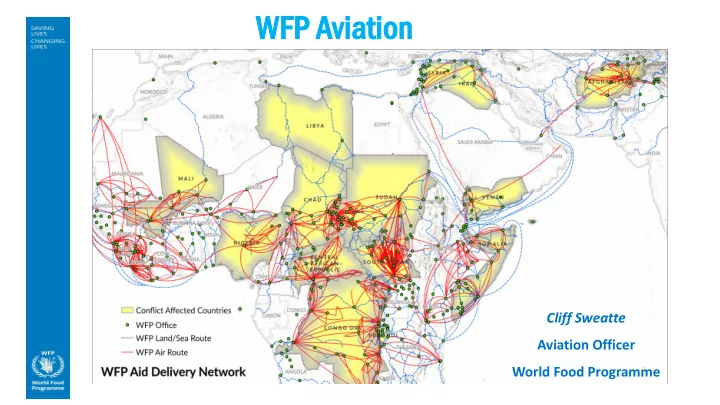
  • 83 Countries, 6 Regional Bureaus, 15 Aviation Field Operations
  • 2017: 327K Pax, 34K MT of Cargo, 3,079 Food Airdrops 80K MT
slide-3
SLIDE 3

RPAS/U AS/UAS/Dr AS/Drones

  • nes

Unmanned Aircraft Include:

  • Free balloons
  • Fully automatic and/or autonomous aircraft
  • Model aircraft
  • Drones
  • Remotely piloted aircraft

Airspace/aerodrome integration requires control Control, in real time, provided by a licensed remote pilot

slide-4
SLIDE 4

Puerto Rico Response - Loon

slide-5
SLIDE 5

Local Loon

  • Loon is planning to launch balloon powered internet connectivity in Kenya

next year, partnering with Telkom Kenya. Loon has successfully sent a test internet connection 1,000 km across seven balloons. That represents a distance that would span the entire country from the port city of Mombasa to the Kenya-Uganda border.

  • By sending a connection across multiple balloons, Loon is not simply

extending the signal to the last balloon in the line to serve users under its

  • position. Each balloon in the network is capable of passing a connection

along while simultaneously transmitting it to users on the ground. This means that instead of one balloon utilizing one ground-based connection point to serve users, that same connection point can be used to power multiple balloons, all of which can transmit service to people below.

  • Combined with the Loon system’s larger coverage area – between 20 to 30

times greater than a traditional ground-based system – this will allow Loon to connect more people without having to build lots of new ground infrastructure – a key obstacle to providing connectivity to those in underserved areas.

slide-6
SLIDE 6

UAS Toolkit

17 December 2018 6

slide-7
SLIDE 7 7

ANNEX NEX 2 – APPENDIX ENDIX 4

RPA shall not be operated across the territory of a contracting State without a special authorization issued by each State in which the flight is to

  • perate.

This authorization may be in the form of agreements between the States involved.

slide-8
SLIDE 8 8

REQUES UEST FOR AU AUTHO HORI RIZA ZATION TION FORM

slide-9
SLIDE 9 9

Operational approval is contingent upon acceptance by the CAA of a safety case that sufficiently identifies and address risks, hazards, and mitigations of the proposed

  • perations

Operation-centric, risk-based approach

slide-10
SLIDE 10 10

RPAS flight ht planning nning should ld includ ude prov

  • visio

sions ns for any ny emergencies gencies/cont /contingencies ingencies:

  • Emergency

gency landi ding/d ng/dit itching ing locations ions

  • Loss

ss of

  • f C2 Link
  • Militar

ary Trai aining ning Routes es

slide-11
SLIDE 11

INTEGRA TEGRATION TION OF OF RPAS OPERATIONS TIONS INTO ATM TM

  • Right-of-way: RPA are obliged to comply

with the Annex 2 right-of-way rules RPAS operators will need to file flight plans in accordance with Annex 2

  • RPAS operator should define lost C2 ink

procedures that are acceptable to the ANSP and regulator

  • It may be difficult for ANSPs, pilots of

manned aircraft and other remote pilots to acquire visual contact with the RPA due to low conspicuity

slide-12
SLIDE 12

HUMANITARIAN ASSITANCE, DISASTER RESPONSE & DEVELOPMENT

WFP UAS OPERATIONS & COMMUNICATIONS/DECONFLICTION PLAN

Operator ___________________ Contact Information: Phone: __________ Email: ______________ SATCOM or Telephone #: ______________ (For Vessel Launches) Radio Call Sign: __________ Vessel #: __________ Vessel Phone: _______ VSAT: __________ Iridium: __________

  • A. 7 Days prior1: Distribute email, including authorization from appropriate civil aviation

authorities (CAAs), to air Navigation Service Provider (ANSP) providers and appropriate government authorities (e.g., Civil Aviation Authority, Coast Guard, Ministry of Foreign Affairs, Ministry of Defense, etc. Area commercial aircraft operators shall also be notified of the pending operation.

  • B. 7 Days to 24 Hours in advance: Contact appropriate ANSP provider, request a Notice to

Airmen (NOTAM) be issued for the operation area. Emergency and National Disaster Operations authorizations may not be able to comply with standard NOTAM issuance timelines.

  • C. 1 Day prior: Provide operation area manned aircraft operator’s schedule for next day.
  • D. By _______ (local time) on day of flight, prior to flight: Participating manned aircraft
  • perators will confirm their flight plan(s).
  • E. 1 Hour prior:
  • 1. Operator files an ICAO flight plan through appropriate CAA or with ANSP. Flight plans shall

be submitted in accordance with Chapter 3 of ICAO Annex 2, Rules of the Air.

  • 2. Receive weather briefing, review NOTAMs, and determine if there are any other flight plans
  • n file

for the operating area.

  • 3. Check Receiver Autonomous Integrity Monitoring (RAIM), appropriate agency website or

UAS app.

  • 4. Contact appropriate ANSP unit via SATCOM or other acceptable means to confirm that any

special use airspace or ALTRV is active.

  • F. 10 Minutes prior to UAS launch: In preparation for launch, broadcast a warning

announcement on VHF _____ MHz common traffic advisory frequency (CTAF) or Marine Common FM Ch ___; e.g., “UAS flight operations are commencing from LAT/LONG of research vessel, or launch site.” Maintain a listening watch on VHF _____ MHz (CTAF) and _____ MHz for any area traffic.

  • G. During flight operations: Periodically broadcast a warning announcement on VHF _____

MHz (CTAF); e.g., “UAS operations are in effect between the surface and ____ feet within 10 .” “ .”

slide-13
SLIDE 13

Operation-centric, risk-based approach

slide-14
SLIDE 14

RPAS S Cargo go Del eliv iver ery

slide-15
SLIDE 15

Futur ture e Collabor llaboration ation and d Enga gagem gements ents

slide-16
SLIDE 16

Path Forward:

  • Cargo delivery category RPAS will be managed by WFP Aviation Service

(OSCA)

  • Identify use cases for RPAS humanitarian cargo delivery
  • UNAVSTADS
  • Collaborate with ICAO, IATA & Civil Aviation Authorities applying best

practices to enable safe, reproducible RPAS authorizations

WFP RPAS Cargo Delivery ry

slide-17
SLIDE 17

Thank You