
SLIDE 1
Nigeria’s Aviation Sector
A Presentation to the Senate Committee On Aviation
By
Honorable Minister of Aviation, Princess Stella Adaeze Oduah OON Tuesday 10th December, 2013
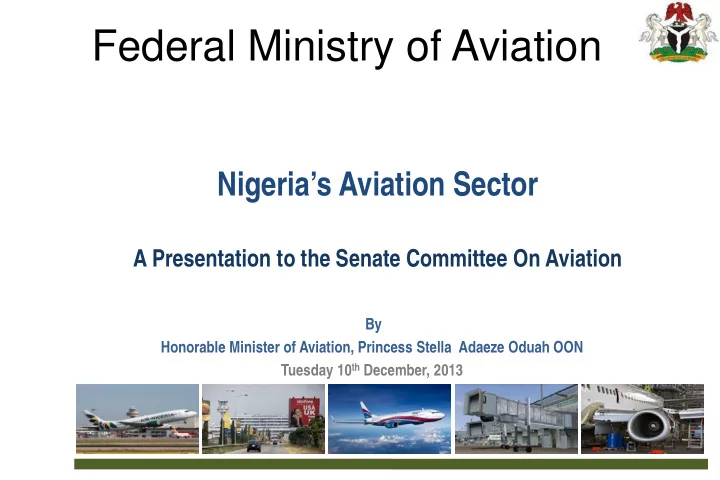
Federal Ministry of Aviation Nigerias Aviation Sector A Presentation - - PowerPoint PPT Presentation
Federal Ministry of Aviation Nigerias Aviation Sector A Presentation to the Senate Committee On Aviation By Honorable Minister of Aviation, Princess Stella Adaeze Oduah OON Tuesday 10 th December, 2013 The unfortunate Associated Airlines
A Presentation to the Senate Committee On Aviation
By
Honorable Minister of Aviation, Princess Stella Adaeze Oduah OON Tuesday 10th December, 2013
accident immediately.
Recorder (FDR), which together are referred to as the ‘Black Boxes’, at their recently commissioned Analytical Laboratory in Abuja.
unfortunate accident.
accident, the Commissioner of the AIPB will talk us through the 2-minute animated video reconstruction of the flight, developed from their Analytical Laboratory.
1. Introduction
2. The Aviation Sector
3. Issues Clarified
4. Economic Importance of Aviation 5. Aerotropolis Nigeria 6. Conclusion
5
either obsolete, unserviceable or unavailable
were dilapidated and derelict
trolleys, elevators, directional signage, power generators, etc were either unserviceable, unreliable, unavailable or not user friendly
mostly unreliable.
with fire hydrants unserviceable and firemen and women had gone without proper kits for years
(i.e. asbestos roofs, leaking roofs, broken floors, no power supply, etc.)
towers with serious safety risks for the industry
the country- in total, 154 abandoned projects in the industry
students and lacked adequate equipment and facilities
manual revenue collection processes
called ‘concession’ agreements that were skewed against the government and the public interest
frameworks in Agencies and Parastatals made accountability difficult, if not impossible
made government interventions wasteful and of no positive effect
and failing to pay their bills as and when due
responsibilites
▪ Complete neglect of economic regulation was seriously compromising overall safety and proper economic development
▪ A General Aviation sector almost completely unregulated, creating a huge safety gap in the industry ▪ An obsolescent National Aviation Policy ▪ A total lack of planning in the entire industry!!!
The state of the industry we inherited - MMA Domestic Terminal
14
The state of the industry we inherited - Mallam Aminu Kano International Airport
15
16
The state of the industry we inherited – Port Harcourt Int. Airport
17
The state of the industry we inherited - Benin Airport
18
19
The state of the industry we inherited – Toilets at MMA Domestic Terminal
20
21
gateway, had been left to rot and decay massively to the point that it had become unbefitting of our Country.
terminal better described as unfit for purpose.
Airport, Kano (MAKIA) was a very sad tale to tell.
the airports.
▪ Safety and Security: The industry was in retrogression, generally lagging far behind the rest
▪ Economically: The industry had become a net liability to government and the national economy ▪ National Prestige: The industry had established for itself a negative image and thus had become a very poor symbol of our national identity
▪ Several intervention funds injected into the industry resulted in no identifiable, tangible benefits. ▪ The country’s Aviation Industry was clearly lagging behind the rest of the world and Africa in all material aspects. ▪ As a result, the industry was not positioned to play the pivotal role that aviation plays in other countries and that it ought to have been playing in Nigeria for years.
from the United States who had carried out a World Bank Study
comprehensively on their findings.
Financial Affairs of all the Parastatals and Agencies under the Ministry to clarify the state of their financial affairs
Parastatals and Agencies under the Ministry
studies comissioned coupled with my years of business experience, I appointed a competent team of CEOs and DGs for all the Parastatals and Agencies under the Ministry.
Aviation Master Plan and Road Map to turn around Nigeria’s Aviation Industry.
President in January 2012 and since then, all our actions have followed the Road Map
without making very fundamental changes.
exiting from various lopsided ‘concessions’ entered into previously.
from the arrangements to the detriment of the industry and the national interest, who have continued to fight and distort public perceptions of the actions which my team and I continue to take to transform the Aviation Industry.
such plan for the Nigerian Aviation Industry.
development, human capacity development, the strengthening of domestic carriers, the establishment of a national carrier, the development of Regional Hubs and Perishable Cargo handling facilities, Free Trade Zones and Aerotropoli.
new and robust National Civil Aviation Policy.
Industry as pivotal to the economic growth of Nigeria, in line with Mr. President’s Transformation Agenda.
Before July 2011 October 2013
1 Doppler Weather Radar 2 installed (Abuja & PH), Work on going on 2 at Yola & Maiduguri 2 Low Level Windshear Alert Systems (LLWAS) 1 airport only (Abuja) 9 airports (Abuja, Kano, PH, Ikeja, Benin, Enugu, Owerri, Yola, Sokoto). 3 Upper Air Weather Monitoring Equipment 5 (Abuja, Enugu, Kano, Lagos, Maiduguri) 8 (Abuja, Enugu, Kano, Lagos, Maiduguri , Jos, Calabar, Yola) 4 Thunderstorm/Lightning Detector Systems 6 locations 20 locations 5 Integrated Aviation Weather Observation and Displays System (AWODS) 5 airports (Abuja, Lagos, Maiduguri, Ilorin and Port Harcourt). 14 (Abuja, Lagos and Port Harcourt, Owerri, Maiduguri, Enugu, Ilorin, Calabar, Katsina,, Zaria, Kano, Sokoto, Ibadan, Benin) 6 RETIM Synergy Satellite Image Receivers 4 Airports (Abuja, Kano, Lagos, Port Harcourt) 4 (Abuja, Kano, Lagos, Port Harcourt) Upgraded from 3G to state-of-the- art 5G System
Before July 2011 October 2013
7 Pilot/Crew Weather Briefing Facilities 2 airports (Lagos & Abuja) 10 (Lagos, Abuja, Kano, Port Harcourt, Owerri, Enugu, Calabar, Ilorin, Maiduguri, Jos) 8 Installation of Aeromet Systems 19 22 9 SADIS Weather Briefing System 1 (Lagos) 9 (Lagos, Abuja, PH, Kano, Sokoto, Ilorin, Maiduguri, Owerri & Kaduna) 10 Marine Weather Data Buoy 1 (Apapa) 11 Air Quality & Ozone Monitoring system 5 (Abuja, Enugu, Lagos, Kano, Maiduguri) 12 Instrument Calibration Laboratory 1 (Abuja)
20-Dec-13
AIRSPACE INFRASTRUCTURE DEVELOPMENT IN NIGERIA: CHALLENGES & SOLUTIONS
37
Doppler Weather Radar in Abuja
Area of Turbulence in the airspace as detected with Doppler Weather Radar
LLWAS Sensors on Masts
LLWAS Indoor Display Screen
Instrument Calibration Laboratory
Integrated AWODS Sensor Mast Integrated AWODS indoor Monitor
Satellite Images captured with RETIM showing areas of Active Weather
Pilot/Crew Briefing Room
NIMET Weather Forecast Office, Abuja (Compliant with WMO Standard) Automatic Weather Observation Station
Weather Studio
Upper Air
Monitoring
Equipment
ISO 9001:2008 Certification of NIMET’s Aeronautical Services
In compliance with ICAO and WMO requirement, NiMet underwent a Quality Management System audit process from October 2011. The Agency was finally certified in March 2013.
compliance with international aviation standards and best practices in the provision of weather services for airline operations. This certification boosts the confidence
data and products.
to meet the rigorous requirements and receive the ISO
to become the aviation hub for the entire sub-region.
meteorological service in Nigeria. It was made possible by the on-going Transformation of the aviation sector to guarantee quality of service and safety in the Nigerian airspace.
July 2011 October 2013 Flight Safety Analytical Laboratory 1 Released Aircraft Accident Reports 1 9 Safety Recommendations 36 Wreckage preservation/accident reconstruction hangar 1
July 2011 October 2013
1 Alsim AL-X Simulator One (1) Two (2) 2 360 Degrees Visual Tower Simulator for ATC Training Unavailable Procured and installed 3 Boeing 737-200 for cabin crew training Unavailable Procured 4 (2) nos Bell 206l-iv Helicopters Unavailable Procured 5 EADS SOCATA TBM 850 Single Engine Turbo prop Trainer Aircraft Unavailable Procured 6 Gas Turbine Trainer Unavailable Procured and installed
July 2011 October 2013
7 Aerodynamics (Wind Tunnel) Trainer Unavailable Procured and installed 8 Pilot Briefing Room In a deplorable situation Completely Renovated 9 ARTMACS Pc-Based Radar Simulator Unavailable Procured and installed 10 Auto pilot Training station Unavailable Procured and installed
July 2011 October 2013
11 Construction and Furnishing of Modern Lecture Rooms Unavailable Completely Constructed and Furnished 12 Construction & furnishing of Students Hostel Unavailable Completely Constructed and Furnished 13 Auditorium Unavailable 95% Complete 14 College Library Unavailable 98% Complete
55
56
57
58
59
60
The Boeing 737 acquired for Cabin Crew Training
61
The newly acquired ARTMACS PC-based Radar Simulator
62
63
Before July 2011 October 2013
1 TRACON Optimization through commencement of Area Radar Project completed with Approach radar control in Lagos, Kano, Abuja and Port Harcourt Area Radar commenced in Lagos and Kano ACCs 2 Total VHF Radio Coverage of Nigeria On-going Commissioned with ACC frequencies for Lagos West & East, Kano West & East plus additional VSAT node in Wukari 3 11 Control Tower Successfully deployed 4
AIS Automation Not implemented On-going (65% completion)
5 WGS-84 Survey On-going Completed with 22 airports surveyed. GNSS procedures drawn for Lagos, Kano, Abuja and Port Harcourt 6 Solar Power for Navigational Aids 6 locations
Before July 2011 October 2013 7 Calibration of Navigational Aids Not all Navigational Aids calibrated All navigational Aids successfully calibrated 8 Airfield Lighting for Lagos Runway 18L and Enugu Runway 24 Not done Lagos RWY 18L and Enugu RWY 24 successfully installed 9 Performance-Based Navigation (PBN) Not done WGS-84 completed with successful trials 10 MLAT/ADS-B in the Gulf of Guinea Not done Successfully initiated 11 Ground-to-Ground Radio Trunking for 22 airports Not done Successfully initiated
20- Dec- 13 69
The redesigning of the airspace to be WGS-84 compliant is one of the steps taken by the country to meet ICAO’s standard and transit to Performance Based Navigation (PBN)
Before July 2011 October 2013
1 Flight Tracking System Unavailable Successfully deployed 2 Automated Flight Information Reporting System (AFIRS) Unavailable Successfully deployed 3 IOSA Certification None Done in Nigeria 2 Airlines successfully Certified 4 Interlining Not done in Nigeria On-going exercise 5 Consumer Protection Unavailable Established
74
75
76
July 2011 October 2013
Fire Tenders 20
46
Firemen and women kits Old and worn out
450 brand new kits
Serviceable Fire Hydrant Systems 2
7 (11 more work in progress)
3-in-1 (Liquids, Metals and Explosive) detection screening equipment
Installed at MMA and Abuja and being installed at all airports
Terminal Buildings 22 dilapidated terminals
7 completely remodeled and 15 work in progress
Active International Airports 4
5
Renewal projects of critical infrastructure at MMA 1
20
Automation of revenue collection Only for aeronautical revenue and only at MMA and Abuja
All revenue collection now automated and being rolled
80
MMA DOMESTIC TERMINAL 1
81
MMA DOMESTIC TERMINAL 1 – EAST WING
82
MMIA - EXPANDED E WING ARRIVALS
83
LAGOS - INTERIOR OF THE MMA DOMESTIC TERMINAL 1
84
ILORIN - NEWLY REMODELLED DOMESTIC TERMINAL
85
ILORIN – REMODELLED DOMESTIC TERMINAL, AIRSIDE
86
ENUGU - NEWLY REMODELLED INT’L TERMINAL
87
OWERRI – INSIDE THE NEWLY REMODELLED TERMINAL
88
KANO – EXTERIOR OF THE NEWLY REMODELLED TERMINAL
89
KANO – NEWLY REMODELLED DOMESTIC TERMINAL
90
KANO – INSIDE THE NEWLY REMODELLED TERMINAL
91
KANO – OUTSIDE THE NEWLY REMODELLED TERMINAL
92
KANO – WAITING AREA IN THE REMODELLED TERMINAL
L AGOS – E xpa nde d a rriva l foye r a t MMIA: Work in Prog re ss
L AGOS - e volving a ne w inte r ior and ambie nc e at MMIA
T he ne w MMIA Powe r Pla nt
Bra nd ne w e le c tric a l pa ne ls a t the MMIA Powe r Pla nt
Some e xample s follow:
98
100
Be nin Air por t, De pa r tur e L
2013
Be nin Airport, Oc tobe r 2012- T he inte rna l public c irc ula tion a re a (“Hig h Stre e t”)
Sam Mbakwe Int. Car go Air por t, Owe r r i Air por t T e r minal, July 2011
104
Sa m Mbakwe Int. Car go Air por t, Owe r r i Air por t T e r mina l, Oc tobe r 2013
105
106
L
agos (5m passe nge r c apac ity, e xpandable to 8m)
Abuja (2m passe nge r
c apac ity)
Por
t Har c our t- (2m passe nge r c apac ity)
Kano- (1m passe nge r
c apac ity)
E
nugu- (1m passe nge r c apac ity)
world standard.
accidents in the past. By means of LLWAS the occurrence of low level windshear can now be detected and early warning relayed to pilots via the ATC before take off or landing.
hazardous weather systems on real-time basis.
weather data reliability.
every flight out of a Nigerian Airport.
accident data from the CVR and FDR (Black Boxes) right here in Abuja, thus saving time and money, speeding up the investigation process and upgrading the skills of our aircraft accident investigators.
reports from previous years, critical safety information in the form of 36 safety recommendations have been pushed out for implementation by the NCAA to aid in further enhancing the safety net.
TRACON project has improved the safety of the Nigerian airspace exponentially.
Airspace Capacity for the industry
addition to the en-route phases of flight, resulting in Reduced Separation Minima for aircraft, helping airlines save on flight times and fuel consumption and thus significantly reducing their
now available to Nigeria through TRACON.
Aviation Safety and Security in Nigeria- NCAT (1)
accordance with international standards
capacity for the College.
Aviation Safety and Security in Nigeria- NCAT (2)
simulator as well as a high tech 360 degree 3-D control tower simulator have been procured and installed in the college for the first time ever
revived and is fast being repositioned to play its rightful role of developing high quality professionals for the Country’s aviation industry.
Aviation Safety and Security in Nigeria- NCAA (1)
regulator, by emphasizing surveillance and co-operation with industry players, rather than a passive and reactive regulator.
trained to reflect this focus on effective surveillance
Aviation Safety and Security in Nigeria- NCAA (2)
inspectors by recruiting vastly experienced but recently retired training Captains, to use as external examiners and to beef up its flight inspectorate
proactive aviation safety regulator similar to what is found in any advanced Countries of the world.
rescue operations, in terms of equipment as well as personal protective clothing for the fire men and women.
explosive detection) screening equipment at all FAAN’s airports, bringing Nigeria in line with international standards and best practices.
conditioning, stand-by power systems, baggage belt systems, lifts, escalators and travelators as well as the general ambience of all our airport terminals.
The Aviation Industry is now safer and more compliant with ICAO Standards and International Best Practices. Our consistent improvements in safety standards have resulted in ICAO classifying Nigeria as ABOVE GLOBAL AVERAGE in the implementation of ICAO’s Standards and Recommended Practices (SARPs).
Given the above scorecard of the Federal Ministry of Aviation and her Parastatals and Agencies over last two years, it is completely false to suggest that Nigeria’s Aviation industry is less safe than it was two years ago. In fact, the opposite is the case by far. The industry is now much safer, much more compliant to ICAO Standards and International Best Practices and is getting better as we continue to execute our Road Map…
ICAO’s Map of Countries with Effective Implementation above the Global Average, 2013
We SHALL constantly improve Aviation safety standards and implement International Best Practices as we continue to execute the Aviation Master Plan and Road Map.
into Nigeria and indicating their interests to come to Nigeria.
requesting for additional frequencies.
airline market size and dynamics.
advantages.
scrutiny, they have a safety responsibility to take the necessary actions to promote safety.
nothing else.
capable regulator and headed by a 43-year veteran of the industry who is one of the Country’s most experienced pilots and aircraft engineers.
industry and growth had been largely unregulated thus far
NCAA dedicated to the regulation of this industry sector, headed by a seasoned industry professional
systems, procedures and program plans for General Aviation.
ICAO in 2005 to equalize airport standards globally.
begin to apply them in certifying airports
international airports with respect to airfield manouvering areas, including navigational and visual aids, airfield markings and signage, fire and rescue services, as well as Apron markings, signage and operations.
perimeter fencing and operational fencing of an airport. For Nigeria’s airports, which we inherited without these fences, this requires a huge capital outlay.
perimeter fencing as well as 200km of wire gauze operational fencing will be needed for an estimated sum of N40.8 billion
secure this funding as an urgent and important intervention
ameliorate the associated risks
first quarter of 2014, in accordance with the FMA’s program
in accordance with the rules as mistakes or deliberate non-compliance is usually costly.
Ministry of Aviation, to the service providers, to the professionals, to the aircraft owners and operators, to the Distinguished Senate of the National Assembly and its Committe on Aviation.
industry will grow even safer.
132
133
Source: New Zealand CAA
‘The contribution of Air Transport to Sustainable Development in Africa’ (Oxford Economic Forecasting)
US$450b direct contribution to global GDP Biggest mover of people and over 40% of the value of goods traded internationally Transports over 2.2 billion people annually and employs more than 5 million people directly and more than 15 million people indirectly worldwide Contributes $1.3 trillion to global GDP (2.5% of global GDP)
Accounts for approximately 4% of global air passenger traffic and less than 3% of air cargo traffic Contributes more than 450,000 jobs and $10b to continental GDP 10 countries account for 70% of the total passenger traffic and 90% of total cargo traffic 4 countries account for 70% of the total domestic passenger traffic on the continent (SA, Egypt, Morocco and Nigeria)
COUNTRY TOTAL PAX NUMBER
1. South Africa 35,411,329 2. Egypt 31,937,706 3. Morocco 15,104,662
4. Nigeria 14,927,918
5. Tunisia 10,833,819 6. Algeria 7,900,794 7. Kenya 7,723,559 8. Ethiopia 7,684,734
(Source: ACI)
through their supply chains a further 33,000 jobs (ground handlers, aviation fuel suppliers, catering service providers, etc).
Nigerian economy (GDP) and indirectly another N67 billion. A further N21 billion comes from the spending of the employees of the industry and their suppliers.
Nigerian economy annually and supports more than 70,000 jobs in Nigeria.
additional 80,000 – 100,000 job opportunities would have been created.
billion to the Nigerian economy (GDP) directly and indirectly. This will come from additional investments, construction of the infrastructure and FDI inflows into the industry.
GDP contribution of over N500 billion to the Nigerian economy annually and will support more than 200,000 jobs in Nigeria.
dignified and respectable air travel experience for Nigerians and visitors alike
population, economy, geographical position, size and diversity of market
until 2011.
A ke y e le me nt of the National Aviation T
r ansfor mation Road Map for the industr y.
It r
e pr e se nts our de te r mination to e nsur e that our air por ts impac t signific antly, not just on the host c ommunitie s but also on the national e c onomy.
T
hough at the pr e liminar y stage , we ar e de ve loping land use plans for L agos, Abuja, Por t Har c our t and Kano to guide the Ae r
Case for Development of Perishable Cargo in Nigeria (1)
2010 was approximately $1.6bn USD.
Ghana, Senegal, Ethiopia, Tanzania and Egypt actively export perishables (fruits, fresh fish, vegetables and flowers) by freight
form of perishable air freight activity yet produces all these commodities in abundance
Fastest Growing Markets in Africa for Perishables: (2007 - 2011):
Kenya + 36% South Africa: + 7% Senegal: + 3,8%
Ethiopia: + 72% Kenya: + 15% Egypt: + 7%
Ethiopia: + 245% Cameroon: + 12% Ghana: + 10% Kenya: + 4,53%
Case for Development of Perishable Cargo in Nigeria (2)
1. Nigeria is the largest Sub-Saharan African country producing perishables but doesn’t export 2. Nigerian farmers waste nearly 60% of their production due to:
3. EU market is looking for new source of perishables globally 4. Nigeria needs to gear up to exploit the market demand for perishables
I hope that we have been able to offer clarity on the true state of
I hope it is evident that the Aviation Industry in Nigeria is undergoing unprecedented transformation and we continue to work assiduously to ensure we bestow a legacy for the future I appeal that we are judged by our actual, tangible, outcomes and results.