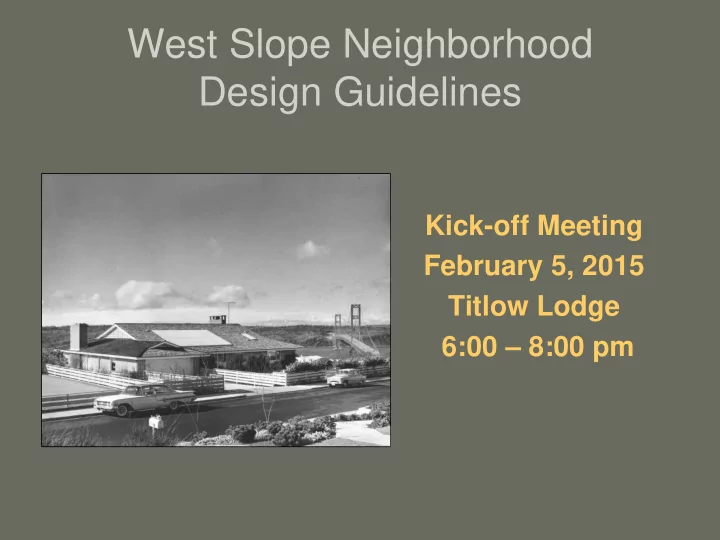
SLIDE 1
West Slope Neighborhood Design Guidelines
Kick-off Meeting February 5, 2015 Titlow Lodge 6:00 – 8:00 pm
SLIDE 2
West Slope Neighborhood Design Guidelines
Purpose of Meeting and Ground rules
SLIDE 3 Proposal Overview
Proposal: Establish a conservation district to maintain neighborhood character through certain restrictions on building design, lot size and subdivision of existing lots. Key elements of WSNC proposal:
- Houses shall be single-story with daylight
basement
- Establish a minimum lot size of 12,500 SF
(zoning is 7500)
- Subdivided lots shall extend from street to
street
- Trees and tall vegetation shall not obstruct
views
SLIDE 4 November 18 West Slope Neighborhood Community Information Meeting February 5 Design Guidelines Kickoff
- Discussion of guidelines content
- Feedback
March 11 Landmarks Preservation Commission presentation Set public hearing date March TBA West Slope Neighborhood Design Guidelines follow up
Schedule: Key Dates
SLIDE 5 Schedule: Key Dates (continued)
April 8 – Tentative Landmarks Preservation Commission public hearing April TBA Presentation to City Council Neighborhoods and Housing Committee July 1 Planning Commission public hearing
SLIDE 6 Schedule: Key Dates (continued)
September 15 City Council Study Session September 15 City Council Public Hearing September 23 City Council Infrastructure, Planning and Sustainability Committee review September 29 City Council First Reading of
October 6 City Council Final Reading of Ordinances October 31 Effective date of adopted amendments
SLIDE 7
Proposed district boundaries
SLIDE 8 Historical background
– recorded in 1944, 107 lots
– Recorded in 1944, 65 lots
– Recorded in 1947, 92 lots
Photo shows graded roads in 1947, looking north
SLIDE 9 Historical background
Norwegian immigrant and builder Eivind Anderson
David H. White
architects, custom- designed by builders,
plans
SLIDE 10
Historical background
Many streets had been developed by 1951
SLIDE 11 Historical background
2015 1951
Each house was carefully placed to maximize views
SLIDE 12
Historical background
Orientation and responding to the topography was important
SLIDE 13
Historical background
Streetscapes were important
SLIDE 14 Historical background
Diversity within Modern architectural styles was important
SLIDE 15 Site design characteristics
east-west
- Through lots (streets
- n both sides)
- Houses sited on
upside (east side) of lots
landscaping
SLIDE 16 House design characteristics
daylight basements, with the main entry on the east side
low pitched roofs
Contemporary (Modern) and traditional Ranch styles
SLIDE 17 House design characteristics
facades
and outdoor space
views
SLIDE 18
Details – subtle entries, entry courts
SLIDE 19
Details – house fronts can be private
SLIDE 20 Details – garages are usually integrated with house;
- riginal doors are paneled
SLIDE 21
Details – natural materials, colors and textures are prized
SLIDE 22 Details – windows are large and horizontally oriented
Front facade Rear facade
SLIDE 23
Details – doors are flush, sometimes with sidelights
SLIDE 24 Design guidelines for mid-century modern districts
- Arapahoe Acres, Englewood, CO, NR Historic
District – extensive design guidelines; voluntary design review
- Oak Hills, Washington Co., OR, NR Historic
District – no design guidelines; no review
- Sea Ranch, Sonoma Co., CA, no historic
designation – extensive, mandatory design guidelines
- Eichler Homes, Sunnyvale, CA, no historic
designation – extensive, mandatory design guidelines
SLIDE 25 Design guidelines - Application
construction
footprints of existing homes
homes
SLIDE 26
Design guidelines – identify elements
SLIDE 27
Design guidelines – identify characteristics
SLIDE 28
Design guidelines – identify characteristics
SLIDE 29
Design guidelines - height
For example: Building heights must be no higher than the average height of adjacent buildings Buildings are one story with a daylight basement
SLIDE 30 Design guidelines - massing and scale
For example: Residential structures shall not exceed a single, main level and a daylight basement Preferred massing is simple, with rectangular, L-shaped
footprints
SLIDE 31
Design guidelines - exterior cladding and materials
For example: New materials will be compatible with existing materials in the neighborhood, including board and batten, brick and masonry veneer, striated cedar shingles, and horizontal board
SLIDE 32
Design guidelines – roof shape and eaves
For example: Roof forms will be compatible with prevailing low- pitched and flat roofs Houses with parapet roofs will not be allowed
SLIDE 33 Design guidelines – fenestration patterns
For example: Fenestration patterns will reflect or be compatible with the prevailing patterns of horizontal windows and emphasize privacy on the front façade; rear facades may be heavily glazed
Front facade Rear facade
SLIDE 34
Design guidelines - fenestration patterns
SLIDE 35 Additional guideline subjects to be addressed:
- Architectural details
- Additions
- Main entrances
- Accessory structures and parking
- Site plan and layout
SLIDE 36
West Slope Neighborhood Design Guidelines
Kick-off Meeting February 5, 2015 Titlow Lodge 6:00 – 8:00 pm