Slope of a Secant MCV4U: Calculus & Vectors Recall that a secant - - PDF document

slope of a secant
SMART_READER_LITE
LIVE PREVIEW

Slope of a Secant MCV4U: Calculus & Vectors Recall that a secant - - PDF document

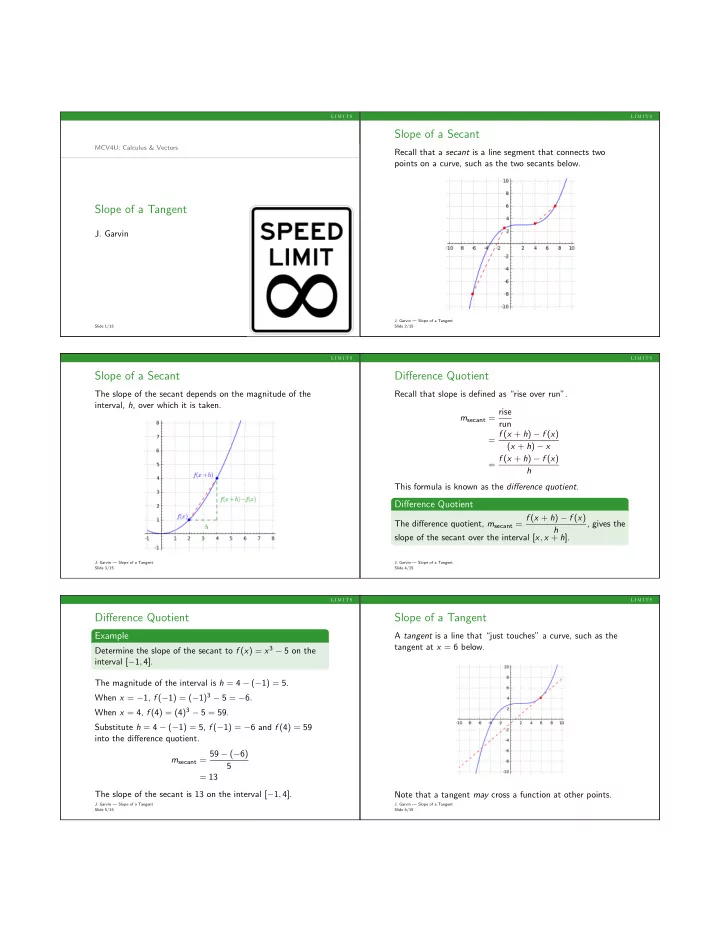
l i m i t s l i m i t s Slope of a Secant MCV4U: Calculus & Vectors Recall that a secant is a line segment that connects two points on a curve, such as the two secants below. Slope of a Tangent J. Garvin J. Garvin Slope of a Tangent


slide-1
SLIDE 1

l i m i t s

MCV4U: Calculus & Vectors

Slope of a Tangent

  • J. Garvin

Slide 1/15

l i m i t s

Slope of a Secant

Recall that a secant is a line segment that connects two points on a curve, such as the two secants below.

  • J. Garvin — Slope of a Tangent

Slide 2/15

l i m i t s

Slope of a Secant

The slope of the secant depends on the magnitude of the interval, h, over which it is taken.

  • J. Garvin — Slope of a Tangent

Slide 3/15

l i m i t s

Difference Quotient

Recall that slope is defined as “rise over run”. msecant = rise run = f (x + h) − f (x) (x + h) − x = f (x + h) − f (x) h This formula is known as the difference quotient.

Difference Quotient

The difference quotient, msecant = f (x + h) − f (x) h , gives the slope of the secant over the interval [x, x + h].

  • J. Garvin — Slope of a Tangent

Slide 4/15

l i m i t s

Difference Quotient

Example

Determine the slope of the secant to f (x) = x3 − 5 on the interval [−1, 4]. The magnitude of the interval is h = 4 − (−1) = 5. When x = −1, f (−1) = (−1)3 − 5 = −6. When x = 4, f (4) = (4)3 − 5 = 59. Substitute h = 4 − (−1) = 5, f (−1) = −6 and f (4) = 59 into the difference quotient. msecant = 59 − (−6) 5 = 13 The slope of the secant is 13 on the interval [−1, 4].

  • J. Garvin — Slope of a Tangent

Slide 5/15

l i m i t s

Slope of a Tangent

A tangent is a line that “just touches” a curve, such as the tangent at x = 6 below. Note that a tangent may cross a function at other points.

  • J. Garvin — Slope of a Tangent

Slide 6/15

slide-2
SLIDE 2

l i m i t s

Slope of a Tangent

As the interval, h, of the secant gets smaller, the slope of the secant better approximates the behaviour of the function at a given point P. If h is sufficiently small, the slope of the secant will approach the slope of the tangent at P. In previous courses, you have estimated the slope of the tangent by using a very small interval, such as h = 0.00001. While this is “good enough” for many functions, a more precise method is better.

  • J. Garvin — Slope of a Tangent

Slide 7/15

l i m i t s

Difference Quotient (Again)

To calculate the slope of the tangent at a given point, we need to evaluate the difference quotient as h → 0. Since setting h = 0 will result in division by zero, it is necessary to rewrite the difference quotient so that this restriction is eliminated. Fortunately, if all steps are done correctly, this should happen naturally.

  • J. Garvin — Slope of a Tangent

Slide 8/15

l i m i t s

Difference Quotient (Again)

Example

Determine the slope of the tangent to f (x) = x2 − 4 at x = 3. When x = 3, f (3) = 32 − 4 = 5, so the point of tangency is (3, 5). Substitute x = 3 and f (3) = 5 into the difference quotient. mtangent = (3 + h)2 − 4 − 5 h = 9 + 6h + h2 − 9 h = h(6 + h) h = 6 + h

  • J. Garvin — Slope of a Tangent

Slide 9/15

l i m i t s

Difference Quotient (Again)

As h → 0, 6 + h → 6. Therefore, the slope of the tangent to f (x) = x2 − 4 at (3, 5) is 6.

  • J. Garvin — Slope of a Tangent

Slide 10/15

l i m i t s

Difference Quotient (Again)

Example

Determine the slope of the tangent to f (x) = √4x + 1 at x = 2. When x = 2, f (2) =

  • 4(2) + 1 = 3, so the point of

tangency is (2, 3). Substitute x = 2 and f (2) = 3 into the difference quotient. mtangent =

  • 4(2 + h) + 1 − 3

h To eliminate the h in the denominator, we can multiply the numerator and denominator by the conjugate of the denominator.

  • J. Garvin — Slope of a Tangent

Slide 11/15

l i m i t s

Difference Quotient (Again)

mtangent =

  • 4(2 + h) + 1 − 3

h ×

  • 4(2 + h) + 1 + 3
  • 4(2 + h) + 1 + 3

= 4(2 + h) + 1 − 9 h(

  • 4(2 + h) + 1 + 3)

= 4h h( √ 9 + 4h + 3) = 4 √ 9 + 4h + 3 As h → 0, 4 √ 9 + 4h + 3 → 4

6 = 2

  • 3. Thus, the slope to

f (x) = √4x + 1 at (2, 3) is 2

3.

  • J. Garvin — Slope of a Tangent

Slide 12/15

slide-3
SLIDE 3

l i m i t s

Difference Quotient (Again)

Example

Determine the slope of the tangent to f (x) = x − 4 x at x = 5. When x = 5, f (5) = 5 − 4 5 = 1

5, so the point of tangency is

  • 5, 1

5

  • . Substitute into the difference quotient.

mtangent =

5+h−4 5+h

− 1

5

h =

1+h 5+h − 1 5

h Find a common denominator for the terms in the numerator, and simplify.

  • J. Garvin — Slope of a Tangent

Slide 13/15

l i m i t s

Difference Quotient (Again)

mtangent =

1+h 5+h − 1 5

h =

5(1+h)−1(5+h) 5(5+h)

h = 4h 5h(5 + h) = 4 5(5 + h) As h → 0, 4 5(5 + h) → 4

  • 25. Thus, the slope to f (x) = x − 4

x at

  • 5, 1

5

  • is

4 25.

  • J. Garvin — Slope of a Tangent

Slide 14/15

l i m i t s

Questions?

  • J. Garvin — Slope of a Tangent

Slide 15/15