On a secant Dirichlet series and Eichler integrals of Eisenstein - - PowerPoint PPT Presentation

on a secant dirichlet series and eichler integrals of
SMART_READER_LITE
LIVE PREVIEW

On a secant Dirichlet series and Eichler integrals of Eisenstein - - PowerPoint PPT Presentation

On a secant Dirichlet series and Eichler integrals of Eisenstein series Oberseminar Zahlentheorie Universit at zu K oln Armin Straub November 12, 2013 University of Illinois & Max-Planck-Institut at UrbanaChampaign f ur


slide-1
SLIDE 1

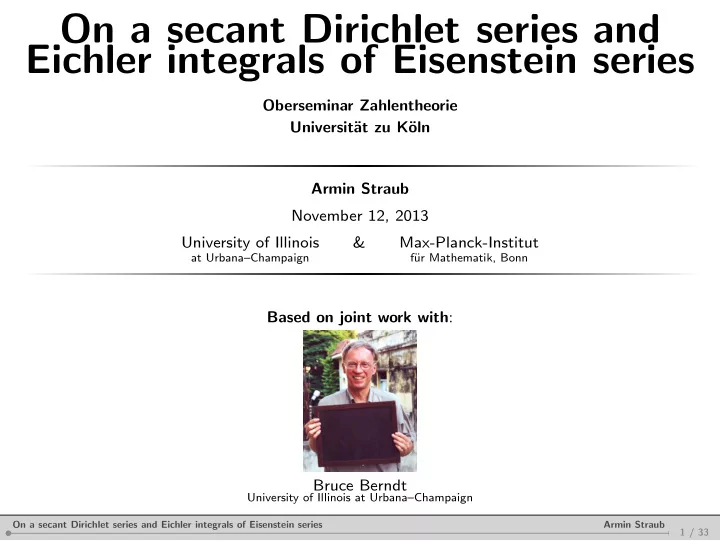
On a secant Dirichlet series and Eichler integrals of Eisenstein series

Oberseminar Zahlentheorie Universit¨ at zu K¨

  • ln

Armin Straub November 12, 2013 University of Illinois

at Urbana–Champaign

& Max-Planck-Institut

f¨ ur Mathematik, Bonn

Based on joint work with: Bruce Berndt

University of Illinois at Urbana–Champaign

On a secant Dirichlet series and Eichler integrals of Eisenstein series Armin Straub 1 / 33

slide-2
SLIDE 2

PART I

A secant Dirichlet series ψs(τ) =

  • n=1

sec(πnτ) ns

On a secant Dirichlet series and Eichler integrals of Eisenstein series Armin Straub 2 / 33

slide-3
SLIDE 3

Secant zeta function

  • Lal´

ın, Rodrigue and Rogers introduce and study ψs(τ) =

  • n=1

sec(πnτ) ns .

  • Clearly, ψs(0) = ζ(s). In particular, ψ2(0) = π2

6 .

ψ2( √ 2) = −π2 3 , ψ2( √ 6) = 2π2 3

EG

LRR ’13

On a secant Dirichlet series and Eichler integrals of Eisenstein series Armin Straub 3 / 33

slide-4
SLIDE 4

Secant zeta function

  • Lal´

ın, Rodrigue and Rogers introduce and study ψs(τ) =

  • n=1

sec(πnτ) ns .

  • Clearly, ψs(0) = ζ(s). In particular, ψ2(0) = π2

6 .

ψ2( √ 2) = −π2 3 , ψ2( √ 6) = 2π2 3

EG

LRR ’13

For positive integers m, r, ψ2m(√r) ∈ Q · π2m.

CONJ

LRR ’13

On a secant Dirichlet series and Eichler integrals of Eisenstein series Armin Straub 3 / 33

slide-5
SLIDE 5

Secant zeta function: Motivation

  • Euler’s identity:

  • n=1

1 n2m = −1 2(2πi)2m B2m (2m)!

  • Half of the Clausen and Glaisher functions reduce, e.g.,

  • n=1

cos(nτ) n2m = polym(τ), poly1(τ) = τ 2 4 − πτ 2 + π2 6 .

  • Ramanujan investigated trigonometric Dirichlet series of similar type.

From his first letter to Hardy:

  • n=1

coth(πn) n7 = 19π7 56700

In fact, this was already included in a general formula by Lerch.

On a secant Dirichlet series and Eichler integrals of Eisenstein series Armin Straub 4 / 33

slide-6
SLIDE 6

Secant zeta function: Convergence

  • ψs(τ) = sec(πnτ)

ns

has singularity at rationals with even denominator

0.2 0.4 0.6 0.8 1.0 4 2 2 4 6

ψ2(τ) truncated to 4 and 8 terms

0.2 0.4 0.6 0.8 1.0 10 5 5 10

Re ψ2(τ + εi) with ε = 1/1000

On a secant Dirichlet series and Eichler integrals of Eisenstein series Armin Straub 5 / 33

slide-7
SLIDE 7

Secant zeta function: Convergence

  • ψs(τ) = sec(πnτ)

ns

has singularity at rationals with even denominator

0.2 0.4 0.6 0.8 1.0 4 2 2 4 6

ψ2(τ) truncated to 4 and 8 terms

0.2 0.4 0.6 0.8 1.0 10 5 5 10

Re ψ2(τ + εi) with ε = 1/1000

The series ψs(τ) = sec(πnτ)

ns

converges absolutely if

1 τ = p/q with q odd and s > 1, 2 τ is algebraic irrational and s 2.

THM

Lal´ ın– Rodrigue– Rogers 2013

  • Proof uses Thue–Siegel–Roth, as well as a result of Worley when

s = 2 and τ is irrational

On a secant Dirichlet series and Eichler integrals of Eisenstein series Armin Straub 5 / 33

slide-8
SLIDE 8

Secant zeta function: Functional equation

  • Obviously, ψs(τ) = sec(πnτ)

ns

satisfies ψs(τ + 2) = ψs(τ).

(1 + τ)2m−1ψ2m

  • τ

1 + τ

  • − (1 − τ)2m−1ψ2m
  • τ

1 − τ

  • = π2m rat(τ)

THM

LRR, BS 2013

On a secant Dirichlet series and Eichler integrals of Eisenstein series Armin Straub 6 / 33

slide-9
SLIDE 9

Secant zeta function: Functional equation

  • Obviously, ψs(τ) = sec(πnτ)

ns

satisfies ψs(τ + 2) = ψs(τ).

(1 + τ)2m−1ψ2m

  • τ

1 + τ

  • − (1 − τ)2m−1ψ2m
  • τ

1 − τ

  • = π2m rat(τ)

THM

LRR, BS 2013

Collect residues of the integral IC = 1 2πi

  • C

sin (πτz) sin(π(1 + τ)z) sin(π(1 − τ)z) dz zs+1 . C are appropriate circles around the origin such that IC → 0 as radius(C) → ∞.

proof

On a secant Dirichlet series and Eichler integrals of Eisenstein series Armin Straub 6 / 33

slide-10
SLIDE 10

Secant zeta function: Functional equation

  • Obviously, ψs(τ) = sec(πnτ)

ns

satisfies ψs(τ + 2) = ψs(τ).

(1 + τ)2m−1ψ2m

  • τ

1 + τ

  • − (1 − τ)2m−1ψ2m
  • τ

1 − τ

  • = π2m[z2m−1]

sin(τz) sin((1 − τ)z) sin((1 + τ)z)

THM

LRR, BS 2013

Collect residues of the integral IC = 1 2πi

  • C

sin (πτz) sin(π(1 + τ)z) sin(π(1 − τ)z) dz zs+1 . C are appropriate circles around the origin such that IC → 0 as radius(C) → ∞.

proof

On a secant Dirichlet series and Eichler integrals of Eisenstein series Armin Straub 6 / 33

slide-11
SLIDE 11

Secant zeta function: Functional equation

  • Obviously, ψs(τ) = sec(πnτ)

ns

satisfies ψs(τ + 2) = ψs(τ).

(1 + τ)2m−1ψ2m

  • τ

1 + τ

  • − (1 − τ)2m−1ψ2m
  • τ

1 − τ

  • = π2m[z2m−1]

sin(τz) sin((1 − τ)z) sin((1 + τ)z)

THM

LRR, BS 2013

F|k a b

c d

  • (τ) = (cτ + d)−kF

aτ + b

cτ + d

  • DEF

slash

  • perator

On a secant Dirichlet series and Eichler integrals of Eisenstein series Armin Straub 6 / 33

slide-12
SLIDE 12

Secant zeta function: Functional equation

  • Obviously, ψs(τ) = sec(πnτ)

ns

satisfies ψs(τ + 2) = ψs(τ).

(1 + τ)2m−1ψ2m

  • τ

1 + τ

  • − (1 − τ)2m−1ψ2m
  • τ

1 − τ

  • = π2m[z2m−1]

sin(τz) sin((1 − τ)z) sin((1 + τ)z)

THM

LRR, BS 2013

F|k a b

c d

  • (τ) = (cτ + d)−kF

aτ + b

cτ + d

  • DEF

slash

  • perator
  • In terms of

T = 1 1 1

  • ,

S = −1 1

  • ,

R = 1 1 1

  • ,

the functional equations become ψ2m|1−2m(T 2 − 1) = 0, ψ2m|1−2m(R2 − 1) = π2m rat(τ).

On a secant Dirichlet series and Eichler integrals of Eisenstein series Armin Straub 6 / 33

slide-13
SLIDE 13

Secant zeta function: Functional equation

  • The matrices

T 2 = 1 2 1

  • ,

R2 = 1 2 1

  • ,

together with −I, generate Γ(2) = {γ ∈ SL2(Z) : γ ≡ I (mod 2)} . For any γ ∈ Γ(2), ψ2m|1−2m(γ − 1) = π2m rat(τ).

COR

On a secant Dirichlet series and Eichler integrals of Eisenstein series Armin Straub 7 / 33

slide-14
SLIDE 14

Secant zeta function: Special values

For positive integers m, r, ψ2m(√r) ∈ Q · π2m.

THM

LRR, BS 2013

  • Note that

X rY Y X

  • · √r = √r.
  • As shown by Lagrange, there are X and Y which solve

Pell’s equation X2 − rY 2 = 1. ψ2m|1−2m(γ − 1) = π2m rat(τ).

proof

On a secant Dirichlet series and Eichler integrals of Eisenstein series Armin Straub 8 / 33

slide-15
SLIDE 15

Secant zeta function: Special values

For positive integers m, r, ψ2m(√r) ∈ Q · π2m.

THM

LRR, BS 2013

  • Note that

X rY Y X

  • · √r = √r.
  • As shown by Lagrange, there are X and Y which solve

Pell’s equation X2 − rY 2 = 1.

  • Since

γ = X rY Y X 2 = X2 + rY 2 2rXY 2XY X2 + rY 2

  • ∈ Γ(2),

the claim follows from the evenness of ψ2m and ψ2m|1−2m(γ − 1) = π2m rat(τ).

proof

On a secant Dirichlet series and Eichler integrals of Eisenstein series Armin Straub 8 / 33

slide-16
SLIDE 16

Secant zeta function: Special values

For integers κ, µ, ψ2

  • κ +
  • κ
  • 1

µ + κ

  • = π2

6

  • 1 + 3κ

  • ,

ψ4

  • κ +
  • κ
  • 1

µ + κ

  • = π4

90

  • 1 + 5κ

2µ − 5κ2(16µ2 − 15) 8µ2(4κµ + 3)

  • .

EG

On a secant Dirichlet series and Eichler integrals of Eisenstein series Armin Straub 9 / 33

slide-17
SLIDE 17

PART II

Eichler integrals of Eisenstein series ˜ f(τ) = i∞

τ

[f(z) − a(0)] (z − τ)k−2dz

On a secant Dirichlet series and Eichler integrals of Eisenstein series Armin Straub 10 / 33

slide-18
SLIDE 18

Eichler integrals

D = 1 2πi d dτ derivative ∂h = D − h 4πy Maass raising operator

∂h(F|hγ)=(∂hF)|h+2γ

∂n

h = ∂h+2(n−1) ◦ · · · ◦ ∂h+2 ◦ ∂h

On a secant Dirichlet series and Eichler integrals of Eisenstein series Armin Straub 11 / 33

slide-19
SLIDE 19

Eichler integrals

D = 1 2πi d dτ derivative ∂h = D − h 4πy Maass raising operator

∂h(F|hγ)=(∂hF)|h+2γ

∂n

h = ∂h+2(n−1) ◦ · · · ◦ ∂h+2 ◦ ∂h

  • By induction on n,

following Lewis–Zagier 2001,

∂n

h

n! =

n

  • j=0

n + h − 1 j − 1 4πy j Dn−j (n − j)!.

On a secant Dirichlet series and Eichler integrals of Eisenstein series Armin Straub 11 / 33

slide-20
SLIDE 20

Eichler integrals

D = 1 2πi d dτ derivative ∂h = D − h 4πy Maass raising operator

∂h(F|hγ)=(∂hF)|h+2γ

∂n

h = ∂h+2(n−1) ◦ · · · ◦ ∂h+2 ◦ ∂h

  • By induction on n,

following Lewis–Zagier 2001,

∂n

h

n! =

n

  • j=0

n + h − 1 j − 1 4πy j Dn−j (n − j)!.

  • In the special case n = 1 − h, with h = 2 − k,

∂k−1

2−k = Dk−1.

On a secant Dirichlet series and Eichler integrals of Eisenstein series Armin Straub 11 / 33

slide-21
SLIDE 21

Eichler integrals

For all sufficiently differentiable F and all γ ∈ SL2(Z), Dk−1(F|2−kγ) = (Dk−1F)|kγ.

THM

Bol 1949

(DF)|2γ = (cτ + d)−2F ′ aτ + b cτ + d

  • = D
  • F

aτ + b cτ + d

  • EG

k = 2

On a secant Dirichlet series and Eichler integrals of Eisenstein series Armin Straub 12 / 33

slide-22
SLIDE 22

Eichler integrals

For all sufficiently differentiable F and all γ ∈ SL2(Z), Dk−1(F|2−kγ) = (Dk−1F)|kγ.

THM

Bol 1949

(DF)|2γ = (cτ + d)−2F ′ aτ + b cτ + d

  • = D
  • F

aτ + b cτ + d

  • EG

k = 2

  • F is an Eichler integral if Dk−1F is modular of weight k.
  • Then Dk−1(F|2−kγ) = Dk−1F, and hence

F|2−k(γ − 1) = poly(τ), deg poly k − 2.

  • poly(τ) is a period polynomial of the modular form.

On a secant Dirichlet series and Eichler integrals of Eisenstein series Armin Straub 12 / 33

slide-23
SLIDE 23

Eichler integrals

  • For modular f(τ) = a(n)qn, weight k, define the Eichler integral

˜ f(τ) = i∞

τ

[f(z) − a(0)] (z − τ)k−2dz = (−1)kΓ(k − 1) (2πi)k−1

  • n=1

a(n) nk−1 qn.

If a(0) = 0, ˜ f is an Eichler integral in the strict sense of the previous slide.

On a secant Dirichlet series and Eichler integrals of Eisenstein series Armin Straub 13 / 33

slide-24
SLIDE 24

Eichler integrals

  • For modular f(τ) = a(n)qn, weight k, define the Eichler integral

˜ f(τ) = i∞

τ

[f(z) − a(0)] (z − τ)k−2dz = (−1)kΓ(k − 1) (2πi)k−1

  • n=1

a(n) nk−1 qn.

If a(0) = 0, ˜ f is an Eichler integral in the strict sense of the previous slide.

For cusp forms f of level 1, the period polynomial ρf(X) is ˜ f|2−k(S − 1) = i∞ f(z)(z − X)k−2 dz = (−1)k

k−1

  • s=1

k − 2 s − 1 Γ(s) (2πi)s L(f, s)Xk−s−1.

EG

On a secant Dirichlet series and Eichler integrals of Eisenstein series Armin Straub 13 / 33

slide-25
SLIDE 25

The period polynomials

  • Let U = TS =

1 −1

1 0

  • , and define

Wk−2 =

  • p ∈ C[X]

deg p=k−2

: p|2−k(1 + S) = p|2−k(1 + U + U 2) = 0

  • .

On a secant Dirichlet series and Eichler integrals of Eisenstein series Armin Straub 14 / 33

slide-26
SLIDE 26

The period polynomials

  • Let U = TS =

1 −1

1 0

  • , and define

Wk−2 =

  • p ∈ C[X]

deg p=k−2

: p|2−k(1 + S) = p|2−k(1 + U + U 2) = 0

  • .
  • Denote with p− the odd part of p.

The space of (level 1) cusp forms Sk is isomorphic to W −

k−2 via

f → ρ−

f (X).

THM

Eichler– Shimura

  • Similarly, Wk−2 is isomorphic to Sk ⊕ Mk.

On a secant Dirichlet series and Eichler integrals of Eisenstein series Armin Straub 14 / 33

slide-27
SLIDE 27

The period polynomials in higher level

  • Let Γ be of finite index in Γ1 = SL2(Z).
  • Let Vk−2 be the polynomials of degree at most k − 2.

The multiple period polynomial of f is ρf : Γ\Γ1 → Vk−2, ρf(A)(X) = i∞ [f|A(z) − a0(f|A)] (z − X)k−2dz.

DEF

Pa¸ sol– Popa 2013

  • γ ∈ Γ1 acts on p : Γ\Γ1 → Vk−2 by

p|γ(A) = p(Aγ−1)|2−kγ.

  • Pa¸

sol and Popa extend Eichler–Shimura isomorphism to this settinsetting.

On a secant Dirichlet series and Eichler integrals of Eisenstein series Armin Straub 15 / 33

slide-28
SLIDE 28

Eichler integrals of Eisenstein series

  • For the Eisenstein series G2k,

G2k(τ) = 2ζ(2k) + 2(2πi)2k Γ(2k)

  • n=1

σ2k−1(n)qn,

n2k−1qn 1 − qn

˜ G2k(τ) = 4πi 2k − 1

  • n=1

σ2k−1(n) n2k−1 qn .

n1−2kqn 1 − qn

On a secant Dirichlet series and Eichler integrals of Eisenstein series Armin Straub 16 / 33

slide-29
SLIDE 29

Eichler integrals of Eisenstein series

  • For the Eisenstein series G2k,

G2k(τ) = 2ζ(2k) + 2(2πi)2k Γ(2k)

  • n=1

σ2k−1(n)qn,

n2k−1qn 1 − qn

˜ G2k(τ) = 4πi 2k − 1

  • n=1

σ2k−1(n) n2k−1 qn .

n1−2kqn 1 − qn

  • The period “polynomial” ˜

G2k|2−2k(S − 1) is given by (2πi)2k 2k − 1 k

  • s=0

B2s (2s)! B2k−2s (2k − 2s)!X2s−1 + ζ(2k − 1) (2πi)2k−1 (X2k−2 − 1)

  • .

On a secant Dirichlet series and Eichler integrals of Eisenstein series Armin Straub 16 / 33

slide-30
SLIDE 30

Ramanujan’s formula

For α, β > 0 such that αβ = π2 and m ∈ Z,

α−m

  • ζ(2m + 1)

2 +

  • n=1

n−2m−1 e2αn − 1

  • = (−β)−m
  • ζ(2m + 1)

2 +

  • n=1

n−2m−1 e2βn − 1

  • −22m

m+1

  • n=0

(−1)n B2n (2n)! B2m−2n+2 (2m − 2n + 2)!αm−n+1βn. THM

Ramanujan, Grosswald On a secant Dirichlet series and Eichler integrals of Eisenstein series Armin Straub 17 / 33

slide-31
SLIDE 31

Ramanujan’s formula

For α, β > 0 such that αβ = π2 and m ∈ Z,

α−m

  • ζ(2m + 1)

2 +

  • n=1

n−2m−1 e2αn − 1

  • = (−β)−m
  • ζ(2m + 1)

2 +

  • n=1

n−2m−1 e2βn − 1

  • −22m

m+1

  • n=0

(−1)n B2n (2n)! B2m−2n+2 (2m − 2n + 2)!αm−n+1βn. THM

Ramanujan, Grosswald

  • In terms of

ξs(τ) =

  • n=1

cot(πnτ) ns , Ramanujan’s formula takes the form

1 ex−1 = 1 2 cot( x 2) − 1 2

ξ2k−1|2−2k(S − 1) = (−1)k(2π)2k−1

k

  • s=0

B2s (2s)! B2k−2s (2k − 2s)!τ 2s−1.

On a secant Dirichlet series and Eichler integrals of Eisenstein series Armin Straub 17 / 33

slide-32
SLIDE 32

Secant zeta function

  • cot(πnτ)

n2k−1

is an Eichler integral of the Eisenstein series G2k. cot(πτ) = 1 π

  • j∈Z

1 τ + j

lim

N→∞ N

  • j=−N

EG

On a secant Dirichlet series and Eichler integrals of Eisenstein series Armin Straub 18 / 33

slide-33
SLIDE 33

Secant zeta function

  • cot(πnτ)

n2k−1

is an Eichler integral of the Eisenstein series G2k. cot(πτ) = 1 π

  • j∈Z

1 τ + j

lim

N→∞ N

  • j=−N

EG

  • sec(πnτ)

n2k

is an Eichler integral of an Eisenstein series with character. sec πτ 2

  • = 2

π

  • j∈Z

χ−4(j) τ + j

EG

m,n∈Z

χ−4(n) (mτ + n)2k+1 is an Eisenstein series of weight 2k + 1.

On a secant Dirichlet series and Eichler integrals of Eisenstein series Armin Straub 18 / 33

slide-34
SLIDE 34

Eisenstein series

  • More generally, we have the Eisenstein series

Ek(τ; χ, ψ) = ′

m,n∈Z

χ(m)ψ(n) (mτ + n)k , where χ and ψ are Dirichlet characters modulo L and M.

  • We assume χ(−1)ψ(−1) = (−1)k. Otherwise, Ek(τ; χ, ψ) = 0.

On a secant Dirichlet series and Eichler integrals of Eisenstein series Armin Straub 19 / 33

slide-35
SLIDE 35

Eisenstein series

  • More generally, we have the Eisenstein series

Ek(τ; χ, ψ) = ′

m,n∈Z

χ(m)ψ(n) (mτ + n)k , where χ and ψ are Dirichlet characters modulo L and M.

  • We assume χ(−1)ψ(−1) = (−1)k. Otherwise, Ek(τ; χ, ψ) = 0.

Modular transformations:

γ = a Mb

Lc d

  • ∈ SL2(Z)
  • Ek(τ; χ, ψ)|kγ = χ(d) ¯

ψ(d)Ek(τ; χ, ψ)

  • Ek(τ; χ, ψ)|kS = χ(−1)Ek(τ; ψ, χ)

PROP

If ψ is primitive, the L-function of E(τ) = Ek(τ; χ, ψ) is L(E, s) = const ·MsL(χ, s)L( ¯ ψ, 1 − k + s).

PROP

On a secant Dirichlet series and Eichler integrals of Eisenstein series Armin Straub 19 / 33

slide-36
SLIDE 36

Generalized Bernoulli numbers

ζ(2n) = −1 2(2πi)2n B2n (2n)!

EG

Euler

  • For integer n > 0 and primitive χ with χ(−1) = (−1)n,

(χ of conductor L and Gauss sum G(χ))

L(n, χ) = (−1)n−1 G(χ) 2 2πi L n Bn,¯

χ

n! , L(1 − n, χ) = −Bn,χ/n.

  • The generalized Bernoulli numbers have generating function

  • n=0

Bn,χ xn n! =

L

  • a=1

χ(a)xeax eLx − 1 .

On a secant Dirichlet series and Eichler integrals of Eisenstein series Armin Straub 20 / 33

slide-37
SLIDE 37

Period polynomials of Eisenstein series

For k 3 and primitive χ = 1, ψ = 1,

const = −χ(−1)G (χ) G(ψ)(2πi)k k − 1

˜ Ek(X; χ, ψ) − ψ(−1)Xk−2 ˜ Ek(−1/X; ψ, χ) = const

k

  • s=0

Bk−s,¯

χ

(k − s)!Lk−s Bs, ¯

ψ

s!Ms Xs−1.

THM

Berndt-S 2013

On a secant Dirichlet series and Eichler integrals of Eisenstein series Armin Straub 21 / 33

slide-38
SLIDE 38

Period polynomials of Eisenstein series

For k 3 and primitive χ = 1, ψ = 1,

const = −χ(−1)G (χ) G(ψ)(2πi)k k − 1

˜ Ek(X; χ, ψ) − ψ(−1)Xk−2 ˜ Ek(−1/X; ψ, χ) = const

k

  • s=0

Bk−s,¯

χ

(k − s)!Lk−s Bs, ¯

ψ

s!Ms Xs−1.

THM

Berndt-S 2013

  • If χ or ψ are principal, then we need to add to the RHS:

−2ψ(−1) k − 1 πi

  • δχ=1L(k − 1, ψ)Xk−2 − δψ=1L(k − 1, χ)
  • Recall that we assume χ(−1)ψ(−1) = (−1)k.

On a secant Dirichlet series and Eichler integrals of Eisenstein series Armin Straub 21 / 33

slide-39
SLIDE 39

Period polynomials of Eisenstein series

For k 3, primitive χ, ψ = 1, and n such that L|n,

Rn = ( 1 0

n 1 )

˜ Ek(X; χ, ψ)|2−k(1 − Rn) = const

k

  • s=0

Bk−s,¯

χ

(k − s)!Lk−s Bs, ¯

ψ

s!Ms Xs−1|2−k(1 − Rn).

COR

Berndt-S 2013

  • Note that

Xs−1|2−k(1 − Rn) = Xs−1(1 − (nX + 1)k−1−s).

On a secant Dirichlet series and Eichler integrals of Eisenstein series Armin Straub 22 / 33

slide-40
SLIDE 40

Application: Grosswald-type formula for Dirichlet L-values

For α ∈ H, such that Rk(α; ¯ χ, 1) = 0 and αk−2 = 1,

(k 3, χ primitive, χ(−1) = (−1)k) L(k − 1, χ) = k − 1 2πi(1 − αk−2)

  • ˜

Ek α − 1 L ; χ, 1

  • − αk−2 ˜

Ek 1 − 1/α L ; χ, 1

  • =

2 1 − αk−2

  • n=1

χ(n) nk−1

  • 1

1 − e2πin(1−α)/L − αk−2 1 − e2πin(1/α−1)/L

  • .

THM

Berndt-S 2013

On a secant Dirichlet series and Eichler integrals of Eisenstein series Armin Straub 23 / 33

slide-41
SLIDE 41

Application: Grosswald-type formula for Dirichlet L-values

For α ∈ H, such that Rk(α; ¯ χ, 1) = 0 and αk−2 = 1,

(k 3, χ primitive, χ(−1) = (−1)k) L(k − 1, χ) = k − 1 2πi(1 − αk−2)

  • ˜

Ek α − 1 L ; χ, 1

  • − αk−2 ˜

Ek 1 − 1/α L ; χ, 1

  • =

2 1 − αk−2

  • n=1

χ(n) nk−1

  • 1

1 − e2πin(1−α)/L − αk−2 1 − e2πin(1/α−1)/L

  • .

THM

Berndt-S 2013

As β ∈ H, β2k−2 = 1, ranges over algebraic numbers, the values

1 π

  • ˜

E2k(β; 1, 1) − β2k−2 ˜ E2k(−1/β; 1, 1)

  • contain at most one algebraic number.

THM

Gun– Murty– Rath 2011

On a secant Dirichlet series and Eichler integrals of Eisenstein series Armin Straub 23 / 33

slide-42
SLIDE 42

PART III

Unimodularity of period polynomials Rk(X) =

k

  • s=0

Bs s! Bk−s (k − s)!Xs−1

On a secant Dirichlet series and Eichler integrals of Eisenstein series Armin Straub 24 / 33

slide-43
SLIDE 43

Unimodular polynomials

p(x) is unimodular if all its zeros have absolute value 1.

DEF

  • Kronecker: if p(x) ∈ Z[x] is monic and unimodular,

hence Mahler measure 1,

then all of its roots are roots of unity. x10 + z9 − z7 − z6 − z5 − z4 − z3 + z + 1 has only the two real roots 0.850, 1.176 off the unit circle.

Lehmer’s conjecture: 1.176 . . . is the smallest Mahler measure (greater than 1)

EG

Lehmer

On a secant Dirichlet series and Eichler integrals of Eisenstein series Armin Straub 25 / 33

slide-44
SLIDE 44

Unimodular polynomials

p(x) is unimodular if all its zeros have absolute value 1.

DEF

  • Kronecker: if p(x) ∈ Z[x] is monic and unimodular,

hence Mahler measure 1,

then all of its roots are roots of unity. x10 + z9 − z7 − z6 − z5 − z4 − z3 + z + 1 has only the two real roots 0.850, 1.176 off the unit circle.

Lehmer’s conjecture: 1.176 . . . is the smallest Mahler measure (greater than 1)

EG

Lehmer

x2 + 6

5x + 1 =

  • x + 3+4i

5

x + 3−4i

5

  • EG

On a secant Dirichlet series and Eichler integrals of Eisenstein series Armin Straub 25 / 33

slide-45
SLIDE 45

Unimodular polynomials

p(x) is unimodular if all its zeros have absolute value 1.

DEF

  • Kronecker: if p(x) ∈ Z[x] is monic and unimodular,

hence Mahler measure 1,

then all of its roots are roots of unity. x10 + z9 − z7 − z6 − z5 − z4 − z3 + z + 1 has only the two real roots 0.850, 1.176 off the unit circle.

Lehmer’s conjecture: 1.176 . . . is the smallest Mahler measure (greater than 1)

EG

Lehmer

x2 + 6

5x + 1 =

  • x + 3+4i

5

x + 3−4i

5

  • EG

P(x) is unimodular if and only if

  • P(x) = a0 + a1x + . . . + anxn is self-inversive, i.e.

ak = εan−k for some |ε| = 1, and

  • P ′(x) has all its roots within the unit circle.

THM

Cohn 1922

On a secant Dirichlet series and Eichler integrals of Eisenstein series Armin Straub 25 / 33

slide-46
SLIDE 46

Ramanujan polynomials

  • Following Gun–Murty–Rath, the Ramanujan polynomials are

Rk(X) =

k

  • s=0

Bs s! Bk−s (k − s)!Xs−1. All nonreal zeros of Rk(X) lie on the unit circle.

For k 2, R2k(X) has exactly four real roots which approach ±2±1.

THM

Murty- Smyth- Wang ’11

R2k(X) + ζ(2k − 1) (2πi)2k−1 (X2k−2 − 1) is unimodular.

THM

Lal´ ın-Smyth ’13

1.0 0.5 0.0 0.5 1.0 1.0 0.5 0.0 0.5 1.0

R20(X)

1.0 0.5 0.0 0.5 1.0 1.0 0.5 0.0 0.5 1.0

Rfull

20 (X)

On a secant Dirichlet series and Eichler integrals of Eisenstein series Armin Straub 26 / 33

slide-47
SLIDE 47

Ramanujan polynomials

1.0 0.5 0.0 0.5 1.0 1.0 0.5 0.0 0.5 1.0

R20(X)

1.0 0.5 0.0 0.5 1.0 1.0 0.5 0.0 0.5 1.0

Rfull

20 (X)

On a secant Dirichlet series and Eichler integrals of Eisenstein series Armin Straub 27 / 33

slide-48
SLIDE 48

Ramanujan polynomials

1.0 0.5 0.0 0.5 1.0 1.0 0.5 0.0 0.5 1.0

R20(X)

1.0 0.5 0.0 0.5 1.0 1.0 0.5 0.0 0.5 1.0

Rfull

20 (X)

On a secant Dirichlet series and Eichler integrals of Eisenstein series Armin Straub 27 / 33

slide-49
SLIDE 49

Generalized Ramanujan polynomials

  • Consider the following generalized Ramanujan polynomials:

Rk(X) =

k

  • s=0

Bs s! Bk−s (k − s)!Xs−1 Rk(X; χ, ψ) =

k

  • s=0

Bs,χ s! Bk−s,ψ (k − s)! X − 1 M k−s−1 (1 − Xs−1)

On a secant Dirichlet series and Eichler integrals of Eisenstein series Armin Straub 28 / 33

slide-50
SLIDE 50

Generalized Ramanujan polynomials

  • Consider the following generalized Ramanujan polynomials:

Rk(X) =

k

  • s=0

Bs s! Bk−s (k − s)!Xs−1 Rk(X; χ, ψ) =

k

  • s=0

Bs,χ s! Bk−s,ψ (k − s)! X − 1 M k−s−1 (1 − Xs−1)

  • For k > 1, R2k(X; 1, 1) = R2k(X).
  • Rk(X; χ, ψ) is self-inversive.

PROP

Berndt-S 2013

On a secant Dirichlet series and Eichler integrals of Eisenstein series Armin Straub 28 / 33

slide-51
SLIDE 51

Generalized Ramanujan polynomials

  • Consider the following generalized Ramanujan polynomials:

Rk(X) =

k

  • s=0

Bs s! Bk−s (k − s)!Xs−1 Rk(X; χ, ψ) =

k

  • s=0

Bs,χ s! Bk−s,ψ (k − s)! X − 1 M k−s−1 (1 − Xs−1)

  • For k > 1, R2k(X; 1, 1) = R2k(X).
  • Rk(X; χ, ψ) is self-inversive.

PROP

Berndt-S 2013

If χ, ψ are nonprincipal real, then Rk(X; χ, ψ) is unimodular.

CONJ

On a secant Dirichlet series and Eichler integrals of Eisenstein series Armin Straub 28 / 33

slide-52
SLIDE 52

Generalized Ramanujan polynomials

Rk(X; χ, 1) For χ real, apparently unimodular unless:

  • χ = 1: R2k(X; 1, 1) has real roots approaching ±2±1
  • χ = 3−: R2k+1(X; 3−, 1) has real roots approaching −2±1

EG

On a secant Dirichlet series and Eichler integrals of Eisenstein series Armin Straub 29 / 33

slide-53
SLIDE 53

Generalized Ramanujan polynomials

Rk(X; χ, 1) For χ real, apparently unimodular unless:

  • χ = 1: R2k(X; 1, 1) has real roots approaching ±2±1
  • χ = 3−: R2k+1(X; 3−, 1) has real roots approaching −2±1

EG

Rk(X; 1, ψ) Apparently:

  • unimodular for ψ one of

3−, 4−, 5+, 8±, 11−, 12+, 13+, 19−, 21+, 24+, . . .

  • all nonreal roots on the unit circle if ψ is one of

1+, 7−, 15−, 17+, 20−, 23−, 24−, . . .

  • four nonreal zeros off the unit circle if ψ is one of

35−, 59−, 83−, 131−, 155−, 179−, . . .

EG

On a secant Dirichlet series and Eichler integrals of Eisenstein series Armin Straub 29 / 33

slide-54
SLIDE 54

Generalized Ramanujan polynomials

  • A second kind of generalized Ramanujan polynomials:

Rk(X) =

k

  • s=0

Bs s! Bk−s (k − s)!Xs−1 Sk(X; χ, ψ) =

k

  • s=0

Bs,χ s! Bk−s,ψ (k − s)! LX M k−s−1

  • Obviously, Sk(X; 1, 1) = Rk(X).

On a secant Dirichlet series and Eichler integrals of Eisenstein series Armin Straub 30 / 33

slide-55
SLIDE 55

Generalized Ramanujan polynomials

  • A second kind of generalized Ramanujan polynomials:

Rk(X) =

k

  • s=0

Bs s! Bk−s (k − s)!Xs−1 Sk(X; χ, ψ) =

k

  • s=0

Bs,χ s! Bk−s,ψ (k − s)! LX M k−s−1

  • Obviously, Sk(X; 1, 1) = Rk(X).

If χ is nonprincipal real, then Sk(X; χ, χ) is unimodular (up to trivial zero roots).

CONJ

On a secant Dirichlet series and Eichler integrals of Eisenstein series Armin Straub 30 / 33

slide-56
SLIDE 56

Generalized Ramanujan polynomials

1.0 0.5 0.0 0.5 1.0 1.0 0.5 0.0 0.5 1.0

R19(X; 1, χ−4)

1.0 0.5 0.0 0.5 1.0 1.0 0.5 0.0 0.5 1.0

S20(X; χ−4, χ−4)

On a secant Dirichlet series and Eichler integrals of Eisenstein series Armin Straub 31 / 33

slide-57
SLIDE 57

Generalized Ramanujan polynomials

1.0 0.5 0.0 0.5 1.0 1.0 0.5 0.0 0.5 1.0

R19(X; 1, χ−4)

1.0 0.5 0.0 0.5 1.0 1.0 0.5 0.0 0.5 1.0

S20(X; χ−4, χ−4)

On a secant Dirichlet series and Eichler integrals of Eisenstein series Armin Straub 31 / 33

slide-58
SLIDE 58

Unimodularity of period polynomials

  • Both kinds of generalized Ramanujan polynomials are, essentially,

period polynomials:

χ, ψ primitive, nonprincipal

Sk(X; χ, ψ) = const ·

  • ˜

Ek(X; ¯ χ, ¯ ψ) − ψ(−1)Xk−2 ˜ Ek(−1/X; ¯ ψ, ¯ χ)

  • Rk(LX + 1; χ, ψ) = Sk(X; χ, ψ)|2−k(1 − RL)

= const · ˜ Ek(X; ¯ χ, ¯ ψ)|2−k(1 − RL)

On a secant Dirichlet series and Eichler integrals of Eisenstein series Armin Straub 32 / 33

slide-59
SLIDE 59

Unimodularity of period polynomials

  • Both kinds of generalized Ramanujan polynomials are, essentially,

period polynomials:

χ, ψ primitive, nonprincipal

Sk(X; χ, ψ) = const ·

  • ˜

Ek(X; ¯ χ, ¯ ψ) − ψ(−1)Xk−2 ˜ Ek(−1/X; ¯ ψ, ¯ χ)

  • Rk(LX + 1; χ, ψ) = Sk(X; χ, ψ)|2−k(1 − RL)

= const · ˜ Ek(X; ¯ χ, ¯ ψ)|2−k(1 − RL) For any Hecke cusp form (for SL2(Z)), the odd part of its period polynomial has

  • trivial zeros at 0, ±2, ± 1

2,

  • and all remaining zeros lie on the unit circle.

THM

Conrey- Farmer- Imamoglu 2012

For any Hecke eigenform (for SL2(Z)), the full period polynomial has all zeros on the unit circle.

THM

El-Guindy– Raji 2013 On a secant Dirichlet series and Eichler integrals of Eisenstein series Armin Straub 32 / 33

slide-60
SLIDE 60

THANK YOU!

Slides for this talk will be available from my website: http://arminstraub.com/talks

  • B. Berndt, A. Straub

On a secant Dirichlet series and Eichler integrals of Eisenstein series Preprint, 2013

On a secant Dirichlet series and Eichler integrals of Eisenstein series Armin Straub 33 / 33