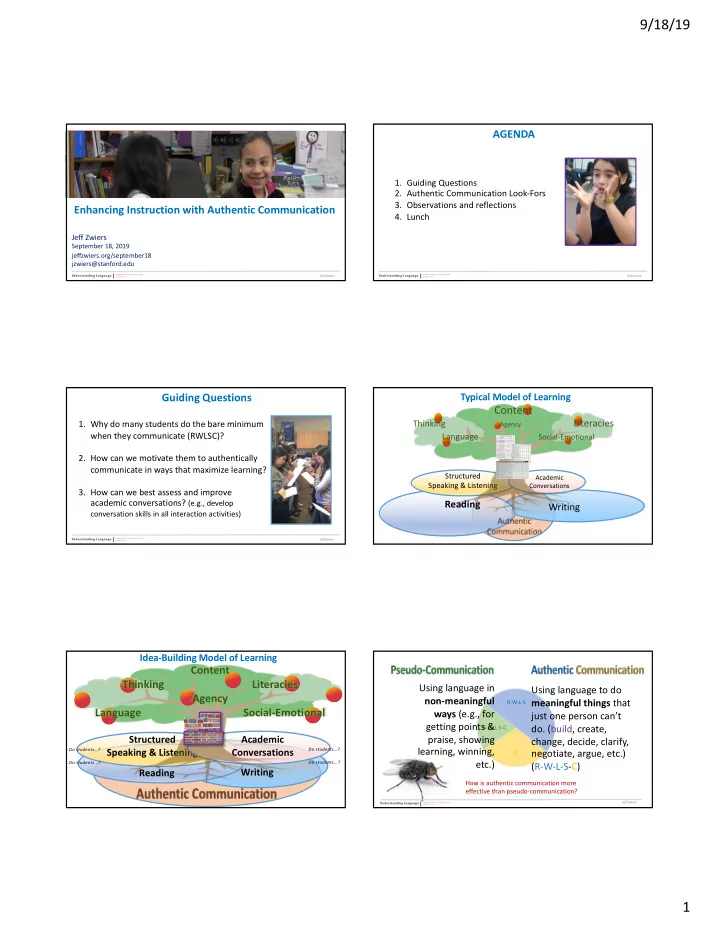
SLIDE 2 9/18/19 2
☑ Requires & helps students to fill information gap(s)
IDEA
Dialogues and actions help to develop themes for us to be better people. Christopher Columbus should not be portrayed as a hero in history books. Whenever I multiply two fractions, the answer is even smaller than them.
Tectonic plate movement often causes earthquakes. ☑ Requires & helps students to clarify & support
Authentic Communication Features
for developing content, thinking, language, and social skills
☑ Requires & helps students to build idea(s) △
Attention to language in service of communication
(Language modeling, practice, feedback, sentence frames, etc.) Clarify Support Clarify Clarify Clarify Support Support Support Support Support Support Clarify
It’ s important to be friends with people who are different from us.
Looked up definition of friend Winn Dixie helped her make friends Older people have lots of stories that teach kids about life Opal made friends with Gloria Dump Class discussion on friends in other stories TV episode on friendships I’m friends with my mother’ s friend Picture of how to be a good friend David’ s poster and explanation Otis had been to jail If they speak other languages, I can learn Pair-share with Manuel
An Example of Idea Building
(This will be different for each person.)
She made friends with the brothers Friends with Otis Opal made friends with Ms. Franny My parents’ Moroccan friends Why doesn’t this happen more? Conversation with mom about friends Short story we read about making friends
Improved farming techniques produced surplus food, which was needed for civilizations to form.
Article’ s description of specialization Video clip from movie
David’ s poster and explanation Diagrams in the Lee article Textbook examples Answer text questions Thinking about modern food and jobs Group work on presentation
An Example of Idea Building
(This will be different for each student.)
Writing up what I learned from the simulation How Egyptians used the Nile Forming Civilizations simulation YouTube: irrigation Looked up definition of civilization Timeline of hunter-gathers, farmers, and cities How Mesopotamia formed Greece, Persia, China, Mayans, Why did they fall? Conversation with Lisa about buildings My trip through the valley seeing all the crops
Communication Look-Fors
- 1. How well does the activity or teacher
require and/or help students to build up a meaningful idea?
- 2. How well does the activity or teacher require
and/or help students to clarify and support the idea?
- 3. How well does the activity or teacher require
and/or help students to fill information gaps?
- 4. How much do students push themselves and
- thers to do more than the bare minimum?
Conversation Skills & Features COAT Notes
Collaboratively build one or more ideas to the max Pose one or more relevant & buildable idea(s) & choose the best one(s) to build Support idea(s) with evidence, examples, explanations; accurate content Clarify (define, ask questions, elaborate, paraphrase, etc.) Evaluate and compare ideas to choose strongest/heaviest after building up both/all sides (if it’s an argument) Use disciplinary thinking (e.g., cause-effect, interpret, understand other perspectives, bias, analyze,…) Take appropriate turns (build on; respectfully challenge; don’t interrupt, etc.) Value each other’s ideas Nonverbal communication
Conversation Observation & Analysis Tool
building of ideas
(clarifying & supporting)
gaps
necessary language
& Agency READING & Viewing
Just focused on answering questions Could provide different texts Could have used some modeling Not much agency in answering ?s
WRITING & Creating
Students do more than the “bare minimum” Students write to fill gaps Frames useful for #1 Grammar modeling focuses on clarity
LISTENING & Watching
Could have used a “building” focused G.O. Could use A and B forms I need to model listening Just trying to fill in the note page
SPEAKING
Push selves to clarify/support Audience not know the topic Sentence frames do serve 1 & 2 Talks to help build idea
CONVERSING
Not push partners to clarify or support Not enough gap for this convo Text-based notes do support lang. Prompt not engaging enough
SOURCES: Admin/Coach Observation Data; Teacher Data & Insights (PLC results); Student Work & Assessments; Student Reflections, Interviews, & Surveys