Agile Estimation (Planning Poker) No plan survives contact with - - PDF document

agile estimation planning poker
SMART_READER_LITE
LIVE PREVIEW

Agile Estimation (Planning Poker) No plan survives contact with - - PDF document

Agile Estimation (Planning Poker) No plan survives contact with the enemy Field Marshal Helmuth Graf von Moltke Prussia (later Germany) Years of service: 1822-1888 Project Planning Basic Questions 1. What am I getting ? 2. When


slide-1
SLIDE 1

1

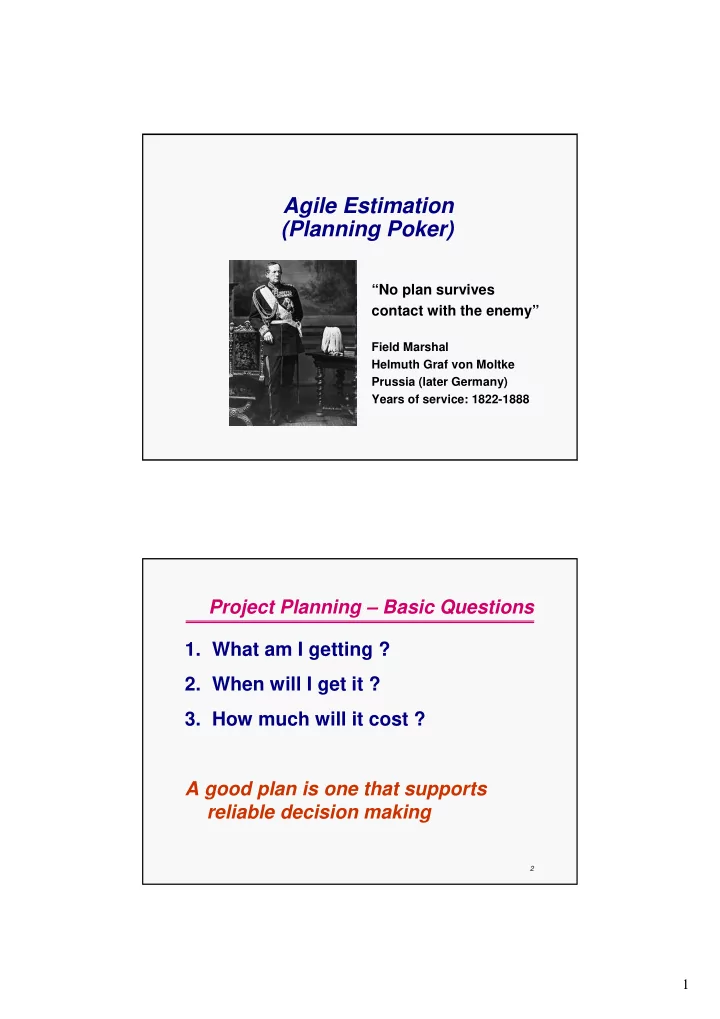
Agile Estimation (Planning Poker)

“No plan survives contact with the enemy”

Field Marshal Helmuth Graf von Moltke Prussia (later Germany) Years of service: 1822-1888

2

Project Planning – Basic Questions

  • 1. What am I getting ?
  • 2. When will I get it ?
  • 3. How much will it cost ?

A good plan is one that supports reliable decision making

slide-2
SLIDE 2

2

3

Planning

“The plan is nothing; the planning is everything” Dwight Eisenhower Allied supreme commander during World War II 34th President of United States (1953-61)

4

Project Planning

Time (Schedule) Cost (Budget) Functionality (Scope) Business Value The Project Triangle

slide-3
SLIDE 3

3

5

Planning

“A good plan violently executed now is better than a perfect plan executed next week” – General George S. Patton

6

Estimation Accuracy

Effort Accuracy

100

slide-4
SLIDE 4

4

7

Project Scheduling

Identify tasks Estimate tasks Allocate resources to tasks Schedule tasks Define product delivery schedule

8

How Long Will it Take?

To read the latest Harry Potter book? To drive to Niagara Falls? To do your calculus homework?

slide-5
SLIDE 5

5

9

Size & Duration

Size Duration

Lines of Code (LOC) Distance Words Hours Days Weeks Months Calculate LOC/Hour Speed Words/Min

10

Answering the Right Question

  • Size = 80 Java source lines
  • Rate = 10 Lines/Hour
  • Duration = ??

Ideal time = 8 hours There are 40 hours in a work week, so the task will be completed on Monday! but – On Mon/Tues there were three hours of meetings, two hours of emails and three hours of field support Elapsed time = two days

slide-6
SLIDE 6

6

11

Velocity

Ideal Time (8 hrs) Velocity (0.5) Elapsed Time (16 hrs) =

12

Agile Estimating

Estimate by analogy Compare features or “stories” being estimated with one another. “This story is a little bigger than that story” aka Triangulation Evidence that we are better estimating relative size than absolute size Unit-less estimates also known as “story points”

slide-7
SLIDE 7

7

13

Assign “Dog Points” to these breeds:

1 5 3 10 3 5 9 3

14

Planning Poker

Wideband Delphi Technique (circa 1946) Allows groups to quickly reach consensus Everyone’s voice is heard Exposes important project questions Emphasize relative estimation

slide-8
SLIDE 8

8

15

Playing Poker

One member of the team reads the feature story to be estimated “Customer logs in to the reservation system” “Customer enters search criteria for a hotel reservation” Each member selects a card without revealing their estimate (1,2,3,5,8,13,20,40) Cards are simultaneously displayed High and low estimates are explained, short discussion ensues Repeat as needed until estimates converge

16

slide-9
SLIDE 9

9

17

Remodel Your Room

Install ceiling fan in existing electrical fixture Hang three shelves Paint four walls Paint trim Replace broken glass in window Paint ceiling Hang four posters Set-up desktop computer and monitor Shampoo carpet Hang plasma monitor Install door lock Assemble new desk

18

Velocity

Relative estimates for each story Customer identifies priority Each completed story has a business value Developers identify dependencies Shampoo the carpet after painting Run the first iteration (two weeks), determine how many stories were completed. The total of story points is the team’s velocity

slide-10
SLIDE 10

10

19

Back to Planning….

Stories (features)

# of Iterations = Total Story Points / Velocity

20

Scrum Planning….

Product Backlog

# of Sprints = Total Story Points / Velocity Sprints

slide-11
SLIDE 11

11

21

Important caveats

Successful projects deliver working software frequently that gives the customer business value. The project schedule is reviewed after each iteration and velocity is updated as needed. The agile approach requires a big commitment on the customer’s part to provide details for each story. Other planning techniques exist. Learn about several approaches and pick the one that best fits your project’s needs.