WELLTOWER INC. (Exact name of registrant as specified in its charter - - PDF document

welltower inc
SMART_READER_LITE
LIVE PREVIEW

WELLTOWER INC. (Exact name of registrant as specified in its charter - - PDF document

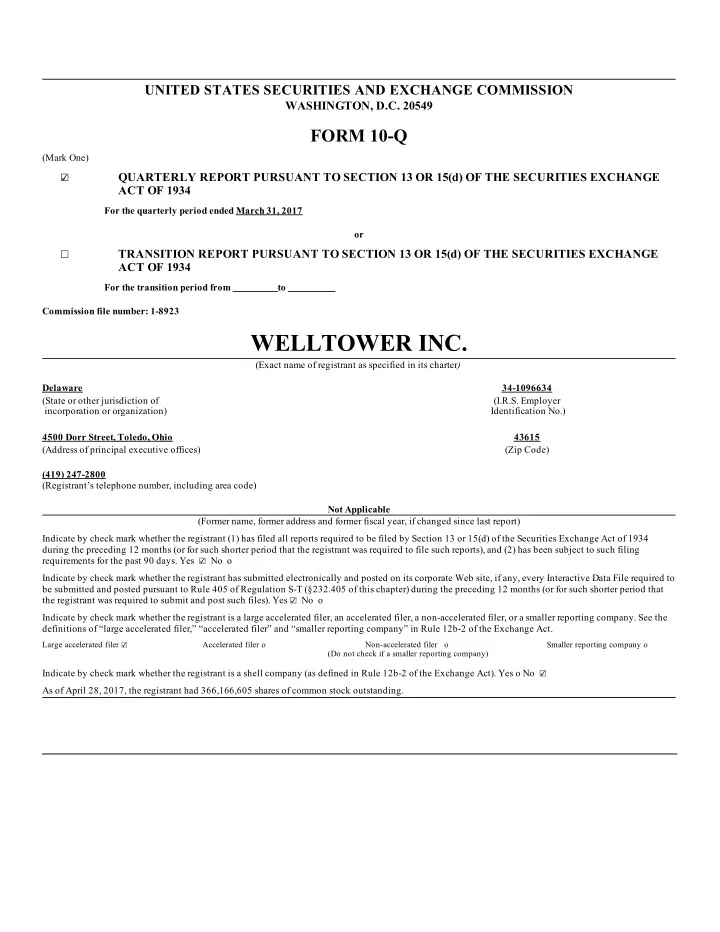
UNITED STATES SECURITIES AND EXCHANGE COMMISSION WASHINGTON, D.C. 20549 FORM 10-Q (Mark One) QUARTERLY REPORT PURSUANT TO SECTION 13 OR 15(d) OF THE SECURITIES EXCHANGE ACT OF 1934 For the quarterly period ended March 31, 2017 or


slide-1
SLIDE 1

UNITED STATES SECURITIES AND EXCHANGE COMMISSION

WASHINGTON, D.C. 20549

FORM 10-Q

(Mark One)

☑ QUARTERLY REPORT PURSUANT TO SECTION 13 OR 15(d) OF THE SECURITIES EXCHANGE ACT OF 1934

For the quarterly period ended March 31, 2017

  • r

☐ TRANSITION REPORT PURSUANT TO SECTION 13 OR 15(d) OF THE SECURITIES EXCHANGE ACT OF 1934

For the transition period from to Commission file number: 1-8923

WELLTOWER INC.

(Exact name of registrant as specified in its charter) Delaware 34-1096634 (State or other jurisdiction of incorporation or organization) (I.R.S. Employer Identification No.) 4500 Dorr Street, Toledo, Ohio 43615 (Address of principal executive offices) (Zip Code) (419) 247-2800 (Registrant’s telephone number, including area code) Not Applicable (Former name, former address and former fiscal year, if changed since last report) Indicate by check mark whether the registrant (1) has filed all reports required to be filed by Section 13 or 15(d) of the Securities Exchange Act of 1934 during the preceding 12 months (or for such shorter period that the registrant was required to file such reports), and (2) has been subject to such filing requirements for the past 90 days. Yes ☑ No o Indicate by check mark whether the registrant has submitted electronically and posted on its corporate Web site, if any, every Interactive Data File required to be submitted and posted pursuant to Rule 405 of Regulation S-T (§232.405 of this chapter) during the preceding 12 months (or for such shorter period that the registrant was required to submit and post such files). Yes ☑ No o Indicate by check mark whether the registrant is a large accelerated filer, an accelerated filer, a non-accelerated filer, or a smaller reporting company. See the definitions of “large accelerated filer,” “accelerated filer” and “smaller reporting company” in Rule 12b-2 of the Exchange Act.

Large accelerated filer ☑ Accelerated filer o Non-accelerated filer o (Do not check if a smaller reporting company) Smaller reporting company o

Indicate by check mark whether the registrant is a shell company (as defined in Rule 12b-2 of the Exchange Act). Yes o No ☑ As of April 28, 2017, the registrant had 366,166,605 shares of common stock outstanding.

slide-2
SLIDE 2

TABLE OF CONTENTS Page PART I. FINANCIAL INFORMATION Item 1. Financial Statements (Unaudited) Consolidated Balance Sheets — March 31, 2017 and December 31, 2016 3 Consolidated Statements of Comprehensive Income — Three months ended March 31, 2017 and 2016 4 Consolidated Statements of Equity — Three months ended March 31, 2017 and 2016 6 Consolidated Statements of Cash Flows — Three months ended March 31, 2017 and 2016 7 Notes to Unaudited Consolidated Financial Statements 8 Item 2. Management’s Discussion and Analysis of Financial Condition and Results of Operations 26 Item 3. Quantitative and Qualitative Disclosures About Market Risk 47 Item 4. Controls and Procedures 48 PART II. OTHER INFORMATION Item 1. Legal Proceedings Item 1A. Risk Factors 48 49 Item 2. Unregistered Sales of Equity Securities and Use of Proceeds 49 Item 5. Other Information 49 Item 6. Exhibits 49 Signatures 50

slide-3
SLIDE 3

PART I. FINANCIAL INFORMATION Item 1. Financial Statements CONSOLIDATED BALANCE SHEETS WELLTOWER INC. AND SUBSIDIARIES

(In thousands)

March 31, 2017 December 31, 2016 (Unaudited) (Note) Assets: Real estate investments: Real property owned: Land and land improvements $ 2,650,473 $ 2,591,071 Buildings and improvements 24,930,472 24,496,153 Acquired lease intangibles 1,421,277 1,402,884 Real property held for sale, net of accumulated depreciation 178,260 1,044,859 Construction in progress 390,180 506,091 Gross real property owned 29,570,662 30,041,058 Less accumulated depreciation and amortization (4,335,160) (4,093,494) Net real property owned 25,235,502 25,947,564 Real estate loans receivable 574,080 622,628 Less allowance for losses on loans receivable (6,196) (6,563) Net real estate loans receivable 567,884 616,065 Net real estate investments 25,803,386 26,563,629 Other assets: Investments in unconsolidated entities 416,110 457,138 Goodwill 68,321 68,321 Cash and cash equivalents 380,360 419,378 Restricted cash 42,777 187,842 Straight-line rent receivable 348,085 342,578 Receivables and other assets 708,238 826,298 Total other assets 1,963,891 2,301,555 Total assets $ 27,767,277 $ 28,865,184 Liabilities and equity Liabilities: Borrowings under primary unsecured credit facility $ 522,000 $ 645,000 Senior unsecured notes 8,188,928 8,161,619 Secured debt 2,669,787 3,477,699 Capital lease obligations 73,470 73,927 Accrued expenses and other liabilities 817,411 827,034 Total liabilities 12,271,596 13,185,279 Redeemable noncontrolling interests 385,418 398,433 Equity: Preferred stock 718,750 1,006,250 Common stock 365,187 363,071 Capital in excess of par value 17,134,490 16,999,691 Treasury stock (62,306) (54,741) Cumulative net income 5,130,593 4,803,575 Cumulative dividends (8,474,775) (8,144,981) Accumulated other comprehensive income (loss) (177,200) (169,531) Other equity 1,464 3,059 Total Welltower Inc. stockholders’ equity 14,636,203 14,806,393 Noncontrolling interests 474,060 475,079 Total equity 15,110,263 15,281,472 Total liabilities and equity $ 27,767,277 $ 28,865,184

NOTE: The consolidated balance sheet at December 31, 2016 has been derived from the audited financial statements at that date but does not include all of the information and footnotes required by U.S. generally accepted accounting principles for complete financial statements.

See notes to unaudited consolidated financial statements

3

slide-4
SLIDE 4

CONSOLIDATED STATEMENTS OF COMPREHENSIVE INCOME (UNAUDITED) WELLTOWER INC. AND SUBSIDIARIES

(In thousands, except per share data)

Three Months Ended March 31, 2017 2016 Revenues: Rental income $ 367,141 $ 415,663 Resident fees and services 670,337 602,149 Interest income 20,748 25,188 Other income 4,072 4,050 Total revenues 1,062,298 1,047,050 Expenses: Interest expense 118,597 132,960 Property operating expenses 510,169 449,636 Depreciation and amortization 228,276 228,696 General and administrative 31,101 45,691 Transaction costs

  • 8,208

Loss (gain) on derivatives, net 1,224

  • Loss (gain) on extinguishment of debt, net

31,356 (24) Impairment of assets 11,031 14,314 Other expenses 11,675

  • Total expenses

943,429 879,481 Income (loss) from continuing operations before income taxes and income from unconsolidated entities 118,869 167,569 Income tax (expense) benefit (2,245) 1,725 Income (loss) from unconsolidated entities (23,106) (3,820) Income (loss) from continuing operations 93,518 165,474 Gain (loss) on real estate dispositions, net 244,092

  • Net income

337,610 165,474 Less: Preferred stock dividends 14,379 16,352 Less: Preferred stock redemption charge 9,769

  • Less:

Net income (loss) attributable to noncontrolling interests(1) 823 153 Net income (loss) attributable to common stockholders $ 312,639 $ 148,969 Average number of common shares outstanding: Basic 362,534 355,076 Diluted 364,652 356,051 Earnings per share: Basic: Income (loss) from continuing operations attributable to common stockholders, including real estate dispositions $ 0.86 $ 0.42 Net income (loss) attributable to common stockholders* $ 0.86 $ 0.42 Diluted: Income (loss) from continuing operations attributable to common stockholders, including real estate dispositions $ 0.86 $ 0.42 Net income (loss) attributable to common stockholders* $ 0.86 $ 0.42 Dividends declared and paid per common share $ 0.87 $ 0.86

* Amounts may not sum due to rounding (1) Includes amounts attributable to redeemable noncontrolling interests.

See notes to unaudited consolidated financial statements

4

slide-5
SLIDE 5

CONSOLIDATED STATEMENTS OF COMPREHENSIVE INCOME (UNAUDITED) WELLTOWER INC. AND SUBSIDIARIES

(In thousands)

Three Months Ended March 31, 2017 2016 Net income $ 337,610 $ 165,474 Other comprehensive income (loss): Unrecognized gain (loss) on available for sale securities (10,569) (7,549) Unrealized gains (losses) on cash flow hedges

  • 483

Unrecognized actuarial gain (loss)

  • 2

Foreign currency translation gain (loss) 5,713 1,372 Total other comprehensive income (loss) (4,856) (5,692) Total comprehensive income (loss) 332,754 159,782 Less: Total comprehensive income (loss) attributable to noncontrolling interests(1) 3,636 15,271 Total comprehensive income (loss) attributable to common stockholders $ 329,118 $ 144,511

(1) Includes amounts attributable to redeemable noncontrolling interests.

See notes to unaudited consolidated financial statements

5

slide-6
SLIDE 6

CONSOLIDATED STATEMENTS OF EQUITY (UNAUDITED) WELLTOWER INC. AND SUBSIDIARIES

(In thousands)

Three Months Ended March 31, 2017 Accumulated Capital in Other Preferred Common Excess of Treasury Cumulative Cumulative Comprehensive Other Noncontrolling Stock Stock Par Value Stock Net Income Dividends Income (Loss) Equity Interests Total Balances at beginning of period $ 1,006,250 $ 363,071 $ 16,999,691 $ (54,741) $ 4,803,575 $ (8,144,981) $ (169,531) $ 3,059 $ 475,079 $ 15,281,472 Comprehensive income: Net income (loss) 336,787 1,780 338,567 Other comprehensive income (7,669) 2,813 (4,856) Total comprehensive income 333,711 Net change in noncontrolling interests 932 (5,612) (4,680) Amounts related to stock incentive plans, net of forfeitures 336 6,903 (7,565) (1,605) (1,931) Proceeds from issuance of common stock 1,780 117,204 118,984 Redemption of preferred stock (287,500) 9,760 (9,769) (287,509) Option compensation expense 10 10 Dividends paid: Common stock dividends (315,415) (315,415) Preferred stock dividends (14,379) (14,379) Balances at end of period $ 718,750 $ 365,187 $ 17,134,490 $ (62,306) $ 5,130,593 $ (8,474,775) $ (177,200) $ 1,464 $ 474,060 $ 15,110,263 Three Months Ended March 31, 2016 Accumulated Capital in Other Preferred Common Excess of Treasury Cumulative Cumulative Comprehensive Other Noncontrolling Stock Stock Par Value Stock Net Income Dividends Income (Loss) Equity Interests Total Balances at beginning of period $ 1,006,250 $ 354,811 $ 16,478,300 $ (44,372) $ 3,725,772 $ (6,846,056) $ (88,243) $ 4,098 $ 585,325 $ 15,175,885 Comprehensive income: Net income (loss) 165,321 1,082 166,403 Other comprehensive income (20,810) 15,118 (5,692) Total comprehensive income 160,711 Net change in noncontrolling interests (5,717) (121,325) (127,042) Amounts related to stock incentive plans, net of forfeitures 637 25,555 (6,899) (115) 19,178 Proceeds from issuance of common stock 1,505 91,600 93,105 Option compensation expense 79 79 Dividends paid: Common stock dividends (305,770) (305,770) Preferred stock dividends (16,352) (16,352) Balances at end of period $ 1,006,250 356,953 16,589,738 (51,271) 3,891,093 (7,168,178) (109,053) 4,062 480,200 $ 14,999,794

See notes to unaudited consolidated financial statements

6

slide-7
SLIDE 7

CONSOLIDATED STATEMENTS OF CASH FLOWS (UNAUDITED) WELLTOWER INC. AND SUBSIDIARIES

(In thousands) Three Months Ended March 31, 2017 2016 Operating activities: Net income $ 337,610 $ 165,474 Adjustments to reconcile net income to net cash provided from (used in) operating activities: Depreciation and amortization 228,276 228,696 Other amortization expenses 3,361 1,118 Impairment of assets 11,031 14,314 Stock-based compensation expense 4,906 8,186 Loss (gain) on derivatives, net 1,224

  • Loss (gain) on extinguishment of debt, net

31,356 (24) Loss (income) from unconsolidated entities 23,106 3,820 Rental income in excess of cash received (18,141) (29,669) Amortization related to above (below) market leases, net 8 230 Loss (gain) on sales of properties, net (244,092)

  • Distributions by unconsolidated entities

474 174 Increase (decrease) in accrued expenses and other liabilities 19,478 (13,526) Decrease (increase) in receivables and other assets (13,071) 1,816 Net cash provided from (used in) operating activities 385,526 380,609 Investing activities: Cash disbursed for acquisitions (102,356) (171,482) Cash disbursed for capital improvements to existing properties (42,115) (35,025) Cash disbursed for construction in progress (69,334) (66,739) Capitalized interest (4,129) (3,037) Investment in real estate loans receivable (25,375) (27,251) Other investments, net of payments 48,311 (30,773) Principal collected on real estate loans receivable 8,792 93,774 Contributions to unconsolidated entities (13,073) (12,784) Distributions by unconsolidated entities 24,161 11,747 Proceeds from (payments on) derivatives 8,218

  • Decrease (increase) in restricted cash

145,065 (394) Proceeds from sales of real property 1,087,074

  • Net cash provided from (used in) investing activities

1,065,239 (241,964) Financing activities: Net increase (decrease) under unsecured credit facilities (123,000) (190,000) Proceeds from issuance of senior unsecured notes

  • 688,560

Payments to extinguish senior unsecured notes

  • (400,000)

Net proceeds from the issuance of secured debt 12,536 75,136 Payments on secured debt (822,438) (130,343) Net proceeds from the issuance of common stock 119,651 93,433 Redemption of preferred stock (287,500)

  • Payments for deferred financing costs and prepayment penalties

(36,674) (1,217) Contributions by noncontrolling interests(1) 2,667 126,142 Distributions to noncontrolling interests(1) (20,014) (76,222) Acquisitions of noncontrolling interests (38)

  • Cash distributions to stockholders

(329,794) (322,122) Other financing activities (8,022) (7,294) Net cash provided from (used in) financing activities (1,492,626) (143,927) Effect of foreign currency translation on cash and cash equivalents 2,843 323 Increase (decrease) in cash and cash equivalents (39,018) (4,959) Cash and cash equivalents at beginning of period 419,378 360,908 Cash and cash equivalents at end of period $ 380,360 $ 355,949 Supplemental cash flow information: Interest paid $ 109,438 $ 134,872 Income taxes paid 3,349 2,431

(1) Includes amounts attributable to redeemable noncontrolling interests.

See notes to unaudited consolidated financial statements

7

slide-8
SLIDE 8

WELLTOWER INC. NOTES TO UNAUDITED CONSOLIDATED FINANCIAL STATEMENTS

  • 1. Business

Welltower Inc., an S&P 500 company headquartered in Toledo, Ohio, is driving the transformation of health care infrastructure. The company invests with leading seniors housing operators, post-acute providers and health systems to fund the real estate and infrastructure needed to scale innovative care delivery models and improve people’s wellness and overall health care experience. Welltower™, a real estate investment trust (“REIT”), owns interests in properties concentrated in major, high-growth markets in the United States, Canada and the United Kingdom, consisting of seniors housing and post-acute communities and outpatient medical properties. Founded in 1970, we were the first real estate investment trust to invest exclusively in health care facilities.

  • 2. Accounting Policies and Related Matters

Basis of Presentation The accompanying unaudited consolidated financial statements have been prepared in accordance with U.S. generally accepted accounting principles (“U.S. GAAP”) for interim financial information and with instructions to Quarterly Report on Form 10-Q and Article 10 of Regulation S-X. Accordingly, they do not include all of the information and footnotes required by U.S. GAAP for complete financial statements. In the opinion of management, all adjustments (consisting of normal recurring accruals) considered necessary for a fair presentation have been included. Operating results for the three months ended March 31, 2017 are not necessarily an indication of the results that may be expected for the year ending December 31, 2017. For further information, refer to the financial statements and notes thereto included in our Annual Report on Form 10-K for the year ended December 31, 2016. New Accounting Standards In May 2014, the Financial Accounting Standards Board (the “FASB”) issued ASU No. 2014-09, “Revenue from Contracts with Customers (Topic 606)”. The standard is a comprehensive new revenue recognition model that requires revenue to be recognized in a manner to depict the transfer of goods or services to a customer at an amount that reflects the consideration expected to be received in exchange for those goods or services. ASU 2014-09 is effective for fiscal years, and interim periods within those years, beginning after December 15, 2017, and early adoption is permitted beginning after December 15, 2016. A reporting entity may apply the new standard using either a modified retrospective approach by recording a cumulative-effect adjustment to equity as of the beginning of the fiscal year of adoption or a full retrospective approach. We are currently evaluating the impact that the adoption of the standard will have

  • n our consolidated financial statements and have not yet determined the method by which we will adopt the new standard. A significant source of our

revenue is generated through leasing arrangements, which are specifically excluded from the new standard. We expect that the new standard will affect our accounting policies related to non-lease revenue, including certain fees in our RIDEA joint ventures, common area maintenance in our outpatient medical properties and real estate sales. Under ASU 2014-09, revenue recognition for real estate sales is mainly based on the transfer of control versus current guidance of continuing involvement. We expect that the new guidance will result in more transactions qualifying as sales of real estate and being recognized at an earlier date than under the current guidance. In January 2016, the FASB issued ASU No. 2016-01, “Financial Instruments – Overall: Recognition and Measurement of Financial Assets and Financial Liabilities,” which will require entities to measure their investments at fair value and recognize any changes in fair value in net income unless the investments qualify for the new practicability exception. The practicability exception will be available for equity investments that do not have readily determinable fair values. ASU 2016-01 is effective for fiscal years and interim periods within those years, beginning after December 15, 2017. We are currently evaluating the impact that the standard will have on our consolidated financial statements. In February 2016, the FASB issued ASU No. 2016-02, “Leases (Topic 842),” which requires lessees to recognize assets and liabilities on their balance sheet related to the rights and obligations created by most leases, while continuing to recognize expenses on their income statements over the lease term. It will also require disclosures designed to give financial statement users information regarding amount, timing, and uncertainty of cash flows arising from

  • leases. ASU 2016-02 is effective for fiscal years, and interim periods within those years, beginning after December 15, 2018, and early adoption is permitted.

Entities are required to use a modified retrospective approach for leases that exist or are entered into after the beginning of the earliest comparative period in the financial statements. We are currently evaluating the impact of this standard on our consolidated financial statements. We believe that the adoption of this standard will likely have a material impact to our consolidated balance sheet for the recognition of certain operating leases as right-of-use assets and lease liabilities. We are in the process of analyzing our lease portfolio and evaluating systems to comply with the standard’s retrospective adoption requirements. In March 2016, the FASB issued ASU No. 2016-09, “Improvements to Employee Share-Based Payment Accounting”. ASU 2016-09 is effective for fiscal years, and interim periods within those years, beginning after December 15, 2016, and early adoption is permitted. We adopted ASU 2016-09 on January 1,

  • 2017. The standard allows companies to make a policy election as to whether

8

slide-9
SLIDE 9

WELLTOWER INC. NOTES TO UNAUDITED CONSOLIDATED FINANCIAL STATEMENTS they will include an estimate of awards expected to be forfeited or whether they will account for forfeitures as they occur. We have elected to account for forfeitures as they occur. This election had an immaterial impact on our consolidated financial statements. The standard also requires an employer to classify as a financing activity in the statement of cash flow the cash paid to a tax authority when shares are withheld to satisfy the employer’s statutory income tax withholding obligation. This standard is required to be applied on a retrospective basis and resulted in an increase in net cash provided by operating activities and a decrease in net cash used in financing activities of $6,897,000 for the three months ended March 31, 2016. Upon adoption, no other provisions of ASU 2016-09 had an effect on our unaudited consolidated financial statements or related footnote disclosures. In June 2016, the FASB issued ASU No. 2016-13, “Measurement of Credit Losses on Financial Instruments”. This standard requires a new forward-looking “expected loss” model to be used for receivables, held-to-maturity debt, loans, and other instruments. ASU 2016-13 is effective for fiscal years, and interim periods within those years, beginning after December 15, 2019, and early adoption is permitted for fiscal years beginning after December 15, 2018. We are currently evaluating the impact that the standard will have on our consolidated financial statements. In January 2017, the FASB issued ASU No. 2017-01, “Clarifying the Definition of a Business”. This standard changes the definition of a business to assist entities with evaluating when a set of transferred assets and activities is a business. ASU 2017-01 is effective for fiscal years, and interim periods within those years, beginning after December 15, 2017, and early adoption is permitted. A reporting entity must apply ASU 2017-01 using a prospective approach. We adopted ASU 2017-01 on January 1, 2017 and as a result, have classified our real estate acquisitions completed during the three months ended March 31, 2017 as asset acquisitions rather than business combinations due to the fact that substantially all of the fair value of the gross assets acquired were concentrated in a single asset or group of similar identifiable assets. We have recorded identifiable assets acquired, liabilities assumed and any noncontrolling interests associated with any asset acquisitions at cost on a relative fair value basis and have capitalized transaction costs incurred.

  • 3. Real Property Acquisitions and Development

The total purchase price for all properties acquired has been allocated to the tangible and identifiable intangible assets, liabilities and noncontrolling interests based upon their relative fair values in accordance with our accounting policies. The results of operations for these acquisitions have been included in our consolidated results of operations since the date of acquisition and are a component of the appropriate segments. Transaction costs primarily represent costs incurred with acquisitions, including due diligence costs, fees for legal and valuation services and termination of pre-existing relationships computed based on the fair value of the assets acquired, lease termination fees and other acquisition-related costs. Effective January 1, 2017, with our adoption of ASU 2017-01, transaction costs related to asset acquisitions are capitalized as a component of purchase price and all other non-capitalizable costs are reflected in “Other Expenses” on our Consolidated Statements of Comprehensive Income. Certain of our subsidiaries’ functional currencies are the local currencies of their respective countries. See Note 2 to the financial statements included in our Annual Report on Form 10-K for the year ended December 31, 2016 for information regarding our foreign currency policies. Triple-net Activity

Three Months Ended (In thousands) March 31, 2017 March 31, 2016 Land and land improvements $ 4,017 $ 15,331 Buildings and improvements 37,241 114,235 Acquired lease intangibles

  • 1,623

Total assets acquired 41,258 131,189 Accrued expenses and other liabilities

  • (809)

Total liabilities assumed

  • (809)

Non-cash acquisition related activity(1)

  • (28,621)

Cash disbursed for acquisitions 41,258 101,759 Construction in progress additions 46,754 43,835 Less: Capitalized interest (2,028) (1,684) Foreign currency translation (164) (583) Cash disbursed for construction in progress 44,562 41,568 Capital improvements to existing properties 10,495 7,438 Total cash invested in real property, net of cash acquired $ 96,315 $ 150,765

(1) Includes $25,691,000 related to the acquisition of assets previously financed as real estate loans receivable and $2,871,000 related to the acquisition of assets previously financed as an investment in an unconsolidated entity.

9

slide-10
SLIDE 10

WELLTOWER INC. NOTES TO UNAUDITED CONSOLIDATED FINANCIAL STATEMENTS Seniors Housing Operating Activity

Three Months Ended (In thousands) March 31, 2017 March 31, 2016 Land and land improvements $ 4,304 $ 3,440 Building and improvements 44,075 48,218 Acquired lease intangibles 1,741 1,942 Receivables and other assets 74 36 Total assets acquired(1) 50,194 53,636 Accrued expenses and other liabilities (2,755) (11) Total liabilities assumed (2,755) (11) Noncontrolling interests (647) (549) Non-cash acquisition related activity(2) (14,148)

  • Cash disbursed for acquisitions

32,644 53,076 Construction in progress additions 8,062 4,033 Less: Capitalized interest (1,707) (565) Foreign currency translation 691 (1,107) Cash disbursed for construction in progress 7,046 2,361 Capital improvements to existing properties 24,254 16,808 Total cash invested in real property, net of cash acquired $ 63,944 $ 72,245

(1) Excludes $400,000 and $113,000 of cash acquired during the three months ended March 31, 2017 and 2016, respectively. (2) Includes $6,349,000 related to the acquisition of assets previously financed as real estate loans receivable and $7,799,000 previously financed as an investment in an unconsolidated entity.

Outpatient Medical Activity

Three Months Ended (In thousands) March 31, 2017 March 31, 2016 Land and land improvements $ 2,895 $

  • Buildings and improvements

23,310 17,637 Acquired lease intangibles 3,496

  • Receivables and other assets

3

  • Total assets acquired

29,704 17,637 Accrued expenses and other liabilities (1,250) (990) Total liabilities assumed (1,250) (990) Cash disbursed for acquisitions 28,454 16,647 Construction in progress additions 14,921 28,934 Less: Capitalized interest (717) (788) Accruals(1) 3,522 (5,336) Cash disbursed for construction in progress 17,726 22,810 Capital improvements to existing properties 7,366 10,779 Total cash invested in real property $ 53,546 $ 50,236

(1) Represents the change in non-cash consideration accruals for amounts to be paid in periods other than the period in which the construction projects converted to operations.

10

slide-11
SLIDE 11

WELLTOWER INC. NOTES TO UNAUDITED CONSOLIDATED FINANCIAL STATEMENTS Construction Activity The following is a summary of the construction projects that were placed into service and began generating revenues during the periods presented (in thousands):

Three Months Ended March 31, 2017 March 31, 2016 Development projects: Triple-net $ 157,460 $

  • Seniors housing operating

3,634

  • Outpatient medical

25,910 35,363 Total development projects 187,004 35,363 Total construction in progress conversions $ 187,004 $ 35,363

  • 4. Real Estate Intangibles

The following is a summary of our real estate intangibles, excluding those classified as held for sale, as of the dates indicated (dollars in thousands):

March 31, 2017 December 31, 2016 Assets: In place lease intangibles $ 1,267,280 $ 1,252,143 Above market tenant leases 63,184 61,700 Below market ground leases 62,224 61,628 Lease commissions 28,589 27,413 Gross historical cost 1,421,277 1,402,884 Accumulated amortization (1,010,364) (966,714) Net book value $ 410,913 $ 436,170 Weighted-average amortization period in years 14.4 13.7 Liabilities: Below market tenant leases $ 90,745 $ 89,468 Above market ground leases 8,107 8,107 Gross historical cost 98,852 97,575 Accumulated amortization (54,354) (52,134) Net book value $ 44,498 $ 45,441 Weighted-average amortization period in years 15.1 15.2

The following is a summary of real estate intangible amortization for the periods presented (in thousands):

Three Months Ended

March 31,

2017 2016 Rental income related to above/below market tenant leases, net $ 304 $ 81 Property operating expenses related to above/below market ground leases, net (312) (311) Depreciation and amortization related to in place lease intangibles and lease commissions (39,302) (34,454)

11

slide-12
SLIDE 12

WELLTOWER INC. NOTES TO UNAUDITED CONSOLIDATED FINANCIAL STATEMENTS The future estimated aggregate amortization of intangible assets and liabilities is as follows for the periods presented (in thousands):

Assets Liabilities 2017 $ 105,454 $ 4,959 2018 77,561 6,106 2019 37,948 5,685 2020 24,169 5,208 2021 20,191 4,720 Thereafter 145,590 17,820 Total $ 410,913 $ 44,498

  • 5. Dispositions, Assets Held for Sale and Discontinued Operations

We periodically sell properties for various reasons, including favorable market conditions, the exercise of tenant purchase options or reduction of concentrations (e.g., property type, operator or geography). During the three months ended March 31, 2017 and 2016, we recorded impairment charges on certain held-for-sale seniors housing operating and outpatient medical properties as the fair values less estimated costs to sell exceeded our carrying values. The following is a summary of our real property disposition activity for the periods presented (in thousands):

Three Months Ended March 31, 2017 March 31, 2016 Real estate dispositions: Triple-net $ 808,204 $

  • Seniors housing operating

13,845

  • Total dispositions

822,049

  • Gain (loss) on real estate dispositions, net

244,092

  • Net other assets/liabilities disposed

20,933

  • Proceeds from real estate dispositions

$ 1,087,074 $

  • Dispositions and Assets Held for Sale

Pursuant to our adoption of ASU No. 2014-08, “Presentation of Financial Statements (Topic 205) and Property, Plant and Equipment (Topic 360): Reporting Discontinued Operations and Disclosures of Disposals of Components of an Entity”, operating results attributable to properties sold subsequent to

  • r classified as held for sale after January 1, 2014 and which do not meet the definition of discontinued operations are no longer reclassified on our

Consolidated Statements of Comprehensive Income. The following represents the activity related to these properties for the periods presented (in thousands):

Three Months Ended March 31, 2017 2016 Revenues: Rental income $ 16,734 $ 5,477 Expenses: Interest expense 1,301 851 Property operating expenses 1,855 1,362 Provision for depreciation 245 820 Total expenses 3,401 3,033 Income (loss) from real estate dispositions, net $ 13,333 $ 2,444

12

slide-13
SLIDE 13

WELLTOWER INC. NOTES TO UNAUDITED CONSOLIDATED FINANCIAL STATEMENTS

  • 6. Real Estate Loans Receivable

Please see Note 2 to the financial statements included in our Annual Report on Form 10-K for the year ended December 31, 2016 for discussion of our accounting policies for real estate loans receivable and related interest income. The following is a summary of our real estate loan activity for the periods presented (in thousands):

Three Months Ended March 31, 2017 March 31, 2016 Outpatient Outpatient Triple-net Medical Totals Triple-net Medical Totals Advances on real estate loans receivable: Investments in new loans $ 7,828 $

  • $

7,828 $ 8,013 $

  • $

8,013 Draws on existing loans 17,547

  • 17,547

19,206 32 19,238 Net cash advances on real estate loans 25,375

  • 25,375

27,219 32 27,251 Receipts on real estate loans receivable: Loan payoffs 14,474 60,500 74,974 104,068 12,290 116,358 Principal payments on loans 667

  • 667

3,107

  • 3,107

Sub-total 15,141 60,500 75,641 107,175 12,290 119,465 Less: Non-cash activity(1)(2) (6,349) (60,500) (66,849) (25,691)

  • (25,691)

Net cash receipts on real estate loans 8,792

  • 8,792

81,484 12,290 93,774 Net cash advances (receipts) on real estate loans 16,583

  • 16,583

(54,265) (12,258) (66,523) Change in balance due to foreign currency translation 1,718

  • 1,718

(1,987)

  • (1,987)

Net change in real estate loans receivable $ 11,952 $ (60,500) $ (48,548) $ (81,943) $ (12,258) $ (94,201)

(1) Triple-net represents acquisitions of assets previously financed as real estate loans. Please see Note 3 for additional information. (2) Outpatient medical represents a deed in lieu of foreclosure on a previously financed first mortgage property.

In 2016, we restructured two existing real estate loans in the triple-net segment with Genesis Healthcare. The two existing loans, with a combined principal balance of $317,000,000, were scheduled to mature in 2017 and 2018. These loans were restructured into four separate loans effective October 1,

  • 2016. Each loan has a five-year term, a 10% interest rate and 25 basis point annual escalator. In 2016, we recorded a loan loss charge in the amount of

$6,935,000 on one of the loans as the present value of expected future cash flows was less than the carrying value of the loan. We expect to collect all principal amounts due under the loans and, due to the passage of time, at March 31, 2017, the allowance for loan losses related to these loans is $6,196,000. At March 31, 2017, we had no real estate loans with outstanding balances on non-accrual status and recorded no provision for loan losses during the three months ended March 31, 2017.

Three Months Ended March 31, 2017 March 31, 2016 Balance of impaired loans at end of period $ 317,049 $

  • Allowance for loan losses

6,196

  • Balance of impaired loans not reserved

$ 310,853 $

  • Average impaired loans for the period

$ 340,920 $

  • Interest recognized on impaired loans(1)

8,243

  • (1) Represents interest recognized in period since loans were identified as impaired.

13

slide-14
SLIDE 14

WELLTOWER INC. NOTES TO UNAUDITED CONSOLIDATED FINANCIAL STATEMENTS

  • 7. Investments in Unconsolidated Entities

We participate in a number of joint ventures, which generally invest in seniors housing and health care real estate. The results of operations for these

properties have been included in our consolidated results of operations from the date of acquisition by the joint ventures and are reflected in our Consolidated Statements of Comprehensive Income as income or loss from unconsolidated entities. The following is a summary of our investments in unconsolidated entities (dollars in thousands):

Percentage Ownership(1) March 31, 2017 December 31, 2016 Triple-net 10% to 49% $ 23,108 $ 27,005 Seniors housing operating 10% to 50% 360,260 407,172 Outpatient medical 43% 32,742 22,961 Total $ 416,110 $ 457,138

(1) Excludes ownership of in-substance real estate.

At March 31, 2017, the aggregate unamortized basis difference of our joint venture investments of $211,268,000 is primarily attributable to the difference between the amount for which we purchase our interest in the entity, including transaction costs, and the historical carrying value of the net assets of the

  • entity. This difference is being amortized over the remaining useful life of the related properties and included in the reported amount of income from

unconsolidated entities.

  • 8. Credit Concentration

We use net operating income from continuing operations (“NOICO”) as our credit concentration metric. See Note 17 for additional information and

  • reconciliation. The following table summarizes certain information about our credit concentration for the three months ended March 31, 2017, excluding our

share of NOICO in unconsolidated entities (dollars in thousands):

Number of Total Percent of Concentration by relationship:(1) Properties NOICO NOICO(2) Genesis Healthcare 86 $ 49,048 9% Sunrise Senior Living(3) 153 74,893 14% Brookdale Senior Living 137 38,372 7% Revera(3) 98 37,802 7% Benchmark Senior Living 48 22,614 4% Remaining portfolio 755 329,400 59% Totals 1,277 $ 552,129 100%

(1) Genesis Healthcare is in our triple-net segment. Sunrise Senior Living and Revera are in our seniors housing operating segment. Benchmark Senior Living and Brookdale Senior Living are in both our triple-net and seniors housing operating segments. (2) NOICO with our top five relationships comprised 45% of total NOICO for the year ending December 31, 2016. (3) Revera owns a controlling interest in Sunrise Senior Living.

  • 9. Borrowings Under Credit Facilities and Related Items

At March 31, 2017, we had a primary unsecured credit facility with a consortium of 29 banks that includes a $3,000,000,000 unsecured revolving credit facility, a $500,000,000 unsecured term credit facility and a $250,000,000 Canadian-denominated unsecured term credit facility. We have an option, through an accordion feature, to upsize the unsecured revolving credit facility and the $500,000,000 unsecured term credit facility by up to an additional $1,000,000,000, in the aggregate, and the $250,000,000 Canadian-denominated unsecured term credit facility by up to an additional $250,000,000. The primary unsecured credit facility also allows us to borrow up to $1,000,000,000 in alternate currencies (none outstanding at March 31, 2017). Borrowings under the unsecured revolving credit facility are subject to interest payable at the applicable margin over LIBOR interest rate (1.88% at March 31, 2017). The applicable margin is based on certain of our debt ratings and was 0.90% at March 31, 2017. In addition, we pay a facility fee quarterly to each bank based on the bank’s commitment amount. The facility fee depends on certain of our debt ratings and was 0.15% at March 31, 2017. The term credit facilities mature

  • n May 13, 2021. The revolving credit facility is scheduled to mature on May 13, 2020 and can be extended for two successive terms of six months each at
  • ur option.

14

slide-15
SLIDE 15

WELLTOWER INC. NOTES TO UNAUDITED CONSOLIDATED FINANCIAL STATEMENTS The following information relates to aggregate borrowings under the primary unsecured revolving credit facility for the periods presented (dollars in thousands):

Three Months Ended March 31, 2017 2016 Balance outstanding at quarter end(1) $ 522,000 $ 645,000 Maximum amount outstanding at any month end $ 1,010,000 $ 945,000 Average amount outstanding (total of daily principal balances divided by days in period) $ 796,356 $ 671,044 Weighted average interest rate (actual interest expense divided by average borrowings outstanding) 1.81% 1.29%

(1) As of March 31, 2017, letters of credit in the aggregate amount of $32,456,000 have been issued, which reduces the borrowing capacity on the unsecured revolving credit facility.

  • 10. Senior Unsecured Notes and Secured Debt

We may repurchase, redeem or refinance senior unsecured notes from time to time, taking advantage of favorable market conditions when available. We may purchase senior notes for cash through open market purchases, privately negotiated transactions, a tender offer or, in some cases, through the early redemption of such securities pursuant to their terms. The senior unsecured notes are redeemable at our option, at any time in whole or from time to time in part, at a redemption price equal to the sum of (1) the principal amount of the notes (or portion of such notes) being redeemed plus accrued and unpaid interest thereon up to the redemption date and (2) any “make-whole” amount due under the terms of the notes in connection with early redemptions. Redemptions and repurchases of debt, if any, will depend on prevailing market conditions, our liquidity requirements, contractual restrictions and other

  • factors. At March 31, 2017, the annual principal payments due on these debt obligations were as follows (in thousands):

Senior Secured Unsecured Notes(1,2) Debt (1,3) Totals 2017 $

  • $

284,879 $ 284,879 2018 450,000 421,751 871,751 2019 605,000 499,895 1,104,895 2020(4) 675,208 149,888 825,096 2021(5,6) 1,137,674 228,993 1,366,667 Thereafter(7,8,9,10) 5,416,385 1,080,071 6,496,456 Totals $ 8,284,267 $ 2,665,477 $ 10,949,744

(1) Amounts represent principal amounts due and do not include unamortized premiums/discounts, debt issuance costs, or other fair value adjustments as reflected on the balance sheet. (2) Annual interest rates range from 1.6% to 6.5%. (3) Annual interest rates range from 1.32% to 7.93%. Carrying value of the properties securing the debt totaled $4,947,646,000 at March 31, 2017. (4) In November 2015, one of our wholly-owned subsidiaries issued and we guaranteed $300,000,000 of Canadian-denominated 3.35% senior unsecured notes due 2020 (approximately $225,208,000 based on the Canadian/U.S. Dollar exchange rate on March 31, 2017). (5) On May 13, 2016, we refinanced the funding on a $250,000,000 Canadian-denominated unsecured term credit facility (approximately $187,674,000 based on the Canadian/U.S. Dollar exchange rate on March 31, 2017). The loan matures on May 13, 2021 and bears interest at the Canadian Dealer Offered Rate plus 95 basis points (1.84% at March 31, 2017). (6) On May 13, 2016, we refinanced the funding on a $500,000,000 unsecured term credit facility. The loan matures on May 13, 2021 and bears interest at LIBOR plus 95 basis points (1.83% at March 31, 2017). (7) On November 20, 2013, we completed the sale of £550,000,000 (approximately $689,535,000 based on the Sterling/U.S. Dollar exchange rate in effect on March 31, 2017) of 4.8% senior unsecured notes due 2028. (8) On November 25, 2014, we completed the sale of £500,000,000 (approximately $626,850,000 based on the Sterling/U.S. Dollar exchange rate in effect on March 31, 2017) of 4.5% senior unsecured notes due 2034. (9) In May 2015, we issued $750,000,000 of 4.0% senior unsecured notes due 2025. In October 2015, we issued an additional $500,000,000 of these notes under a re-opening of the offer. (10) In March 2016, we issued $700,000,000 of 4.25% senior unsecured notes due 2026.

15

slide-16
SLIDE 16

WELLTOWER INC. NOTES TO UNAUDITED CONSOLIDATED FINANCIAL STATEMENTS The following is a summary of our senior unsecured notes principal activity during the periods presented (dollars in thousands):

Three Months Ended March 31, 2017 March 31, 2016 Weighted Avg. Weighted Avg. Amount Interest Rate Amount Interest Rate Beginning balance $ 8,260,038 4.245% $ 8,645,758 4.237% Debt issued

  • 0.000%

700,000 4.250% Debt extinguished

  • 0.000%

(400,000) 3.625% Foreign currency 24,229 4.391% (11,665) 3.943% Ending balance $ 8,284,267 4.262% $ 8,934,093 4.266%

The following is a summary of our secured debt principal activity for the periods presented (dollars in thousands):

Three Months Ended March 31, 2017 March 31, 2016 Weighted Avg. Weighted Avg. Amount Interest Rate Amount Interest Rate Beginning balance $ 3,465,066 4.094% $ 3,478,207 4.440% Debt issued 12,536 2.340% 75,136 3.060% Debt extinguished (806,189) 5.580% (111,701) 4.450% Principal payments (16,249) 4.469% (18,642) 4.539% Foreign currency 10,313 3.262% 65,488 3.669% Ending balance $ 2,665,477 3.744% $ 3,488,488 4.400%

Our debt agreements contain various covenants, restrictions and events of default. Certain agreements require us to maintain certain financial ratios and minimum net worth and impose certain limits on our ability to incur indebtedness, create liens and make investments or acquisitions. As of March 31, 2017, we were in compliance with all of the covenants under our debt agreements.

  • 11. Derivative Instruments

We are exposed to various market risks, including the potential loss arising from adverse changes in interest rates. We may elect to use financial derivative instruments to hedge interest rate exposure. These decisions are principally based on our policy to manage the general trend in interest rates at the applicable dates and our perception of the future volatility of interest rates. In addition, non-U.S. investments expose us to the potential losses associated with adverse changes in foreign currency to U.S. Dollar exchange rates. We may elect to manage this risk through the use of forward contracts and issuing debt in foreign currencies. Interest Rate Swap Contracts and Foreign Currency Forward Contracts Designated as Cash Flow Hedges For instruments that are designated and qualify as a cash flow hedge, the effective portion of the gain or loss on the derivative is reported as a component

  • f other comprehensive income (“OCI”), and reclassified into earnings in the same period or periods, during which the hedged transaction affects earnings.

Gains and losses on the derivative representing either hedge ineffectiveness or hedge components excluded from the assessment of effectiveness are recognized in earnings. Approximately $3,395,000 of gains, which are included in accumulated other comprehensive income (“AOCI”), are expected to be reclassified into earnings in the next 12 months. Foreign Currency Hedges For instruments that are designated and qualify as net investment hedges, the variability in the foreign currency to U.S. Dollar of the instrument is recorded as a cumulative translation adjustment component of OCI. During the three months ended March 31, 2017 and 2016, we settled certain net investment hedges generating cash proceeds of $8,218,000 and $0, respectively. The balance of the cumulative translation adjustment will be reclassified to earnings when the hedged investment is sold or substantially liquidated. 16

slide-17
SLIDE 17

WELLTOWER INC. NOTES TO UNAUDITED CONSOLIDATED FINANCIAL STATEMENTS The following presents the notional amount of derivatives and other financial instruments as of the dates indicated (in thousands):

March 31, 2017 December 31, 2016 Derivatives designated as net investment hedges: Denominated in Canadian Dollars $ 875,000 $ 900,000 Denominated in Pounds Sterling £ 550,000 £ 550,000 Financial instruments designated as net investment hedges: Denominated in Canadian Dollars $ 250,000 $ 250,000 Denominated in Pounds Sterling £ 1,050,000 £ 1,050,000 Derivatives designated as cash flow hedges: Denominated in U.S. Dollars $

  • $

57,000 Denominated in Canadian Dollars $ 72,000 $ 54,000 Denominated in Pounds Sterling £ 69,000 £ 48,000 Derivative instruments not designated: Denominated in Canadian Dollars $ 37,000 $ 37,000

The following presents the impact of derivative instruments on the Consolidated Statements of Comprehensive Income for the periods presented (in thousands):

Three Months Ended March 31, Location 2017 2016 Gain (loss) on interest rate swaps reclassified from AOCI into income (effective portion) Interest expense $

  • $

(483) Gain (loss) on forward exchange contracts recognized in income Interest expense 2,457 (1,327) Gain (loss) on foreign exchange contracts and term loans designated as net investment hedge recognized in OCI OCI (44,341) (2,739)

  • 12. Commitments and Contingencies

At March 31, 2017, we had 14 outstanding letter of credit obligations totaling $169,961,000 and expiring between 2017 and 2024. At March 31, 2017, we had outstanding construction in progress of $390,180,000 and were committed to providing additional funds of approximately $466,031,000 to complete

  • construction. At March 31, 2017, we had contingent purchase obligations totaling $17,058,000. These contingent purchase obligations relate to unfunded

capital improvement obligations and contingent obligations on acquisitions. Rents due from the tenant are increased to reflect the additional investment in the property. We evaluate our leases for operating versus capital lease treatment in accordance with ASC Topic 840 “Leases.” A lease is classified as a capital lease if it provides for transfer of ownership of the leased asset at the end of the lease term, contains a bargain purchase option, has a lease term greater than 75% of the economic life of the leased asset, or if the net present value of the future minimum lease payments are in excess of 90% of the fair value of the leased asset. Certain leases contain bargain purchase options and have been classified as capital leases. At March 31, 2017, we had operating lease obligations of $1,092,169,000 relating to certain ground leases and company office space and capital lease obligations of $93,697,000 relating primarily to certain investment properties. Regarding ground leases, we have sublease agreements with certain of our operators that require the operators to reimburse us for our monthly operating lease obligations. At March 31, 2017, aggregate future minimum rentals to be received under these noncancelable subleases totaled $73,840,000. 17

slide-18
SLIDE 18

WELLTOWER INC. NOTES TO UNAUDITED CONSOLIDATED FINANCIAL STATEMENTS

  • 13. Stockholders’ Equity

The following is a summary of our stockholders’ equity capital accounts as of the dates indicated:

March 31, 2017 December 31, 2016 Preferred Stock: Authorized shares 50,000,000 50,000,000 Issued shares 14,375,000 25,875,000 Outstanding shares 14,375,000 25,875,000 Common Stock, $1.00 par value: Authorized shares 700,000,000 700,000,000 Issued shares 365,651,576 363,576,924 Outstanding shares 364,563,653 362,602,173

Preferred Stock. The following is a summary of our preferred stock activity during the periods indicated:

Three Months Ended March 31, 2017 March 31, 2016 Weighted Avg. Weighted Avg. Shares Dividend Rate Shares Dividend Rate Beginning balance 25,875,000 6.500% 25,875,000 6.500% Shares redeemed (11,500,000) 6.500%

  • 0.000%

Ending balance 14,375,000 6.500% 25,875,000 6.500%

During the three months ended March 31, 2017, we recognized a charge of $9,769,000 in connection with the redemption of the Series J preferred stock. Common Stock. The following is a summary of our common stock issuances during the three months ended March 31, 2017 and 2016 (dollars in thousands, except per share amounts):

Shares Issued Average Price Gross Proceeds Net Proceeds 2016 Dividend reinvestment plan issuances 1,058,085 $ 60.00 $ 63,484 $ 63,484 2016 Option exercises 9,864 21.29 210 210 2016 Equity shelf program issuances 443,096 67.12 30,192 29,739 2016 Stock incentive plans, net of forfeitures 484,005

  • 2016 Totals

1,995,050 $ 93,886 $ 93,433 2017 Dividend reinvestment plan issuances 1,284,719 $ 68.33 $ 87,985 $ 87,784 2017 Option exercises 156,675 52.71 8,258 8,258 2017 Equity shelf program issuances 338,486 69.75 23,776 23,609 2017 Stock incentive plans, net of forfeitures 181,600

  • 2017 Totals

1,961,480 $ 120,019 $ 119,651

  • Dividends. The increase in dividends is primarily attributable to increases in our common shares outstanding as described above and an increase in

common dividends per share. The following is a summary of our dividend payments (in thousands, except per share amounts): 18

slide-19
SLIDE 19

WELLTOWER INC. NOTES TO UNAUDITED CONSOLIDATED FINANCIAL STATEMENTS

Three Months Ended March 31, 2017 March 31, 2016 Per Share Amount Per Share Amount Common Stock $ 0.8700 $ 315,415 $ 0.8600 $ 305,770 Series I Preferred Stock 0.8125 11,680 0.8125 11,680 Series J Preferred Stock 0.2347 2,699 0.4064 4,672 Totals $ 329,794 $ 322,122

Accumulated Other Comprehensive Income. The following is a summary of accumulated other comprehensive income (loss) for the periods presented (in thousands):

Unrecognized gains (losses) related to: Foreign Currency Translation Available for Sale Securities Actuarial Losses Cash Flow Hedges Total Balance at December 31, 2016 $ (173,496) $ 5,120 $ (1,153) $ (2) $ (169,531) Other comprehensive income before reclassification adjustments 2,900 (10,569)

  • (7,669)

Net current-period other comprehensive income 2,900 (10,569)

  • (7,669)

Balance at March 31, 2017 $ (170,596) $ (5,449) $ (1,153) $ (2) $ (177,200) Balance at December 31, 2015 $ (85,484) $

  • $

(1,343) $ (1,416) $ (88,243) Other comprehensive income before reclassification adjustments (13,746) (7,549) 2

  • (21,293)

Reclassification amount to net income

  • 483 (1)

483 Net current-period other comprehensive income (13,746) (7,549) 2 483 (20,810) Balance at March 31, 2016 $ (99,230) $ (7,549) $ (1,341) $ (933) $ (109,053)

(1) Please see Note 11 for additional information.

  • 14. Stock Incentive Plans

Our 2016 Long-Term Incentive Plan (“2016 Plan”) authorizes up to 10,000,000 shares of common stock to be issued at the discretion of the Compensation Committee of the Board of Directors. Our non-employee directors, officers and key employees are eligible to participate in the 2016 Plan. The 2016 Plan allows for the issuance of, among other things, stock options, stock appreciation rights, restricted stock, deferred stock units and dividend equivalent rights. Vesting periods for options, deferred stock units and restricted shares generally range from three to five years. Options expire ten years from the date of grant. Stock-based compensation expense totaled $4,906,000 for the three months ended March 31, 2017 and $8,186,000 for the same period in 2016. 19

slide-20
SLIDE 20

WELLTOWER INC. NOTES TO UNAUDITED CONSOLIDATED FINANCIAL STATEMENTS

  • 15. Earnings Per Share

The following table sets forth the computation of basic and diluted earnings per share (in thousands, except per share data):

Three Months Ended March 31, 2017 2016 Numerator for basic and diluted earnings per share - net income (loss) attributable to common stockholders $ 312,639 $ 148,969 Denominator for basic earnings per share - weighted average shares 362,534 355,076 Effect of dilutive securities: Employee stock options 70 101 Non-vested restricted shares 397 253 Redeemable shares 1,651 621 Dilutive potential common shares 2,118 975 Denominator for diluted earnings per share - adjusted weighted average shares 364,652 356,051 Basic earnings per share $ 0.86 $ 0.42 Diluted earnings per share $ 0.86 $ 0.42

The Series I Cumulative Convertible Perpetual Preferred Stock was not included in the calculations as the effect of conversions into common stock was anti-dilutive.

  • 16. Disclosure about Fair Value of Financial Instruments

U.S. GAAP provides authoritative guidance for measuring and disclosing fair value measurements of assets and liabilities. The guidance defines fair value as the exchange price that would be received for an asset or paid to transfer a liability (an exit price) in the principal or most advantageous market for the asset or liability in an orderly transaction between market participants on the measurement date. The guidance also establishes a fair value hierarchy which requires an entity to maximize the use of observable inputs and minimize the use of unobservable inputs when measuring fair value. Please see Note 2 to the financial statements included in our Annual Report on Form 10-K for the year ended December 31, 2016 for additional information. The guidance describes three levels of inputs that may be used to measure fair value: Level 1 - Quoted prices in active markets for identical assets or liabilities. Level 2 - Observable inputs other than Level 1 prices such as quoted prices for similar assets or liabilities, quoted prices in markets that are not active, or other inputs that are observable or can be corroborated by observable market data for substantially the full term of the assets or liabilities. Level 3 - Unobservable inputs that are supported by little or no market activity and that are significant to the fair value of the assets or liabilities. The following methods and assumptions were used to estimate the fair value of each class of financial instruments for which it is practicable to estimate that value. Mortgage Loans and Other Real Estate Loans Receivable — The fair value of mortgage loans and other real estate loans receivable is generally estimated by using Level 2 and Level 3 inputs such as discounting the estimated future cash flows using the current rates at which similar loans would be made to borrowers with similar credit ratings and for the same remaining maturities. Cash and Cash Equivalents — The carrying amount approximates fair value. 20

slide-21
SLIDE 21

WELLTOWER INC. NOTES TO UNAUDITED CONSOLIDATED FINANCIAL STATEMENTS Available-for-sale Equity Investments — Available-for-sale equity investments are recorded at their fair value based on Level 1 publicly available trading prices. Borrowings Under Primary Unsecured Credit Facility — The carrying amount of the primary unsecured credit facility approximates fair value because the borrowings are interest rate adjustable. Senior Unsecured Notes — The fair value of the senior unsecured notes payable was estimated based on Level 1 publicly available trading prices. The carrying amount of the variable rate senior unsecured notes approximates fair value because they are interest rate adjustable. Secured Debt — The fair value of fixed rate secured debt is estimated using Level 2 inputs by discounting the estimated future cash flows using the current rates at which similar loans would be made with similar credit ratings and for the same remaining maturities. The carrying amount of variable rate secured debt approximates fair value because the borrowings are interest rate adjustable. Foreign Currency Forward Contracts — Foreign currency forward contracts are recorded in other assets or other liabilities on the balance sheet at fair market

  • value. Fair market value is determined using Level 2 inputs by estimating the future value of the currency pair based on existing exchange rates, comprised
  • f current spot and traded forward points, and calculating a present value of the net amount using a discount factor based on observable traded interest rates.

Redeemable OP Unitholder Interests — Our redeemable unitholder interests are recorded on the balance sheet at fair value using Level 2 inputs. The fair value is measured using the closing price of our common stock, as units may be redeemed at the election of the holder for cash or, at our option, one share of

  • ur common stock per unit, subject to adjustment in certain circumstances.

The carrying amounts and estimated fair values of our financial instruments are as follows (in thousands):

March 31, 2017 December 31, 2016 Carrying Amount Fair Value Carrying Amount Fair Value Financial assets: Mortgage loans receivable $ 430,607 $ 465,548 $ 485,735 $ 521,773 Other real estate loans receivable 143,473 149,151 136,893 138,050 Available-for-sale equity investments 17,330 17,330 27,899 27,899 Cash and cash equivalents 380,360 380,360 419,378 419,378 Foreign currency forward contracts 110,439 110,439 135,561 135,561 Financial liabilities: Borrowings under unsecured credit facilities $ 522,000 $ 522,000 $ 645,000 $ 645,000 Senior unsecured notes 8,188,928 8,965,318 8,161,619 8,879,176 Secured debt 2,669,787 2,728,171 3,477,699 3,558,378 Foreign currency forward contracts 9,840 9,840 4,342 4,342 Redeemable OP unitholder interests $ 116,917 $ 116,917 $ 110,502 $ 110,502

Items Measured at Fair Value on a Recurring Basis The market approach is utilized to measure fair value for our financial assets and liabilities reported at fair value on a recurring basis. The market approach uses prices and other relevant information generated by market transactions involving identical or comparable assets or liabilities. The following summarizes items measured at fair value on a recurring basis (in thousands): 21

slide-22
SLIDE 22

WELLTOWER INC. NOTES TO UNAUDITED CONSOLIDATED FINANCIAL STATEMENTS

Fair Value Measurements as of March 31, 2017 Total Level 1 Level 2 Level 3 Available-for-sale equity investments(1) $ 17,330 $ 17,330 $

  • $
  • Foreign currency forward contracts, net(2)

100,599

  • 100,599
  • Redeemable OP unitholder interests

116,917

  • 116,917
  • Totals

$ 234,846 $ 17,330 $ 217,516 $

  • (1) Unrealized gains or losses on equity investments are recorded in accumulated other comprehensive income (loss) at each measurement date.

(2) Please see Note 11 for additional information.

Items Measured at Fair Value on a Nonrecurring Basis In addition to items that are measured at fair value on a recurring basis, we also have assets and liabilities in our balance sheet that are measured at fair value on a nonrecurring basis. As these assets and liabilities are not measured at fair value on a recurring basis, they are not included in the tables above. Assets, liabilities and noncontrolling interests that are measured at fair value on a nonrecurring basis include those acquired/assumed. Asset impairments (if applicable, see Note 5 for impairments of real property and Note 6 for impairments of loans receivable) are also measured at fair value on a nonrecurring basis. We have determined that the fair value measurements included in each of these assets and liabilities rely primarily on company-specific inputs and our assumptions about the use of the assets and settlement of liabilities, as observable inputs are not available. As such, we have determined that each of these fair value measurements generally resides within Level 3 of the fair value hierarchy. We estimate the fair value of real estate and related intangibles using the income approach and unobservable data such as net operating income and estimated capitalization and discount rates. We also consider local and national industry market data including comparable sales, and commonly engage an external real estate appraiser to assist us in our estimation of fair value. We estimate the fair value of assets held for sale based on current sales price expectations or, in the absence of such price expectations, Level 3 inputs described

  • above. We estimate the fair value of secured debt assumed in business combinations using current interest rates at which similar borrowings could be
  • btained on the transaction date.
  • 17. Segment Reporting

We invest in seniors housing and health care real estate. We evaluate our business and make resource allocations on our three operating segments: triple- net, seniors housing operating and outpatient medical. During the three months ended December 31, 2016, we reclassified interest expense on our foreign- denominated senior notes from the seniors housing operating segment to non-segment. Accordingly, the segment information provided in this Note has been reclassified to conform to the current presentation for all periods presented. Our triple-net properties include long-term/post-acute care facilities, assisted living facilities, independent living/continuing care retirement communities, care homes (United Kingdom), independent support living facilities (Canada), care homes with nursing (United Kingdom) and combinations thereof. Under the triple-net segment, we invest in seniors housing and health care real estate through acquisition and financing of primarily single tenant properties. Properties acquired are primarily leased under triple-net leases and we are not involved in the management of the property. Our seniors housing operating properties include the seniors housing communities referenced above that are owned and/or operated through RIDEA structures (see Notes 3 and 18). Our

  • utpatient medical properties are typically leased to multiple tenants and generally require a certain level of property management.

We evaluate performance based upon net operating income from continuing operations (“NOICO”) of each segment. We define NOICO as total revenues, including tenant reimbursements, less property operating expenses. We believe NOICO provides investors relevant and useful information as it measures the

  • perating performance of our properties at the property level on an unleveraged basis. We use NOICO to make decisions about resource allocations and to

assess the property level performance of our properties. Non-segment revenue consists mainly of interest income on certain non-real estate investments and other income. Non-segment assets consist of corporate assets including cash, deferred loan expenses and corporate offices and equipment among others. Non-property specific revenues and expenses are not allocated to individual segments in determining NOICO. The accounting policies of the segments are the same as those described in the summary of significant accounting policies (see Note 2 to the financial statements included in our Annual Report on Form 10-K for the year ended December 31, 2016). The results of operations for all acquisitions described in Note 3 are included in our consolidated results of operations from the acquisition dates and are components of the appropriate segments. There are no intersegment sales or transfers. Summary information for the reportable segments (which excludes unconsolidated entities) is as follows (in thousands): 22

slide-23
SLIDE 23

WELLTOWER INC. NOTES TO UNAUDITED CONSOLIDATED FINANCIAL STATEMENTS

Three Months Ended March 31, 2017: Triple-net Seniors Housing Operating Outpatient Medical Non-segment / Corporate Total Rental income $ 227,290 $

  • $

139,851 $

  • $

367,141 Resident fees and services

  • 670,337
  • 670,337

Interest income 20,679 69

  • 20,748

Other income 1,766 1,461 612 233 4,072 Total revenues 249,735 671,867 140,463 233 1,062,298 Property operating expenses

  • 462,425

47,744

  • 510,169

Net operating income from continuing

  • perations

249,735 209,442 92,719 233 552,129 Interest expense 5,511 15,816 2,291 94,979 118,597 Loss (gain) on derivatives, net 1,224

  • 1,224

Depreciation and amortization 59,608 119,737 48,931

  • 228,276

General and administrative

  • 31,101

31,101 Loss (gain) on extinguishment of debt, net 29,084 890 1,382

  • 31,356

Impairment of assets

  • 5,406

5,625

  • 11,031

Other expenses 5,010 1,778 360 4,527 11,675 Income (loss) from continuing operations before income taxes and income from unconsolidated entities 149,298 65,815 34,130 (130,374) 118,869 Income tax (expense) benefit (800) (1,087) (335) (23) (2,245) Income (loss) from unconsolidated entities 5,638 (29,191)(1) 447

  • (23,106)

Income (loss) from continuing operations 154,136 35,537 34,242 (130,397) 93,518 Gain (loss) on real estate dispositions, net 231,081 13,011

  • 244,092

Net income (loss) $ 385,217 $ 48,548 $ 34,242 $ (130,397) $ 337,610 Total assets $ 9,906,585 $ 12,646,321 $ 4,947,544 $ 266,827 $ 27,767,277

(1) Primarily due to the recognition of goodwill and intangible asset impairments, as well as non-recurring income tax expense.

Three Months Ended March 31, 2016: Triple-net Seniors Housing Operating Outpatient Medical Non-segment / Corporate Total Rental income $ 283,825 $

  • $

131,838 $

  • $

415,663 Resident fees and services

  • 602,149
  • 602,149

Interest income 22,853 1,031 1,304

  • 25,188

Other income 1,490 2,189 313 58 4,050 Total revenues 308,168 605,369 133,455 58 1,047,050 Property operating expenses

  • 408,894

40,742

  • 449,636

Net operating income from continuing

  • perations

308,168 196,475 92,713 58 597,414 Interest expense 6,364 20,523 5,744 100,329 132,960 Depreciation and amortization 79,800 101,832 47,064

  • 228,696

General and administrative

  • 45,691

45,691 Transaction costs 2,852 3,933 1,423

  • 8,208

Loss (gain) on extinguishment of debt, net (24)

  • (24)

Impairment of assets 14,314

  • 14,314

Income (loss) from continuing operations before income taxes and income from unconsolidated entities 204,862 70,187 38,482 (145,962) 167,569 Income tax (expense) benefit (317) 2,767 (228) (497) 1,725 Income (loss) from unconsolidated entities 3,081 (6,935) 34

  • (3,820)

Income (loss) from continuing operations 207,626 66,019 38,288 (146,459) 165,474 Net income (loss) $ 207,626 $ 66,019 $ 38,288 $ (146,459) $ 165,474

23

slide-24
SLIDE 24

WELLTOWER INC. NOTES TO UNAUDITED CONSOLIDATED FINANCIAL STATEMENTS Our portfolio of properties and other investments are located in the United States, the United Kingdom and Canada. Revenues and assets are attributed to the country in which the property is physically located. The following is a summary of geographic information for the periods presented (dollars in thousands):

Three Months Ended March 31, 2017 March 31, 2016 Revenues: Amount % Amount % United States $ 858,668 80.9% $ 842,357 80.5% United Kingdom 93,843 8.8% 100,555 9.6% Canada 109,787 10.3% 104,138 9.9% Total $ 1,062,298 100.0% $ 1,047,050 100.0% As of March 31, 2017 December 31, 2016 Assets: Amount % Amount % United States $ 22,425,964 80.8% $ 23,572,459 81.7% United Kingdom 2,835,782 10.2% 2,782,489 9.6% Canada 2,505,531 9.0% 2,510,236 8.7% Total $ 27,767,277 100.0% $ 28,865,184 100.0%

  • 18. Income Taxes and Distributions

We elected to be taxed as a REIT commencing with our first taxable year. To qualify as a REIT for federal income tax purposes, at least 90% of taxable income (excluding 100% of net capital gains) must be distributed to stockholders. REITs that do not distribute a certain amount of current year taxable income in the current year are also subject to a 4% federal excise tax. The main differences between undistributed net income for federal income tax purposes and financial statement purposes are the recognition of straight-line rent for reporting purposes, basis differences in acquisitions, recording of impairments, differing useful lives and depreciation and amortization methods for real property and the provision for loan losses for reporting purposes versus bad debt expense for tax purposes. Under the provisions of the REIT Investment Diversification and Empowerment Act of 2007 (“RIDEA”), for taxable years beginning after July 30, 2008, a REIT may lease “qualified health care properties” on an arm’s-length basis to a taxable REIT subsidiary (“TRS”) if the property is operated on behalf of such TRS by a person who qualifies as an “eligible independent contractor.” Generally, the rent received from the TRS will meet the related party rent exception and will be treated as “rents from real property.” A “qualified health care property” includes real property and any personal property that is, or is necessary or incidental to the use of, a hospital, nursing facility, assisted living facility, congregate care facility, qualified continuing care facility, or other licensed facility which extends medical or nursing or ancillary services to patients. We have entered into various joint ventures that were structured under RIDEA. Resident level rents and related operating expenses for these facilities are reported in the unaudited consolidated financial statements and are subject to federal and state income taxes as the operations of such facilities are included in TRS entities. Certain net operating loss carryforwards could be utilized to

  • ffset taxable income in future years.

Income taxes reflected in the financial statements primarily represents U.S. federal and state and local income taxes as well as non-U.S. income based or withholding taxes on certain investments located in jurisdictions outside the U.S. The provision for income taxes for the three months ended March 31, 2017 and 2016, was primarily due to operating income or losses, offset by certain discrete items at our TRS entities. In 2014, we established certain wholly-owned direct and indirect subsidiaries in Luxembourg and Jersey and transferred interests in certain foreign investments into this holding company structure. The structure includes a property holding company that is tax resident in the United Kingdom. No material adverse current tax consequences in Luxembourg, Jersey or the United Kingdom resulted from the creation of this holding company structure and all of the subsidiary entities in the structure are treated as disregarded entities of the company for U.S. federal income tax purposes. The company reflects current and deferred tax liabilities for any such withholding taxes incurred as a result of this holding company structure in its consolidated financial statements. Generally, given current statutes of limitations, we are subject to audit by the Internal Revenue Service (“IRS”) for the year ended December 31, 2013 and subsequent years and by state taxing authorities for the year ended December 31, 2012 and subsequent 24

slide-25
SLIDE 25

WELLTOWER INC. NOTES TO UNAUDITED CONSOLIDATED FINANCIAL STATEMENTS

  • years. The company and its subsidiaries are also subject to audit by the Canada Revenue Agency and provincial authorities generally for periods subsequent

to our initial investments in Canada in May 2012, by HM Revenue & Customs for periods subsequent to our initial investments in the United Kingdom in August 2012 and by Luxembourg taxing authorities generally for periods subsequent to our establishment of certain Luxembourg-based subsidiaries during 2014.

  • 19. Variable Interest Entities

We have entered into joint ventures to own certain seniors housing and outpatient medical assets which are deemed to be variable interest entities (“VIE”). We have concluded that we are the primary beneficiary of these VIE’s based on a combination of operational control of the joint venture and the rights to receive residual returns or the obligation to absorb losses arising from the joint ventures. Except for capital contributions associated with the initial joint venture formations, the joint ventures have been and are expected to be funded from the ongoing operations of the underlying properties. Accordingly, such joint ventures have been consolidated, and the table below summarizes the balance sheets of consolidated VIE’s in the aggregate (in thousands):

March 31, 2017 December 31, 2016 Assets Net real property owned $ 980,570 $ 989,596 Cash and cash equivalents 7,390 10,501 Receivables and other assets 16,530 12,102 Total assets(1) $ 1,004,490 $ 1,012,199 Liabilities and equity Secured debt $ 449,163 $ 450,255 Accrued expenses and other liabilities 13,880 13,803 Redeemable noncontrolling interests 72,957 185,556 Total equity 468,490 362,585 Total liabilities and equity $ 1,004,490 $ 1,012,199

(1) Note that assets of the consolidated variable interest entities can only be used to settle obligations relating to such variable interest entities. Liabilities of the consolidated variable interest entities represent claims against the specific assets of the variable interest entities.

25

slide-26
SLIDE 26

Item 2. Management’s Discussion and Analysis of Financial Condition and Results of Operations EXECUTIVE SUMMARY Company Overview Business Strategy Key Transactions in 2017 Key Performance Indicators, Trends and Uncertainties Corporate Governance 27 27 28 29 31 LIQUIDITY AND CAPITAL RESOURCES Sources and Uses of Cash Off-Balance Sheet Arrangements Contractual Obligations Capital Structure 31 32 33 33 RESULTS OF OPERATIONS Summary Triple-net Seniors Housing Operating Outpatient Medical Non-Segment/Corporate 34 34 36 38 41 OTHER Cautionary Statement Regarding Forward-Looking Statements 47 26

slide-27
SLIDE 27

Item 2. Management’s Discussion and Analysis of Financial Condition and Results of Operations The following discussion and analysis is based primarily on the unaudited consolidated financial statements of Welltower Inc. for the periods presented and should be read together with the notes thereto contained in this Quarterly Report on Form 10-Q. Other important factors are identified in our Annual Report on Form 10-K for the year ended December 31, 2016, including factors identified under the headings “Business,” “Risk Factors,” and “Management’s Discussion and Analysis of Financial Condition and Results of Operations.” References herein to “we,” “us,” “our,” or the “company” refer to Welltower Inc. and its subsidiaries unless specifically noted otherwise. Executive Summary Company Overview Welltower Inc. (NYSE:HCN), an S&P 500 company headquartered in Toledo, Ohio, is driving the transformation of health care infrastructure. The company invests with leading seniors housing operators, post-acute providers and health systems to fund the real estate and infrastructure needed to scale innovative care delivery models and improve people’s wellness and overall health care experience. Welltower™, a real estate investment trust (“REIT”),

  • wns properties concentrated in major, high-growth markets in the United States, Canada and the United Kingdom, consisting of seniors housing and post-

acute communities and outpatient medical properties. Our capital programs, when combined with comprehensive planning, development and property management services, make us a single-source solution for acquiring, planning, developing, managing, repositioning and monetizing real estate assets. The following table summarizes our consolidated portfolio for the three months ended March 31, 2017 (dollars in thousands):

Percentage of Number of Type of Property NOICO(1) NOICO Properties Triple-net $ 249,735 45.3% 592 Seniors housing operating 209,442 37.9% 421 Outpatient medical 92,719 16.8% 264 Totals $ 551,896 100.0% 1,277

(1) Represents net operating income from continuing operations per Note 17 of our unaudited consolidated financial statements. Excludes our share of investments in unconsolidated

  • entities. Entities in which we have a joint venture with a minority partner are shown at 100% of the joint venture amount.

Business Strategy Our primary objectives are to protect stockholder capital and enhance stockholder value. We seek to pay consistent cash dividends to stockholders and create opportunities to increase dividend payments to stockholders as a result of annual increases in net operating income from continuing operations and portfolio growth. To meet these objectives, we invest across the full spectrum of seniors housing and health care real estate and diversify our investment portfolio by property type, relationship and geographic location. Substantially all of our revenues are derived from operating lease rentals, resident fees and services, and interest earned on outstanding loans receivable. These items represent our primary sources of liquidity to fund distributions and depend upon the continued ability of our obligors to make contractual rent and interest payments to us and the profitability of our operating properties. To the extent that our customers/partners experience operating difficulties and become unable to generate sufficient cash to make payments to us, there could be a material adverse impact on our consolidated results of operations, liquidity and/or financial condition. To mitigate this risk, we monitor our investments through a variety of methods determined by the type of property. Our proactive and comprehensive asset management process for seniors housing properties generally includes review of monthly financial statements and other

  • perating data for each property, review of obligor/partner creditworthiness, property inspections, and review of covenant compliance relating to licensure,

real estate taxes, letters of credit and other collateral. Our internal property management division actively manages and monitors the outpatient medical portfolio with a comprehensive process including tenant relations, lease expirations, the mix of health service providers, hospital/health system relationships, property performance, capital improvement needs, and market conditions among other things. In monitoring our portfolio, our personnel use a proprietary database to collect and analyze property-specific data. Additionally, we conduct extensive research to ascertain industry trends. We evaluate the operating environment in each property’s market to determine the likely trend in operating performance of the facility. When we identify unacceptable trends, we seek to mitigate, eliminate or transfer the risk. Through these efforts, we are generally able to intervene at an early stage to address any negative trends, and in so doing, support both the collectability of revenue and the value of our investment. In addition to our asset management and research efforts, we also structure our investments to help mitigate payment risk. Operating leases and loans are normally credit enhanced by guaranties and/or letters of credit. In addition, operating leases are 27

slide-28
SLIDE 28

Item 2. Management’s Discussion and Analysis of Financial Condition and Results of Operations typically structured as master leases and loans are generally cross-defaulted and cross-collateralized with other real estate loans, operating leases or agreements between us and the obligor and its affiliates. For the three months ended March 31, 2017, rental income and resident fees and services represented 35% and 63%, respectively, of total revenues. Substantially all of our operating leases are designed with escalating rent structures. Leases with fixed annual rental escalators are generally recognized on a straight-line basis over the initial lease period, subject to a collectability assessment. Rental income related to leases with contingent rental escalators is generally recorded based on the contractual cash rental payments due for the period. Our yield on loans receivable depends upon a number of factors, including the stated interest rate, the average principal amount outstanding during the term of the loan and any interest rate adjustments. Our primary sources of cash include rent and interest receipts, resident fees and services, borrowings under our primary unsecured credit facility, public issuances of debt and equity securities, proceeds from investment dispositions and principal payments on loans receivable. Our primary uses of cash include dividend distributions, debt service payments (including principal and interest), real property investments (including acquisitions, capital expenditures, construction advances and transaction costs), loan advances, property operating expenses and general and administrative expenses. Depending upon the availability and cost of external capital, we believe our liquidity is sufficient to fund these uses of cash. We also continuously evaluate opportunities to finance future investments. New investments are generally funded from temporary borrowings under our primary unsecured credit facility, internally generated cash and the proceeds from investment dispositions. Our investments generate cash from net operating income from continuing operations and principal payments on loans receivable. Permanent financing for future investments, which replaces funds drawn under our primary unsecured credit facility, has historically been provided through a combination of the issuance of public debt and equity securities and the incurrence or assumption of secured debt. Depending upon market conditions, we believe that new investments will be available in the future with spreads over our cost of capital that will generate appropriate returns to our stockholders. It is also possible that investment dispositions may occur in the future. To the extent that investment dispositions exceed new investments, our revenues and cash flows from operations could be adversely affected. We expect to reinvest the proceeds from any investment dispositions in new investments. To the extent that new investment requirements exceed our available cash on-hand, we expect to borrow under our primary unsecured credit facility. At March 31, 2017, we had $380,360,000 of cash and cash equivalents, $42,777,000 of restricted cash and $2,445,544,000 of available borrowing capacity under our primary unsecured credit facility. Key Transactions in 2017

  • Capital. During the three months ended March 31, 2017, we extinguished $806,189,000 of secured debt at a blended average interest rate of 5.6%. In

addition, we redeemed all 11,500,000 shares of our 6.5% Series J Cumulative Redeemable Preferred Stock. During the three months ended March 31, 2017, we raised $111,761,000 through our dividend reinvestment program and our Equity Shelf Program (as defined below).

  • Investments. The following summarizes our acquisitions and joint venture investments completed during the three months ended March 31, 2017 (dollars

in thousands):

Properties Investment Amount(1) Capitalization Rates(2) Book Amount(3) Triple-net 3 $ 41,301 6.7% $ 41,258 Seniors housing operating 1 34,200 6.1% 50,194 Outpatient medical 2 28,995 6.5% 29,704 Totals 6 $ 104,496 6.4% $ 121,156

(1) Represents stated pro rata purchase price including cash and any assumed debt but excludes fair value adjustments pursuant to U.S. GAAP. (2) Represents annualized contractual or projected income to be received in cash divided by investment amounts. (3) Represents amounts recorded on our books including fair value adjustments pursuant to U.S. GAAP. See Notes 3 and 7 to our unaudited consolidated financial statements for additional information.

  • Dispositions. The following summarizes property dispositions made during the three months ended March 31, 2017 (dollars in thousands):

28

slide-29
SLIDE 29

Item 2. Management’s Discussion and Analysis of Financial Condition and Results of Operations

Properties Proceeds(1) Capitalization Rates(2) Book Amount(3) Triple-net 43 $ 1,027,951 6.5% $ 808,204 Seniors housing operating 1 27,519 4.8% 13,845 Totals 44 $ 1,055,470 6.5% $ 822,049

(1) Represents pro rata proceeds received upon disposition including any seller financing. (2) Represents annualized contractual income that was being received in cash at date of disposition divided by disposition proceeds. (3) Represents carrying value of assets at time of disposition. See Note 5 to our unaudited consolidated financial statements for additional information.

  • Dividends. Our Board of Directors increased the annual cash dividend to $3.48 per common share ($0.87 per share quarterly), as compared to $3.44 per

common share for 2016, beginning in February 2017. The dividend declared for the quarter ended March 31, 2017 represents the 184th consecutive quarterly dividend payment. Key Performance Indicators, Trends and Uncertainties We utilize several key performance indicators to evaluate the various aspects of our business. These indicators are discussed below and relate to operating performance, concentration risk and credit strength. Management uses these key performance indicators to facilitate internal and external comparisons to our historical operating results, in making operating decisions and for budget planning purposes. Operating Performance. We believe that net income attributable to common stockholders (“NICS”) per the Statement of Comprehensive Income and net

  • perating income from continuing operations (“NOICO”) per Note 17 to the Consolidated Financial Statements are the most appropriate earnings measures.

Other useful supplemental measures of our operating performance include funds from operations attributable to common stockholders (“FFO”) and same store NOI (“SSNOI”); however, these supplemental measures are not defined by U.S. generally accepted accounting principles (“U.S. GAAP”). Please refer to the section entitled “Non-GAAP Financial Measures” for further discussion and reconciliations of FFO and SSNOI. These earnings measures (and FFO per share amounts) are widely used by investors and analysts in the valuation, comparison and investment recommendations of companies. The following table reflects the recent historical trends of our operating performance measures for the periods presented (in thousands, except per share amounts):

Three Months Ended March 31, June 30, September 30, December 31, March 31, 2016 2016 2016 2016 2017 Net income (loss) attributable to common stockholders $ 148,969 $ 195,474 $ 334,910 $ 333,042 $ 312,639 Funds from operations attributable to common stockholders 391,264 416,974 401,870 372,829 306,231 Net operating income from continuing operations 597,414 617,825 605,453 583,486 552,128 Same store net operating income 469,784 485,091 472,347 469,928 468,590 Per share data (fully diluted): Net income (loss) attributable to common stockholders $ 0.42 $ 0.54 $ 0.93 $ 0.91 $ 0.86 Funds from operations attributable to common stockholders 1.10 1.16 1.11 1.02 0.84

Credit Strength. We measure our credit strength both in terms of leverage ratios and coverage ratios. The leverage ratios indicate how much of our balance sheet capitalization is related to long-term debt, net of cash and IRC section 1031 deposits. The coverage ratios indicate our ability to service interest and fixed charges (interest, secured debt principal amortization and preferred dividends). We expect to maintain capitalization ratios and coverage ratios sufficient to maintain a capital structure consistent with our current profile. The coverage ratios are based on earnings before interest, taxes, depreciation and amortization (“EBITDA”). Please refer to the section entitled “Non-GAAP Financial Measures” for further discussion and reconciliations of these measures. Leverage ratios and coverage ratios are widely used by investors, analysts and rating agencies in the valuation, comparison, investment recommendations and rating of companies. The following table reflects the recent historical trends for our credit strength measures for the periods presented: 29

slide-30
SLIDE 30

Item 2. Management’s Discussion and Analysis of Financial Condition and Results of Operations

Three Months Ended March, 31 June 30, September 30, December 31, March 31, 2016 2016 2016 2016 2017 Net debt to book capitalization ratio 45% 45% 45% 43% 42% Net debt to undepreciated book capitalization ratio 40% 39% 39% 37% 36% Net debt to market capitalization ratio 32% 30% 31% 31% 29% Interest coverage ratio 3.85x 4.21x 5.24x 5.26x 5.67x Fixed charge coverage ratio 3.06x 3.34x 4.17x 4.15x 4.53x

Concentration Risk. We evaluate our concentration risk in terms of NOICO by property mix, relationship mix and geographic mix. Concentration risk is a valuable measure in understanding what portion of our NOICO could be at risk if certain sectors were to experience downturns. Property mix measures the portion of our NOICO that relates to our various property types. Relationship mix measures the portion of our NOICO that relates to our top five relationships. Geographic mix measures the portion of our NOICO that relates to our top five states (or international equivalents). The following table reflects our recent historical trends of concentration risk by NOICO for the periods indicated below:

Three Months Ended March 31, June 30, September 30, December 31, March 31, 2016 2016 2016 2016 2017 Property mix:(1) Triple-net 52% 50% 51% 48% 45% Seniors housing operating 32% 34% 33% 36% 38% Outpatient medical 16% 16% 16% 16% 17% Relationship mix:(1) Sunrise Senior Living(2) 13% 14% 12% 13% 14% Genesis Healthcare 17% 16% 16% 13% 9% Brookdale Senior Living 7% 7% 7% 7% 7% Revera(2) 6% 6% 6% 7% 7% Benchmark Senior Living 4% 4% 4% 4% 4% Remaining relationships 53% 53% 55% 56% 59% Geographic mix:(1) California 10% 10% 10% 12% 13% United Kingdom 8% 8% 7% 7% 9% Canada 7% 7% 7% 8% 8% New Jersey 8% 8% 8% 8% 7% Texas 6% 6% 7% 7% 7% Remaining geographic areas 61% 61% 61% 58% 56%

(1) Excludes our share of investments in unconsolidated entities. Entities in which the company has a joint venture with a minority partner are shown at 100% of the joint venture amount. (2) Revera owns a controlling interest in Sunrise Senior Living.

Lease Expirations. The following table sets forth information regarding lease expirations for certain portions of our portfolio as of March 31, 2017 (dollars in thousands): 30

slide-31
SLIDE 31

Item 2. Management’s Discussion and Analysis of Financial Condition and Results of Operations

Expiration Year 2017 2018 2019 2020 2021 2022 2023 2024 2025 2026 Thereafter Triple-net: Properties

  • 51
  • 14

12 8 4 5 61 32 406 Base rent(1) $

  • $

37,120 $

  • $

17,740 $ 25,239 $ 8,784 $ 4,175 $ 11,076 $ 73,478 $ 64,327 $ 701,046 % of base rent 0.0% 3.9% 0.0% 1.9% 2.7% 0.9% 0.4% 1.2% 7.8% 6.8% 74.3% Units/beds

  • 3,151
  • 1,225

2,289 810 317 762 4,538 3,724 41,529 % of Units/beds 0.0% 5.4% 0.0% 2.1% 3.9% 1.4% 0.5% 1.3% 7.8% 6.4% 71.2% Outpatient medical: Square feet 899,397 999,677 1,189,481 1,205,331 1,465,953 2,381,966 1,197,716 1,392,959 690,769 1,063,903 3,979,627 Base rent(1) $ 22,866 $ 25,911 $ 31,568 $ 31,876 $ 39,422 $ 51,176 $ 30,197 $ 38,992 $ 19,586 $ 27,377 $ 90,952 % of base rent 5.6% 6.3% 7.7% 7.8% 9.6% 12.5% 7.4% 9.5% 4.8% 6.7% 22.1% Leases 242 275 305 276 264 252 177 109 96 118 151 % of Leases 10.7% 12.1% 13.5% 12.2% 11.7% 11.1% 7.8% 4.8% 4.2% 5.2% 6.7% (1) The most recent monthly base rent including straight line for leases with fixed escalators or annual cash rents for leases with contingent escalators. Base rent does not include tenant recoveries or amortization of above and below market lease intangibles.

We evaluate our key performance indicators in conjunction with current expectations to determine if historical trends are indicative of future results. Our expected results may not be achieved and actual results may differ materially from our expectations. Factors that may cause actual results to differ from expected results are described in more detail in “Cautionary Statement Regarding Forward-Looking Statements” and other sections of this Quarterly Report

  • n Form 10-Q. Management regularly monitors economic and other factors to develop strategic and tactical plans designed to improve performance and

maximize our competitive position. Our ability to achieve our financial objectives is dependent upon our ability to effectively execute these plans and to appropriately respond to emerging economic and company-specific trends. Please refer to our Annual Report on Form 10-K for the year ended December 31, 2016, under the headings “Business,” “Risk Factors” and “Management’s Discussion and Analysis of Financial Condition and Results of Operations” for further discussion of these risk factors. Corporate Governance Maintaining investor confidence and trust is important in today’s business environment. Our Board of Directors and management are strongly committed to policies and procedures that reflect the highest level of ethical business practices. Our corporate governance guidelines provide the framework for our business operations and emphasize our commitment to increase stockholder value while meeting all applicable legal requirements. These guidelines meet the listing standards adopted by the New York Stock Exchange and are available on the Internet at www.welltower.com/investors/governance. The information

  • n our website is not incorporated by reference in this Quarterly Report on Form 10-Q, and our web address is included as an inactive textual reference only.

Liquidity and Capital Resources Sources and Uses of Cash Our primary sources of cash include rent and interest receipts, resident fees and services, borrowings under our primary unsecured credit facility, public issuances of debt and equity securities, proceeds from investment dispositions and principal payments on loans receivable. Our primary uses of cash include dividend distributions, debt service payments (including principal and interest), real property investments (including acquisitions, capital expenditures, construction advances and transaction costs), loan advances, property operating expenses, and general and administrative expenses. These sources and uses

  • f cash are reflected in our Consolidated Statements of Cash Flows and are discussed in further detail below. The following is a summary of our sources and

uses of cash flows (dollars in thousands): 31

slide-32
SLIDE 32

Item 2. Management’s Discussion and Analysis of Financial Condition and Results of Operations

Three Months Ended Change March 31, 2017 March 31, 2016 $ % Cash and cash equivalents at beginning of period $ 419,378 $ 360,908 $ 58,470 16% Cash provided from (used in) operating activities 385,526 380,609 4,917 1% Cash provided from (used in) investing activities 1,065,239 (241,964) 1,307,203 n/a Cash provided from (used in) financing activities (1,492,626) (143,927) (1,348,699) 937% Effect of foreign currency translation 2,843 323 2,520 780% Cash and cash equivalents at end of period $ 380,360 $ 355,949 $ 24,411 7%

Operating Activities. The change in net cash provided from operating activities was immaterial. Please see “Results of Operations” for discussion of net income fluctuations. For the three months ended March 31, 2017 and 2016, cash flow provided from operations exceeded cash distributions to stockholders. Investing Activities. The changes in net cash used in investing activities are primarily attributable to an increase in dispositions, which are summarized above in “Key Transactions in 2017” and Notes 5 and 6 of our unaudited consolidated financial statements. The following is a summary of cash used in non- acquisition capital improvement activities (dollars in thousands):

Three Months Ended Change March 31, March 31, 2017 2016 $ % New development $ 69,334 $ 66,739 $ 2,595 4% Recurring capital expenditures, tenant improvements and lease commissions 13,834 12,265 1,569 13% Renovations, redevelopments and other capital improvements 28,281 22,760 5,521 24% Total $ 111,449 $ 101,764 $ 9,685 10%

The change in new development is primarily due to the number and size of construction projects on-going during the relevant periods. Renovations, redevelopments and other capital improvements include expenditures to maximize property value, increase net operating income, maintain a market- competitive position and/or achieve property stabilization. Generally, these expenditures have increased as a result of acquisitions, primarily in our seniors housing operating segment. Financing Activities. The changes in net cash provided from financing activities are primarily attributable to changes related to our long-term debt arrangements, the issuance/redemption of common and preferred stock and dividend payments. Please refer to Notes 9, 10 and 13 of our unaudited consolidated financial statements for additional information. Off-Balance Sheet Arrangements At March 31, 2017, we had investments in unconsolidated entities with our ownership ranging from 10% to 50%. Please see Note 7 to our unaudited consolidated financial statements for additional information. We use financial derivative instruments to hedge interest rate and foreign currency exchange rate exposure. Please see Note 11 to our unaudited consolidated financial statements for additional information. At March 31, 2017, we had 14 outstanding letter of credit obligations. Please see Note 12 to our unaudited consolidated financial statements for additional information. 32

slide-33
SLIDE 33

Item 2. Management’s Discussion and Analysis of Financial Condition and Results of Operations Contractual Obligations The following table summarizes our payment requirements under contractual obligations as of March 31, 2017 (in thousands):

Payments Due by Period Contractual Obligations Total 2017 2018-2019 2020-2021 Thereafter Unsecured revolving credit facility(1) $ 522,000 $

  • $
  • $

522,000 $

  • Senior unsecured notes and term credit facilities:(2)

U.S. Dollar senior unsecured notes 6,050,000

  • 1,050,000

900,000 4,100,000 Canadian Dollar senior unsecured notes(3) 225,208

  • 225,208
  • Pounds Sterling senior unsecured notes(3)

1,316,385

  • 1,316,385

U.S. Dollar term credit facility 505,000

  • 5,000

500,000

  • Canadian Dollar term credit facility(3)

187,674

  • 187,674
  • Secured debt:(2,3)

Consolidated 2,665,477 284,879 921,646 378,881 1,080,071 Unconsolidated 683,574 21,195 156,839 45,426 460,114 Contractual interest obligations:(4) Unsecured revolving credit facility 49,683 7,845 20,919 20,919

  • Senior unsecured notes and term loans(3)

3,330,186 281,365 689,321 580,751 1,778,749 Consolidated secured debt(3) 526,087 73,890 159,552 110,453 182,192 Unconsolidated secured debt(3) 161,651 19,443 50,734 34,700 56,774 Capital lease obligations(5) 93,697 4,592 9,012 8,346 71,747 Operating lease obligations(5) 1,092,169 12,818 34,485 33,629 1,011,237 Purchase obligations(5) 483,089 360,773 122,316

  • Other long-term liabilities(6)

3,810 1,106 2,704

  • Total contractual obligations

$ 17,895,690 $ 1,067,906 $ 3,222,528 $ 3,547,987 $ 10,057,269

(1) Relates to unsecured revolving credit facility with an aggregate commitment of $3,000,000,000. See Note 9 to our unaudited consolidated financial statements for additional information. (2) Amounts represent principal amounts due and do not reflect unamortized premiums/discounts or other fair value adjustments as reflected on the balance sheet. (3) Based on foreign currency exchange rates in effect as of balance sheet date. (4) Based on variable interest rates in effect as of balance sheet date. (5) See Note 12 to our unaudited consolidated financial statements for additional information. (6) Primarily relates to payments to be made under our Supplemental Executive Retirement Plan.

Capital Structure Please refer to “Credit Strength” above for a discussion of our leverage and coverage ratio trends. Our debt agreements contain various covenants, restrictions and events of default. Certain agreements require us to maintain financial ratios and minimum net worth and impose certain limits on our ability to incur indebtedness, create liens and make investments or acquisitions. As of March 31, 2017, we were in compliance with all of the covenants under our debt agreements. None of our debt agreements contain provisions for acceleration which could be triggered by our debt ratings. However, under our primary unsecured credit facility, the ratings on our senior unsecured notes are used to determine the fees and interest charged. We plan to manage the company to maintain compliance with our debt covenants and with a capital structure consistent with our current profile. Any downgrades in terms of ratings or outlook by any or all of the rating agencies could have a material adverse impact on our cost and availability of capital, which could in turn have a material adverse impact on our consolidated results of operations, liquidity and/or financial condition. On May 1, 2015, we filed with the Securities and Exchange Commission (1) an open-ended automatic or “universal” shelf registration statement covering an indeterminate amount of future offerings of debt securities, common stock, preferred stock, depositary shares, warrants and units and (2) a registration statement in connection with our enhanced dividend reinvestment plan (“DRIP”) under which we may issue up to 15,000,000 shares of common stock. As of April 28, 2017, 5,893,662 shares of common stock remained available for issuance under the DRIP registration statement. We have entered into separate Equity Distribution Agreements with each of Morgan Stanley & Co. LLC, Merrill Lynch, Pierce, Fenner & Smith Incorporated, Goldman, Sachs & Co., UBS Securities LLC and Wells Fargo Securities, LLC relating to the offer and sale from time to time of up to $1,000,000,000 aggregate amount of our common stock (“Equity Shelf Program”). As of April 28, 2017, we had $903,411,000 of remaining capacity 33

slide-34
SLIDE 34

Item 2. Management’s Discussion and Analysis of Financial Condition and Results of Operations under the Equity Shelf Program. Depending upon market conditions, we anticipate issuing securities under our registration statements to invest in additional properties and to repay borrowings under our primary unsecured credit facility. Results of Operations Summary Our primary sources of revenue include rent and resident fees and services. Our primary expenses include interest expense, depreciation and amortization, property operating expenses, and general and administrative expenses. We evaluate our business and make resource allocations on our three business segments: triple-net, seniors housing operating and outpatient medical. The primary performance measures for our properties are NOICO and SSNOI, which are discussed below. Please see Note 17 to our unaudited consolidated financial statements for additional information. The following is a summary of our results of operations (dollars in thousands, except per share amounts):

Three Months Ended Change March 31, March 31, 2017 2016 Amount % Net income (loss) attributable to common stockholders $ 312,639 $ 148,969 $ 163,670 110% Funds from operations attributable to common stockholders 306,231 391,264 (85,033)

  • 22%

EBITDA 686,728 525,405 161,323 31% Net operating income from continuing operations (NOICO) 552,129 597,414 (45,285)

  • 8%

Same store NOI 468,590 469,784 (1,194) 0% Per share data (fully diluted): Net income (loss) attributable to common stockholders $ 0.86 $ 0.42 $ 0.44 105% Funds from operations attributable to common stockholders $ 0.84 $ 1.10 $ (0.26)

  • 24%

Interest coverage ratio 5.67x 3.85x 1.82x 47% Fixed charge coverage ratio 4.53x 3.06x 1.47x 48%

Triple-net The following is a summary of our NOICO and SSNOI for the triple-net segment (dollars in thousands):

Three Months Ended Change March 31, March 31, 2017 2016 $ % NOICO $ 249,735 $ 308,168 $ (58,433)

  • 19%

Non SSNOI attributable to same store properties (13,253) (16,181) 2,928

  • 18%

NOICO attributable to non same store properties(1) (46,995) (105,327) 58,332

  • 55%

SSNOI(2) $ 189,487 $ 186,660 $ 2,827 2%

(1) Change is primarily due to the acquisition of 14 properties and the conversion of 23 construction projects into revenue-generating properties subsequent to January 1, 2016 and 211 properties disposed or held for sale. (2) Relates to 538 same store properties.

34

slide-35
SLIDE 35

Item 2. Management’s Discussion and Analysis of Financial Condition and Results of Operations The following is a summary of our results of operations for the triple-net segment (dollars in thousands):

Three Months Ended Change March 31, March 31, 2017 2016 $ % Revenues: Rental income $ 227,290 $ 283,825 $ (56,535)

  • 20%

Interest income 20,679 22,853 (2,174)

  • 10%

Other income 1,766 1,490 276 19% Total revenues 249,735 308,168 (58,433)

  • 19%

Net operating income from continuing operations (NOICO)(1) 249,735 308,168 (58,433)

  • 19%

Other expenses: Interest expense 5,511 6,364 (853)

  • 13%

Loss (gain) on derivatives, net 1,224

  • 1,224

n/a Depreciation and amortization 59,608 79,800 (20,192)

  • 25%

Transaction costs(2)

  • 2,852

(2,852)

  • 100%

Loss (gain) on extinguishment of debt, net 29,084 (24) 29,108 n/a Impairment of assets

  • 14,314

(14,314)

  • 100%

Other expenses(2) 5,010

  • 5,010

n/a Total other expenses 100,437 103,306 (2,869)

  • 3%

Income from continuing operations before income taxes and income (loss) from unconsolidated entities 149,298 204,862 (55,564)

  • 27%

Income tax benefit (expense) (800) (317) (483) 152% Income (loss) from unconsolidated entities 5,638 3,081 2,557 83% Income from continuing operations 154,136 207,626 (53,490)

  • 26%

Gain (loss) on real estate dispositions, net(3) 231,081

  • 231,081

n/a Net income 385,217 207,626 177,591 86% Less: Net income (loss) attributable to noncontrolling interests 603 (342) 945 n/a Net income attributable to common stockholders $ 384,614 $ 207,968 $ 176,646 85%

(1) See Note 17 to our unaudited consolidated financial statements. (2) See Note 2 to our unaudited consolidated financial statements. (3) See Note 5 to our unaudited consolidated financial statements.

The decrease in rental income is attributable to the disposition of properties exceeding new acquisitions. Certain of our leases contain annual rental escalators that are contingent upon changes in the Consumer Price Index and/or changes in the gross operating revenues of the tenant’s properties. These escalators are not fixed, so no straight-line rent is recorded; however, rental income is recorded based on the contractual cash rental payments due for the

  • period. If gross operating revenues at our facilities and/or the Consumer Price Index do not increase, a portion of our revenues may not continue to increase

For the three months ended March 31, 2017, we had one lease renewal and 25 leases with rental rate increasers ranging from 0.13% to 0.41% in our triple-net

  • portfolio. The decrease in interest income is directly related to the volume of loan payoffs during 2016 and 2017.

Depreciation and amortization decreased as a result of the disposition of triple-net properties. To the extent that we acquire or dispose of additional properties in the future, our provision for depreciation and amortization will change accordingly. During the three months ended March 31, 2016, we recorded impairment charges on certain held-for-sale triple-net properties as the fair values less estimated costs to sell exceeded our carrying values. Changes in the gain on sales of properties are related to the volume of property sales and the sales prices. During the three months ended March 31, 2017, we completed five triple-net construction projects totaling $157,460,000 or $257,290 per bed/unit. The following is a summary of triple-net construction projects pending as of March 31, 2017 (dollars in thousands): 35

slide-36
SLIDE 36

Item 2. Management’s Discussion and Analysis of Financial Condition and Results of Operations

Location Units/Beds Commitment Balance

  • Est. Completion

Raleigh, NC 60 $ 23,925 $ 16,415 2Q17 Livingston, NJ 120 53,440 46,048 2Q17 Piscataway, NJ 124 40,800 38,190 2Q17 Bracknell, UK 64 15,825 12,213 2Q17 Alexandria, VA 116 60,156 23,549 2Q18 Exton, PA 120 34,175 5,939 2Q18 604 $ 228,321 $ 142,354

Interest expense for the three months ended March 31, 2017 and 2016 represents secured debt interest expense and related fees. The change in interest expense is due to the net effect and timing of assumptions, segment transitions, fluctuations in foreign currency rates, extinguishments and principal

  • amortizations. The fluctuation in losses/gains on debt extinguishment is attributable to the large volume of extinguishments in the first quarter of 2017. The

following is a summary of our triple-net secured debt principal activity (dollars in thousands):

Three Months Ended March 31, 2017 March 31, 2016

  • Wtd. Avg.
  • Wtd. Avg.

Amount Interest Rate Amount Interest Rate Beginning balance $ 594,199 4.580% $ 554,014 5.488% Debt extinguished (255,553) 5.923% (33,919) 5.895% Foreign currency 3,155 2.751% 5,291 5.315% Principal payments (2,531) 5.790% (2,987) 5.587% Ending balance $ 339,270 3.549% $ 522,399 5.467% Monthly averages $ 531,647 4.441% $ 540,554 5.482%

A portion of our triple-net properties were formed through partnerships. Income or loss from unconsolidated entities represents our share of net income or losses from partnerships where we are the noncontrolling partner. Net income attributable to noncontrolling interest represents our partners’ share of net income relating to those partnerships where we are the controlling partner. Seniors Housing Operating The following is a summary of our NOICO and SSNOI for the seniors housing operating segment (dollars in thousands):

Three Months Ended Change March 31, March 31, 2017 2016 $ % NOICO $ 209,442 $ 196,475 $ 12,967 7% Non SSNOI attributable to same store properties 231 248 (17)

  • 7%

NOICO attributable to non same store properties(1) (17,109) 99 (17,208)

  • 17382%

SSNOI(2) $ 192,564 $ 196,822 $ (4,258)

  • 2%

(1) Change is primarily due to the acquisition of 41 properties subsequent to January 1, 2016. (2) Relates to 376 same store properties.

The following is a summary of our seniors housing operating results of operations (dollars in thousands): 36

slide-37
SLIDE 37

Item 2. Management’s Discussion and Analysis of Financial Condition and Results of Operations

Three Months Ended Change March 31, March 31, 2017 2016 $ % Revenues: Resident fees and services $ 670,337 $ 602,149 $ 68,188 11% Interest income 69 1,031 (962)

  • 93%

Other income 1,461 2,189 (728)

  • 33%

Total revenues 671,867 605,369 66,498 11% Property operating expenses 462,425 408,894 53,531 13% Net operating income from continuing operations (NOICO)(1) 209,442 196,475 12,967 7% Other expenses: Interest expense 15,816 20,523 (4,707)

  • 23%

Depreciation and amortization 119,737 101,832 17,905 18% Transaction costs(2)

  • 3,933

(3,933)

  • 100%

Loss (gain) on extinguishment of debt, net 890

  • 890

n/a Impairment of assets 5,406

  • 5,406

n/a Other expenses(2) 1,778

  • 1,778

n/a Total other expenses 143,627 126,288 17,339 14% Income (loss) from continuing operations before income taxes and income (loss) from unconsolidated entities 65,815 70,187 (4,372)

  • 6%

Income tax benefit (expense) (1,087) 2,767 (3,854) n/a Income (loss) from unconsolidated entities (29,191) (6,935) (22,256) 321% Income from continuing operations 35,537 66,019 (30,482)

  • 46%

Gain (loss) on real estate dispositions, net(3) 13,011

  • 13,011

n/a Net income (loss) 48,548 66,019 (17,471)

  • 26%

Less: Net income (loss) attributable to noncontrolling interests (590) 360 (950) n/a Net income (loss) attributable to common stockholders $ 49,138 $ 65,659 $ (16,521)

  • 25%

(1) See Note 17 to our unaudited consolidated financial statements. (2) See Note 2 to our unaudited consolidated financial statements. (3) See Note 5 to our unaudited consolidated financial statements.

Fluctuations in revenues and property operating expenses are primarily a result of acquisitions and the movement of U.S. and foreign currency exchange

  • rates. The fluctuations in depreciation and amortization are due to acquisitions and variations in amortization of short-lived intangible assets. To the extent

that we acquire or dispose of additional properties in the future, these amounts will change accordingly. During the three month period ended March 31, 2017, we recorded an impairment charge related to one held-for-sale property for which the fair value less costs to sell exceeded our carrying value. During the three month period ended March 31, 2017, we recorded a gain on sale related to the sale of one property previously classified as held-for-sale. During the three month period ended March 31, 2017, we completed one seniors housing construction project representing $3,634,000 or $302,833 per

  • unit. The following is a summary of our seniors housing operating construction projects, excluding expansions, pending as of March 31, 2017 (dollars in

thousands): 37

slide-38
SLIDE 38

Item 2. Management’s Discussion and Analysis of Financial Condition and Results of Operations

Location Units Commitment Balance

  • Est. Completion

Chertsey, UK 94 $ 39,115 $ 22,504 1Q18 Bushey, UK 95 51,088 19,851 2Q18 189 $ 90,203 42,355 New York, NY Project in planning stage 129,327 Total $ 171,682

Interest expense represents secured debt interest expense. The change in secured debt interest expense is primarily due to the net effect and timing of assumptions, extinguishments and principal amortizations. The following is a summary of our seniors housing operating property secured debt principal activity (dollars in thousands):

Three Months Ended March 31, 2017 March 31, 2016 Weighted Avg. Weighted Avg. Amount Interest Rate Amount Interest Rate Beginning balance $ 2,463,249 3.936% $ 2,290,552 3.958% Debt issued 12,536 2.340% 75,136 3.063% Debt extinguished (438,532) 5.301% (58,533) 3.037% Foreign currency 7,158 3.488% 60,197 3.524% Principal payments (11,259) 3.733% (12,170) 3.959% Ending balance $ 2,033,152 3.663% $ 2,355,182 3.980% Monthly averages $ 2,162,185 3.729% $ 2,306,203 3.976%

The majority of our seniors housing operating properties are formed through partnership interests. Net income attributable to noncontrolling interests represents our partners’ share of net income (loss) related to joint ventures. The fluctuations in income (loss) from unconsolidated entities is primarily due to the recognition of goodwill and intangible asset impairments as well as non-recurring income tax expense adjustments related to our investments in unconsolidated entities during the three month period ended March 31, 2017. Outpatient Medical The following is a summary of our NOICO and SSNOI for the outpatient medical segment (dollars in thousands):

Three Months Ended Change March 31, March 31, 2017 2016 $ % NOICO $ 92,719 $ 92,713 $ 6 0% Non SSNOI on same store properties (2,214) (2,373) 159

  • 7%

NOICO attributable to non same store properties(1) (3,966) (4,038) 72

  • 2%

SSNOI(2) $ 86,539 $ 86,302 $ 237 0%

(1) Change is primarily due to acquisitions of five properties and conversions of construction projects into seven revenue-generating properties subsequent to January 1, 2016. (2) Relates to 235 same store properties.

38

slide-39
SLIDE 39

Item 2. Management’s Discussion and Analysis of Financial Condition and Results of Operations The following is a summary of our results of operations for the outpatient medical segment (dollars in thousands):

Three Months Ended Change March 31, March 31, 2017 2016 $ % Revenues: Rental income $ 139,851 $ 131,838 $ 8,013 6% Interest income

  • 1,304

(1,304)

  • 100%

Other income 612 313 299 96% Total revenues 140,463 133,455 7,008 5% Property operating expenses 47,744 40,742 7,002 17% Net operating income from continuing operations (NOICO)(1) 92,719 92,713 6 0% Other expenses: Interest expense 2,291 5,744 (3,453)

  • 60%

Depreciation and amortization 48,931 47,064 1,867 4% Transaction costs(2)

  • 1,423

(1,423)

  • 100%

Impairment of assets 5,625

  • 5,625

n/a Loss (gain) on extinguishment of debt, net 1,382

  • 1,382

n/a Other expenses(2) 360

  • 360

n/a Total other expenses 58,589 54,231 4,358 8% Income from continuing operations before income taxes and income from unconsolidated entities 34,130 38,482 (4,352)

  • 11%

Income tax (expense) benefit (335) (228) (107) 47% Income from unconsolidated entities 447 34 413 1215% Net income (loss) 34,242 38,288 (4,046)

  • 11%

Less: Net income (loss) attributable to noncontrolling interests 810 135 675 500% Net income (loss) attributable to common stockholders $ 33,432 $ 38,153 $ (4,721)

  • 12%

(1) See Note 17 to our unaudited consolidated financial statements. (2) See Note 2 to our unaudited consolidated financial statements.

The increase in rental income is primarily attributable to the acquisitions of new properties and the conversion of newly constructed outpatient medical properties from which we receive rent. Certain of our leases contain annual rental escalators that are contingent upon changes in the Consumer Price Index. These escalators are not fixed, so no straight-line rent is recorded; however, rental income is recorded based on the contractual cash rental payments due for the period. If the Consumer Price Index does not increase, a portion of our revenues may not continue to increase. Sales of real property would offset revenue increases and, to the extent that they exceed new acquisitions, could result in decreased revenues. Our leases could renew above or below current rent rates, resulting in an increase or decrease in rental income. For the three months ended March 31, 2017, our consolidated outpatient medical portfolio signed 93,623 square feet of new leases and 163,472 square feet of renewals. The weighted-average term of these leases was six years, with a rate of $36.86 per square foot and tenant improvement and lease commission costs of $21.36 per square foot. Substantially all of these leases during the referenced quarter contain an annual fixed or contingent escalation rent structure ranging from 0% to 5%. The fluctuation in property operating expenses is primarily attributable to acquisitions and construction conversions of new outpatient medical facilities for which we incur certain property operating expenses. The fluctuations in depreciation and amortization are due to acquisitions and variations in amortization of short-lived intangible assets. To the extent that we acquire or dispose of additional properties in the future, these amounts will change accordingly. During the three months ended March 31, 2017, we recorded impairment charges related to certain held-for-sale properties for which the fair values less estimated costs to sell exceeded our carrying values. 39

slide-40
SLIDE 40

Item 2. Management’s Discussion and Analysis of Financial Condition and Results of Operations During the three months ended March 31, 2017, we completed two outpatient medical construction projects representing $25,910,000 or $259 per square

  • foot. The following is a summary of the outpatient medical construction projects, excluding expansions, pending as of March 31, 2017 (dollars in

thousands):

Location Square Feet Commitment Balance

  • Est. Completion

Timmonium, MD 46,000 20,996 13,118 3Q17 Howell, MI 56,211 15,509 10,827 3Q17 Brooklyn, NY 140,955 103,624 43,236 2Q18 Total 243,166 $ 140,129 $ 67,181

Total interest expense represents secured debt interest expense. The change in secured debt interest expense is primarily due to the net effect and timing of assumptions, extinguishments and principal amortizations. The fluctuation in losses/gains on debt extinguishment is attributable to the large volume of extinguishments in the first quarter of 2017. The following is a summary of our outpatient medical secured debt principal activity (dollars in thousands):

Three Months Ended March 31, 2017 March 31, 2016 Weighted Avg. Weighted Avg. Amount Interest Rate Amount Interest Rate Beginning balance $ 404,079 4.846% $ 627,689 5.177% Debt extinguished (112,104) 5.889% (19,187) 6.196% Principal payments (2,151) 6.491% (3,142) 5.671% Ending balance $ 289,824 4.509% $ 605,360 5.218% Monthly averages $ 332,085 4.664% $ 619,350 5.237%

A portion of our outpatient medical properties were formed through partnerships. Income or loss from unconsolidated entities represents our share of net income or losses related to certain unconsolidated property investments. Net income attributable to noncontrolling interests represents our partners’ share of net income relating to those partnerships where we are the controlling partner. 40

slide-41
SLIDE 41

Item 2. Management’s Discussion and Analysis of Financial Condition and Results of Operations Non-Segment/Corporate The following is a summary of our results of operations for the non-segment/corporate activities (dollars in thousands):

Three Months Ended Change March 31, March 31, 2017 2016 $ % Revenues: Other income $ 233 $ 58 $ 175 302% Expenses: Interest expense 94,979 100,329 (5,350)

  • 5%

General and administrative 31,101 45,691 (14,590)

  • 32%

Other expenses 4,527

  • 4,527

n/a Total expenses 130,607 146,020 (15,413)

  • 11%

Loss from continuing operations before income taxes (130,374) (145,962) 15,588

  • 11%

Income tax (expense) benefit (23) (497) 474

  • 95%

Loss from continuing operations (130,397) (146,459) 16,062

  • 11%

Less: Preferred stock dividends 14,379 16,352 (1,973)

  • 12%

Less: Preferred stock redemption charge 9,769

  • 9,769

n/a Net loss attributable to common stockholders $ (154,545) $ (162,811) $ 8,266

  • 5%

The following is a summary of our non-segment/corporate interest expense (dollars in thousands):

Three Months Ended Change March 31, March 31, 2017 2016 $ % Senior unsecured notes $ 86,591 $ 93,534 $ (6,943)

  • 7%

Secured debt 60 97 (37)

  • 38%

Primary unsecured credit facility 5,037 3,709 1,328 36% Loan expense 3,291 2,989 302 10% Totals $ 94,979 $ 100,329 $ (5,350)

  • 5%

The change in interest expense on senior unsecured notes is due to the net effect of issuances and extinguishments. The decrease in interest expense is attributed primarily to the $450,000,000 of 4.70% senior unsecured notes extinguished in December 2016. Please refer to Note 10 to our unaudited consolidated financial statements for additional information. Loan expense represents the amortization of deferred loan costs incurred in connection with the issuance and amendments of debt. Loan expense changes are due to amortization of charges for costs incurred in connection with senior unsecured note

  • issuances. The change in interest expense on the primary unsecured credit facility is due primarily to the net effect and timing of draws, paydowns and

variable interest rate changes. Please refer to Note 9 of our unaudited consolidated financial statements for additional information regarding our primary unsecured credit facility. General and administrative expenses as a percentage of consolidated revenues for the three months ended March 31, 2017 and 2016 were 2.93% and 4.36%, respectively. The decrease in general and administrative expenses for the three months ended March 31, 2017 is primarily related to a reduction in professional service fees for tax and legal consulting and compensation costs as a result of execution of our strategic initiatives. Other expenses for the three months ended March 31, 2017 included costs associated with the departure of certain executive officers and key employees. 41

slide-42
SLIDE 42

Item 2. Management’s Discussion and Analysis of Financial Condition and Results of Operations Other Non-GAAP Financial Measures We believe that net operating income from continuing operations (“NOICO”), net income and net income attributable to common stockholders (“NICS”), as defined by U.S. GAAP, are the most appropriate earnings measurements. However, we consider FFO, SSNOI, EBITDA and Adjusted EBITDA to be useful supplemental measures of our operating performance. Historical cost accounting for real estate assets in accordance with U.S. GAAP implicitly assumes that the value of real estate assets diminishes predictably over time as evidenced by the provision for depreciation. However, since real estate values have historically risen or fallen with market conditions, many industry investors and analysts have considered presentations of operating results for real estate companies that use historical cost accounting to be insufficient. In response, the National Association of Real Estate Investment Trusts (“NAREIT”) created funds from operations attributable to common stockholders (“FFO”) as a supplemental measure of operating performance for REITs that excludes historical cost depreciation from net income. FFO, as defined by NAREIT, means NICS, computed in accordance with U.S. GAAP, excluding gains (or losses) from sales

  • f real estate and impairment of depreciable assets, plus depreciation and amortization, and after adjustments for unconsolidated entities and noncontrolling

interests. As discussed in Note 17 to our unaudited consolidated financial statements, NOICO is used to evaluate the operating performance of our properties. We define NOICO as total revenues, including tenant reimbursements, less property operating expenses. Property operating expenses represent costs associated with managing, maintaining and servicing tenants for our seniors housing operating and medical facility properties. These expenses include, but are not limited to, property-related payroll and benefits, property management fees, marketing, housekeeping, food service, maintenance, utilities, property taxes and

  • insurance. General and administrative expenses represent costs unrelated to property operations or transaction costs. These expenses include, but are not

limited to, payroll and benefits, professional services, office expenses and depreciation of corporate fixed assets. Same store NOI (“SSNOI”) is used to evaluate the operating performance of our properties under a consistent population which eliminates changes in the composition of our portfolio. As used herein, same store is generally defined as those revenue-generating properties in the portfolio for the reporting period subsequent to January 1, 2016. Land parcels, loans and sub-leases as well as any properties acquired, developed/redeveloped, transitioned, sold or classified as held for sale during that period are excluded from the same store amounts. We believe NOICO and SSNOI provide investors relevant and useful information because they measure the operating performance of our properties at the property level on an unleveraged basis. We use NOICO and SSNOI to make decisions about resource allocations and to assess the property level performance of our properties. EBITDA stands for earnings (net income) before interest, taxes, depreciation and amortization. We believe that EBITDA, along with net income and cash flow provided from operating activities, is an important supplemental measure because it provides additional information to assess and evaluate the performance of our operations. We primarily utilize EBITDA to measure our interest coverage ratio, which represents EBITDA divided by total interest, and

  • ur fixed charge coverage ratio, which represents EBITDA divided by fixed charges. Fixed charges include total interest, secured debt principal amortization

and preferred dividends. Covenants in our senior unsecured notes contain a financial ratios based on a definition of EBITDA that is specific to those

  • agreements. Failure to satisfy these covenants could result in an event of default that could have a material adverse impact on our cost and availability of

capital, which could in turn have a material adverse impact on our consolidated results of operations, liquidity and/or financial condition. Due to the materiality of these debt agreements and the financial covenants, we have disclosed Adjusted EBITDA, which represents EBITDA as defined above excluding unconsolidated entities and adjusted for items per our covenant. We use Adjusted EBITDA to measure our adjusted fixed charge coverage ratio, which represents Adjusted EBITDA divided by fixed charges on a trailing twelve months basis. Fixed charges include total interest (excluding capitalized interest and non-cash interest expenses), secured debt principal amortization and preferred dividends. Our covenant requires an adjusted fixed charge coverage ratio of at least 1.50 times. Our supplemental reporting measures and similarly entitled financial measures are widely used by investors, equity and debt analysts and rating agencies in the valuation, comparison, rating and investment recommendations of companies. Management uses these financial measures to facilitate internal and external comparisons to our historical operating results and in making operating decisions. Additionally, these measures are utilized by the Board of Directors to evaluate management. None of our supplemental measures represent net income or cash flow provided from operating activities as determined in accordance with U.S. GAAP and should not be considered as alternative measures of profitability or liquidity. Finally, the supplemental measures, as defined by us, may not be comparable to similarly entitled items reported by other real estate investment trusts or other companies. 42

slide-43
SLIDE 43

Item 2. Management’s Discussion and Analysis of Financial Condition and Results of Operations The following table reflects the reconciliation of SSNOI to NOICO, the most directly comparable U.S. GAAP measure, for the periods presented. Dollars are in thousands.

Three Months Ended March 31, June 30, September 30, December 31, March 31, SSNOI Reconciliations: 2016 2016 2016 2016 2017 NOICO: Triple-net $ 308,168 $ 310,311 $ 310,864 $ 279,516 $ 249,735 Seniors housing operating 196,475 207,255 199,495 210,895 209,442 Outpatient medical 92,713 99,805 94,905 92,841 92,719 Total 597,356 617,371 605,264 583,252 551,896 Adjustments: Triple-net: Non SSNOI on same store properties (16,181) (14,399) (14,251) (14,138) (13,253) NOICO attributable to non same store properties (105,327) (106,242) (107,491) (76,528) (46,995) Subtotal (121,508) (120,641) (121,742) (90,666) (60,248) Seniors housing operating: Non SSNOI on same store properties 248 242 1,269 231 231 NOICO attributable to non same store properties 99 71 (4,532) (17,908) (17,109) Subtotal 347 313 (3,263) (17,677) (16,878) Outpatient medical: Non SSNOI on same store properties (2,373) (2,611) (2,636) (1,974) (2,214) NOICO attributable to non same store properties (4,038) (9,341) (5,276) (3,007) (3,966) Subtotal (6,411) (11,952) (7,912) (4,981) (6,180) SSNOI: Properties Triple-net 538 186,660 189,670 189,122 188,850 189,487 Seniors housing operating 376 196,822 207,568 196,232 193,218 192,564 Outpatient medical 235 86,302 87,853 86,993 87,860 86,539 Total 1,149 $ 469,784 $ 485,091 $ 472,347 $ 469,928 $ 468,590 SSNOI Property Reconciliation: Total properties 1,277 Acquisitions (60) Developments (34) Held-for-sale (24) Segment transitions (2) Other(1) (8) Same store properties 1,149

(1) Includes eight land parcels.

43

slide-44
SLIDE 44

Item 2. Management’s Discussion and Analysis of Financial Condition and Results of Operations The table below reflects the reconciliation of FFO to NICS, the most directly comparable U.S. GAAP measure, for the periods presented. Noncontrolling interest and unconsolidated entity amounts represent adjustments to reflect our share of depreciation and amortization. Amounts are in thousands except for per share data.

Three Months Ended March 31, June 30, September 30, December 31, March 31, FFO Reconciliations: 2016 2016 2016 2016 2017 NICS $ 148,969 $ 195,474 $ 334,910 $ 333,042 $ 312,639 Depreciation and amortization 228,696 226,569 218,061 227,916 228,276 Impairment of assets 14,314

  • 9,705

13,187 11,031 Loss (gain) on sales of properties, net

  • (1,530)

(162,351) (200,165) (244,092) Noncontrolling interests (17,319) (20,616) (15,695) (17,897) (18,107) Unconsolidated entities 16,604 17,077 17,240 16,746 16,484 FFO $ 391,264 $ 416,974 $ 401,870 $ 372,829 $ 306,231 Average common shares outstanding: Basic 355,076 356,646 358,932 362,088 362,534 Diluted 356,051 358,891 361,237 364,369 364,652 Per share data: NICS Basic $ 0.42 $ 0.55 $ 0.93 $ 0.92 $ 0.86 Diluted 0.42 0.54 0.93 0.91 0.86 FFO Basic $ 1.10 $ 1.17 $ 1.12 $ 1.03 $ 0.84 Diluted 1.10 1.16 1.11 1.02 0.84

The table below reflects the reconciliation of EBITDA to net income, the most directly comparable U.S. GAAP measure, for the periods presented. Dollars are in thousands.

Three Months Ended March 31, June 30, September 30, December 31, March 31, EBITDA Reconciliations: 2016 2016 2016 2016 2017 Net income $ 165,474 $ 210,749 $ 354,741 $ 351,108 $ 337,610 Interest expense 132,960 132,326 129,699 126,360 118,597 Income tax expense (benefit) (1,725) (513) (305) (16,585) 2,245 Depreciation and amortization 228,696 226,569 218,061 227,916 228,276 EBITDA $ 525,405 $ 569,131 $ 702,196 $ 688,799 $ 686,728 Interest Coverage Ratio: Interest expense $ 132,960 $ 132,326 $ 129,699 $ 126,360 $ 118,597 Non-cash interest expense 599 (1,519) (543) (216) (1,679) Capitalized interest 3,037 4,306 4,766 4,834 4,129 Total interest 136,596 135,113 133,922 130,978 121,047 EBITDA $ 525,405 $ 569,131 $ 702,196 $ 688,799 $ 686,728 Interest coverage ratio 3.85x 4.21x 5.24x 5.26x 5.67x Fixed Charge Coverage Ratio: Total interest $ 136,596 $ 135,113 $ 133,922 $ 130,978 $ 121,047 Secured debt principal payments 18,642 19,096 18,151 18,577 16,249 Preferred dividends 16,352 16,352 16,352 16,352 14,379 Total fixed charges 171,590 170,561 168,425 165,907 151,675 EBITDA $ 525,405 $ 569,131 $ 702,196 $ 688,799 $ 686,728 Fixed charge coverage ratio 3.06x 3.34x 4.17x 4.15x 4.53x

44

slide-45
SLIDE 45

Item 2. Management’s Discussion and Analysis of Financial Condition and Results of Operations The table below reflects the reconciliation of Adjusted EBITDA to net income, the most directly comparable U.S. GAAP measure, for the periods presented. Dollars are in thousands.

Twelve Months Ended Adjusted EBITDA March 31, June 30, September 30, December 31, March 31, Reconciliations: 2016 2016 2016 2016 2017 Net income $ 844,606 $ 724,894 $ 880,380 $ 1,082,070 $ 1,254,208 Interest expense 504,048 517,512 526,082 521,345 506,982 Income tax expense (benefit) 5,030 (2,899) 139 (19,128) (15,158) Depreciation and amortization 866,106 883,873 896,135 901,242 900,822 EBITDA 2,219,790 2,123,380 2,302,736 2,485,529 2,646,854 Loss (income) from unconsolidated entities 12,676 11,682 10,801 10,357 29,643 Transaction costs 70,579 63,245 73,754 42,910 34,702 Stock-based compensation expense 29,976 25,883 25,807 28,869 25,588 Loss (gain) on extinguishment of debt, net 19,252 398 (186) 17,214 48,593 Losses/impairments (gain) on sale of properties, net (209,228) (20,647) (171,246) (326,839) (574,216) Provision for loan losses

  • 10,215

10,215 Loss (gain) on derivatives, net

  • (2,516)

(2,448) (1,225) Other expenses 40,636 37,386 37,386 7,721 19,396 Additional other income (2,144) (13,955) (11,811) (16,664) (16,664) Adjusted EBITDA $ 2,181,537 $ 2,227,372 $ 2,264,725 $ 2,256,864 $ 2,222,886 Adjusted Fixed Charge Coverage Ratio: Interest expense $ 504,048 $ 517,512 $ 526,082 $ 521,345 $ 506,982 Capitalized interest 9,320 11,566 14,467 16,943 18,035 Non-cash interest expense (1,868) (7,589) (4,341) (1,681) (3,958) Total interest 511,500 521,489 536,208 536,607 521,059 Adjusted EBITDA $ 2,181,537 $ 2,227,372 $ 2,264,725 $ 2,256,864 $ 2,222,886 Adjusted interest coverage ratio 4.26x 4.27x 4.22x 4.21x 4.27x Total interest $ 511,500 $ 521,489 $ 536,208 $ 536,607 $ 521,059 Secured debt principal payments 70,076 71,836 74,170 74,466 72,073 Preferred dividends 65,408 65,408 65,407 65,406 63,434 Total fixed charges 646,984 658,733 675,785 676,479 656,566 Adjusted EBITDA $ 2,181,537 $ 2,227,372 $ 2,264,725 $ 2,256,864 $ 2,222,886 Adjusted fixed charge coverage ratio 3.37x 3.38x 3.35x 3.34x 3.39x

Our leverage ratios include book capitalization, undepreciated book capitalization and market capitalization. Book capitalization represents the sum of net debt (defined as total long-term debt less cash and cash equivalents and any IRC section 1031 deposits), total equity and redeemable noncontrolling

  • interests. Undepreciated book capitalization represents book capitalization adjusted for accumulated depreciation and amortization. Market capitalization

represents book capitalization adjusted for the fair market value of our common stock. Our leverage ratios are defined as the proportion of net debt to total

  • capitalization. The table below reflects the reconciliation of our leverage ratios to our balance sheets for the periods presented. Dollars are in thousands.

45

slide-46
SLIDE 46

Item 2. Management’s Discussion and Analysis of Financial Condition and Results of Operations

As of March 31, June 30, September 30, December 31, March 31, 2016 2016 2016 2016 2017 Book capitalization: Borrowings under primary unsecured credit facility $ 645,000 $ 745,000 $ 1,350,000 $ 645,000 $ 522,000 Long-term debt obligations(1) 12,418,198 12,228,727 12,080,888 11,713,245 10,932,185 Cash & cash equivalents(2) (355,949) (466,585) (456,420) (557,659) (380,360) Total net debt 12,707,249 12,507,142 12,974,468 11,800,586 11,073,825 Total equity 14,999,794 14,868,568 15,264,238 15,281,472 15,110,263 Redeemable noncontrolling interest 359,656 394,126 393,530 398,433 385,418 Book capitalization $ 28,066,699 $ 27,769,836 $ 28,632,236 $ 27,480,491 $ 26,569,506 Net debt to book capitalization ratio 45% 45% 45% 43% 42% Undepreciated book capitalization: Total net debt $ 12,707,249 $ 12,507,142 $ 12,974,468 $ 11,800,586 $ 11,073,825 Accumulated depreciation and amortization 4,032,726 4,109,585 4,243,038 4,093,494 4,335,160 Total equity 14,999,794 14,868,568 15,264,238 15,281,472 15,110,263 Redeemable noncontrolling interest 359,656 394,126 393,530 398,433 385,418 Undepreciated book capitalization $ 32,099,425 $ 31,879,421 $ 32,875,274 $ 31,573,985 $ 30,904,666 Net debt to undepreciated book capitalization ratio 40% 39% 39% 37% 36% Market capitalization: Total net debt $ 12,707,249 $ 12,507,142 $ 12,974,468 $ 11,800,586 $ 11,073,825 Common shares outstanding 356,773 357,690 362,425 362,602 364,564 Period end share price $ 69.34 $ 76.17 $ 74.77 $ 66.93 $ 70.82 Common equity market capitalization 24,738,620 27,245,247 27,098,517 24,268,952 25,818,422 Noncontrolling interests 839,856 869,320 867,923 873,512 859,478 Preferred stock 1,006,250 1,006,250 1,006,250 1,006,250 718,750 Enterprise value $ 39,291,975 $ 41,627,959 $ 41,947,158 $ 37,949,300 $ 38,470,475 Net debt to market capitalization ratio 32% 30% 31% 31% 29%

(1) Amounts include senior unsecured notes, secured debt and capital lease obligations as reflected on our consolidated balance sheet. (2) Inclusive of IRC section 1031 deposits, if any.

Critical Accounting Policies Our unaudited consolidated financial statements are prepared in accordance with U.S. GAAP, which requires us to make estimates and assumptions. Management considers an accounting estimate or assumption critical if: · the nature of the estimates or assumptions is material due to the levels of subjectivity and judgment necessary to account for highly uncertain matters or the susceptibility of such matters to change; and · the impact of the estimates and assumptions on financial condition or operating performance is material. Management has discussed the development and selection of its critical accounting policies with the Audit Committee of the Board of Directors. Management believes the current assumptions and other considerations used to estimate amounts reflected in our unaudited consolidated financial statements are appropriate and are not reasonably likely to change in the future. However, since these estimates require assumptions to be made that were uncertain at the time the estimate was made, they bear the risk of change. If actual experience differs from the assumptions and other considerations used in estimating amounts reflected in our unaudited consolidated financial statements, the resulting changes could have a material adverse effect on our consolidated results of operations, liquidity and/or financial condition. Please refer to Note 2 to the financial statements included in our Annual Report on Form 10-K for the year ended December 31, 2016 for further information regarding significant accounting policies that impact us. There have been no material changes to these policies in 2017. 46

slide-47
SLIDE 47

Item 2. Management’s Discussion and Analysis of Financial Condition and Results of Operations Cautionary Statement Regarding Forward-Looking Statements This Quarterly Report on Form 10-Q may contain “forward-looking” statements as defined in the Private Securities Litigation Reform Act of 1995. When the company uses words such as “may,” “will,” “intend,” “should,” “believe,” “expect,” “anticipate,” “project,” “estimate” or similar expressions that do not relate solely to historical matters, it is making forward-looking statements. In particular, these forward-looking statements include, but are not limited to, those relating to the company’s opportunities to acquire, develop or sell properties; the company’s ability to close its anticipated acquisitions, investments or dispositions on currently anticipated terms, or within currently anticipated timeframes; the expected performance of the company’s operators/tenants and properties; the company’s expected occupancy rates; the company’s ability to declare and to make distributions to shareholders; the company’s investment and financing opportunities and plans; the company’s continued qualification as a real estate investment trust (“REIT”); the company’s ability to access capital markets or other sources of funds; and the company’s ability to meet its earnings guidance. Forward-looking statements are not guarantees of future performance and involve risks and uncertainties that may cause the company’s actual results to differ materially from the company’s expectations discussed in the forward-looking statements. This may be a result of various factors, including, but not limited to: the status of the economy; the status of capital markets, including availability and cost of capital; issues facing the health care industry, including compliance with, and changes to, regulations and payment policies, responding to government investigations and punitive settlements and operators’/tenants’ difficulty in cost-effectively obtaining and maintaining adequate liability and other insurance; changes in financing terms; competition within the health care and seniors housing industries; negative developments in the operating results or financial condition of operators/tenants, including, but not limited to, their ability to pay rent and repay loans; the company’s ability to transition or sell properties with profitable results; the failure to make new investments or acquisitions as and when anticipated; natural disasters and other acts of God affecting the company’s properties; the company’s ability to re-lease space at similar rates as vacancies occur; the company’s ability to timely reinvest sale proceeds at similar rates to assets sold; operator/tenant or joint venture partner bankruptcies or insolvencies; the cooperation of joint venture partners; government regulations affecting Medicare and Medicaid reimbursement rates and operational requirements; liability or contract claims by or against operators/tenants; unanticipated difficulties and/or expenditures relating to future investments or acquisitions; environmental laws affecting the company’s properties; changes in rules or practices governing the company’s financial reporting; the movement of U.S. and foreign currency exchange rates; the company’s ability to maintain its qualification as a REIT; and key management personnel recruitment and retention. Other important factors are identified in the company’s Annual Report on Form 10-K for the year ended December 31, 2016, including factors identified under the headings “Business,” “Risk Factors” and “Management’s Discussion and Analysis of Financial Condition and Results of Operations.” Finally, the company undertakes no obligation to update or revise publicly any forward-looking statements, whether because of new information, future events or otherwise, or to update the reasons why actual results could differ from those projected in any forward-looking statements. Item 3. Quantitative and Qualitative Disclosures About Market Risk We are exposed to various market risks, including the potential loss arising from adverse changes in interest rates and foreign currency exchange rates. We seek to mitigate the underlying foreign currency exposures with gains and losses on derivative contracts hedging these exposures. We seek to mitigate the effects of fluctuations in interest rates by matching the terms of new investments with new long-term fixed rate borrowings to the extent possible. We may or may not elect to use financial derivative instruments to hedge interest rate exposure. These decisions are principally based on our policy to match our variable rate investments with comparable borrowings, but are also based on the general trend in interest rates at the applicable dates and our perception of the future volatility of interest rates. This section is presented to provide a discussion of the risks associated with potential fluctuations in interest rates and foreign currency exchange rates. We historically borrow on our primary unsecured credit facility to acquire, construct or make loans relating to health care and seniors housing properties. Then, as market conditions dictate, we will issue equity or long-term fixed rate debt to repay the borrowings under our primary unsecured credit facility. We are subject to risks associated with debt financing, including the risk that existing indebtedness may not be refinanced or that the terms of refinancing may not be as favorable as the terms of current indebtedness. The majority of our borrowings were completed under indentures or contractual agreements that limit the amount of indebtedness we may incur. Accordingly, in the event that we are unable to raise additional equity or borrow money because of these limitations, our ability to acquire additional properties may be limited. A change in interest rates will not affect the interest expense associated with our fixed rate debt. Interest rate changes, however, will affect the fair value of

  • ur fixed rate debt. Changes in the interest rate environment upon maturity of this fixed rate debt could have an effect on our future cash flows and earnings,

depending on whether the debt is replaced with other fixed rate debt, variable rate debt or equity or repaid by the sale of assets. To illustrate the impact of changes in the interest rate markets, we performed a sensitivity analysis on our fixed rate debt instruments whereby we modeled the change in net present values arising from a hypothetical 1% increase in interest rates to determine the instruments’ change in fair value. The following table summarizes the 47

slide-48
SLIDE 48

analysis performed as of the dates indicated (in thousands):

March 31, 2017 December 31, 2016 Principal Change in Principal Change in balance fair value balance fair value Senior unsecured notes $ 7,591,593 $ (517,480) $ 7,568,832 $ (521,203) Secured debt 1,731,448 (60,509) 2,489,276 (73,944) Totals $ 9,323,041 $ (577,989) $ 10,058,108 $ (595,147)

Our variable rate debt, including our primary unsecured credit facility, is reflected at fair value. At March 31, 2017, we had $2,148,703,000 outstanding related to our variable rate debt. Assuming no changes in outstanding balances, a 1% increase in interest rates would result in increased annual interest expense of $21,487,000. At December 31, 2016, we had $2,311,996,000 outstanding under our variable rate debt. Assuming no changes in outstanding balances, a 1% increase in interest rates would have resulted in increased annual interest expense of $23,120,000. We are subject to currency fluctuations that may, from time to time, affect our financial condition and results of operations. Increases or decreases in the value of the Canadian Dollar or Pounds Sterling relative to the U.S. Dollar impact the amount of net income we earn from our investments in Canada and the United Kingdom. Based solely on our results for the three months ended March 31, 2017, including the impact of existing hedging arrangements, if these exchange rates were to increase or decrease by 10%, our net income from these investments would increase or decrease, as applicable, by less than $1,500,000. We will continue to mitigate these underlying foreign currency exposures with non-U.S. denominated borrowings and gains and losses on derivative contracts. If we increase our international presence through investments in, or acquisitions or development of, seniors housing and health care properties outside the U.S., we may also decide to transact additional business or borrow funds in currencies other than U.S. Dollars, Canadian Dollars or Pounds Sterling. To illustrate the impact of changes in foreign currency markets, we performed a sensitivity analysis on our derivative portfolio whereby we modeled the change in net present values arising from a hypothetical 1% increase in foreign currency exchange rates to determine the instruments’ change in fair value. The following table summarizes the results of the analysis performed, excluding cross currency hedging activity (dollars in thousands):

March 31, 2017 December 31, 2016 Carrying Change in Carrying Change in Value fair value Value fair value Foreign currency forward contracts(1) $ 101,116 $ 14,491 $ 87,962 $ 722 Debt designated as hedges 1,504,059 15,041 1,481,591 13,000 Totals $ 1,605,175 $ 29,532 $ 1,569,553 $ 13,722

(1) Amounts exclude cross currency hedge activity.

For additional information regarding fair values of financial instruments, see “Item 2 — Management’s Discussion and Analysis of Financial Condition and Results of Operations — Critical Accounting Policies” and Notes 11 and 16 to our unaudited consolidated financial statements. Item 4. Controls and Procedures Our management, under the supervision and with the participation of our Chief Executive Officer and Chief Financial Officer, has evaluated the effectiveness of our disclosure controls and procedures (as defined in Rule 13a-15(e) of the Securities Exchange Act of 1934, as amended (the “Exchange Act”)) as of the end of the period covered by this Quarterly Report on Form 10-Q. Based on that evaluation, the Chief Executive Officer and Chief Financial Officer have concluded that our disclosure controls and procedures are effective in providing reasonable assurance that information required to be disclosed by us in the reports we file with or submit to the SEC under the Exchange Act is recorded, processed, summarized and reported within the time periods specified in the SEC’s rules and forms. No changes in our internal control over financial reporting (as defined in Rule 13a-15(f) under the Exchange Act)

  • ccurred during the fiscal quarter covered by this Quarterly Report on Form 10-Q that have materially affected, or are reasonably likely to materially affect,
  • ur internal control over financial reporting.

PART II. OTHER INFORMATION Item 1. Legal Proceedings From time to time, there are various legal proceedings pending against us that arise in the ordinary course of our business. 48

slide-49
SLIDE 49

Management does not believe that the resolution of any of these legal proceedings either individually or in the aggregate will have a material adverse effect

  • n our business, results of operations or financial condition. Despite management’s view of the ultimate resolution of these legal proceedings, we may have

significant legal expenses and costs associated with the defense of such matters. Further, management cannot predict the outcome of these legal proceedings and if management’s expectation regarding such matters is not correct, such proceedings could have a material adverse effect on our business, results of

  • perations or financial condition.

From time to time, we are party to certain legal proceedings for which third parties, such as tenants, operators and/or managers, are contractually obligated to indemnify, defend and hold us harmless. In some of these matters, the indemnitors have insurance for the potential damages. In other matters, we are being defended by tenants and other obligated third parties and these indemnitors may not have sufficient insurance, assets, income or resources to satisfy their defense and indemnification obligations to us. The unfavorable resolution of such legal proceedings could, individually or in the aggregate, materially adversely affect the indemnitors’ ability to satisfy their respective obligations to us, which, in turn, could have a material adverse effect on our business, results of operations or financial condition. It is management’s opinion that there are currently no such legal proceedings pending that will, individually or in the aggregate, have such a material adverse effect. Item 1A. Risk Factors There have been no material changes from the risk factors identified under the heading “Risk Factors” in our Annual Report on Form 10-K for the year ended December 31, 2016. Item 2. Unregistered Sales of Equity Securities and Use of Proceeds

Issuer Purchases of Equity Securities Period Total Number of Shares Purchased(1) Average Price Paid Per Share Total Number of Shares Purchased as Part of Publicly Announced Plans or Programs(2) Maximum Number of Shares that May Yet Be Purchased Under the Plans or Programs January 1, 2017 through January 31, 2017 101,340 $ 66.51 February 1, 2017 through February 28, 2017 11,222 70.38 March 1 2017 through March 31, 2017 610 69.14 Totals 113,172 $ 66.90

(1) During the three months ended March 31, 2017, the company acquired shares of common stock held by employees who tendered owned shares to satisfy tax withholding

  • bligations.

(2) No shares were purchased as part of publicly announced plans or programs.

Item 5. Other Information None. Item 6. Exhibits 10.1 Amended and Restated Employment Agreement, dated January 3, 2017, between the company and Thomas J. DeRosa (filed with the Securities and Exchange Commission as Exhibit 10.4(a) to the company’s Form 10-K filed February 22, 2017 (File No. 001-08923), and incorporated herein by reference thereto).* 10.2 Executive Retirement Agreement, dated as of February 10, 2017, by and between Jeffrey H. Miller and the company (filed with the Securities and Exchange Commission as Exhibit 10.8 to the company’s Form 10-K filed February 22, 2017 (File No. 001-08923), and incorporated herein by reference thereto).* 10.3 Separation Agreement, dated as of February 6, 2017, by and between Scott M. Brinker and the company (filed with the Securities and Exchange Commission as Exhibit 10.10 to the company’s Form 10-K filed February 22, 2017 (File No. 001-08923), and incorporated herein by reference thereto).* 10.4 Welltower Inc. 2017-2019 Long-Term Incentive Program.* 12 Statement Regarding Computation of Ratio of Earnings to Fixed Charges and Ratio of Earnings to Combined Fixed Charges and Preferred Stock Dividends (Unaudited). 49

slide-50
SLIDE 50

31.1 Rule 13a-14(a)/15d-14(a) Certification of Chief Executive Officer. 31.2 Rule 13a-14(a)/15d-14(a) Certification of Chief Financial Officer. 32.1 Certification pursuant to 18 U.S.C. Section 1350 by Chief Executive Officer. 32.2 Certification pursuant to 18 U.S.C. Section 1350 by Chief Financial Officer. 101.INS XBRL Instance Document** 101.SCH XBRL Taxonomy Extension Schema Document** 101.CAL XBRL Taxonomy Extension Calculation Linkbase Document** 101.LAB XBRL Taxonomy Extension Label Linkbase Document** 101.PRE XBRL Taxonomy Extension Presentation Linkbase Document** 101.DEF XBRL Taxonomy Extension Definition Linkbase Document**

* ** Management Contract or Compensatory Plan or Arrangement Attached as Exhibit 101 to this Quarterly Report on Form 10-Q are the following materials, formatted in XBRL (eXtensible Business Reporting Language): (i) the Consolidated Balance Sheets at March 31, 2017 and December 31, 2016, (ii) the Consolidated Statements of Comprehensive Income for the three months ended March 31, 2017 and 2016, (iii) the Consolidated Statements of Equity for the three months ended March 31, 2017 and 2016, (iv) the Consolidated Statements of Cash Flows for the three months ended March 31, 2017 and 2016 and (v) the Notes to Unaudited Consolidated Financial Statements.

SIGNATURES Pursuant to the requirements of the Securities Exchange Act of 1934, the registrant has duly caused this report to be signed on its behalf by the undersigned thereunto duly authorized. WELLTOWER INC. Date: May 5, 2017 By: /s/ THOMAS J. DEROSA Thomas J. DeRosa, Chief Executive Officer (Principal Executive Officer) Date: May 5, 2017 By: /s/ SCOTT A. ESTES Scott A. Estes, Executive Vice President - Chief Financial Officer (Principal Financial Officer) Date: May 5, 2017 By: /s/ PAUL D. NUNGESTER, JR. Paul D. Nungester, Jr., Senior Vice President & Controller (Principal Accounting Officer) 50

slide-51
SLIDE 51

EXHIBIT 10.4

WELLTOWER INC. 2017-2019 LONG-TERM INCENTIVE PROGRAM

  • 1. Purpose. This 2017-2019 Long-Term Incentive Program (the “Program”) is adopted pursuant to the Welltower Inc. 2016 Long-Term

Incentive Plan (the “Equity Plan”) and any successor equity plan and is intended to provide an incentive for superior work and to motivate executives and employees of Welltower Inc. (the “Company”) toward even higher achievement and business results, to tie their goals and interests to those of the Company and its stockholders and to enable the Company to attract and retain highly qualified executives and employees. The Program is for the benefit of Participants (as defined below).

  • 2. Definitions. Capitalized terms used herein without definitions shall have the meanings given to those terms in the Equity Plan. In

addition, as used herein: “All REIT Index” means the MSCI US REIT Index “Annualized TSR Percentage” means (1*(1 + Cumulative TSR))^(1/3) - 1. “Award” means a grant to a Participant hereunder. “Award Notice” means the restricted stock unit award agreement with a Participant that sets forth the terms, conditions and limitations of the Participant’s participation in this Program, including, without limitation, the Participant’s Target Award and the Participant’s threshold, target, and high payout multiples. “Cause” for termination of the Participant’s employment for purposes of Section 7 means (a) if the Participant is a party to an employment agreement with the Company immediately prior to such termination, and “Cause” is defined therein, then “Cause” shall have the meaning set forth in such employment agreement, or (b) if the Participant is not party to an employment agreement with the Company immediately prior to such termination or the Participant’s employment agreement does not define “Cause,” then “Cause” shall mean: (i) negligence or willful misconduct by the Participant in connection with the performance of his or her material duties as an employee of the Company or any Subsidiary; (ii) a breach by the Participant of any of his or her material duties as an employee of the Company or any Subsidiary, including but not limited to the provisions of Section 4 herein; (iii) conduct by the Participant against the material best interests of the Company or any Subsidiary, including but not limited to embezzlement or misappropriation of corporate assets, or a material act

  • f statutory or common law fraud against the Company, any Subsidiary or the employees of either the Company or any Subsidiary; (iv) conviction for or plea
  • f nolo contendere to any crime that is a felony, involves moral turpitude, or was committed in connection with the performance of Participant’s job

responsibilities for the Company; (v) indictment of the Participant of a felony or a misdemeanor involving moral turpitude and such indictment has a material adverse effect on the interests or reputation of the Company or any Subsidiary; (vi) the intentional and willful failure by Participant to substantially perform his or her job responsibilities to the Company (other than any such failure resulting from Participant’s incapacity due to physical or mental disability) after a demand for substantial performance is made by the Company; (vii) the failure by Participant to satisfactorily perform his or her job responsibilities to the Company (other than any such failure resulting from Participant’s incapacity due to physical or mental disability); or (viii) a breach by Participant of any of the Company’s policies and procedures, including but not limited to the Company’s Code of Business Conduct & Ethics. “Change in Corporate Control” shall have the same meaning as set forth in Section 10.1(a) of the Equity Plan and Section 10.1(c) of the Equity

  • Plan. In addition, in order to qualify as a “Change in Corporate Control”, an event must also meet the requirements for a “change in the ownership or

effective control of a corporation, or a change in the ownership of a substantial portion of the assets of a corporation” with the meaning of Treas. Reg. §1.409A-3(i)(5). “Code” means the Internal Revenue Code of 1986, as amended. “Common Stock” means the Company’s common stock, par value $1.00 per share, either currently existing or authorized hereafter. “Common Stock Price” means, as of a particular date, the average of the Fair Market Value of one share of Common Stock over the 20 consecutive trading days ending on, and including such date (or if such date is not a trading day, the most recent trading day immediately preceding such date); provided that, if such date is the date upon which a Change in Corporate Control occurs, the

slide-52
SLIDE 52

Common Stock Price as of such date shall be equal to the fair value, as determined by the Committee, of the total consideration paid or payable in the transaction resulting in the Change in Corporate Control for one share of Common Stock. “Cumulative TSR” means ((1*(1 + TSR Year 1)*(1 + TSR Year 2)*(1 + TSR Year 3)) ‑ 1. “Debt + Preferred” means the sum of the Company’s secured debt, unsecured debt and the total amount of preferred stock for the designated period. “Disability” for termination of the Participant’s employment for purposes of Section 7 means (a) if the Participant is a party to an employment agreement with the Company immediately prior to such termination, and “Disability” is defined therein, then “Disability” shall have the meaning set forth in such employment agreement, or (b) if the Participant is not party to an employment agreement with the Company that defines “Disability,” then “Disability” shall have the same meaning as defined in the Equity Plan. “Dividend Value” means the aggregate amount of dividends and other distributions paid on one Share for which the record date occurred on or after the first day of the Performance Period and prior to the final settlement date at which shares of Common Stock are issued to a Participant (excluding dividends and distributions paid in the form of additional Shares). “Earned Award” means, with respect to a Participant, the actual number of shares of Common Stock that were earned by such Participant pursuant to this Program at the end of the Performance Period based on the achievement of the performance goals set forth in Section 5. “EBITDA” means the Company’s earnings before interest, taxes, depreciation and amortization, as determined in accordance with Generally Accepted Accounting Principles, for the designated period. “Equity Plan” means the Welltower Inc. 2016 Long-Term Incentive Plan, as amended from time to time. “Fair Market Value” means, as of any given date, the fair market value of a security which shall be the closing sale price reported for such security on the principal stock exchange or, if applicable, any other national exchange on which the security is traded or admitted to trading on such date on which a sale was reported. If there are no market quotations for such date, the determination shall be made by reference to the last date preceding such date for which there are market quotations. “Good Reason” for termination of the Participant’s employment for purposes of Section 7 means (a) if the Participant is a party to an employment agreement with the Company immediately prior to such termination, and “good reason” is defined therein, then “Good Reason” shall have the meaning set forth in such employment agreement, or (b) if the Participant is not party to an employment agreement with the Company immediately prior to such termination and/or the Participant’s employment agreement does not define “Good Reason”: (i) a substantial adverse change, not consented to by the Participant, in the nature or scope of the Participant’s responsibilities, authorities, powers, functions, or duties; or (ii) a breach by the Company of any of its material obligations hereunder. Unless otherwise provided in an employment agreement to which the Participant is a party immediately prior to such termination, to constitute “good reason termination,” the Participant must: (1) provide written notice to the Company within 90 days of the initial existence

  • f the event constituting “Good Reason;” (2) may not terminate his or her employment unless the Company fails to substantially remedy the event

constituting “Good Reason” within 30 days after such notice has been given; and (3) the Participant must terminate employment with the Company no later than 30 days after the end of the 30-day period in which the Company fails to substantially remedy the event constituting “Good Reason.” “Health Care REIT Index” means the NAREIT Health Care REIT Index (or a successor index including a comparable universe of publicly traded U.S. real estate investment trusts), in each case adjusted and reweighted to exclude the Company from the index. As of the beginning of the Performance Period, the NAREIT Health Care REIT Index was comprised of Ventas, Inc, HCP, Inc., Omega Healthcare Investors, Senior Housing Properties Trust, Healthcare Trust

  • f America, Inc., Healthcare Realty Trust, National Health Investors, Medical Properties Trust, Community Healthcare Trust, Inc., Care Capital Properties,

Sabra Health Care REIT, LTC Properties, New Senior Investment Group, Physicians Realty Trust, Universal Health Realty Income, Care Trust REIT, Quality Care Properties, Inc., MedEquities Realty Trust, Inc., and Global Medical REIT. Any health care REIT organization that is not in existence for the entire Performance Period shall be omitted from this index. “Index Return” means, with respect to the Performance Period, the compounded annualized return of either the Health Care REIT Index, or the All REIT Index, as applicable, over the Performance Period expressed as a percentage. For the avoidance of doubt, the intent of the Committee is that Index Return over the Performance Period be calculated in a manner designed to produce a fair comparison between the Company’s Annualized TSR Percentage and the Index Return for the purpose of determining Relative Performance. In the case of the Health Care REIT Index, the Index Return shall be computed as the sum of each component

slide-53
SLIDE 53

company’s weighted TSR with each component company’s weight as the average of its relative market capitalization on dates that correspond to the beginning of each year of the Performance Period. “Participant” means an executive or employee of the Company or any Subsidiary selected by the Compensation Committee to participate in the Program. “Performance Period” means the period commencing on January 1, 2017 and concluding on the earlier of (i) December 31, 2019, or (ii) a Change in Corporate Control. “Program” means this Welltower Inc. 2017-2019 Long-Term Incentive Program, as amended from time to time. “Qualified Termination” means termination of a Participant’s employment for Good Reason, by reason of the Participant’s death, Disability, by the Company without Cause, Retirement and in the case of a Participant who is party to an employment agreement with the Company, a non‑renewal by the Company of the term of such agreement. “Relative Performance” means the Annualized TSR Percentage relative to the applicable Index Return. “Retirement” means the voluntary termination of employment by a Participant after attaining age 55 and completing ten consecutive full years of service; provided, however, that the sum of the Participant’s age and consecutive full years of service to the Company shall be equal to 70 or more; and provided further that the Participant (a) delivers to the Company, so that the Company receives or is deemed to have received in accordance with Section 12(i) at least six months prior to the date of his or her retirement, written notice specifying such retirement date, (b) remains in the continuous service of the Company from the date the written notice is received until his or her retirement date, and (c) enters into a retirement agreement with the Company in such form as shall be determined by the Company from time to time that includes both (i) a customary release of claims covering the Company and its affiliates, and (ii) an affirmation of continued compliance with the non-competition, non-solicitation, non-disparagement and non-disclosure covenants in favor of the Company and related persons as set forth in Section 4. “Target Award” means a Participant’s target award, expressed as a number of restricted stock units, for the Performance Period, as set forth in the Participant’s Award Notice. “Total Shareholder Return” or “TSR” means the compounded annual growth rate, expressed as a percentage (rounded to the nearest tenth of a percent (0.1%)) in the value per share of Common Stock during the Performance Period due to the appreciation in the price per share of Common Stock and dividends paid during the Performance Period, assuming dividends are reinvested. Total Shareholder Return or TSR for any 12-month period shall be calculated as follows: (i) the Common Stock Price at the end of the period plus dividends paid during the 12-month period divided by (ii) the Fair Market Value of the Common Stock at the beginning of the period, minus (iii) 1. As set forth in, and pursuant to, Section 9 of this Agreement, appropriate adjustments to the Total Shareholder Return shall be made to take into account all stock dividends, stock splits, reverse stock splits and the other events set forth in Section 9 that occur during the Performance Period.

  • 3. Administration

(a) The Program shall be administered by the Compensation Committee in accordance with the Equity Plan. The Compensation Committee shall have the discretionary authority to make all determinations (including, without limitation, the interpretation and construction of the Program and the determination of relevant facts) regarding the entitlement to any Award hereunder and the amount of any Award to be paid under the Program (including the number of shares of Common Stock issuable to any Participant), provided such determinations are not made in bad faith and are not inconsistent with the terms, purpose and intent of the Program. The Compensation Committee may delegate to one or more officers or employees of the Company some or all of its authority to administer the Program as described in this Section 3, and in the event of such delegation, references to the Compensation Committee in this Section 3 shall apply in the same manner to such delegate or delegates to the extent of such delegated authority. In particular, but without limitation and subject to the foregoing, the Compensation Committee shall have the authority: (i) to select Participants under the Program in its sole discretion; (ii) to determine the Target Award and any formula or criteria for the determination of the Target Award for each Participant and to determine the Earned Award; (iii) to determine the terms and conditions, consistent with the terms of this Program, which shall govern Award Notices and all other written instruments evidencing an Award hereunder, including the waiver or modification of any such conditions;

slide-54
SLIDE 54

(iv) to adopt, alter and repeal such administrative rules, guidelines and practices governing the Program as it shall from time to time deem advisable; and (v) to interpret the terms and provisions of the Program and any Award granted under the Program (and any Award Notices or

  • ther agreements relating thereto) and to otherwise supervise the administration of the Program.

(b) Subject to the terms hereof, all decisions made by the Compensation Committee in good faith pursuant to the Program shall be final, conclusive and binding on all persons, including the Company and the Participants. No member of the Compensation Committee, and no officer or employee of the Company acting on behalf of the Compensation Committee, shall be personally liable for any action, determination, or interpretation taken

  • r made in good faith with respect to this Program, and all members of the Compensation Committee and each and any officer or employee of the Company

acting on their behalf shall, to the fullest extent not prohibited by law, be fully indemnified and protected by the Company in respect of any such action, determination or interpretation.

  • 4. Conditions of Participation

As a condition of entitlement to participate in the Program, whether or not the Participant receives any payment or other benefit under the Program, each Participant shall comply with the following restrictive covenants. (a) Protection of Confidential Information. Participant, both during employment with the Company and thereafter, shall not, directly or indirectly, disclose or make available to any person, firm, corporation, association or other entity for any reason or purpose whatsoever, any Confidential Information (as defined below) except as may be required for Participant to perform in good faith his or her job responsibilities to the Company while employed by the Company. Upon Participant’s termination of employment, Participant shall return to the Company all Confidential Information and shall not retain any Confidential Information in Participant’s possession that is in written or other tangible form and shall not furnish any such Confidential Information to any third party, except as provided herein. Notwithstanding the foregoing, this Section 4(a) shall not apply to Confidential Information that (i) was publicly known at the time of disclosure to Participant, (ii) becomes publicly known or available thereafter other than by any means in violation of this Section 4 or any other duty owed to the Company by Participant, (iii) is lawfully disclosed to Participant by a third party, or (iv) is required to be disclosed by law or by any court, arbitrator or administrative or legislative body with actual or apparent jurisdiction to order Participant to disclose or make accessible any information or is voluntarily disclosed by Participant to law enforcement or other governmental authorities. Furthermore, in accordance with the Defend Trade Secrets Act of 2016, Participant will not be held criminally or civilly liable under any federal or state trade secret law for the disclosure of a trade secret that (x) is made (i) in confidence to a federal, state or local government official, either directly or indirectly, or to an attorney; and (ii) solely for the purpose of reporting or investigating a suspected violation of law; or (y) is made in a complaint or other document filed in a lawsuit or other proceeding, if such filing is made under seal. As used in this Program, Confidential Information means, without limitation, any non-public confidential or proprietary information disclosed to Participant or known by Participant as a consequence of or through Participant’s relationship with the Company, in any form, including electronic media. Confidential Information also includes, but is not limited to the Company’s business plans and financial information, marketing plans, and business opportunities. Nothing herein shall limit in any way any obligation Participant may have relating to Confidential Information under any

  • ther agreement, promise or duty to the Company.

(b) Non-Competition. In the course of the performance of Participant’s job responsibilities for the Company, Participant has

  • btained extensive and valuable knowledge and information concerning the Company’s business (including confidential information relating to the

Company and its operations, intellectual property, assets, contracts, customers, personnel, plans, marketing plans, research and development plans and prospects). Accordingly, during employment with the Company and for [one year] [1] following Participant’s termination of employment, Participant will not engage in any business activities on behalf of any enterprise which competes with the Company or any of its affiliates in the business of (i) ownership or

  • peration of Health Care Facilities (defined below); (ii) investment in or lending to health care related enterprises (including, without limitation, owners or

developers of Health Care Facilities); (iii) management of Health Care Facilities; or (iv) provision of any planning or development services for Health Care

  • Facilities. “Health Care Facilities” means any senior housing facilities or facilities used or intended primarily for the delivery of health care services,

including, without limitation, any active adult communities, independent living facilities, [1] One year will be the duration of the non-competition period for SVPs and above. For employees holding the title of Director, Assistant Vice President and Vice President, the duration will be six months. For all other employees (i.e., Managers and below), the duration will be three months.

slide-55
SLIDE 55

assisted living facilities, skilled nursing facilities, inpatient rehabilitation facilities, ambulatory surgery centers, medical office buildings, hospitals of any kind, or any similar types of facilities or projects. Participant will be deemed to be engaged in such competitive business activities if Participant participates in such a business enterprise as an employee, officer, director, consultant, agent, partner, proprietor, or other participant; provided that the ownership of no more than two percent (2%) of the stock of a publicly traded corporation engaged in a competitive business shall not be deemed to be engaging in competitive business activities. (c) Non-Solicitation. During employment with the Company and for one year following the end of Participant’s employment with the Company, Participant, to the fullest extent not prohibited by applicable law, directly or indirectly, individually or on behalf of any other person or entity, including Participant, will not encourage, induce, attempt to induce, recruit, attempt to recruit, solicit or attempt to solicit or participate in any way in hiring

  • r retaining for employment, contractor or consulting opportunities anyone who is employed or providing full-time services as a consultant at that time by

the Company or any subsidiary or affiliate of the Company. (d) Non-Disparagement. At all times during and following Participant’s employment with the Company, Participant will not make or direct anyone else to make on Participant’s behalf any disparaging or untruthful remarks or statements, whether oral or written, about the Company, its operations or its products, services, affiliates, officers, directors, employees, or agents, or issue any communication that reflects adversely on or encourages any adverse action against the Company. Participant will not make any direct or indirect written or oral statements to the press, television, radio, on social media or to, on or through other media or other external persons or entities concerning any matters pertaining to the business and affairs of the Company, its affiliates or any of its officers or directors. The restrictions described in this paragraph shall not apply to any truthful statements made in response to a subpoena or other compulsory legal process or to law enforcement or other governmental authorities. (e) Remedies. For the avoidance of doubt, any breach of any of the provisions in this Section 4 shall constitute a material breach by Participant. Notwithstanding any other provision of this Program, by becoming entitled to receive any payments or other benefits under this Program, Participant is deemed to have agreed that damages would be an inadequate remedy for the Company in the event of a breach or threatened breach by Participant of any of Sections 4(a) through 4(d), inclusive. In the event of any such breach or threatened breach, and without relinquishing any other rights or remedies that the Company may have, including but not limited to the forfeiture or repayment by Participant of any payments or benefits otherwise payable or paid to Participant under this Program, the Company may, either with or without pursuing any potential damage remedies and without being required to post a bond, obtain from a court of competent jurisdiction, and enforce, an injunction prohibiting Participant from violating this Section 4 and requiring Participant to comply with its provisions. The Company may present this Section 4 to any third party with which Participant may have accepted employment, or otherwise entered into a business relationship, that the Company contends violates this Section 4, if the Company has reason to believe Participant has or may have breached a provision of this Section 4.

  • 5. Determination of Awards

(a) Each Participant’s Award Notice shall specify such Participant’s Target Award and threshold, target, and high payout multiples. (b) The percentage of a Participant’s Target Award that may be earned for the Performance Period shall be determined as follows: 25 percent of the Target Award shall be earned based on the Company’s Relative Performance to the Health Care REIT Index; 15 percent of the Target Award shall be earned based on the Company’s Relative Performance to the All REIT Index; 10 percent of the Target Award shall be earned based on the Company’s Annualized TSR Percentage; 20 percent of the Target Award shall be earned based on the Company’s (Debt + Preferred) / EBITDA ratio; 15% shall be earned based on the establishment of Academic Medical Centers and Super-Regional Health Systems Relationships; and 15 percent of the Target Award shall be earned based on the Effectiveness of Management and Progression on Corporate Initiatives; all as further set forth on Exhibit A. (c) Depending on the score for each of the performance goals as determined pursuant to Exhibit A, the Earned Award for the Performance Period shall be determined based on the Participant’s individual threshold, target and high payout multiples described in the Participant’s Award Notice. For performance between two different tiers, the percentage payable shall be calculated using interpolation between tiers. The level of achievement for each listed performance goal shall be determined independently. Except as otherwise provided herein, the Earned Award shall be settled in shares of Common Stock upon satisfaction of the vesting requirements as set forth in Section 8.

slide-56
SLIDE 56
  • 6. Change in Corporate Control. In the event that prior to December 31, 2019, a Change in Corporate Control occurs, then each outstanding

Award will be deemed earned as of the date of such Change in Corporate Control in accordance with the computation described in Section 5(b) as if the Performance Period ended on the day prior to the consummation of the Change in Corporate Control, except that corporate metrics not tied to TSR shall be calculated based on the results through the most recent completed fiscal quarter, but each Award shall further be multiplied by a fraction, the numerator of which shall be the number of full and partial months from the beginning of the Performance Period through the Change in Corporate Control and the denominator of which shall be 36. Notwithstanding Sections 4 and 8(b), any shares of Common Stock issued to satisfy such outstanding Earned Awards shall be fully vested and nonforfeitable.

  • 7. Termination of Participant’s Employment.

(a) If a Participant’s employment with the Company terminates, the provisions of this Section 7 shall govern the treatment of the Participant’s Award exclusively, regardless of the provisions of any employment, change in control or other agreement or arrangement to which the Participant is a party, or any termination or severance policies of the Company then in effect, which shall be superseded by this Program. (b) In the event of termination of a Participant’s employment by reason of a Qualified Termination prior to the end of the Performance Period, then the Compensation Committee shall determine the Participant’s Earned Award in accordance with the computation described in Section 5(b) as if the Performance Period ended on the calendar quarter end immediately preceding the date of the Participant’s Qualified Termination; provided, however, that the Earned Award of such terminated Participant for the Performance Period shall be multiplied by a fraction, the numerator of which shall be the number of days in which the Participant an employee of the Company during the Performance Period and the denominator of which shall be the total number of days in the Performance Period. The pro-rated Earned Award shall be paid out in shares of Common Stock that are fully vested. (c) In the event of termination of a Participant’s employment by reason of a Qualified Termination after the end of the Performance Period, any portion of the Participant’s Earned Award that has not yet been settled shall become fully vested and shall be paid out in shares of Common Stock. (d) As a condition of receiving any payments or benefits under this Program on account of Participant’s Qualified Termination, the Company may require Participant to deliver an irrevocable, effective release of claims in the form determined by the Company and/or an affirmation of continued compliance with the non-competition, non-solicitation, non-disparagement and non-disclosure covenants in favor of the Company and related persons as set forth in Section 4. (e) In the event of a termination of a Participant’s employment for any reason other than a Qualified Termination prior to the end of the Performance Period, except as otherwise set forth in the Participant’s Award Notice, the Award held by the Participant for the Performance Period shall, without payment of any consideration by the Company, automatically and without notice terminate, be forfeited and be and become null and void, and neither the Participant nor any of his or her successors, heirs, assigns, or personal representatives will thereafter have any further rights or interests in such

  • Award. In the event of a termination of a Participant’s employment for any reason other than a Qualified Termination after the end of the Performance Period,

any portion of the Earned Award that has not yet been settled in shares of Common Stock shall be forfeited.

  • 8. Payment of Awards.

(a) As soon as practicable following the end of the Performance Period , the Compensation Committee shall determine the size of each Participant’s Earned Award, if any, with respect to the Performance Period (with the date of such determination being referred to as the “Issuance Date”). In no event shall the Issuance Date with respect to the Performance Period be later than 74 days after the end of the Performance Period; provided that (i) in the case of the Performance Period that ends upon a Change in Corporate Control, the Issuance Date shall be no later than immediately prior to the consummation of the Change in Corporate Control, and (ii) in the case of a determination required by Section 7(b), the Issuance Date shall be no later than 74 days after the date of the Participant’s Qualified Termination. (b) Except as otherwise provided in Sections 6 and 7, on each vesting date described below, the Company shall issue to each Participant (or such Participant’s estate or beneficiary, if applicable) a number of shares of Common Stock equal to the vested portion of the Earned Award. Subject to a Participant’s continued employment with the Company or a subsidiary and continued compliance with the restrictive covenants set forth in Section 4 through such date, one-third of the shares subject to a Participant’s Earned Award shall be vested as of the Issuance Date, one-third of such shares shall become fully vested on December 31, 2020, and one-third of such shares shall become fully vested on December 31, 2021. In addition, on each such vesting date, as applicable (or on the Issuance Date with regard to an Earned Award settled in accordance with Section 6 or 7), the Company shall pay

slide-57
SLIDE 57

in cash to each Participant (or such Participant’s estate or beneficiary, if applicable) an amount equal to the Dividend Value multiplied by the number of shares issued pursuant to Section 6, Section 7 or this Section 8(b) on such date.

  • 9. Adjustments. Without duplication with the provisions of Sections 3 and 11 of the Equity Plan, if (i) the Company shall at any time be

involved in a merger, consolidation, dissolution, liquidation, reorganization, exchange of Shares, sale of all or substantially all of the assets or Shares of the Company or a transaction similar thereto, (ii) any stock dividend, stock split, reverse stock split, stock combination, reclassification, recapitalization, or other similar change in the capital structure of the Company, or any distribution to holders of Shares other than ordinary cash dividends, shall occur or (iii) any

  • ther event shall occur which in the judgment of the Compensation Committee necessitates action by way of adjusting the terms of the Program, then and in

that event, the Compensation Committee shall take such action as shall be necessary to maintain the Participants’ rights hereunder so that they are substantially the same rights existing under this Program prior to such event.

  • 10. Restrictions and Conditions. Subject to the provisions of the Equity Plan and this Program, except as may otherwise be permitted by the

Compensation Committee, a Participant shall not be permitted voluntarily or involuntarily to sell, assign, transfer, or otherwise encumber or dispose of the restricted stock units or an Award; provided that the foregoing restriction shall not apply to Shares actually issued to a Participant.

  • 11. Withholding of Tax. Each Participant shall, not later than the date as of which vesting or payment in respect of an Award becomes a

taxable event for Federal income tax purposes, pay to the Company or make arrangements satisfactory to the Company for payment of any Federal, state and local taxes required by law to be withheld on account of such taxable event. The Company shall have the authority to cause the required minimum tax withholding obligation to be satisfied by withholding a number of Shares to be issued to a Participant with an aggregate Fair Market Value that would satisfy the withholding amount due. The Company’s obligation to deliver stock certificates (or evidence of book entry) to any Participant is subject to and conditioned on tax withholding obligations being satisfied by such Participant or through the Company’s exercise of its authority.

  • 12. Miscellaneous.

(a) Amendment and Termination. The Company reserves the right to amend or terminate the Program at any time in its discretion without the consent of any Participant, but no such amendment shall adversely affect the rights of the Participants with regard to outstanding Awards in any material respect. (b) No Contract for Continuing Services. This Program shall not be construed as creating any contract for continued services between the Company or any of its Subsidiaries and any Participant and nothing herein contained shall give any Participant the right to be retained as an employee or consultant of the Company or any of its Subsidiaries. (c) Governing Law. The Program and each Award Notice awarded under the Program shall be construed in accordance with and governed the laws of the State of Ohio, without regard to principles of conflict of laws of such state. (d) Arbitration. Subject to Section 4(e) hereof, all claims, disputes, questions, or controversies arising out of or relating to this Program, will be resolved exclusively in final and binding arbitration held under the auspices of Judicial Arbitration & Mediation Services, Inc. (“JAMS”) in accordance with JAMS then current Employment Arbitration Rules and Procedures, or successor rules then in effect. The arbitration will be held in New York, New York, and will be conducted and administered by JAMS or, in the event JAMS does not then conduct arbitration proceedings, a similarly reputable arbitration administrator. Participant and the Company will select a mutually acceptable, neutral arbitrator from among the JAMS panel of arbitrators. Except as provided by this Program, the Federal Arbitration Act will govern the administration of the arbitration proceedings. The arbitrator will apply the substantive law (and the law of remedies, if applicable) of the State of Ohio, or federal law, if Ohio law is preempted, and the arbitrator is without jurisdiction to apply any different substantive law. Participant and the Company will each be allowed to engage in adequate discovery, the scope of which will be determined by the arbitrator consistent with the nature of the claim(s) in dispute. The arbitrator will have the authority to entertain a motion to dismiss and/or a motion for summary judgment by any party and will apply the standards governing such motions under the Federal Rules of Civil Procedure. The arbitrator will render a written award and supporting opinion that will set forth the arbitrator’s findings of fact and conclusions of law. Judgment upon the award may be entered in any court of competent jurisdiction. The Company will pay the arbitrator’s fees, as well as all administrative fees, associated with the arbitration. Each party will be responsible for paying its own attorneys’ fees and costs (including expert witness fees and costs, if any), provided, however, that the arbitrator may award attorney’s fees and costs to the prevailing party, except as prohibited by law. If the Company is the prevailing party, the arbitration may award some or all of the costs for the arbitrator’s fees and/or other administrative fees to the fullest extent not prohibited by law. The existence and subject matter of all arbitration proceedings, including, any settlements or awards thereunder, shall remain confidential.

slide-58
SLIDE 58

(e) Construction. Wherever appropriate, the use of the masculine gender shall be extended to include the feminine and/or neuter or vice versa; and the singular form of words shall be extended to include the plural; and the plural shall be restricted to mean the singular. (f) Headings. The Section headings and Section numbers are included solely for ease of reference. If there is any conflict between such headings or numbers and the text of this Program, the text shall control. (g) Effect on Other Plans. Nothing in this Program shall be construed to limit the rights of Participants under the Company’s or its Subsidiaries’ benefit plans, programs or policies. (h) Clawback Policy. All Awards granted under this Program shall be subject to forfeiture (as determined by the Compensation Committee) in accordance with the terms of the Company’s clawback or recoupment policy (as in effect from time to time). Furthermore, prior to the

  • ccurrence of a Change in Corporate Control, an Award (including an Earned Award) granted under this Program and shares of Common Stock issued under

this Program to a Participant shall be subject to forfeiture (as determined by the Compensation Committee) in the event that a Participant breaches any provision of Section 4 herein. (i) Notices. Any notice provided for under this Program shall be in writing and may be delivered in person or sent by overnight courier, certified mail, or registered mail (return receipt requested), postage prepaid, addressed as follows (or to such other address as such party may designate in writing from time to time): If to the Company: Welltower Inc., 4500 Dorr Street, Toledo, OH 43615 Attention: Legal Department If to a Participant, at the address on file with the Company’s Human Resources Department. The actual date of mailing, as shown by a mailing receipt therefor, shall determine the time at which notice was given. Any Participant may change the address at which notice shall be given by notifying the Company in the manner set forth in this Section 12(i). The Company may change the address at which notice shall be given by notifying each Participant in the manner set forth in this Section 12(i). (j) Section 409A. (1) This Program is intended to comply with Section 409A of the Code (“Code Section 409A”) and will be interpreted in a manner intended to comply with Code Section 409A. Any provision that would cause this Program or any payment hereunder to fail to satisfy Code Section 409A of the Code shall have no force or effect until amended to the minimum extent required to comply with Code Section 409A, which amendment may be retroactive to the extent permitted by Code Section 409A. A termination of employment shall not be deemed to have occurred for purposes of any provision

  • f this Agreement providing for the payment of amounts or benefits that may be considered “deferred compensation” under Code Section 409A (after taking

into account all exclusions applicable to such payments or benefits under Code Section 409A) upon or following a termination of employment unless such termination is also a “separation from service” within the meaning of Code Section 409A and, for purposes of any such provision of this Program, references to a “retirement,” “termination,” “termination of employment” or like terms shall mean separation from service. (2) Any payment scheduled to be made under this Program that may be considered “deferred compensation” under Code Section 409A (after taking into account all exclusions applicable to such payments or benefits under Code Section 409A), that are otherwise due on or within the six-month period following termination of employment will accrue during such six-month period and will instead become payable in a lump sum payment on the first business day period following such six-month period. Furthermore, if any other payments of money or other benefits due to a Participant under this Agreement could cause the application of an accelerated or additional tax under Code Section 409A, such payments or other benefits shall be deferred if deferral will make such payment or other benefits compliant under Code Section 409A, or otherwise such payment or other benefits shall be restructured, to the extent possible, in a manner, determined by the Company, that does not cause such an accelerated or additional tax. (3) Notwithstanding any contrary provision herein, a Participant’s right to any payment (including each installment payment) under this Program shall be treated as a “separate payment” within the meaning of Code Section 409A.

slide-59
SLIDE 59

END OF PROGRAM DOCUMENT

slide-60
SLIDE 60

EXHIBIT 12 STATEMENT REGARDING COMPUTATION OF RATIO OF EARNINGS TO FIXED CHARGES AND RATIO OF EARNINGS TO COMBINED FIXED CHARGES AND PREFERRED STOCK DIVIDENDS (UNAUDITED)

Year Ended December 31, Three Months Ended March 31, (dollars in thousands) 2012 2013 2014 2015 2016 2016 2017 Earnings: Pretax income from continuing operations before adjustment for income or loss from equity investees(1) $ 185,912 $ 102,245 $ 384,213 $ 636,117 $ 709,253 $ 167,569 $ 118,869 Fixed charges 359,947 460,918 485,762 498,253 536,607 136,596 121,047 Capitalized interest (9,777) (6,700) (7,150) (8,670) (16,943) (3,037) (4,129) Amortized premiums, discounts and capitalized expenses related to indebtedness 11,395 4,142 2,427 2,586 1,681 (599) 1,679 Noncontrolling interest in pre-tax income of subsidiaries that have not incurred fixed charges 2,415 6,770 (147) (4,799) (4,267) (153) (823) Earnings $ 549,892 $ 567,375 $ 865,105 $ 1,123,487 $ 1,226,331 $ 300,376 $ 236,643 Fixed charges: Interest expense(1) $ 361,565 $ 458,360 $ 481,039 $ 492,169 $ 521,345 $ 132,960 $ 118,597 Capitalized interest 9,777 6,700 7,150 8,670 16,943 3,037 4,129 Amortized premiums, discounts and capitalized expenses related to indebtedness (11,395) (4,142) (2,427) (2,586) (1,681) 599 (1,679) Fixed charges $ 359,947 $ 460,918 $ 485,762 $ 498,253 $ 536,607 $ 136,596 $ 121,047 Consolidated ratio of earnings to fixed charges 1.53 1.23 1.78 2.25 2.29 2.20 1.95 Earnings: Pretax income from continuing operations before adjustment for income or loss from equity investees(1) $ 185,912 $ 102,245 $ 384,213 $ 636,117 $ 709,253 $ 167,569 $ 118,869 Fixed charges 359,947 460,918 485,762 498,253 536,607 136,596 121,047 Capitalized interest (9,777) (6,700) (7,150) (8,670) (16,943) (3,037) (4,129) Amortized premiums, discounts and capitalized expenses related to indebtedness 11,395 4,142 2,427 2,586 1,681 (599) 1,679 Noncontrolling interest in pre-tax income of subsidiaries that have not incurred fixed charges 2,415 6,770 (147) (4,799) (4,267) (153) (823) Earnings $ 549,892 $ 567,375 $ 865,105 $ 1,123,487 $ 1,226,331 $ 300,376 $ 236,643 Fixed charges: Interest expense(1) $ 361,565 $ 458,360 $ 481,039 $ 492,169 $ 521,345 $ 132,960 $ 118,597 Capitalized interest 9,777 6,700 7,150 8,670 16,943 3,037 4,129 Amortized premiums, discounts and capitalized expenses related to indebtedness (11,395) (4,142) (2,427) (2,586) (1,681) 599 (1,679) Fixed charges 359,947 460,918 485,762 498,253 536,607 136,596 121,047 Preferred stock dividends 69,129 66,336 65,408 65,406 65,406 16,352 14,379 Combined fixed charges and preferred stock dividends $ 429,076 $ 527,254 $ 551,170 $ 563,659 $ 602,013 $ 152,948 $ 135,426 Consolidated ratio of earnings to combined fixed charges and preferred stock dividends 1.28 1.08 1.57 1.99 2.04 1.96 1.75

(1) We have reclassified the income and expenses attributable to the properties sold prior to or held for sale at January 1, 2014 to discontinued operations.

slide-61
SLIDE 61

EXHIBIT 31.1 CERTIFICATION OF CHIEF EXECUTIVE OFFICER I, Thomas J. DeRosa, certify that: 1. I have reviewed this quarterly report on Form 10-Q of Welltower Inc.; 2. Based on my knowledge, this report does not contain any untrue statement of a material fact or omit to state a material fact necessary to make the statements made, in light of the circumstances under which such statements were made, not misleading with respect to the period covered by this report; 3. Based on my knowledge, the financial statements, and other financial information included in this report, fairly present in all material respects the financial condition, results of operations and cash flows of the registrant as of, and for, the periods presented in this report; 4. The registrant’s other certifying officer and I are responsible for establishing and maintaining disclosure controls and procedures (as defined in Exchange Act Rules 13a-15(e) and 15d-15(e)) and internal control over financial reporting (as defined in Exchange Act Rules 13a-15(f) and 15d- 15(f)) for the registrant and have: (a) Designed such disclosure controls and procedures, or caused such disclosure controls and procedures to be designed under our supervision, to ensure that material information relating to the registrant, including its consolidated subsidiaries, is made known to us by others within those entities, particularly during the period in which this report is being prepared; (b) Designed such internal control over financial reporting, or caused such internal control over financial reporting to be designed under

  • ur supervision, to provide reasonable assurance regarding the reliability of financial reporting and the preparation of financial

statements for external purposes in accordance with generally accepted accounting principles; (c) Evaluated the effectiveness of the registrant’s disclosure controls and procedures and presented in this report our conclusions about the effectiveness of the disclosure controls and procedures, as of the end of the period covered by this report based on such evaluation; and (d) Disclosed in this report any change in the registrant’s internal control over financial reporting that occurred during the registrant’s most recent fiscal quarter (the registrant’s fourth fiscal quarter in the case of an annual report) that has materially affected, or is reasonably likely to materially affect, the registrant’s internal control over financial reporting; and 5. The registrant’s other certifying officer and I have disclosed, based on our most recent evaluation of internal control over financial reporting, to the registrant’s auditors and the audit committee of the registrant’s board of directors (or persons performing the equivalent functions): (a) All significant deficiencies and material weaknesses in the design or operation of internal control over financial reporting which are reasonably likely to adversely affect the registrant’s ability to record, process, summarize and report financial information; and (b) Any fraud, whether or not material, that involves management or other employees who have a significant role in the registrant’s internal control over financial reporting. Date: May 5, 2017 /s/ THOMAS J. DEROSA Thomas J. DeRosa, Chief Executive Officer

slide-62
SLIDE 62

EXHIBIT 31.2 CERTIFICATION OF CHIEF FINANCIAL OFFICER I, Scott A. Estes, certify that: 1. I have reviewed this quarterly report on Form 10-Q of Welltower Inc.; 2. Based on my knowledge, this report does not contain any untrue statement of a material fact or omit to state a material fact necessary to make the statements made, in light of the circumstances under which such statements were made, not misleading with respect to the period covered by this report; 3. Based on my knowledge, the financial statements, and other financial information included in this report, fairly present in all material respects the financial condition, results of operations and cash flows of the registrant as of, and for, the periods presented in this report; 4. The registrant’s other certifying officer and I are responsible for establishing and maintaining disclosure controls and procedures (as defined in Exchange Act Rules 13a-15(e) and 15d-15(e)) and internal control over financial reporting (as defined in Exchange Act Rules 13a-15(f) and 15d- 15(f)) for the registrant and have: (a) Designed such disclosure controls and procedures, or caused such disclosure controls and procedures to be designed under our supervision, to ensure that material information relating to the registrant, including its consolidated subsidiaries, is made known to us by others within those entities, particularly during the period in which this report is being prepared; (b) Designed such internal control over financial reporting, or caused such internal control over financial reporting to be designed under

  • ur supervision, to provide reasonable assurance regarding the reliability of financial reporting and the preparation of financial

statements for external purposes in accordance with generally accepted accounting principles; (c) Evaluated the effectiveness of the registrant’s disclosure controls and procedures and presented in this report our conclusions about the effectiveness of the disclosure controls and procedures, as of the end of the period covered by this report based on such evaluation; and (d) Disclosed in this report any change in the registrant’s internal control over financial reporting that occurred during the registrant’s most recent fiscal quarter (the registrant’s fourth fiscal quarter in the case of an annual report) that has materially affected, or is reasonably likely to materially affect, the registrant’s internal control over financial reporting; and 5. The registrant’s other certifying officer and I have disclosed, based on our most recent evaluation of internal control over financial reporting, to the registrant’s auditors and the audit committee of the registrant’s board of directors (or persons performing the equivalent functions): (a) All significant deficiencies and material weaknesses in the design or operation of internal control over financial reporting which are reasonably likely to adversely affect the registrant’s ability to record, process, summarize and report financial information; and (b) Any fraud, whether or not material, that involves management or other employees who have a significant role in the registrant’s internal control over financial reporting. Date: May 5, 2017 /s/ SCOTT A. ESTES Scott A. Estes, Chief Financial Officer

slide-63
SLIDE 63

EXHIBIT 32.1 CERTIFICATION PURSUANT TO 18 U.S.C. SECTION 1350 I, Thomas J. DeRosa, the Chief Executive Officer of Welltower Inc. (the “Company”), certify, pursuant to Section 906 of the Sarbanes-Oxley Act of 2002 (18 U.S.C. Section 1350), that (i) the Quarterly Report on Form 10-Q for the Company for the quarter ended March 31, 2017 (the “Report”), fully complies with the requirements of Section 13(a) or 15(d) of the Securities Exchange Act of 1934 and (ii) the information contained in the Report fairly presents, in all material respects, the financial condition and results of operations of the Company. /s/ THOMAS J. DEROSA Thomas J. DeRosa, Chief Executive Officer Date: May 5, 2017 A signed original of this written statement required by Section 906 has been provided to the Company and will be retained by the Company and furnished to the Securities and Exchange Commission or its staff upon request.

slide-64
SLIDE 64

EXHIBIT 32.2 CERTIFICATION PURSUANT TO 18 U.S.C. SECTION 1350 I, Scott A. Estes, the Chief Financial Officer of Welltower Inc. (the “Company”), certify, pursuant to Section 906 of the Sarbanes-Oxley Act of 2002 (18 U.S.C. Section 1350), that (i) the Quarterly Report on Form 10-Q for the Company for the quarter ended March 31, 2017 (the “Report”), fully complies with the requirements of Section 13(a) or 15(d) of the Securities Exchange Act of 1934 and (ii) the information contained in the Report fairly presents, in all material respects, the financial condition and results of operations of the Company. /s/ SCOTT A. ESTES Scott A. Estes, Chief Financial Officer Date: May 5, 2017 A signed original of this written statement required by Section 906 has been provided to the Company and will be retained by the Company and furnished to the Securities and Exchange Commission or its staff upon request.

slide-65
SLIDE 65