Wellness 4A: Nutrition for the Student Vegetables Nutrition of the - - PowerPoint PPT Presentation

wellness 4a nutrition for the student
SMART_READER_LITE
LIVE PREVIEW

Wellness 4A: Nutrition for the Student Vegetables Nutrition of the - - PowerPoint PPT Presentation

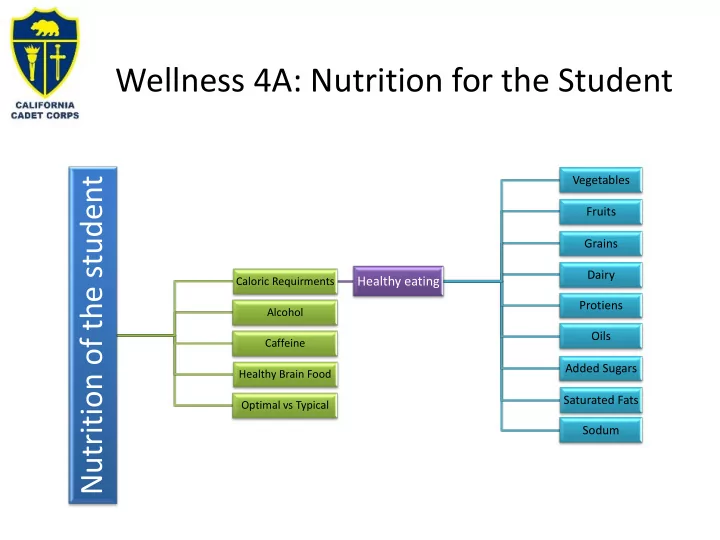
Wellness 4A: Nutrition for the Student Vegetables Nutrition of the student Fruits Grains Dairy Caloric Requirments Healthy eating Protiens Alcohol Oils Caffeine Added Sugars Healthy Brain Food Saturated Fats Optimal vs Typical Sodum


slide-1
SLIDE 1

Wellness 4A: Nutrition for the Student

Nutrition of the student

Caloric Requirments

Healthy eating

Vegetables Fruits Grains Dairy Protiens Oils Added Sugars Saturated Fats Sodum

Alcohol Caffeine Healthy Brain Food Optimal vs Typical
slide-2
SLIDE 2

NUTRITION FOR THE STUDENT

  • A1. Caloric Requirements For A Student
  • A2. Healthy eating patterns for a student
  • A3. Vegetables
  • A4. Fruits
  • A5. Grains
  • A6. Dairy
  • A7. Proteins
  • A8. Oils
  • A9. Added Sugars
  • A10. Saturated Fats
  • A11. Sodium
  • A12. Alcohol
  • A13. Caffeine
  • A14. Healthy Brain Food for Test Day
  • A15. Optimal Vs. Typical Sample Menus
slide-3
SLIDE 3

NUTRITION FOR THE STUDENT: UNIT OBJECTIVES

The desired outcome of this unit is for students to learn various nutritional facts, proper diets of nutrition, and planning for specific activities in a student cadet's life.

Plan of Action:

1. Understand caloric requirements for sustainment 2. Define and apply estimated energy requirements (EER). 3. Define Basal Metabolic Rate (BMR) 4. Compare and contrast and apply macronutrients and micronutrients. 5. Define carbohydrates, simple and complex carbohydrates. 6. Apply Recommended Dietary Allowance (RDA) 7. Understand empty calories and apply steps to avoid them 8. Understand and apply the FIT nutrition model, and its role in “meal prepping” 9. Compare the difference between a portion and a serving size

  • 10. Define and give examples of the 6 sub-categories of vegetables.
slide-4
SLIDE 4

NUTRITION OF THE STUDENT: UNIT OBJECTIVES

  • 11. Express reasons why vegetables are difficult for an individual to have in their

daily diet.

  • 12. Define nutrient-dense foods
  • 13. Apply the difference between hypokalemia and hypokalemia.
  • 14. Understand the chemical grains become in the digestion process
  • 15. Understand and define the key vitamins/minerals grains contain
  • 16. List the similarities and differences of whole grains, refined grains, and

enriched refined grains

  • 17. Understands dairy products chemical contents
  • 18. Define probiotics and prebiotics give examples of where to find each.
  • 19. Understand vitamins/minerals found in dairy products
  • 20. Understand proteins roles in body functions/body chemistry
slide-5
SLIDE 5

NUTRITION OF THE STUDENT: UNIT OBJECTIVES

  • 21. Explain nonessential amino acids, essential amino acids, and amino acids

role/functions in the body

  • 22. Express where to find proteins in various foods.
  • 23. Understand various nutrients found in oils
  • 24. Define and understand the roles of sugars, glucose, isomers, cellulose,

disaccharides, polysaccharides, and glycogen

  • 25. Understand and explain in relative terms type 1 diabetes, type 2 diabetes,

hyperglycemic, and hypoglycemic.

  • 26. Compare and contrast saturated and unsaturated fats.
  • 27. Identify two types( subtypes) of trans fats
  • 28. Relate sodium’s role to hypertension
  • 29. Understand sodium’s overall role in body chemistry
  • 30. Understand and apply blood pressure classification levels to their identifications.
slide-6
SLIDE 6

NUTRITION OF THE STUDENT: UNIT OBJECTIVES

  • 31. Define alcohol
  • 32. Explain why alcohol is a psychoactive drug.
  • 33. Explain and relate the Brain Blood Barriers (BBB) roles with alcohol
  • 34. Evaluate the outcome information on alcohol abuse, alcoholism, fetal alcohol

syndrome, and cirrhosis.

  • 35. Explain the combination of energy drinks and alcohol
  • 36. List issues and prospective positives caused by caffeine use
  • 37. List and explain various brain foods for large concentration days or events
  • 38. Explain with reason why aspartame is possibly dangerous
  • 39. Define adenosines triphosphate (ATP)
  • 40. Discuss and reason optimal vs typical health perspectives or dietary intakes.
slide-7
SLIDE 7

NUTRITION OF THE STUDENT : CALORIC REQUIREMENTS FOR A STUDENT

Objectives: Cadets will be able to

  • Understand caloric requirements for sustainment
  • Define and apply estimated energy requirements (EER).
  • Define Basal Metabolic Rate (BMR)
  • Compare and contrast and apply macronutrients and micronutrients.
  • Define carbohydrates, simple and complex carbohydrates.

Essential Question: How do we use scientific systems of caloric intake?

slide-8
SLIDE 8

CALORIC REQUIREMENTS FOR A STUDENT

  • Estimated Energy Requirements (EER) are equations that are used to predict

energy maintenance factoring in height, weight, age, and sex.

  • Basal metabolic rate (BMR) is the rate of the energy expenditure (calories

burned) of a person after they have slept for 8 hours and fasted for 12 hours in the supine (laying down) position in a hospital or laboratory setting, essentially it’s the “do nothing” but breathe for 16 hours metabolic rate.

  • Resting Metabolic rate (RMR) is a test that is the same test except it does not

require the patient to stay at the hospital because the values were identical

  • Macronutrients are types of food that provides the energy that is required in our
  • diet. The three basic categories of macronutrients are fats, carbohydrates, and

proteins.

slide-9
SLIDE 9

CALORIC REQUIREMENTS FOR A STUDENT

slide-10
SLIDE 10

CHECK ON UNDERSTANDING

  • 1. What does EER stand for?
  • 2. According to the table, moderate

exercising females and males at 16 have the same caloric need (T/F)

  • 3. Basal metabolic Rate and Resting

Metabolic Rate are not the same test; what makes them different?

slide-11
SLIDE 11

NUTRITION OF THE STUDENT: HEALTHY EATING PATTERNS FOR A STUDENT

Objectives: Cadets will be able to

  • Define carbohydrates, simple and complex carbohydrates.
  • Apply Recommended Dietary Allowance (RDA)
  • Understand empty calories and apply steps to avoid them
  • Understand and apply the FIT nutrition model, and its role in “meal

prepping”

  • Compare the difference between a portion and a serving size

Essential Question: How do intake amounts (caloric, and physical amounts) have precise

  • utcomes?
slide-12
SLIDE 12

HEALTHY EATING PATTERNS FOR A STUDENT

  • Carbohydrates are the body’s main source of energy
  • there are two types simple and complex.
  • Simple carbohydrates are sugars, including basic table

sugar, fructose sugar from fruit, and sucrose, mostly found in soft drinks, they are the quick fuel.

  • Complex carbohydrates are carbohydrates that take

longer to digest because their chemical structure is harder to break down, such as bread, beans, and vegetables.

  • Micronutrients are items that the body needs smaller

amounts of such as vitamins and minerals.

slide-13
SLIDE 13

HEALTHY EATING PATTERNS FOR A STUDENT

  • Dietary Reference Intake (DRI) designates the recommended

amounts of micronutrients needed to be consumed.

  • Recommended Dietary Allowance (RDA) tells us the

minimum amount of nutrients to maintain and meet the health needs of most people.

  • Adequate Intake (AI) is commonly used when the RDA of a

micronutrient is not sufficient.

  • Tolerable Upper Intake Level (UL) is the maximum number of

a vitamin or mineral that can be consumed without causing a health risk

slide-14
SLIDE 14

HEALTHY EATING PATTERNS FOR A STUDENT

empty calories are foods that are full of simple carbohydrates like candy, pastries, and sugary soft drinks

slide-15
SLIDE 15

HEALTHY EATING PATTERNS FOR A STUDENT

FIT formula for nutrition.

  • Frequency, eating three meals a day with planned snacks.
  • Intensity the calories are measured to its relative amount

and balancing the 5 food groupings.

  • Time matching the intervals of a regular schedule in spacing

them out morning, noon, and evening.

slide-16
SLIDE 16

HEALTHY EATING PATTERNS FOR A STUDENT

  • A portion is the amount of food on the plate. It can be under or
  • ver the recommended serving.
  • A serving is what is recommended for each component of food

as shown in

slide-17
SLIDE 17

CHECK ON UNDERSTANDING

  • 1. Define the FIT Formula as it relates to

nutrition.

  • 2. What is the academic word for quick fuel?
  • 3. ____________ are found in pastries and

soft drinks.

slide-18
SLIDE 18

NUTRITION OF THE STUDENT: VEGETABLES

Objectives: Cadets will be able to

  • Define and give examples of the 6 categories of vegetables.
  • Express reasons why vegetables are difficult for an individual to have in

their daily diet. Essential Question: How are vegetables crucial to human body chemistry and overall health?

slide-19
SLIDE 19

Vegetables

There are 6 categories of Vegetable:

  • Dark green vegetables are veggies such as broccoli, spinach, and kale
  • Orange vegetables are items like carrots, butternut squash, pumpkin, and

tomatoes

  • Dried peas are the various peas such as black-eyed peas, chickpeas, and

green peas

  • Beans are a type of protein but are still a vegetable, some examples of

those are, black beans, pinto beans, and kidney beans

  • Starchy vegetables are potatoes, corn, yams, and sweet potatoes
  • The other category for vegetables is a compilation of various veggies, such

as onions, artichokes, celery, cucumbers, and many others

slide-20
SLIDE 20

Vegetables Eating Vegetables are difficult

  • Taste/texture: some people simply dislike the

taste or texture of certain vegetables

  • Economics: accessing fresh veggies is hard due to

stores not carrying quality produce, or the money it costs to buy fresh veggies

  • Food experiences: individuals may have had a

negative interaction with some or all veggies as a younger child

  • Habits: people will not eat veggies because it’s not

part of their daily routine

  • Culture: can play a part in the type or amount of

vegetables in someone’s diet

slide-21
SLIDE 21

Vegetables Eating Vegetables are difficult (cont.)

  • Geography: where the person may live, there are no fresh vegetables
  • Advertising: the media does not promote healthy eating
  • Social factors: the individual has not enjoyed that particular item because
  • f how someone else prepared them
  • Health concerns: food allergies and digestive impacts
  • Emotions: stress may affect the overall eating habits
  • Green food/sustainability: even though it is a vegetarian diet base, the

cruelty-free element makes some vegetables inaccessible for those who follow that ideal, due to them being grown using animal products

slide-22
SLIDE 22

CHECK ON UNDERSTANDING

  • 1. List 3 reasons why choosing vegetables

may be difficult?

  • 2. All vegetables are carbohydrates? (T/F)
  • 3. Which category of vegetables has more

varieties?

slide-23
SLIDE 23

NUTRITION OF THE STUDENT: FRUITS

Objectives: Cadets will be able to

  • Define nutrient-dense foods
  • Apply the difference between hypokalemia and hypokalemia.

Essential Question: How is body chemistry dependent on elements found in fruits?

slide-24
SLIDE 24

Fruits

Nutrient-dense foods are considered the opposite of empty calorie foods, meaning they are full of vitamins and minerals. Fruits in diet have been found to be a factor in brain health, improving cognitive function.

– Some fruits are high in water content, sometimes containing between 80%-99% of water. Examples are watermelons, cantaloupes, strawberries, apples, grapes, oranges, pears, and pineapples

slide-25
SLIDE 25

Fruits Potassium & Body Chemistry

Potassium is an element which is needed for the human body to function, impacting the body systems that involve the kidneys, blood plasma, and intracellular fluid. An imbalance of potassium can cause issues such as muscle weakness, cramps, breathing issues, and constipation.

– Hypokalemia is an insufficient amount of potassium in the

  • body. Too little or too much potassium can cause the heart to

abnormally contract, leading to death. – Hyperkalemia is high levels of potassium in the blood, usually disrupting the electrical impulses and signals and mostly a result of a kidney dysfunction.

Potassium can be found in fruits like bananas, apples, and apricots

slide-26
SLIDE 26

CHECK ON UNDERSTANDING

  • 1. What is the difference between

Hyperkalemia and Hypokalemia?

  • 2. Nutrient-dense is the opposite of empty-

calorie (T/F)

  • 3. What is the largest component of fruits

like watermelons, apples, and pears?

slide-27
SLIDE 27

NUTRITION OF THE STUDENT: GRAINS

Objectives: Cadets will be able to

  • Understand the chemical grains become in the digestion process
  • Understand and define the key vitamins/minerals grains contain
  • List the similarities and differences of whole grains, refined grains,

and enriched refined grains Essential Question: How are different types of grains needed for overall health and what are the benefits of each?

slide-28
SLIDE 28

Grains

  • Grains are the most well-known carbohydrate
  • Whole grains are considered a nutrient-dense type of food
  • Whole grains are usually high in potassium
  • Grains are full of starch molecules, turning into glucose in

the body.

  • The starches turn into chains and there two different chains

– amylose contains hundreds of glucose units – amylopectin contains thousands of glucose units

slide-29
SLIDE 29

Grains Vitamins and Minerals

The following minerals and vitamins are laid out by function:

– Zinc’s major functions include protein along with DNA production, healing wounds, boosting the immune system, and assisting in growth. – Iron is carries oxygen and supports in energy production – Magnesium produces protein, aiding in muscle contraction and nerve transmissions. – Niacin is a vitamin that assists in energy metabolism

slide-30
SLIDE 30

Grains Anatomy of Grains

  • Whole grains are comprised of

grains with whole kernels.

  • Anatomy of grain is defined by

the

bran (outside/shell) – the germ( the innermost segment), – the endosperm (the largest inside portion)

  • These are items like oatmeal,

buckwheat, whole cornmeal, quinoa, and brown rice.

slide-31
SLIDE 31

CHECK ON UNDERSTANDING

  • 1. What are the three structures in the

grain anatomy?

  • 2. Which are healthier, refined grains or

enriched refined grains?

  • 3. Grains turn into ____________ in the

body to be used as fuel.

slide-32
SLIDE 32

NUTRITION OF THE STUDENT: DAIRY

Objectives: Cadets will be able to

  • Understand dairy products’ chemical contents
  • Define probiotics and prebiotics and give examples of where

to find each

  • Understand vitamins/minerals found in dairy products

Essential Question: How are dairy products in various forms essential to intake of elements that are connected to the body's functioning?

slide-33
SLIDE 33

Dairy

  • Dairy is an important component of maintaining overall health and

body chemistry

  • All dairy contains lipids, which are fatty acids
  • There are three types of lipids:

– triglycerides make up 95% of lipids ingested, found in fried food, cheeses, whole milk, and vegetable oil – phospholipids only makes up 2% of lipids found in foods, and their job is to enclose fat cells while in transport through the bloodstream – sterols are the least common but the most known lipid because their full name is cholesterol and their major function is producing sex hormones (testosterone, estrogen, etc.), vitamin D, and bile salts.

slide-34
SLIDE 34

Dairy

Some dairy products have things called probiotics and prebiotics Both are considered good/friendly bacteria that aid digestion

– Probiotics are lactic acid bacteria, also known as lactobacilli. They are added as a live culture bacteria to food items that go through a fermentation process, such as yogurt and Kefir – Prebiotics are soluble fibers that fuel the growth of select bacteria to grow in the large intestinal tract

slide-35
SLIDE 35

Dairy

Dairy is full of vitamins and minerals the body needs to maintain function.

– Calcium the chemical element that builds and maintains bones, aids in blood clotting, and aids in muscular and nerve functions. – Phosphorous aids in the maintenance of teeth and bones, and supports the release of energy from nutrients. – Vitamin B2 also known as riboflavin, breaks down proteins and carbohydrates. – Vitamin B12 chemical name cobalamin, is the element that supports in the formation of nucleic and amino acids. – Vitamin D helps the body absorb calcium and phosphorous

slide-36
SLIDE 36

Dairy

  • Dairy comes in four categories:

– Milk including skim milk, flavored milks, lactose-free, 2%, and whole milk. Also includes substances like frozen yogurt, ice cream, puddings, sherbets, and smoothies. – Non-dairy calcium such as soymilk and rice milk – Cheese is any of the three different types of cheeses, including naturally hard cheeses such as cheddar, mozzarella, Swiss, and many more, and soft cheeses like brie, cottage cheese, feta, and ricotta, as well as processed cheeses like cheese spreads and America cheese. – The yogurt category includes all yogurts and soymilk yogurts

slide-37
SLIDE 37

CHECK ON UNDERSTANDING

  • 1. ______________ makes up 95% of all

lipids?

  • 2. My common name is cholesterol, but my

scientific name is___________?

  • 3. In order for the body to be able to absorb

calcium milk also provides what vitamin?

slide-38
SLIDE 38

NUTRITION OF THE STUDENT: PROTEINS

Objectives: Cadets will be able to

  • Understand protein’s roles in body functions/body chemistry
  • Explain nonessential amino acids, essential amino acids, and

amino acids role/functions in the body

  • Express where to find proteins in various foods.

Essential Question: How do proteins and elements within proteins impact the body and what foods are they are found in?

slide-39
SLIDE 39

Proteins

Proteins are a class of nitrogen-containing biomolecule composed of amino acids.

– Proteins are the main component of the cell, used to grow, repair and maintain muscles and connective tissues, assist in the production of hemoglobin, enzymes, and hormones, control acid to base balance, maintain osmotic pressure in the blood, support the formation of antibodies/disease protection and produce energy. – Amino acids are components of proteins that the body needs to either self- create or acquire from a diet source. They are considered the building blocks because of the connection to growing and building muscles and other body tissues – Nonessential amino acids are produced by the body, but the body does not rely

  • n them.

– Essential Amino acids are the 8-9 (adults/children) amino acids that the body cannot self-create/synthesize and must be part of daily food intake.

slide-40
SLIDE 40

Proteins

– Meats consist of beef, ham, lamb, bison, rabbit, venison, and pork – Poultry includes chicken, duck, goose, and turkey – Beans and peas are lentils, pinto beans, black beans, kidney beans, and edamame, among others – Soy products include tempeh, tofu, and veggie burgers – Eggs include chicken eggs and duck eggs – Nuts and Seeds include almonds, peanuts, pecans, pumpkin seeds, sunflower seeds, and walnuts – Seafood is a misleading name, as not all items in the category come from the

  • cean. It has its three subcategories:
  • finfish like catfish, cod, seas bass, snapper, trout, and tuna
  • shellfish such as clams, crab, lobster, oysters, shrimp, mussels, squid, and octopus
  • canned fish are items like anchovies, sardines, and tuna
slide-41
SLIDE 41

CHECK ON UNDERSTANDING

Check on Understanding:

  • 1. ______________ is a self-created or

synthesized amino acid that is not vital.

  • 2. Protein has no shared elements/items in

any other food group (T/F)

  • 3. Name at least 2 functions of proteins in

the body.

slide-42
SLIDE 42

NUTRITION OF THE STUDENT: OILS

Objectives: Cadets will be able to

  • Understand various nutrients found in oils

Essential Question: What are oils in nutrition and what is their role in human health?

slide-43
SLIDE 43

Oils

  • Oils are a type of lipid and are primarily fat

in liquid form

  • Oils are not its own food group but does

provide significant nutrients

  • Since oils are fat the intake of them must be

limited.

  • Omega -3 fatty acid is an oil mostly found in

fish and is a healthy portion of the daily diet.

slide-44
SLIDE 44

Oils

  • Polyunsaturated fatty acids (PUFA) are things like corn oil,
  • live oil, and canola oil.

– Some oils are primarily used in a manner to flavor food such as walnut oil and sesame seed oil. Some foods naturally have oils in them such as various nuts, certain fish, and avocadoes. Condiments like mayonnaise, salad dressings, and squeeze margarine are mostly made up of oils

  • Monounsaturated fatty acids (MUFA) are oils found in

plant-based items, vegetables, and fruits.

  • Poly and monounsaturated fats do not elevate the bad

(LDL) cholesterol levels in the blood supply.

  • Most oils contain vitamin E that is important to vision,

reproduction, and the health of your blood, brain and

  • skin. It is an antioxidant, protecting cells and the body

against cancer and other diseases.

slide-45
SLIDE 45

CHECK ON UNDERSTANDING

  • 1. ______________ is fat in liquid form.
  • 2. What oil is mostly found in fish?
  • 3. What does MUFA stand for?
slide-46
SLIDE 46

NUTRITION OF THE STUDENT: ADDED SUGARS

Objectives: Cadets will be able to

  • Define and understand the roles of sugars, glucose, isomers,

cellulose, disaccharides, polysaccharides, and glycogen

  • Understand and explain in relative terms type 1 diabetes,

type 2 diabetes, hyperglycemic, and hypoglycemic. Essential Question: What is sugar’s role in body functions, and how does it impact

  • verall health?
slide-47
SLIDE 47

Sugars

  • Sugar is an organic compound that the body uses as fuel or

energy to complete work.

– The everyday name for monosaccharide is simple sugar or glucose

  • Glucose is a simple sugar with the molecular formula C6H12O6.
  • Fructose is fruit sugar, often bonded to glucose to form sucrose
  • Disaccharide is comprised of two or more monosaccharides. An

example of a disaccharide is sucrose.

  • Polysaccharide is a carbohydrate (e.g. starch, cellulose, or

glycogen) whose molecules consist of a number of sugar molecules bonded together

slide-48
SLIDE 48

Sugars

  • Cellulose is a structural component some plants have and is a

polysaccharide that the human body cannot digest. A common example of this is celery. Celery chemically and biomedically is famous for burning more calories to chew it than a human can gain from eating it.

  • Glycogen is a polysaccharide that is deposited in muscle cells

and is stored for it to be used as energy in the form of glucose

slide-49
SLIDE 49

Sugars in the Body

Sugar is needed for the body to function. It is involved in the circulation of the blood, and in order to enter that circulation, sugars are ingested, digested by the body, and sent to the intestinal cells to the capillaries to the blood vessels.

– The simple way to imagine how the process goes is that the blood vessels are a highway and blood is the vehicle on the

  • highway. The converted sugars are the engine in the vehicle.

The brain's key fuel to function comes from sugar, but it’s not an excuse to overdo it on sugary sodas. Both too much sugar and not enough sugar in the body are bad for organs and the brain

slide-50
SLIDE 50

Diabetes

  • Diabetes mellitus is commonly named simple diabetes

and is characterized by the blood glucose levels being high, also known as hyperglycemia.

  • Hyperglycemia results in insufficient production of

insulin due to a malfunction in the pancreas. This is known as Type 2 diabetes.

  • Type 2 diabetes, also referred to as non-insulin-

dependent diabetes mellitus (NIDDM), simply put does not produce enough insulin or is insulin resistant.

  • Insulin resistance is a condition where the body does

not respond to insulin. This causes hyperglycemia.

  • Type 2 diabetes is also a health problem associated

with being obese or overweight

slide-51
SLIDE 51

Diabetes

  • Type I diabetes is due to the inability to produce

insulin as needed sufficiently, due to failure of the β-Cells (beta-cells) inside the pancreas. This type is also known as Insulin-dependent diabetes mellitus (IDDM). Simply put, the pancreas produces little to no insulin.

  • Hypoglycemia is a low blood sugar level. It mostly

happens with Type I diabetes but can happen to anyone if there is not enough glucose in the body to support work or energy. Exercise can improve glycemic control resulting in fewer hypoglycemic episodes

slide-52
SLIDE 52

CHECK ON UNDERSTANDING

Check on Understanding:

  • 1. ______________ means the blood sugar

in too high.

  • 2. Chemical equation or name for glucose is

C___H___O___

  • 3. What type of diabetes is due to the

inability to produce insulin?

slide-53
SLIDE 53

NUTRITION OF THE STUDENT: SATURATED AND UNSATURATED FATS

Objectives: Cadets will be able to

  • Compare and contrast saturated and unsaturated fats.
  • Identify two types( subtypes) of trans fats

Essential Question: What are the types of fats and what is their connection to cardiovascular health?

slide-54
SLIDE 54

Saturated and Unsaturated Fats

  • Fatty acids are long chains of carbon

with hydrogen atoms combined.

  • Saturated fat is an acid where each

carbon atom has 4 single bonds. – Saturated fats are normally solids at room temperature. They are found in food like beef, lamb, pork, lard, cream butter, and cheese.

  • Unsaturated fat has one or more

double bonds making it easier to metabolize/absorb – Unsaturated fats (mono or poly) are oils and liquid at room temperature.

slide-55
SLIDE 55

Saturated and Unsaturated Fats

  • Trans-fat are unsaturated fats, naturally
  • ccurring and artificial
  • Naturally occurring trans-fat occurs in the

gut of animals and food made from various animals’ meat and milk.

  • Artificial trans-fat occurs in the process of

adding hydrogen to vegetable oils in order to solidify them more, such as foods like doughnuts, cakes, margarine, crackers, frozen pizzas, and cookies. These fats are called hydrogenated.

slide-56
SLIDE 56

Fat and Cardiovascular Disease

  • Researchers have not been able to prove that

saturated fats are bad for you. They have generally been connected with heart disease, but studies have not proven this.

  • Trans-fats are bad for you!
  • Unsaturated fats may help lower your risk for

heart disease.

  • Polyunsaturated fats (Omega-3 and Omega-6

fatty acids) are healthy and needed by the body

slide-57
SLIDE 57

CHECK ON UNDERSTANDING

  • 1. ______________ has 4 single bonds to

each carbon atom.

  • 2. All trans-fat is good for you T/F?
  • 3. Of the types of fat, which is the best for

your health?

slide-58
SLIDE 58

NUTRITION OF THE STUDENT: SODIUM

Objectives: Cadets will be able to

  • Relate sodium’s role to hypertension
  • Understand sodium’s overall role in body chemistry
  • Understand and apply blood pressure classification levels to

their identifications Essential Question: What is the role of sodium on the brain and body’s basic functions?

slide-59
SLIDE 59

Sodium

  • Sodium (Na) is an element on the

periodic table of elements, but usually refers commonly to salt.

  • Regulates blood volume, membrane

functions, impulses of nerves and aid in muscle contraction

  • Table salt, is actually NaCl, sodium

chloride, which like most salts disassociate or dissolves in water

slide-60
SLIDE 60

Sodium

  • Sodium has many types because it bonds with

different elements such as sodium bicarbonate (baking soda) and sodium citrate (from citric acid/ citrus fruits).

  • Due to western diets, sodium depletion is highly

unlikely because most preserved foods contain

  • sodium. Sodium is found mostly in packaged

and canned foods, such as soups, lunch meats, frozen dinners, burritos, tacos, and pizzas

slide-61
SLIDE 61

Sodium & Hypertension

  • Sweating allows for the loss of salts and minerals through exercise.

Having too much of certain minerals can cause negative effects. Too much sodium can cause high blood pressure and lead to hypertension.

  • Hypertension is defined as abnormally high blood pressure, stage 1

at

140−159 90−99 , stage 2 at greater than or equaled to 160+ 100+.

– Hypertension causes the heart to work harder than it should and over time it can lead to scarring of the heart and losing its elasticity, which may lead to stroke.

  • Prehypertension classified as

120−139 80−89 .

slide-62
SLIDE 62

Blood Pressure

  • Blood pressure is the amount of pressure applied/pressed
  • n the vessel walls by the blood.
  • Systolic blood pressure (SBP) is represented by the higher

number and means it’s the amount of pressure in the artery during ventricular systole (when heart contracts).

  • Diastolic blood pressure (DBP) is the amount of pressure

represented by the lower number during ventricular diastole (when the heart refills with blood).

– An average/normal blood pressure at rest is usually

120 80 , can be

defined as less than 120 over 80

slide-63
SLIDE 63

Sodium & Blood Pressure

Sodium maintains fluid balance, which is why it plays a key role in blood pressure control. There is a direct relationship between sodium intake and blood pressure. Reducing sodium to 2.3 grams sodium (6 g table salt) daily is linked with decreased blood pressure levels.

slide-64
SLIDE 64

CHECK ON UNDERSTANDING

  • 1. Sodium’s chemical name is?
  • 2. Too much sodium has no effects on the

body T/F?

  • 3. What is considered an average/normal

blood pressure?

slide-65
SLIDE 65

NUTRITION OF THE STUDENT: ALCOHOL

Objectives: Cadets will be able to

  • Define alcohol
  • Explain why alcohol is a psychoactive drug.
  • Explain and relate the Brain Blood Barriers (BBB) roles with alcohol
  • Evaluate the outcome information on alcohol abuse, alcoholism,

fetal alcohol syndrome, and cirrhosis.

  • Explain the combination of energy drinks and alcohol

Essential Question: How is alcohol destructive to the human body, vital organs, and damaging to the brain?

slide-66
SLIDE 66

Alcohol

  • Alcohol is a beverage that is a psychoactive drug, this

substance is volatile and is also known as liquor or its chemical name of ethanol.

  • Psychoactive drug this means that when the substance is

ingested it crosses the blood-brain barrier affecting the actions of the body, altering the mood, thinking, decision making, memory, motor control, and social behavior.

– Drinking alcohol is detrimental to the overall health of a human;

  • vertime abuse of amount and frequency will damage the liver whose

function is to filter or metabolize the substance.

  • Binge-Drinking by definition is when a male consumes five or

more alcoholic drinks, and a female consumes four or more alcoholic drinks by volume. This type of behavior is extremely dangerous and will lead to degrading health complications

slide-67
SLIDE 67

Alcohol

  • The blood-brain barrier (BBB) is

the barricade for the neural tissue in the central nervous system from the general blood circulation.

  • Alcohol abuse is the overuse of

drinking alcohol that results in behavioral and/or physical effects due to the overindulgence.

slide-68
SLIDE 68

Alcohol

slide-69
SLIDE 69

Alcohol

Alcoholism is the continuing/unending abuse of drinking alcohol paired with physiological changes aligned with addiction. – Statistics express that alcohol affects 10 million Americans, it is a leading cause of expensive health problems (car accidents, innocent death victims, property, etc.), accounts for over 200,000 deaths in the United States a year and is responsible for 60- 90% of all documented liver disease cases.

slide-70
SLIDE 70

Alcohol

  • Fetal alcohol syndrome (FAS) is a condition

assumed by a newborn due to a pregnant woman drinking while pregnant, with characteristics of deformities/defects such as small head, slow growth, and scientifically termed mental retardation.

  • Cirrhosis a liver disease that is characterized by

the destruction of hepatocytes replacing healthy tissue in the liver with fibrous tissue/scar tissue which will lead to liver failure.

slide-71
SLIDE 71

Alcohol

Cirrhosis is a deadly disease. As it progresses it leads to multisystem failure and advanced deterioration of the body.

  • Rupturing submucosal tissues
  • Jaundice
  • Hypertension
  • Disorientation of the brain

function, confusion, or the inability to communicate.

slide-72
SLIDE 72

CHECK ON UNDERSTANDING

  • 1. Alcohol is not considered a psychoactive

drug T/F?

  • 2. Define alcoholism.
  • 3. What organ is most affected by cirrhosis?
slide-73
SLIDE 73

NUTRITION OF THE STUDENT: CAFFEINE

Objectives: Cadets will be able to

  • List issues and prospective positives caused by caffeine use

Essential Question: How does caffeine interact with the human body?

slide-74
SLIDE 74

Caffeine

  • Caffeine is a central nervous system (CNS) stimulant,

chemical, or drug, and is widely consumed

  • It is found in coffee, soft drinks/soda, teas, and energy drinks.
  • It is also available as an over-the-counter medication.
  • It has a proposed/suggested benefit of improving alertness,

energy, ability to concentrate, reaction time, and prolonging endurance.

Through studies, the proven effect was as follows: increased alertness, concentration, elevated mood, but decreased reaction time and fatigue. – Even though it’s widely accessible and not regulated consuming it with risks such as nervousness, restlessness, insomnia, headaches, gastrointestinal problems, & tremors – a withdrawal of intake can result in distress of the gastrointestinal tract, fatigue, and irritability.

slide-75
SLIDE 75

Caffeine

  • Diuretic: speeds up water excretion from the body
  • Psychotropics: a category of drug known as mood
  • changers. They alter the central nervous system

pattern of functioning and change or alter the mental state or mood. They also can be highly addictive agents. Caffeine is a psychotropic drug.

  • Withdrawal is the physical and psychological

suffering symptoms when an individual stops or is prevented from in taking drugs, substances, etc.

slide-76
SLIDE 76

CHECK ON UNDERSTANDING

  • 1. Caffeine is not considered a drug T/F?
  • 2. Name 3 proposed benefits of caffeine.
  • 3. What symptoms result in the withdrawal

from caffeine in the body?

slide-77
SLIDE 77

NUTRITION OF THE STUDENT: HEALTHY BRAIN FOOD FOR TEST DAY

Objectives: Cadets will be able to

  • List and explain various brain foods for large concentration

days or events

  • Explain with reason why aspartame is possibly dangerous
  • Define adenosines triphosphate (ATP)

Essential Question: Does eating a collection of health foods improve performance in concentration?

slide-78
SLIDE 78

Heathy Brain Food for Test Day

  • Eating healthy helps you prepare for any important day,

such as test day, academic presentations, and other tasks that take a large amount of concentration.

  • Science has not proven that the body responds to

particular foods, but only that eating healthy can encourage emotional response-control in humans.

  • Food and a healthy balance of combinations of food are

symbolic in traditions, cultures, and special events; birthdays, weddings, funerals, graduations, sporting events, festivals, etc.

  • In order to remain alert, the brain must metabolize 6

grams of glucose per hour from the blood, in order to not slide into a state of confusion, coma, or death.

slide-79
SLIDE 79

Heathy Brain Food for Test Day

  • The Blueberry is linked to brain health

because it has a high content of anthocyanins.

  • Anthocyanins are a powerful antioxidant

that decreases inflammation.

  • Adenosine (adenosine triphosphate) (ATP)

is a caffeine-like organic compound that provides energy to drive processes in cells. It energizes the brain to function fully in alertness.

slide-80
SLIDE 80

Heathy Brain Food for Test Day

  • Foods for brain health in terms of focus are

– Carbohydrates with caloric limits – Digestible carbohydrates – Water – Vitamins – Minerals

  • Stay away from artificial sweeteners such

as aspartame which is possibly linked to brain tumors, autism, emotional disorders, etc.

slide-81
SLIDE 81

Heathy Brain Food for Test Day

  • Omega-3 fatty acids and Omega-6 essential fatty acids are a key

supplement source found in fish, poultry, and grain-fed animals.

  • Vitamin C is a supplement that aids in brain health within limits.
  • White rice contains Thiamin (B1) a vitamin whose role is to be an

energy source and in charge of manufacturing neurotransmitters required for RNA, DNA, and ATP; deficiency in this vitamin can cause brain and heart issues.

  • Choline is a beneficial compound found in egg yolk, wheat, meat, and

fish.

  • In order to improve brain functionality, the CDC recommendation

is to increase fruit and vegetable intake

slide-82
SLIDE 82

CHECK ON UNDERSTANDING

Check on Understanding:

  • 1. It is scientifically proven that food for the

brain has an exact path. (T/F)

  • 2. _____________ is the antioxidant that

the blueberry contains.

  • 3. The vitamin/supplement

________________ is found in white rice.

slide-83
SLIDE 83

NUTRITION OF THE STUDENT: OPTIMAL VS TYPICAL SAMPLE MENUS

Objectives: Cadets will be able to

  • Discuss optimal vs typical health perspectives or dietary

intakes. Essential Question: What kind of impact on overall health do different menu types of food products have?

slide-84
SLIDE 84

Optimal vs Typical Sample Menus

  • The important thing about eating healthy/ healthier it is to

meet the needs specific to you.

  • Optimal health perspective choices are based on habitual

routines and making intentional food choices

– Moderation in eating and in taking nutritional rich foods. This is completed through the following: fill half the plate with vegetables and fruits, one quarter with lean meat/protein, poultry or fish, one quarter with a grain/rice, one serving of dairy

slide-85
SLIDE 85

Optimal vs Typical Sample Menus

  • Typical health perspective is a look at the reality of what

many people eat. Some choices are healthy, many are not. No food is forbidden if taken in moderation, but that is not the typical American diet.

– The USDA did a longitudinal study spanning from 1970-2005, it tracked what individuals in the United States were consuming over a protracted period.

slide-86
SLIDE 86

Typical Food Choices

slide-87
SLIDE 87

Optimal Menus

Two weeks of sample healthy menus are in the supplementary information provided with this lesson.

slide-88
SLIDE 88

Optimal vs Typical Sample Menus

slide-89
SLIDE 89

Optimal vs Typical Sample Menus

slide-90
SLIDE 90

CHECK ON UNDERSTANDING

1. The typical health perspective represents a nutritious diet ( T/F) 2. What slogan does the government use for health guidance for planning meals? 3. Using context clues, what does longitudinal mean?