SLIDE 1
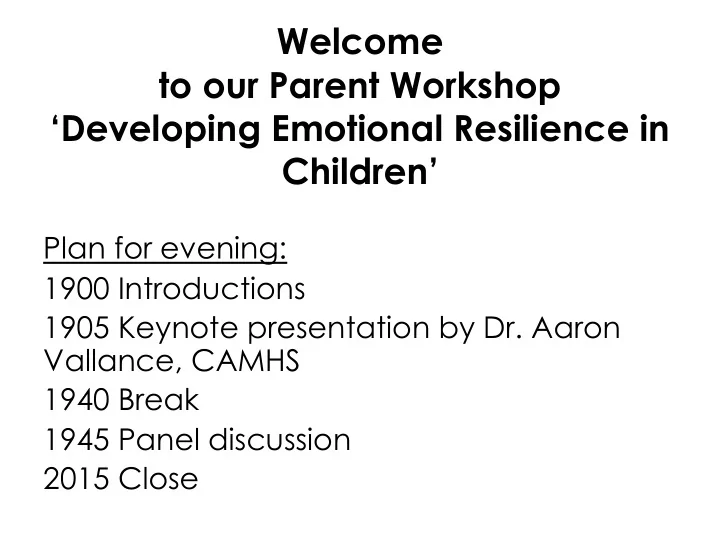
Welcome to our Parent Workshop ‘Developing Emotional Resilience in Children’
Plan for evening: 1900 Introductions 1905 Keynote presentation by Dr. Aaron Vallance, CAMHS 1940 Break 1945 Panel discussion 2015 Close
SLIDE 2 Managing Anger
Consultant in Child & Adolescent Psychiatry, Surrey And Borders Partnership NHS Trust
- Hon. Clinical Senior Lecturer, Imperial College London
Dad to Joe (ex-St Michaels) and Ben (4H)
SLIDE 3
SLIDE 4
SLIDE 5
What gets YOU Angry?
SLIDE 6 Anger is…
- Normal
- Common
- Dependent on context/meaning of a situation.
- May relate to other things going on.
SLIDE 7 Emotional
Anger / frustration
Cognitive
“How dare you do/say that!” “It’s all ruined!” “So unfair!” “This is a big deal!”
Physiological
Muscle tension Restless Heart races Nausea / butterflies Clammy Difficulty breathing
Behavioural
Shout / argue Say something you don’t mean Leave Slam / Throw Hit out
SLIDE 8
SLIDE 9
4 / 10 anger thermomete r
SLIDE 10
8 / 10
SLIDE 11
10 / 10
SLIDE 12
Angry mind Wise mind
SLIDE 13
Step 1: Acknowledge the feelings
Hmm..
SLIDE 14
Step 1: Acknowledge the feelings
Hmm.. I can see you’re angry,
SLIDE 15
Step 1: Acknowledge the feelings
Hmm.. I can see you’re angry, X must be really annoying you.
SLIDE 16 Step 1: Acknowledge the feelings
- Active listening – calmly
- Name the feeling - descriptively
- Connect with them, showing you understand
why they’re angry – non-judgementally / slowly
- But if temperature is too hot, now’s not the time
to get drawn into the detail.
SLIDE 17
Step 1 (if it’s you who’s angry): Acknowledge it!
SLIDE 18 Step 2 (if things are too hot): Time Out
Somewhere:
- To be alone
- That’s calm & quiet
- Distractions are okay
SLIDE 19
10 / 10 anger thermomete r
SLIDE 20
8 / 10
SLIDE 21
4 / 10
SLIDE 22
Step 3: Strategies to reduce anger
SLIDE 23 Breathing Exercises
- slow deep breaths, counting..
Visualization
breathing exercise e.g. balloon, waves
Muscle Tension & Relaxation
toe, tensing muscles then release
Mindfulness
- bringing attention to the
present.
- acknowledging any worries, but
gently move on to the senses.
- guided mindfulness activities
(e.g. Headspace app).
Distraction
Step 3: Strategies to reduce anger
SLIDE 24
Mindfulness exercise: “The Visitor”
SLIDE 25
Step 4: Managing angry thoughts
SLIDE 26 Step 4: Managing angry thoughts
- People may have similar thoughts popping up
each time they’re angry, linked to wider tendencies in their patterns of thinking:
– Taking things too personally. – Overly focussing on the negative, ignoring the positive. – Expecting too much from themselves or others. – Black-and-white thinking.
SLIDE 27 Step 4: Managing angry thoughts
- Try to challenge negative thoughts with
something more balanced. E.g.
– “That email appeared hostile, but did they really mean it as such.” [not take things too personally] – “The passenger spent ages talking to the driver, but maybe they had a good reason. And so what if we’re late anyway.” [don’t expect too much from
– “My child ignored my instruction, but only because they were too busy clearing the table.”[ignoring the positive]
SLIDE 28
– listing solutions – pros & cons – who can help?
- Anger related to defiant behaviour
– It’s only once anger has subsided, that would be best time to discuss the rule/instruction, and ensure it’s carried out.
Step 4: Managing angry thoughts
SLIDE 29
Step 4: Managing angry thoughts What’s underneath the anger?..
SLIDE 30
SLIDE 31 Managing anger when being bullied
– physical, verbal, or isolating. – in person or online.
- Very understandable to be angry!
- Tell parents and staff, so they can intervene.
- When it occurs, best if child:
– Ignores/walks off. – If confident, responds unfazed…
SLIDE 32 https://www.youtube.com/watch?v=7
SLIDE 33
Quality time is important!
SLIDE 34
And so are the basics!..
SLIDE 35 Summary
Acknowledge the feelings
SLIDE 36
Be kind to yourself too: no-one’s perfect!
SLIDE 37
Thank you!
SLIDE 38
BREAK (5 mins) Please take a moment to write an anonymous question for the panel.
SLIDE 39 PANEL DISCUSSION
- Dr. Aaron Vallance, Consultant in Child
and Adolescent Psychiatry, CAMHS
- Dr. Claire Whitefield, Consultant Child
and Adolescent Psychotherapist, CAMHS
- James Bawn, Deputy Headteacher