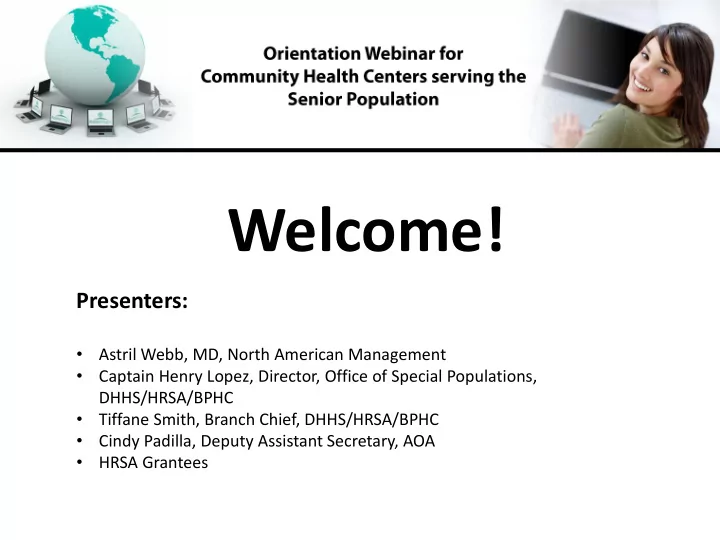
Welcome! Presenters: Astril Webb, MD, North American Management - - PowerPoint PPT Presentation

welcome
SMART_READER_LITE
LIVE PREVIEW

Welcome! Presenters: Astril Webb, MD, North American Management - - PowerPoint PPT Presentation

Welcome! Presenters: Astril Webb, MD, North American Management Captain Henry Lopez, Director, Office of Special Populations, DHHS/HRSA/BPHC Tiffane Smith, Branch Chief, DHHS/HRSA/BPHC Cindy Padilla, Deputy Assistant


slide-1
SLIDE 1

Welcome!

Presenters:

  • Astril Webb, MD, North American Management
  • Captain Henry Lopez, Director, Office of Special Populations,

DHHS/HRSA/BPHC

  • Tiffane Smith, Branch Chief, DHHS/HRSA/BPHC
  • Cindy Padilla, Deputy Assistant Secretary, AOA
  • HRSA Grantees
slide-2
SLIDE 2

Overview:

  • Webinar FAQ’s
  • Overview of HRSA’s Health Center Program, the Office of Special

Population Health and National Cooperative Agreement

  • Introduction of the training and technical services provided by the

National Center for Health and The Aging

  • Highlight supportive services available through Administration on Aging

(AOA)

  • Highlight best practices of integrated partnerships that work in meeting

the healthcare needs of seniors

  • Share real-life examples of successful partnerships
  • Overview of upcoming activities
slide-3
SLIDE 3

Eld lder erly ly Hea ealt lth

Captai ain Henry y Lopez Lopez Director ctor Tiff ffane ne Smith th Chief, f, Health th Systems tems Branch ch Office fice of Specia ial Populatio tion Health th U.S. . Departme rtment nt of Health th and Human n Services vices Health th Resources urces and Servi vices ces Administratio inistration Bureau au of Primary mary Health th Care January ary 12, 2012

slide-4
SLIDE 4

Na Nationa nal l Overvi erview ew

  • Health Center Program Performance

Off ffice ice of Special al Populatio tion n He Health th

  • Health Systems Branch
  • Goals of the National Cooperative Agreement

Elderly ly He Health th Program ram Up Update te

  • Updates and Collaborations

HR HRSA Re Resource rces

  • National Cooperative Agreements

Today’s Presentation

4

slide-5
SLIDE 5

19.5 Million Patients

  • 93% Below 200% poverty
  • 38% Uninsured
  • 62% Racial/Ethnic Minorities
  • 1,052,000 Homeless Individuals
  • 863,000 Migrant/Seasonal Farmworkers
  • 173,000 Residents of Public Housing

77 Million Patient Visits

  • 1,124 Grantees
  • 8,100+ Service Sites

Over 131,000 Staff

  • 9,592 Physicians
  • 6,362 NPs, PAs, & CNMs

Source: Uniform Data System, 2010

Health th Cente ter r Pr Program am Overv rvie iew Ca Calend ndar ar Ye Year 2010

slide-6
SLIDE 6

Health th Cente ter r Pr Program am Na Nationa

  • nal

l Pr Presenc ence

6

slide-7
SLIDE 7

Bu Bureau u of Pr Primary ry Health th Care Or Organiz nizati ationa

  • nal

l St Structu cture re

OFFICE OF THE ASSOCIATE ADMINISTRATOR Southwest Division Division of National Hansen’s Disease Program Northeast Division North Central Division Central Southeast Division Office of Administrative Management Office of Training &Technical Assistance Coordination Office of Policy and Program Development Office of Quality and Data Office of Special Population Health

7

slide-8
SLIDE 8

Offic fice e of Sp Special al Po Populatio ation n Health th

  • Focus:

s: – National Cooperative Agreements (NCA) for Special Populations – National Advisory Council for Migrant and Seasonal Farmworkers – Special Populations Program Assistance – Department, Agency and Bureau-level Initiatives and Workgroups for Minority and Special Populations

  • Two

wo Branch ches: es: – Health Services Branch – Health Systems Branch

8

slide-9
SLIDE 9

Offic fice e of Sp Special al Po Populatio ation n Health th

  • He

Health h System tem Branch ch

  • Focus on the delivery of primary health care services to special populations

which include:

‒ Elderly Health (Aging) ‒ Homeless Individuals and Families ‒ Residents of Public Housing ‒ Children and; ‒ Other vulnerable populations

  • Oversees and manages National Cooperative Agreements (NCA) that

provide training and technical assistance to special population grantees.

  • Coordinates activities focused on primary health care, eliminating health

disparities, and improvement of the health status of the Nation’s underserved populations.

  • Advises BPHC of the needs and special circumstances of the special

populations and ensures they are addressed in their programs and policies.

9

slide-10
SLIDE 10

Upd pdat ates es

  • North American Management (NAM) will hold their first

annual one day conference for the elderly/aging NCA in April 2012 in Alexandria, VA.

  • NAM is collaborating with the Administration on Aging

to execute the NCA work plan.

  • NAM is developing a 2012 calendar events to highlight

dates for future webinars and will be available on their website: http://www.healthandtheaging.org/

10

slide-11
SLIDE 11

NCA Co A Contac act t Infor

  • rmati

ation

  • n

North American Management: Astril Webb, MD Director of Health and Family Services North American Management 2111 Eisenhower Avenue Alexandria, VA 22314 (703) 812-8822 awebb@namgt.com www.namgt.com

11

slide-12
SLIDE 12

Th Than ank Y k You

  • u!

12

slide-13
SLIDE 13

Tiffane Smith, MSM Office of Special Population Health U.S. Department of Health and Human Services Health Resources and Services Administration Bureau of Primary Health Care 5600 Fishers Lane Rm. 15-62 Rockville, MD 20857 Telephone: 301-594-4303 Email: tsmith@hrsa.gov

13

slide-14
SLIDE 14

North American Management (NAM)

The Health and the Aging National Cooperative Agreement is managed by NAM. In September, 2011, NAM commenced the Health and The Aging (HATA) project through a training and technical assistance national cooperative agreement grant award by the Department of Health and Human Services, Health Resources and Services Administration (HRSA), Bureau of Primary Health Care (BPHC) to aid health centers increase their capacity to serve the aging population.

slide-15
SLIDE 15

Main Target Audience

Training and technical assistance is provided to Federally Qualified Health Centers (FQHC) authorized under Section 330(e), 330(g), 330(h), and 330(i) of U.S. Public Health Service Act and FQHC Look A Likes through the health and aging national cooperative agreement with NAM.

slide-16
SLIDE 16

Collaborations

  • Federal Agencies – HRSA, AOA, SAMHSA, CMS, CDC, DOE
  • State and National Organizations - eg National Council on Aging, National Association
  • f Area Agencies on Aging, National Association of States for Aging and Disability
  • National Cooperative Agreements
  • Academic and Research Organizations
  • Community-Based and Faith-Based Organizations
  • Provider Groups
  • Health Systems
  • Payers
slide-17
SLIDE 17

Areas of Focus

 Healthy Aging Practices  Chronic Disease Management: Chronic Disease Self-Management  Heart Disease, Stroke, and Obesity Prevention  Pain Management and Injury Prevention  Healthy Weight , Nutrition, Exercise, and Lifestyle Intervention  Oral Health  Hearing Loss  Vision Loss: Age-Related Eye Diseases  Mental Health and Substance Abuse Services  Alzheimer’s Disease  Parkinson’s Disease  STD Prevention/HIV/AIDS  Pneumonia and Flu Vaccination  Shingles Awareness  Rural Health Outreach  Patient Centered Medical Home  Health Information Technology and Meaningful Use  Special Populations - Aging Migrants, American Indians and Alaska Natives, Public Housing Residents, Individuals Experiencing Homelessness, and Lesbian, Gay, Bisexual, and Transgender Individuals

slide-18
SLIDE 18

Activities

 Remote, on-site, and one-on-one Training and Technical Assistance and Peer Mentoring, and New HRSA BPHC Grantee Training  Development of Protocols and Tools

  • Health Literacy
  • Cultural Competency
  • Outreach to Seniors

 On-line Resources:

  • Website: Health and the Aging - http://www.healthandtheaging.org/
  • Webinars

 Publications: Monographs; Fact Sheets, Success Stories; Presentations; Monthly e-Newsletters  Annual Aging Conference

slide-19
SLIDE 19

Training and Technical Assistance

To request Training or Technical Assistance please visit us online at: www.healthandtheaging.org Here you will find a link for T/TA where you can complete our request form. *Note: There is no cost Associated with Training or Technical Assistance

slide-20
SLIDE 20

Grantee Presentations

Zara Marselian President and CEO La Maestra Community Health Centers Dale B. Fiedler Corporate Director of Planning and Development Southern Illinois Healthcare Foundation Karen Williams Program Director West End Medical Centers

slide-21
SLIDE 21

21

West End Medical Centers

Karen Williams, MS

Associate VP Public Housing Primary Care HRSA / AOA January 12, 2012 Webinar

slide-22
SLIDE 22

22

Background Information

 West End Medical Center is an FQHC  35 year history in community  20 year history providing primary care on-site in Public

Housing communities

 Two Counties / Two Housing Authorities  2 Senior High-Rise Sites  Primary Care and supportive Services  Outreach/ CHW  Collaborative Partners

slide-23
SLIDE 23

23

Programs

 Community Surveys  Household Resident

Data

 Health Topics  Health Assessments  Site Management  Faith Community

Ministries

slide-24
SLIDE 24

24

Contact Information

Karen Williams, MS

Associate VP PHPC

West End Medical Centers

868 York Ave., SW

Atlanta, GA 30310

404.756.6901

kwwill@comcast.net

slide-25
SLIDE 25

New Grantee Senior Orientation Webinar for Community Health Centers The Seniors I. Q. Program

Improving The Quality of Independence

slide-26
SLIDE 26

Purpose Provide one example of a senior program Describe the Design Inputs Provide an overview of the program Highlight best practices – Value Sustainability Options

slide-27
SLIDE 27

Southern Illinois Healthcare Foundation

A CHC serving almost a 100,000 urban and rural patients with over 30 locations in 7 different counties. 330 (e), (g), (h) and (i) Special Populations Funding Serves almost 7,000 patients 65+

slide-28
SLIDE 28

SENIORS IQ Design Inputs

Local foundation RFP how to keep seniors living independently Social determinants of health Consortiums / networks / AAA CHC Board members

slide-29
SLIDE 29

Social Determinants

  • Located in East St. Louis and surrounding communities in Illinois
  • 98% of East St. Louis residents are African-American
  • Local seniors face many of the same problems as seniors

elsewhere; however, they are exacerbated by the complications

  • f living in a high poverty community.
  • 63% of East St. Louis residents are low income (below 200% of

poverty)

  • 90% of program participants are low income.
  • The community is challenged with a high illiteracy rate and low

comprehension levels which make many seniors in this area vulnerable to possible fraudulent activities.

  • The seniors of this area are known to be a hard to reach and serve

population

slide-30
SLIDE 30

Growth Chart

slide-31
SLIDE 31

Services Provided

  • Advocacy / Follow Up / (Case management of

the senior’s issues)

  • Certified enrollment site for SHAP (Senior Health

Assistance Program) and SHIP (Senior Health Insurance Program)

  • Circuit Breaker/Illinois Cares
  • Energy Assistance (summer/winter)
  • Medicare enrollment period (plan comparison)
  • SLMB (Specified Low-Income Medicare

Beneficiaries Program) – Medicaid will pay the $96.50 cost for your Medicare coverage monthly

slide-32
SLIDE 32

Services Provided (cont)

  • Initiated events for seniors where they naturally

congregate and include community partners

  • Referrals for homemaker services
  • Referrals for home medical equipment; shower

bench, high rise toilet seat, emergency lifeline

  • Scheduling doctor’s appointments
  • Arranging transportation to doctor’s

appointments

slide-33
SLIDE 33

A One-Stop-Shop A Number to Call

To the extent possible without duplicating … create convenience Seniors coming to you or … You going to seniors with an array of services

– Enrollment Form/Application (In-Person / Verbal) – Obtain forms from agencies that offer services to your population to save time, releases, etc – SHAP & SHIP

slide-34
SLIDE 34

Following Up

  • Make sure ALL referrals/services initiated

have an end result – hopefully positive

  • Communication is power - direct dialogue

with the senior participant or responsible party on any referral/service is vital

  • Make sure services/program you refer to is

a reputable before referring

slide-35
SLIDE 35

Community Partnerships

  • What organizations/agencies supply the

services/programs regarding the immediate needs of population?

  • Bring together healthcare partners with social service

partners – help others reach the seniors

  • Always combine health services with supportive services

to maximize participation Examples:

– AARP Senior Employment Program (seniors working with seniors) – Senior Apartments – Senior Centers – Churches – YMCA

slide-36
SLIDE 36
  • Value For Seniors (They are not interested in encounter

goals, health system bottom lines… They want to keep their heat on, essentials today …THEN health care )

  • Know their Needs
  • Follow through, Advocacy – Create Trust
  • Community Partnerships
  • As we grew Newsletter became the most effective way

to communicate to the large group

  • Once you’re established in the community; your best

cheerleader should become the seniors themselves

Key to Success / Best Practices VALUE

slide-37
SLIDE 37

Sustainability

  • Stay Lean i.e. AARP workers
  • Avoid duplication – Refer, advocate
  • Align with a Medical / Legal Partnership program
  • Document accomplishments
  • Approach local hospitals – Community benefit
  • Health Reform – Care coordination around

services to address social determinants should reduce readmissions

  • Entities that can leverage community resources

to assist in discharge planning should have Value

slide-38
SLIDE 38

Zara Marselian President and CEO La Maestra Community Health Centers

slide-39
SLIDE 39
  • Outreach & Health Fairs

(education/screening) at Housing Sites

  • Eligibility & Enrollment

Assistance

  • Transportation

CIRCLE OF CARE

Residents of Public Housing

slide-40
SLIDE 40

LA MAESTRA GREEN HEALTH CENTER IN CITY HEIGHTS

Designed & Built to Achieve LEED Gold Certification

slide-41
SLIDE 41

U.S. Administration on Aging HRSA Aging Initiative

HRSA Grantee Orientation January 12, 2012

slide-42
SLIDE 42

Rev-05/03/11 42

July 14, 1965 The Older Americans Act signed into law as part

  • f the “Great Society” legislation. Established the

Administration on Aging within the Department of Health, Education, and Welfare, and called for the creation of State Units on Aging. This act was considered one of the most important contributions of aging legislation enacted by Congress. Medicare, Title XVIII, a health insurance program for the elderly, and Medicaid, Title XIX are also established.

slide-43
SLIDE 43

Rev-05/03/11 43

Three Important Programs Enacted 1965:

  • Medicare
  • Medicaid
  • Older Americans Act

Every State and every community can now move toward a coordinated program of services and opportunities for our older citizens.” President Lyndon B. Johnson, July 1965

slide-44
SLIDE 44

44 Rev-05/03/11

  • U. S. Administration On

Aging’s Mission

The mission of AoA is to develop a comprehensive, coordinated and cost-effective system of home and community-based services that helps elderly individuals maintain their health and independence in their homes and communities.

Vision

In order to serve a growing senior population, AoA envisions ensuring the continuation

  • f a vibrant aging services network at State, Territory, local and Tribal levels through

funding of lower-cost, non-medical services and supports that provide the means by which many more seniors can maintain their independence.

Authorities

Older Americans Act of 1965

  • Public Health Service Act section 398 – Alzheimer’s Disease Supportive Services
  • Public Health Service title XVII – Lifespan Respite Care
  • Medicare Improvements for Patients and Providers Act of 2008
  • ARRA – Chronic Disease Self-Management, Nutrition Services
  • ACA-Affordable Care Act
slide-45
SLIDE 45

45 Rev-05/03/11 45

Older Americans Act Declaration Of Objectives Title I

To Assure Older Americans:

  • An adequate income in retirement
  • Best possible physical and mental health
  • Suitable housing
  • Comprehensive long term care services
  • Employment opportunities
  • Retirement in health, honor& dignity
  • Civic, cultural, educational and recreational opportunities
  • Continuum of care for vulnerable elderly
  • Benefits from research
  • Freedom & independence to manage their own lives
slide-46
SLIDE 46

46 Rev-05/03/11 46

Key Provisions of The 2006 Older Americans Act

  • Title I — Objectives
  • Title II — Administration on Aging
  • Title III — Grants for State & Community Programs
  • A. Administration
  • B. Supportive Services & Senior Centers
  • C-1. Congregate Nutrition Services
  • 2. Home Delivered Nutrition Services
  • D. Disease Prevention & Health Promotion
  • E. National Family Caregiver Support Program
slide-47
SLIDE 47

47 Rev-05/03/11 47

Key Provisions of The 2006 Older Americans Act (Cont.)

  • Title IV -Training, Research and Discretionary

– Projects such as Evidence-Based Disease Prevention & Health Promotion Programs

  • Title V - Senior Community Service Employment
  • Title VI -Grants for Native Americans
  • Title VII -Elder Rights Protection
slide-48
SLIDE 48

How The Aging Network Helps 11 Million Seniors And Their Caregivers Remain At Home Through Community Based- Services

AoA

56 State Units, 629 Area Agencies & 246 Tribal Organizations 20,000 Service Providers & 500,000 Volunteers

Provides Services and Supports to 1 in 5 Seniors

241 million meals 28 million rides 29 million hours of personal care 69,000 caregivers trained 855,000 caregivers assisted 6.4 million hours of respite care 483,000

  • mbudsman

consultations 4 million hours of case management

48 Rev-05/03/11

slide-49
SLIDE 49

49 Rev-05/03/11 49

2 4 6 8 10

1990 1995 2000 2005 2010 2015 2020 2025 2030

3.1 3.7 4.3 5.1 5.8 6.3 6.6 7.2 8.7

Population in millions

Population 85 and Older

50 100

1990 1995 2000 2005 2010 2015 2020 2025 2030

41.9 43.7 45.9 49.7 57 65.7 75.8 85.3 92.2 Population in millions

Population 60 and Older

The Older Population of the United States

  • In 2010: ~11.4 million age 65+ with 1+ ADLs, ~28% of the non-institutionalized 65+ population
slide-50
SLIDE 50

50 Rev-05/03/11 50

Aging Network Challenge

In the United States: (2010)

  • 56 million persons age 60+
  • 11.4 million minority persons age 60+
  • 5.7 million persons age 85+
  • 5.3 million persons age 60+ below poverty
  • 1.7 million persons in nursing facilities
  • 10.4 million persons age 60+ in rural areas
slide-51
SLIDE 51

51 51 Rev-05/03/11

AoA’s Major Initiatives

  • OAA Programs
  • Aging & Disability Resource Centers
  • Care Transitions Activities
  • Consumer Direction
  • Veteran Directed Home and Community-Based Service Program (VCHCBS)
  • Evidence-Based Disease Prevention and Health Promotion
  • Alzheimer’s Disease Supportive Services Program (ADSSP)
  • Senior Medicare Patrol (SMP)
  • Elder Justice Act
slide-52
SLIDE 52

Questions & Answers

Please use the Q&A feature at the bottom of the page to ask a question.

?

slide-53
SLIDE 53

Upcoming Events

Needs Assessment for Community Health Centers serving the Aging population Release Date: Winter 2012 1st Annual National Primary Care Conference

  • n Aging

April 30th, 2012 The Westin Hotel Alexandria Virginia

slide-54
SLIDE 54

The 2012 Health Care Conference for The Aging will take place on April 30, 2012 at the Westin Hotel in Alexandria VA. This one day national conference will highlight innovative senior programs and services, address issues including physical and mental health, multicultural aging, workforce, resources and the latest research findings to improve access to quality care and improve health

  • utcomes of seniors in underserved communities.

Invited guest speakers include leaders of federal agencies, nonprofits, academic institutions and businesses of diverse multidisciplines in aging, healthcare and senior health education. Registration will begin January 20, 2012. Please visit us online at www.healthandtheaging.org for details and registration.

slide-55
SLIDE 55

Contact Us

National Center for Health and the Aging 2111 Eisenhower Avenue, Suite 300 Alexandria, VA 22314 Phone: 703.812.8822 Information: info@healthandtheaging.org Website: www.healthandtheaging.org

slide-56
SLIDE 56

Thank You