Welcome! A Project Presentation Will Begin at 6:00 PM Topics to - - PowerPoint PPT Presentation

welcome a project presentation will begin at 6 00 pm
SMART_READER_LITE
LIVE PREVIEW

Welcome! A Project Presentation Will Begin at 6:00 PM Topics to - - PowerPoint PPT Presentation

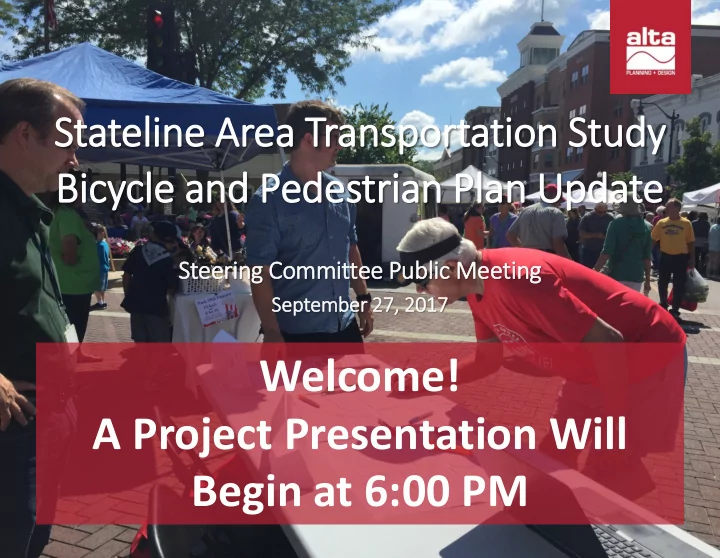
Stateline A Area Transportation S Study Bicycle and Pedestri rian Pl Plan Update Steer ering C Committee P ee Public M c Meet eting September 27, 27, 2017 2017 Welcome! A Project Presentation Will Begin at 6:00 PM Topics to cover

slide-1
SLIDE 1

Stateline A Area Transportation S Study Bicycle and Pedestri rian Pl Plan Update

Steer ering C Committee P ee Public M c Meet eting

September 27, 27, 2017 2017

Welcome! A Project Presentation Will Begin at 6:00 PM

slide-2
SLIDE 2

Topics to cover

  • Current conditions
  • Key Findings
  • School and Online Surveys
  • The Next Steps – Making

Recommendations

  • Questions
slide-3
SLIDE 3

Existing Bicycling and Walking Facilities

slide-4
SLIDE 4

Pedestrian Level

  • f Stress
slide-5
SLIDE 5

Bicycle Level of Stress

slide-6
SLIDE 6

Crash Frequency

slide-7
SLIDE 7

Crashes by Severity

slide-8
SLIDE 8

Equity Analysis

slide-9
SLIDE 9
  • Crash

Frequency

  • Equity: Concentration of

Residents over 65

  • Equity: Concentration of

Residents under 18

Equity Analysis

slide-10
SLIDE 10
  • Crash

Frequency

  • Equity: Limited English

Proficiency

  • Equity: No Access to

Automobile

Equity Analysis

slide-11
SLIDE 11
  • Crash

Frequency

  • Equity: No High School

Diploma

  • Equity: Concentration of

Non-White Population

Equity Analysis

slide-12
SLIDE 12

Demand Analysis

slide-13
SLIDE 13
  • Demand: Learn
  • Demand: Retail

Demand Analysis

slide-14
SLIDE 14
  • Crash

Frequency

  • Demand: Live
  • Demand: Play

Demand Analysis

slide-15
SLIDE 15
  • Demand: Retail
  • Demand: Transit

Demand Analysis

slide-16
SLIDE 16

Key Findings:

  • A palette of bicycle and pedestrian infrastructure types for

people of all ages and abilities will help connect the region. Previous plans rely on signed bicycle routes and off-street trails to build routes.

  • Beloit has historically acted as the region’s center. Downtown

Beloit, South Beloit, and Rockton, as well as Rock Township at the northern end of the SLATS area, are important areas to connect through regional walking and bicycling routes.

  • The region lacks east-west connectivity. Residents mentioned

this as well as a desire to improve north-south connections into downtown Beloit and the riverfront.

slide-17
SLIDE 17

Key Findings:

  • Bicycle infrastructure installed since the 2010 system plan and

the 2014 study are prime opportunities to upgrade to striped bike lanes. The programmed Park Avenue road diet will enhance connectivity at the state line and will illustrate the benefits of reallocating street space to balance the needs of people walking, bicycling, and driving.

  • Residents desire places to walk and bike that feel like the

riverfront: comfortable, separated from traffic, and scenic. They look for connections to the river as well as comfortable routes in their home communities.

slide-18
SLIDE 18

Key Findings (continued):

  • Areas of high need must be included in system planning efforts:

Rockton Township near Rockton Bog Nature Preserve, South Beloit east of South Beloit Municipal Park, central and western Beloit, and Janesville south of Southern Wisconsin Regional Airport.

  • In Wisconsin, areas with the highest demand for walking and

bicycling correlate with areas of high levels of socioeconomic

  • need. The correlation is not as pronounced on the Illinois side
  • f the study area.
  • Residents’ perceptions of barriers to walking and bicycling are

echoed in mapping analyses that investigate streets’ level of walking and bicycling comfort.

slide-19
SLIDE 19

Key Findings (continued):

  • Streets perceived as high-stress routes in urban areas have

multiple lanes and high traffic speeds. High stress routes in rural areas lack space to separate people walking and bicycling from people driving at high speeds.

  • Low-stress areas are primarily located in residential
  • neighborhoods. However, residents must cross busy roads to

reach important destinations.

  • Group bicycle rides and events occur frequently in the region.

Local groups fill an advocacy role and are knowledgeable of local lower stress bike routes that connect to destinations.

slide-20
SLIDE 20

Key Findings (continued):

  • Pedestrian crashes occur mainly at intersections of busy streets

(i.e., arterials and collectors).

  • Bicycle crashes occur mainly at intersections of busy streets that

lack bicycle specific infrastructure, such as bike lanes. West Beloit is one exception. Many crashes in this area occurred on streets with low posted speed limits and low traffic volumes.

  • The majority of bicycle and pedestrian crashes resulted in injury.
slide-21
SLIDE 21

School Survey

  • 13/33 Schools Responded = 39% Response Rate
  • No Bike and Walk to School Day
  • Kids walk or bike at every school
  • Top barriers to walking and biking include distance

and neighborhood and traffic safety

slide-22
SLIDE 22

Online Survey Results

  • For Work Trips: 79% Use a Car (Includes Carpooling); 17%

Use a Bike; 8% Walk; 3% Use Transit

  • Non-work trips: 90% Car, 7% Biking, 3% Walking
  • Most People walk 5 days a week for exercise
  • Most People bike 2 days a week for exercise
  • The top three reasons people walk and bike are: Fitness,

Getting Outdoors and Having Fun

  • Top three priorities for infrastructure: More Trails, More On

Street Bikeways, Better Intersections and crossing for Pedestrians

  • Top Barriers for Walking and Biking; Traffic too fast, Difficult

crossings at major streets; Roads, Trails and Sidewalks don’t feel safe; no convenient routes

  • Respondents between ages of 26-65 (69%); 55% M, 45% F
slide-23
SLIDE 23

The Next Steps – Making Recommendations Next Steps:

  • Multi-modal Design Opportunities
  • Funding Opportunities
  • Non-Infrastructure Opportunities
slide-24
SLIDE 24

Mixed Traffic Yield Roadway Advisory Shoulder Bike Boulevard Wayfinding Signage

slide-25
SLIDE 25

Visually Separated

Paved Shoulders Bike Lane Buffered Bike Lane Contra-Flow Bike Lane

slide-26
SLIDE 26

Physically Separated

Shared Use Path Separated Bike Lane Sidewalk Sidepath

slide-27
SLIDE 27

Funding Opportunities

Roadway Resurfacing Roadway Reconfiguration Roadway Widening

slide-28
SLIDE 28

Non-Infrastructure Opportunities

slide-29
SLIDE 29

Questions?

Tim Gustafson AICP

timgustafson@altaplanning.com

Charlie Short

charlieshort@altaplanning.com

www.statelinewalkbike.com