
CS490W: Web I nformation Search & Management
CS-490W Web Information Search and Management Luo Si
Department of Computer Science Purdue University
Overview Web:
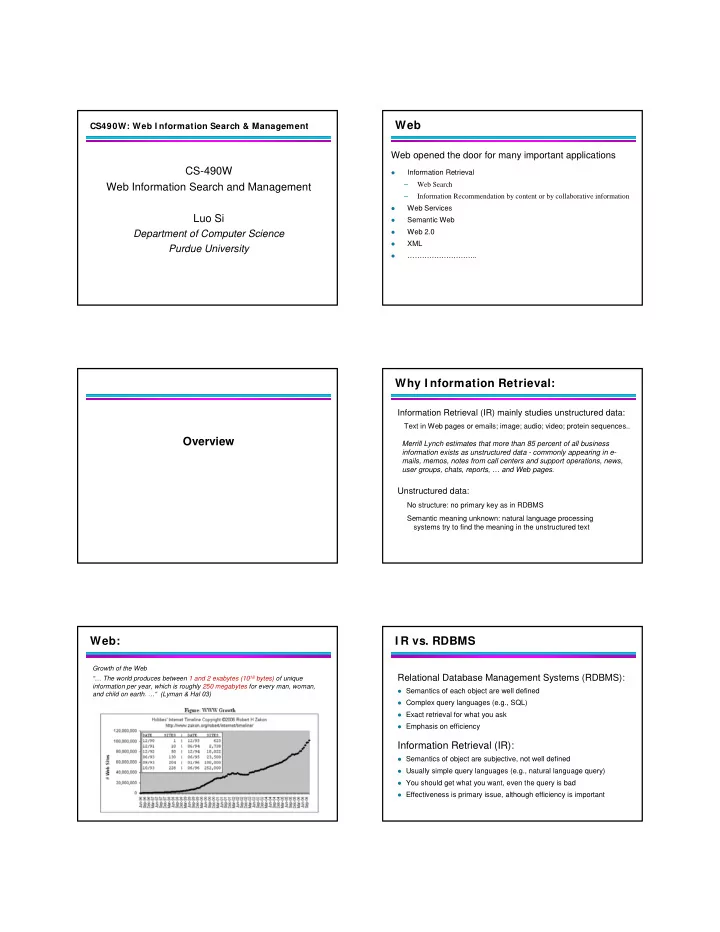
Growth of the Web “… The world produces between 1 and 2 exabytes (1018 bytes) of unique information per year, which is roughly 250 megabytes for every man, woman, and child on earth. …“ (Lyman & Hal 03)
Web
Web opened the door for many important applications
- Information Retrieval
– Web Search – Information Recommendation by content or by collaborative information
- Web Services
- Semantic Web
- Web 2.0
- XML
- ………………………..
Why I nformation Retrieval:
Information Retrieval (IR) mainly studies unstructured data:
Merrill Lynch estimates that more than 85 percent of all business information exists as unstructured data - commonly appearing in e- mails, memos, notes from call centers and support operations, news, user groups, chats, reports, … and Web pages. Text in Web pages or emails; image; audio; video; protein sequences..
Unstructured data:
No structure: no primary key as in RDBMS Semantic meaning unknown: natural language processing systems try to find the meaning in the unstructured text
I R vs. RDBMS
Relational Database Management Systems (RDBMS):
Semantics of each object are well defined Complex query languages (e.g., SQL) Exact retrieval for what you ask Emphasis on efficiency
Information Retrieval (IR):
Semantics of object are subjective, not well defined Usually simple query languages (e.g., natural language query) You should get what you want, even the query is bad Effectiveness is primary issue, although efficiency is important