Agenda Web MVC-2: Apache Struts Drawbacks with Web Model 1 Web - - PowerPoint PPT Presentation

agenda web mvc 2 apache struts
SMART_READER_LITE
LIVE PREVIEW

Agenda Web MVC-2: Apache Struts Drawbacks with Web Model 1 Web - - PowerPoint PPT Presentation

Agenda Web MVC-2: Apache Struts Drawbacks with Web Model 1 Web Model 2 (Web MVC) Rimon Mikhaiel Struts framework rimon@cs.ualberta.ca Example of workflow management. A Hello World Example Web Model 2 Web Model 1 Web MVC


slide-1
SLIDE 1

Web MVC-2: Apache Struts

Rimon Mikhaiel

rimon@cs.ualberta.ca

Agenda

Drawbacks with Web Model 1 Web Model 2 (Web MVC) Struts framework

Example of workflow management.

A Hello World Example

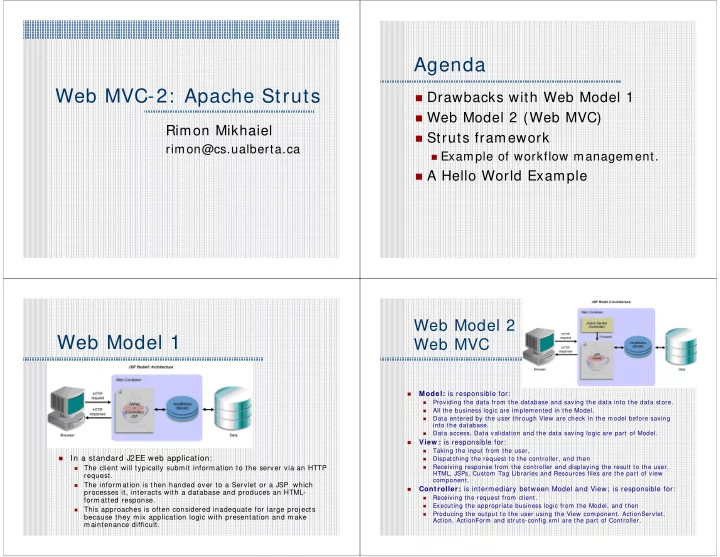
Web Model 1

  • In a standard J2EE web application:
  • The client will typically submit information to the server via an HTTP

request.

  • The information is then handed over to a Servlet or a JSP which

processes it, interacts with a database and produces an HTML- formatted response.

  • This approaches is often considered inadequate for large projects

because they mix application logic with presentation and make maintenance difficult.

Web Model 2 Web MVC

  • Model: is responsible for:
  • Providing the data from the database and saving the data into the data store.
  • All the business logic are implemented in the Model.
  • Data entered by the user through View are check in the model before saving

into the database.

  • Data access, Data validation and the data saving logic are part of Model.
  • View : is responsible for:
  • Taking the input from the user,
  • Dispatching the request to the controller, and then
  • Receiving response from the controller and displaying the result to the user.

HTML, JSPs, Custom Tag Libraries and Resources files are the part of view component.

  • Controller: is intermediary between Model and View; is responsible for:
  • Receiving the request from client.
  • Executing the appropriate business logic from the Model, and then
  • Producing the output to the user using the View component. ActionServlet,

Action, ActionForm and struts-config.xml are the part of Controller.

slide-2
SLIDE 2

MVC Frameworks

J2EE:

Struts Spring MVC

PHP

CakePHP Strusts4php

C# .NET

Girders

Ruby on Rails

Struts Framework

Apache open source web application framework

(it is free).

Base on Model 2 MVC architecture. Supports J2EE web application

  • “Write once, Run Anywhere”

Supports different model implementation (Javabeans,

EJB, etc.)

Extends the Java Servlet API.

Supports different presentation implementation (JSP,

XML/ XSLT, JSF).

Supports internationalization (I18N).

Enable Multi-language applications

Supports application wide standard (error)

message.

The struts architecture

http:/ / m y-com pany.com / login.action < action-mappings> < action path= "/ login" type= “com.myproject.action.LoginAction" > < forward name= “success" path= "/ jsp/ MainMenu.jsp" / > < forward name= “fail" path= "/ jsp/ LoginView.jsp" / > < / action> < / action-mappings> class LoginForm extends ActionForm { String username,password; public String getUsername(){ return username; } public void setUsername(String username){ this.username= username; } public String getPassword(){ return password; } public void setPassword(String password){ this.password= password; } }

Working with Struts

  • From strut’s official download page http://struts.apache.org/download.cgi:
  • From the recent release, download Struts2-blank.war
  • Rename Struts2-blank.war to YourProjectName.war (say

MyStruts.war)

  • Make sure that your tomcat is up and running.
  • Copy MyStruts.war under ~/catalina/webapps/ the war file will be

automatically extract itself under the same directory (~/catalina/webapps/MyStruts).

  • Restart your tomcat.
  • Test your Struts application through:

http: / / machine.cs.ualberta.ca: port/ YourProjectName (http: / / ui01.cs.ualberta.ca: 17067/ MyStruts)

  • You should see the following screen:
slide-3
SLIDE 3

Struts application structure

MyStruts

| -- META-INF | -- WEB-INF (jars, classes, and configurations) | -- example (jsp files) (optional) ` -- index.html (front page) (optional)

MyStruts/ WEB-INF/ classes

| -- example (package example, you can find the source under ‘MyStruts/ WEB- INF/ src/ java/ example/ ’) | | -- ExampleSupport.class | | -- HelloWorld.class | | -- Login-validation.xml | | -- Login.class | | -- package.properties | ` -- package_es.properties | -- example.xml ` -- struts.xml

Hello World (JSP page)

Create a directory: ~/catalina/webapps/MyStruts/jsps Under the above directory, create the following

HelloWorld.jsp

< % @ taglib prefix= "s" uri= "/ struts-tags" % > < html> < head> < title> Hello World!< / title> < / head> < body> < h2> < s: property value= "message" / > < / h2> < / body> < / html>

Hello World (Action)

package c410; import com.opensymphony.xwork2.ActionSupport; public class HelloWorld extends ActionSupport { public static final String MESSAGE = "Struts is up and running ..."; private String message; public String execute() throws Exception { setMessage(MESSAGE); return SUCCESS; } public void setMessage(String message){ this.message = message; } public String getMessage() { return message; } }

  • Create a directory

~/catalina/webapps/MyStruts/WEB- INF/src/c410 to store your java source code for a package “c410”

  • Create HelloWorld.java under the

above directory.

  • While being under the above

directory, compile source code using: javac -classpath "../../lib/xwork-2.0.4.jar" HelloWorld.java

  • Create a directory

~/catalina/webapps/MyStruts/WEB- INF/classes/c410 and copy the generate HelloWorld.class under this directory

Hello World (Mapping)

  • Modify ~/catalina/webapps/MyStruts/WEB-INF/classes/struts.xml

to look like:

< !DOCTYPE struts PUBLIC "-/ / Apache Software Foundation/ / DTD Struts Configuration 2.0/ / EN" "http: / / struts.apache.org/ dtds/ struts-2.0.dtd"> < struts> < package name= "c410" extends= "struts-default"> < action name= "HelloWorld" class= "c410.HelloWorld"> < result> / jsps/ HelloWorld.jsp< / result> < / action> < !-- Add your actions here --> < / package> < / struts>

slide-4
SLIDE 4

Run HelloWorld

You can run it through

http://machine.cs.ualberta.ca:p

  • rt/MyStruts/HelloWorld.action

You should get something like the following screen

Exercise for next class

  • Implement a simple bi-lingual (e.g. English, French, Spanish,

etc) login screen:

  • Validate that both user-name and password are given
  • When user-name/ password are given you display a message “This

page is under construction”

  • When the user clicks on “Sign On”, you display the same message

“This page is under construction”

References

Struts Offical Home Page Apache Struts2 Documentation:

Bootstrap

Struts Guide What is Struts?